Table of Contents >> Show >> Hide
- Why Scalp Psoriasis and Dandruff Get Confused
- A Quick Cheat Sheet
- What Scalp Psoriasis Actually Is
- What Dandruff Is (And Why “Just Dry Scalp” Isn’t the Whole Story)
- 8 “Flake Detective” Clues to Tell Them Apart
- What Dermatologists Look For (And Why Self-Diagnosis Can Be Hard)
- Treatment: Same Neighborhood, Different Addresses
- Real-World Examples: What It Looks Like in Daily Life
- When You Should Stop Guessing and See a Professional
- Scalp Care Tips That Help Either Way
- Bottom Line
- Experiences From Real Life: What People Commonly Notice (And What Helps)
If you’ve ever scratched your head, looked down, and found what appears to be a
tiny snowstorm on your shirt… welcome to the club. The tricky part? Those flakes can come from
dandruff or scalp psoriasistwo conditions that can look annoyingly similar
at first glance, but behave very differently once you start paying attention.
This guide breaks down the differences in plain American English, with real-world clues you can use at home,
plus what dermatologists typically look for, how treatment differs, and when it’s time to stop guessing and get help.
(Because your scalp didn’t sign up to be a mystery novel.)
Why Scalp Psoriasis and Dandruff Get Confused
Both conditions can cause flaking, itching, and an irritated scalp. Both can come and go.
Both can make you question every black shirt you own. And both can respondat least a littleto medicated shampoos,
which makes the confusion even worse.
The big difference is what’s happening under the surface:
dandruff is usually tied to oil, irritation, and yeast on the scalp, while scalp psoriasis is driven by
an immune system “overreaction” that speeds up skin-cell turnover. That difference matters, because it changes
what treatments work best (and which ones will barely make a dent).
A Quick Cheat Sheet
| Clue | Scalp Psoriasis | Dandruff (Often Seborrheic Dermatitis) |
|---|---|---|
| Look | Thicker, well-defined patches (plaques) with dry, silvery/white scale | Looser flakes (white or yellowish), often greasy; scalp may look oily |
| Edges | Often sharply borderedpatch ends, normal skin begins | More “diffuse” irritation; less sharply outlined |
| Where it shows up | May extend beyond hairline; can also affect elbows, knees, nails | Scalp plus oily areas: eyebrows, sides of nose, behind ears, chest |
| Itch/Burn | Itch is common; can sting or feel sore when plaques crack | Itch common; often improves with antifungal/anti-dandruff shampoos |
| Response to OTC shampoo | May improve a bit, but often persistent and stubborn | Often noticeably improves with consistent medicated shampoo use |
What Scalp Psoriasis Actually Is
Psoriasis is a chronic inflammatory skin condition in which the immune system speeds up
skin-cell production. Instead of skin cells maturing and shedding gradually, they pile up quickly
creating thickened patches topped with scale.
Typical signs of scalp psoriasis
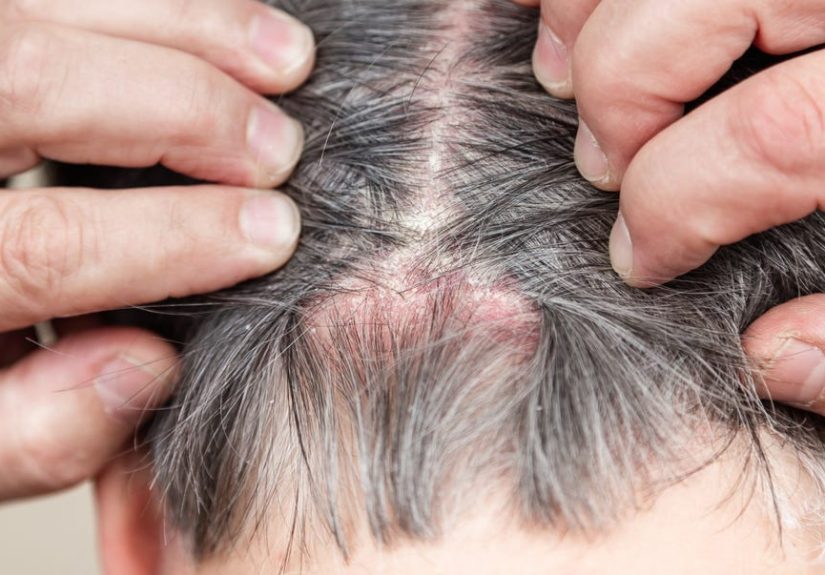
- Thick plaques that can feel raisedlike your scalp is wearing tiny “armor plates.”
- Dry, silvery-white scale (sometimes described as a silvery sheen in the hair).
- Well-demarcated bordersyou can often see where the patch starts and ends.
- Patches that can be pink/red, brown, or purple depending on skin tone.
- Extension past the hairline onto the forehead, neck, or around the ears.
- Sometimes temporary hair shedding from inflammation or from aggressive scratching/picking.
Extra hints that point toward psoriasis
If you have any of these elsewhere, scalp psoriasis becomes more likely:
- Thick, scaly patches on elbows, knees, or lower back
- Nail changes like pitting, lifting, or thickening
- Joint pain or stiffness that could suggest psoriatic arthritis
What Dandruff Is (And Why “Just Dry Scalp” Isn’t the Whole Story)
Dandruff is very common and usually shows up as flakes of skin on the scalp and hair.
It’s often linked to seborrheic dermatitis, a chronic inflammatory condition that favors oily areas of the body.
In plain terms: the scalp gets irritated, sheds faster, and flakes become visible.
Typical dandruff/seborrheic dermatitis clues
- White or yellow flakes that may look greasy
- Oily scalp or oily hair along with flaking
- Itchiness that can flare with stress, weather changes, or product buildup
- Redness or irritation that’s usually less “plaque-like” than psoriasis
- Similar flaking in eyebrows, around the nose, or behind the ears
One important myth to delete from your brain: dandruff is not a sign that you’re “dirty.”
It’s more about scalp biology (oil, irritation, and how your skin reacts), not hygiene.
8 “Flake Detective” Clues to Tell Them Apart
1) Thickness: powder vs. plates
Dandruff tends to be looserflakes that brush off fairly easily.
Psoriasis scale is often thicker, sometimes clinging to the scalp in layers.
2) Greasy vs. dry scale
Dandruff commonly looks oily or waxy (especially the yellowish type).
Psoriasis scale is usually drier and more “silvery.”
3) Borders: fuzzy vs. sharply outlined
Psoriasis often forms distinct plaques. Seborrheic dermatitis can look more spread out
and less sharply edged, like a general irritated zone.
4) The hairline giveaway
A classic psoriasis clue is scaling that extends beyond the hairline onto the forehead,
behind the ears, or the back of the neck. Dandruff usually stays mainly in the scalp.
5) Check other oily areas
If you have flaky irritation in the eyebrows, around the nose, or on the chestespecially with an oily shine
that pattern fits seborrheic dermatitis more than psoriasis.
6) How it responds to medicated shampoo
If a consistent routine with anti-dandruff shampoo noticeably improves symptoms within a few weeks,
dandruff/seb derm is more likely. Scalp psoriasis may improve somewhat but often remains more persistent and prone to relapse.
7) Pain, cracking, or bleeding
Psoriasis plaques can get very dry and may cracksometimes leading to soreness or pinpoint bleeding after scratching.
Dandruff can itch a lot, but it’s less likely to form thick, cracking plaques.
8) You can have both (plot twist)
Yes, it’s possible to have psoriasis and seborrheic dermatitis at the same timesometimes called “sebopsoriasis.”
If your scalp seems half greasy-flaky and half thick-plaque, that might be why your results have been mixed.
What Dermatologists Look For (And Why Self-Diagnosis Can Be Hard)
A dermatologist usually starts with a close look at the scalp and asks about symptom patterns:
where it appears, how long it’s been happening, what treatments you’ve tried, and whether you have
psoriasis signs elsewhere (skin plaques, nail changes, joint symptoms).
In many cases, the diagnosis is clinicalmeaning the pattern is convincing enough just by exam and history.
If it’s unclear or not responding to typical treatment, a clinician might consider additional evaluation
(for example, to rule out fungal infections like ringworm or other scalp conditions).
Treatment: Same Neighborhood, Different Addresses
Here’s where people often waste months: they treat scalp psoriasis like dandruff (or vice versa).
Some overlap existscertain shampoos can help bothbut the “main lever” is different.
Dandruff / seborrheic dermatitis: the shampoo strategy
Dandruff is often managed with medicated shampoos. Common active ingredients include:
- Ketoconazole (antifungal)
- Zinc pyrithione (anti-yeast/antibacterial)
- Selenium sulfide (anti-yeast, helps slow shedding)
- Salicylic acid (helps lift scale)
- Coal tar (helps slow skin-cell turnover and reduce scaling)
Practical tip: anti-dandruff shampoos usually work best when you massage into the scalp and
leave them on briefly before rinsing (follow label directions). And you typically need consistency:
a few uses won’t rewrite your scalp’s personality.
Scalp psoriasis: reduce inflammation + lift scale
Scalp psoriasis treatment often needs a two-pronged approach:
- Calm inflammation (commonly with prescription topical corticosteroids)
- Break up scale so medication can reach the skin (sometimes with salicylic acid or other keratolytics)
Depending on severity, a clinician might recommend prescription topical options (like steroid solutions/foams/sprays
designed for hair-bearing areas), medicated shampoos, and in stubborn cases, other therapies such as light-based treatments
or systemic medications for more widespread disease.
If you suspect psoriasis, it’s worth knowing: scalp psoriasis can be especially stubborn, and treatment is often more
about control than a one-and-done cure. That’s not pessimismjust reality.
Real-World Examples: What It Looks Like in Daily Life
Example 1: The “Head & Shoulders didn’t touch it” scenario
You try a classic anti-dandruff shampoo for a month. The itch improves a little, but the thick patches near your hairline
keep coming back like an uninvited houseguest. You notice flaky redness behind your ears and a scaly spot on an elbow.
That pattern leans more toward scalp psoriasis.
Example 2: The “greasy flakes + eyebrows” scenario
Your scalp gets itchy and flaky, especially in winter or during stressful weeks. The flakes look slightly yellow,
and you also get flaking in your eyebrows. A ketoconazole or zinc pyrithione shampoo helps within a few weeks.
That pattern fits dandruff/seborrheic dermatitis.
Example 3: The “it’s both” scenario
Some areas are oily and flaky; other spots are thick, sharply bordered, and extend past the hairline. Anti-dandruff shampoo
helps one part, but not the other. In these cases, a dermatologist might treat both yeast-driven irritation and psoriasis-driven inflammation.
When You Should Stop Guessing and See a Professional
Consider medical advice if you have:
- Thick, painful plaques; cracking or bleeding
- Flaking that persists despite consistent OTC treatment
- Hair loss, significant soreness, or signs of infection (oozing, increasing redness, warmth)
- Psoriasis signs elsewhere on the body or nail changes
- Joint pain/stiffness along with skin symptoms
Also: if the condition is affecting your sleep, work, confidence, or mental healthyes, that counts.
A “cosmetic” problem can still be a quality-of-life problem.
Scalp Care Tips That Help Either Way
- Be gentle. Scratching and picking can worsen irritation and increase the risk of infection.
- Use fragrance-free when possible. Strongly fragranced products can irritate sensitive scalps.
- Target the scalp, not just the hair. Apply medicated products to the skin of the scalp.
- Give treatments time. Many medicated shampoos need consistent use for weeks, not days.
- Track triggers. Stress, cold/dry weather, and product buildup can flare symptoms for many people.
Bottom Line
Dandruff is common and often responds well to the right medicated shampoo routine. Scalp psoriasis is an immune-driven condition
that tends to create thicker, more defined plaques and may need anti-inflammatory prescription treatment to truly calm down.
If you’re stuck in a cycle of “flakes today, flakes tomorrow, flakes forever,” a dermatologist can help you identify what’s driving it
and build a plan that fits your scalp, hair type, and lifestyle.
Experiences From Real Life: What People Commonly Notice (And What Helps)
People living with scalp flaking often describe the experience less like a single symptom and more like a running commentary from their head:
“itch, itch, itch… oh great, now it’s snowing.” What makes it stressful is the uncertainty. Many people start out assuming it’s dandruff,
buy an over-the-counter shampoo, and expect a quick turnaroundonly to feel confused when the flakes keep coming back.
Those who later learn they have scalp psoriasis often describe a pattern of “stubborn spots” that don’t behave like typical dandruff.
A common story goes like this: the itch improves a little with medicated shampoo, but certain areasoften along the hairline, behind the ears,
or at the back of the headstay rough, thick, and scaly. People may notice that when they lift the hair and look closely, the patches seem
sharply outlined, almost like the scalp is drawing borders on purpose. That “plaque” feelingraised, thickened skincan be the clue that finally
convinces someone to book an appointment.
On the dandruff/seborrheic dermatitis side, many people talk about the greasy factor. They’ll say their scalp feels oily just a day after washing,
and the flakes look slightly yellow or clump together. Some notice it’s worse in winter, during stressful work periods, or after heavy styling products.
A really common “aha” moment is realizing it isn’t only the scalp: flakes show up in eyebrows or around the sides of the nose. Once people switch to
a consistent routineusing an anti-dandruff shampoo that targets yeast and letting it sit on the scalp before rinsingthey often report a noticeable improvement
within a few weeks. The key phrase you’ll hear over and over is: “I had to be consistent.”
Another shared experience: the emotional side is real. People mention avoiding dark shirts, skipping photos, or feeling self-conscious in meetings when they’re itching.
Some describe the itch as distracting enough to affect sleep. And for those with scalp psoriasis, frustration can spike when plaques crack or become sore.
People sometimes admit they picked at scale (because it’s hard not to), only to regret it when the area became tender or irritated.
When treatment starts working, a lot of folks say the biggest relief isn’t just fewer flakesit’s getting their attention back.
Hair type and styling routines also shape the experience. People with thicker hair, curly hair, or protective styles may say it’s harder to get medicated products
onto the scalp skin where they’re needed. Others mention trial-and-error with schedules: washing too often can irritate, but washing too rarely can worsen buildup.
Many people land on a “maintenance rhythm” that keeps symptoms calmerlike alternating medicated shampoo days with gentle, fragrance-free products, and focusing the
medicated lather on the scalp rather than the ends of the hair.
The most consistent “lesson learned” from people dealing with either condition is this: if you’ve tried reasonable over-the-counter care and the problem persists,
don’t treat your scalp like a DIY science fair forever. Getting the right diagnosis can save months of wasted products, reduce flare-ups, and help you stop chasing
the same flakes in circles.