Table of Contents >> Show >> Hide
- What Was SLAM, Exactly?
- Why Build a Nuclear-Powered Cruise Missile?
- Project Pluto: The Reactor That Was Supposed to Fly
- The Missile Everyone Drew, But Nobody Built
- Why People Call It “The Cruise Missile From Hell”
- Why SLAM Was Cancelled
- What Project Pluto Accidentally Gave the Future
- The Modern Echo: Why SLAM Keeps Coming Back in Conversations
- Conclusion: The Missile That Didn’t Flyand That’s the Point
- Research “Experience” Add-On (): Chasing SLAM Through Paper Trails and Desert Wind
The Cold War had a special talent: it made brilliant engineers wake up, drink coffee, and calmly propose inventions that sound like rejected plotlines from a disaster movie.
Case in point: SLAMthe Supersonic Low Altitude Missile. Not the later “SLAM” you may have seen in modern cruise-missile acronyms, but the original, unhinged, 1950s-era concept:
a nuclear-powered ramjet cruise missile designed to sprint under radar, roam for hours, and deliver nuclear warheads like it was doing a very unfriendly paper route.
If you’ve ever wondered, “What would happen if we combined a jet engine with a small reactor and then gave it the job of ending the world?”congratulations, you’ve basically reinvented the sales pitch.
SLAM wasn’t just a weapon. It was a statement. Specifically: “We have gone fully off the rails, and we brought spare rails.”
What Was SLAM, Exactly?
SLAM (Supersonic Low Altitude Missile) was a U.S. Air Force concept from the height of the Cold War: an unmanned, intercontinental, supersonic cruise missile meant to fly very lowthink “nap-of-the-earth”
vibesso enemy radar would have a harder time seeing it coming. In theory, it could carry a heavy payload of nuclear weapons and hit multiple targets in one mission, rather than being a one-and-done ballistic shot.
The “secret sauce” wasn’t stealth coatings or clever software. It was far more 1950s: a nuclear ramjet. The missile would gulp air, heat it using a reactor core, and blast it out the back for thrust.
No conventional fuel required once it was runningjust air, speed, and the power of splitting atoms.
Why Build a Nuclear-Powered Cruise Missile?
To understand SLAM, you have to mentally time-travel to an era when people were genuinely worried that tomorrow morning could begin with sirens and end with a mushroom cloud.
The U.S. and the Soviet Union were locked in an arms race where range, speed, survivability, and “second-strike capability” weren’t academic buzzwordsthey were the difference between deterrence and disaster.
Bombers were powerful but vulnerable. Early ballistic missiles were improving fast but still evolving. Submarines were becoming a stealthy nuclear delivery platform.
SLAM was imagined as something else entirely: a doomsday cruise missile that could be launched, survive defenses, and keep going.
In a worst-case scenario, it could function like an airborne, supersonic “last word” in the language of mutually assured destruction.
The Fantasy (and the Fear) Behind the Requirement
SLAM’s appeal was simple on paper:
- Endurance: A nuclear power source promised flight times far beyond what chemical fuel could provide.
- Speed at low altitude: Supersonic flight close to the ground complicates detection and interception.
- Payload flexibility: Studies and contemporary discussion imagined carrying multiple nuclear weapons rather than a single warhead.
- Psychological pressure: A weapon that could loiter or route unpredictably is a nightmare for planners on the receiving end.
Of course, the same traits that made SLAM attractive also made it… let’s call it “ethically spicy.” And mechanically terrifying.
Project Pluto: The Reactor That Was Supposed to Fly
The engine at the heart of SLAM came from Project Pluto, a U.S. program aimed at proving that a nuclear ramjet could actually work.
The concept is surprisingly straightforward, at least until you picture what it means in real life:
incoming air is compressed by the missile’s speed, runs through a reactor where it’s heated to extreme temperatures, and then expands through a nozzle to generate thrust.
In other words, it’s a jet engine where the “combustion chamber” is replaced by a reactor core.
Elegant? Yes. Also: the kind of elegant that makes your safety officer develop a nervous twitch.
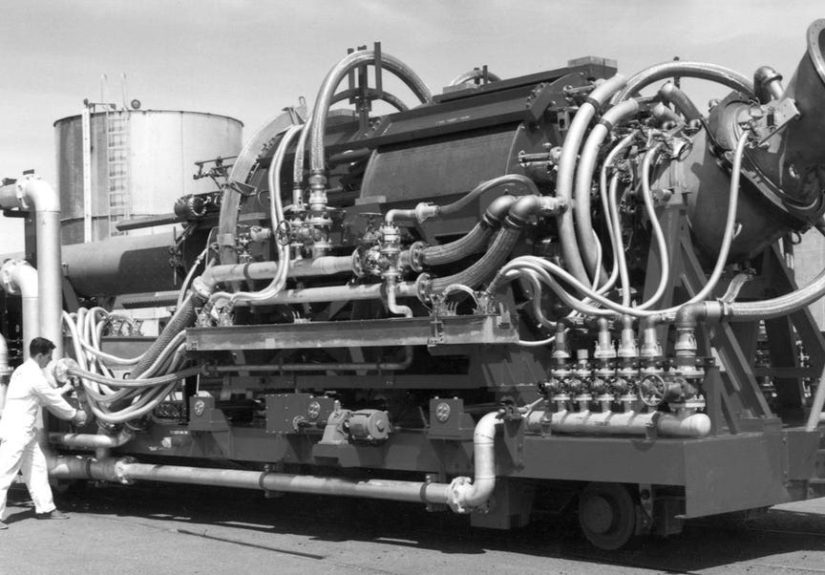
Tory: The Nuclear Ramjet Reactors
Project Pluto produced major reactor prototypes known as Tory. The tests took place at the Nevada Test Site area known as Jackass Flatsa location name that feels less like geography
and more like the universe quietly judging everyone involved.
One early milestone: in May 1961, the Tory reactor test proved the basic idea could run, even if only briefly.
Later, a more advanced reactor, Tory II-C, was run at full power for several minutes and demonstrated staggering outputhundreds of megawattsand enough thrust-equivalent performance
to make the whole concept feel dangerously real.
Testing a Flying Reactor… Without Flying It
The ground-testing setup was its own engineering epic. You can’t just bolt a reactor to a missile and take it for a casual spin over Nevada. So the test facility had to simulate the airflow of high-speed flight,
forcing massive volumes of air through the reactor so it behaved like it would at Mach-speed conditions.
That requirement alone tells you how extreme the project was: this wasn’t “build an engine.” It was “build an engine, plus the world’s angriest wind tunnel, plus remote handling systems because the engine becomes
lethally radioactive after it runs.”
The Missile Everyone Drew, But Nobody Built
Here’s the weirdly comforting part: SLAM never became a finished, flight-tested missile.
The reactor work advanced far enough to prove feasibility of the propulsion concept, but the full weapon system stayed largely in the realm of design studies, artist impressions, and “what if” memos.
The proposed airframe was typically described as a long, wingless (or nearly wingless) vehicle optimized for supersonic, low-altitude flight, launched with boosters to get it to ramjet ignition speed.
The overall vibe was less “sleek aerospace marvel” and more “industrial staple remover traveling at Mach 3.”
Navigation, Guidance, and the Low-Altitude Problem
Flying fast and low sounds great until you remember Earth is not a smooth tabletop. Terrain varies. Weather exists. Also, birds have opinions.
A low-altitude supersonic profile demands robust guidance, radar terrain awareness, and a structure that can handle intense aerodynamic heating and loads.
SLAM would have needed extremely reliable automation for its erabecause “pilot” was not an option, and “crash into a hill” is a poor delivery strategy.
Even if the guidance problem were solved, the missile still had to survive its own ride: heat, vibration, and constant punishment at low altitude.
Why People Call It “The Cruise Missile From Hell”
Let’s be honest: “From hell” is doing a lot of work here, but SLAM earned the reputation.
The nuclear ramjet concept is fundamentally different from most propulsion systems because the reactor is not politely sealed away like a power plant.
It’s integrated into the airflow path. That means the engine’s exhaust could carry radioactive byproducts and activated particles.
In other words, the missile didn’t just threaten targets with warheadsit raised uncomfortable questions about what it might do to everything in the air it passed through along the way.
Even supporters recognized the political and operational baggage of a system that could be perceived as contaminating territory before it ever dropped a weapon.
The Sonic Boom as a Feature (Yes, Really)
Supersonic flight at low altitude creates continuous sonic boomsloud, destructive pressure waves.
SLAM’s planned profile effectively turns “noise complaint” into “structural damage report.” It’s the only weapon concept that could plausibly
ruin your day before the warhead even arrives.
The Testing and Deployment Headache
Even if you ignore ethics and focus purely on logistics, SLAM was a nightmare:
- How do you flight-test it? Flying an unshielded reactor-powered engine creates risks you can’t hand-wave away.
- Where do you fly it? Over oceans? Allies? Empty deserts? The world is inconveniently full of people.
- What happens if it crashes? “Reactor-powered debris field” is not a phrase any government wants in a press release.
- How do you maintain it? Remote handling, specialized facilities, and long-term contamination concerns make routine operations… not routine.
The missile from hell wasn’t just scary because it was powerful. It was scary because it was powerful and wildly impractical in ways that matter when you’re trying not to poison your own allies.
Why SLAM Was Cancelled
Project Pluto and the SLAM concept were ultimately cancelled in 1964, despite successful reactor tests.
The reasons weren’t mysterious. They were painfully adult.
1) The World Moved On to Faster, Cleaner Deterrence
By the early 1960s, ICBMs were maturing quickly. Submarine-launched ballistic missiles were a growing strategic reality.
These systems were terrifying, yesbut they were also more straightforward in operational terms:
no reactor exhaust, no “weeks of flight time,” and no need to invent a new category of environmental headache.
2) “Military Requirement” Was Doing a Lot of Heavy Lifting
Part of Pluto’s political story is that it became a test case for how advanced technology programs were managed and justified.
Even with technical achievements, decision-makers still had to answer a blunt question:
does this system solve a mission problem better than alternatives, enough to justify its cost and risks?
3) The Safety and Diplomatic Risk Was Real
A nuclear-powered cruise missile doesn’t exist in a vacuum. It exists in a world of allied airspace, public opinion, treaty politics, and the small detail that
people generally dislike the idea of radioactive hardware streaking around the planet at supersonic speed.
In short: SLAM didn’t die because engineers couldn’t make it work. It died because the world looked at the working version and said,
“Absolutely not, please and thank you.”
What Project Pluto Accidentally Gave the Future
Even cancelled programs leave footprints. Project Pluto forced breakthroughs in areas that mattered beyond SLAM:
high-temperature materials, advanced ceramics for fuel elements, remote handling methods, and test infrastructure for extreme environments.
It also served as a cautionary talean example of how “possible” and “wise” can be very different words, even when both appear in the same briefing.
The Modern Echo: Why SLAM Keeps Coming Back in Conversations
Every time a new headline appears about exotic nuclear propulsion concepts, SLAM re-enters the chat like a ghost wearing aviator sunglasses.
Analysts point to Project Pluto as proof that nuclear-powered cruise missiles are not just difficultthey come with a long list of engineering, safety, and political complications.
The core idea still tempts strategists: very long endurance, flexible routing, and the ability to threaten from unexpected angles.
The core problem still refuses to go away: operating a flying reactor has consequences, and the planet is not an empty test range.
Conclusion: The Missile That Didn’t Flyand That’s the Point
SLAM is one of the most vivid examples of Cold War engineering imagination: technically daring, strategically ambitious, and morally awkward enough to make a courtroom lawyer ask for a recess.
It promised a kind of endurance and penetration that conventional engines couldn’t touch.
But it also carried a level of complexity and risk that made it hard to test, hard to deploy, and hard to justify once more practical deterrent systems matured.
And that’s why SLAM still fascinates people today. It’s not just “the missile from hell.” It’s the moment a superpower looked at a working prototype and decided:
some doors are better left closedespecially the ones that glow.
Research “Experience” Add-On (): Chasing SLAM Through Paper Trails and Desert Wind
Researching SLAM feels like rummaging through your grandpa’s attic and finding a beautifully engineered device labeled “DO NOT TURN ON (FOR REAL THIS TIME).”
You start innocently: “What was Project Pluto?” Next thing you know, you’re knee-deep in scanned PDFs that smell like history and contain the kind of calm, technical prose
that only exists when adults are discussing apocalyptic technology with straight faces.
The first “experience” is realizing how normal everyone tried to make it sound. The reports don’t scream, “We built a flying reactor!” They say things like,
“air system performance requirements” and “remote-handling technologies” as if the team was just upgrading a warehouse conveyor belt.
That deadpan tone is the Cold War’s signature move: describe the end of civilization like it’s a quarterly budget review.
The second experience is the geographybecause SLAM’s story is inseparable from the Nevada desert. “Jackass Flats” sounds like a punchline, but it’s also a reminder:
if you’re going to test something this extreme, you pick a place where the nearest neighbor is a tumbleweed with commitment issues.
The documents read like a love letter to isolation: massive air systems, thick shielding, careful planning for what happens after a reactor runs and becomes too hotradiologically and literallyto approach.
It’s engineering built around the fact that humans are fragile and reactors are not.
Then comes the “wow” moment: the numbers. Even when you don’t obsess over specs, it’s hard not to raise an eyebrow at the idea of a reactor producing output on the scale of major infrastructure,
but miniaturized and ruggedized for an engine test. It’s the kind of capability that makes you understand why the program felt irresistible.
For a brief period, it must have seemed like the answer to everything: range, speed, persistence, and a swaggering refusal to accept normal limitations.
But the deeper you go, the more the practical questions start shouting over the cool factor. How do you test flight safely?
What happens when politics changes? What happens when an alternative (like ballistic missiles) becomes easier to deploy and harder to stop?
You can feel the arc of the story bending from “we can” to “we should probably not.” It’s not one dramatic failuremore like reality slowly, relentlessly collecting its overdue bill.
By the end of the research trail, SLAM stops being just a meme-worthy superweapon concept. It becomes a case study in technological temptation:
humans reaching for a lever labeled “limitless,” then pausing long enough to ask what else that lever is connected to.
If you’re looking for a single takeaway, it’s this: the most frightening weapons aren’t always the ones that explode.
Sometimes they’re the ones that almost made operational sense.