Table of Contents >> Show >> Hide
- What Is Amazon’s Latest Dot?
- Design: Still Small, But More Serious
- Inside the Shell: The Big Change Is Audio
- Sound Quality: Better Bass, Clearer Vocals, Still Not Magic
- The Brain: AZ3 Chip and Alexa+
- Sensors: The Dot Is Watching the Room, Not Just Hearing It
- Smart Home Hub Features: Less Clutter, More Control
- Microphones and Voice Recognition
- Connectivity: Wi-Fi, Bluetooth, and the Modern Smart Home
- Repairability and Teardown Lessons
- Privacy: The Button Is Only Part of the Conversation
- How It Compares With the Echo Dot 5th Generation
- Who Should Buy the Echo Dot Max?
- Real-World Experience: Living With Amazon’s Latest Dot
- Conclusion: A Small Speaker With Bigger Ambitions
Amazon’s Echo Dot has always been the smart speaker equivalent of a surprisingly helpful desk gnome: small, affordable, always listening for its name, and somehow involved in half the routines in the house. But the latest Dot-family model, the Amazon Echo Dot Max, is not just another tiny orb with Alexa tucked inside. It is Amazon’s attempt to turn the humble Dot into a louder, smarter, more sensor-packed hub for the Alexa+ era.
So what is really going on inside Amazon’s latest Dot? Is it just a louder Echo Dot wearing a fancier fabric sweater, or has Amazon actually redesigned the little speaker from the inside out? Let’s take a careful, non-destructive peek at the hardware, audio design, smart home features, privacy choices, and real-world experience behind the newest member of the Dot family.
What Is Amazon’s Latest Dot?
When people say “latest Echo Dot,” they may mean two different things. The classic Echo Dot 5th generation remains the familiar budget Alexa speaker released in 2022, with improved bass, a temperature sensor, motion detection, and Eero Built-in support. But Amazon’s newer Dot-family device is the Echo Dot Max, introduced as a more powerful compact smart speaker designed for Alexa+ and richer room-filling sound.
The Echo Dot Max sits between the standard Echo Dot and larger Echo speakers. It keeps the compact, rounded personality of the Dot line, but it adds more serious audio hardware, a built-in smart home hub, newer wireless support, and more onboard sensing. In plain English: this Dot went to the gym, read a few smart home manuals, and came back with opinions about bass response.
Design: Still Small, But More Serious
From the outside, the Echo Dot Max keeps Amazon’s friendly fabric-covered sphere design. It is still meant to blend into a bedroom, kitchen, office, or living room without looking like a tiny spaceship landed next to your lamp. The fabric shell helps it feel less like a gadget and more like part of the furniture, which is exactly what smart speakers need to do if they expect to live on your nightstand without being judged.
The physical controls are straightforward: volume buttons, an action button, and a microphone mute button. That mute button matters. Smart speakers are useful because they listen for wake words, but users also want obvious control over when microphones are active. A visible privacy control is not glamorous, but neither is arguing with a speaker that thinks “Alexa” was hidden somewhere inside your sneeze.
The Light Ring Still Does the Talking
Amazon’s familiar light ring remains a key part of the Echo experience. It gives visual feedback for listening, alerts, timers, volume changes, and device status. The Dot line has always been good at communicating through simple visual cues, and the latest model keeps that idea. You do not need a screen to know the device heard you; the ring handles that little moment of confirmation.
Inside the Shell: The Big Change Is Audio
The biggest internal change in Amazon’s latest Dot is the speaker system. Older Echo Dots were impressive for their size, but they were still small speakers doing small-speaker things. They could play music, answer questions, and fill a quiet room, but nobody confused them with a dedicated home audio system.
The Echo Dot Max changes the formula by using a two-way speaker system. Instead of relying on a single driver to handle everything, it separates audio duties between a woofer and a tweeter. The woofer focuses on lower frequencies and bass, while the tweeter handles higher notes and clearer detail. This is a meaningful upgrade because small speakers often struggle when they try to do too much with too little space.
Amazon also redesigned the internal sound structure so the speaker is integrated more directly into the housing. That matters because air space is precious in compact speakers. More usable internal volume can help bass feel fuller and less like someone tapping a cardboard box with a pencil. Amazon claims the Echo Dot Max delivers nearly three times the bass of the 2022 Echo Dot, and while marketing math should always be approached with one eyebrow raised, reviewers generally agree that the new model sounds much larger than previous Dots.
Sound Quality: Better Bass, Clearer Vocals, Still Not Magic
In real-world terms, the Echo Dot Max is better suited for medium rooms than older Dots. It can handle podcasts, casual music, news briefings, kitchen playlists, alarms, and smart home responses with more body. Vocals come through more clearly, bass has more weight, and the overall presentation feels less thin.
That said, physics still exists. A compact smart speaker cannot fully replace a serious stereo setup or a premium soundbar. Some reviewers praise the Dot Max as one of Amazon’s best compact Alexa speakers, while more audio-focused outlets note that its musical performance still has limits. That balance is important: the Echo Dot Max is a better Echo Dot, not a tiny concert hall in a fabric ball.
Automatic Room Adaptation
One of the smarter additions is automatic room adaptation. The idea is simple: the speaker listens to how sound behaves in its environment and adjusts playback to better suit the room. A speaker placed near a wall, in a corner, or on an open shelf can sound different, and automatic tuning helps reduce the need for manual fiddling. For most users, that is a win. Nobody wants to open an equalizer menu just to make a kitchen playlist sound less like it was recorded inside a cereal box.
The Brain: AZ3 Chip and Alexa+
Amazon designed the Echo Dot Max for the Alexa+ era, and that means the internal processor matters more than before. The device uses Amazon’s AZ3 chip, built to improve responsiveness, voice recognition, and AI-related processing. As Alexa becomes more conversational and context-aware, Echo hardware needs to handle more complex interactions without feeling sluggish.
Older smart speakers were mostly command machines. You asked for the weather, a timer, a song, or a light change. Newer AI assistants are expected to understand follow-up questions, routines, preferences, and more natural conversation. That raises the hardware bar. The Echo Dot Max is not just a microphone connected to the cloud; it is part of Amazon’s larger plan to make Alexa feel less like a command line and more like a household assistant that does not need every request carved into stone tablets.
Sensors: The Dot Is Watching the Room, Not Just Hearing It
The Echo Dot Max includes sensors that make it more useful as a smart home device. Depending on region and configuration, the key sensor features include ambient temperature sensing, presence or motion detection, and other environmental awareness tools. These features allow the speaker to trigger routines based on what is happening in a room.
For example, a temperature sensor can help automate a fan, thermostat routine, or smart plug. Presence detection can turn lights on when someone enters a room or pause routines when a space is empty. These are the kinds of features that move a smart speaker beyond “Alexa, play music” and into actual home automation.
Why Temperature Sensing Is More Useful Than It Sounds
A temperature sensor in a speaker sounds boring until you use it. Then it becomes one of those features you start quietly bragging about, which is how adulthood sneaks up on people. A bedroom can be warmer than the hallway thermostat thinks. A garage can heat up faster than expected. A nursery, home office, or upstairs room can have its own climate personality. With temperature-based routines, the Echo Dot can help make smart home automation more practical.
Smart Home Hub Features: Less Clutter, More Control
One of the biggest upgrades inside the Echo Dot Max is smart home hub support. The device is designed to work with modern smart home standards such as Matter and Thread, while also supporting common smart home connections like Zigbee in supported markets. This makes the speaker more than a voice interface. It can become a central control point for compatible lights, plugs, sensors, switches, and other connected devices.
This matters because smart homes can become cable-and-bridge soup very quickly. One hub for lights, another for sensors, another for a thermostat, and suddenly your router shelf looks like a gadget petting zoo. A compact speaker with built-in hub capability can reduce clutter and simplify setup for many households.
Matter and Thread Make the Dot More Future-Friendly
Matter is intended to make smart home devices work more reliably across ecosystems, while Thread is a low-power mesh networking technology for connected devices. In everyday language, they help smart home products talk to each other with fewer tantrums. The Echo Dot Max supporting these technologies makes it better prepared for newer smart home gear than older basic speakers.
Microphones and Voice Recognition
The microphone system is another important part of the internal story. A smart speaker is only useful if it hears you accurately. That means it has to separate your voice from music, fans, dishwashers, dogs, children, and whatever mysterious sound the refrigerator makes at 2:00 a.m.
Amazon’s newer hardware and processing are designed to improve wake-word detection and voice response in noisy rooms. This is especially important as Alexa+ aims for more natural conversation. A voice assistant that misunderstands simple commands is annoying; one that misunderstands multi-step instructions is a tiny chaos engine with Wi-Fi.
Connectivity: Wi-Fi, Bluetooth, and the Modern Smart Home
The Echo Dot Max supports modern wireless connectivity, including Wi-Fi and Bluetooth. This allows it to stream music, connect with the Alexa app, pair with compatible devices, and function as part of a larger Echo speaker group. For users upgrading from older Echo hardware, the difference is not just speed. It is reliability, compatibility, and smoother integration with newer smart home systems.
Bluetooth support also gives the device a familiar fallback role as a wireless speaker. That is useful when guests want to play audio from a phone or when a streaming service works better through a direct Bluetooth connection. The Dot Max may be built for Alexa, but it is still practical enough to handle basic speaker duty without demanding a ceremony.
Repairability and Teardown Lessons
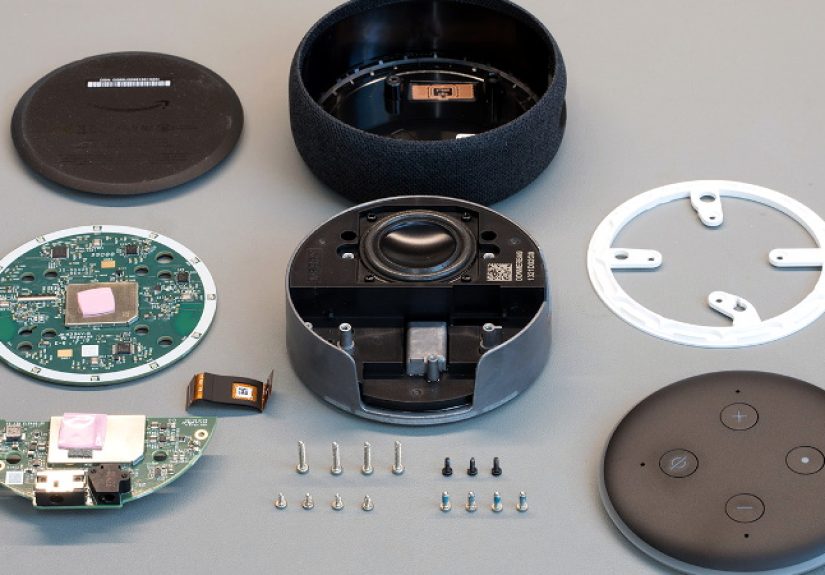
Looking at Echo Dot teardown history reveals a clear pattern: Amazon designs these devices to be compact, layered, and efficient. Inside a small Echo speaker, space is carefully divided among the speaker assembly, printed circuit boards, microphones, light diffuser, power components, buttons, and enclosure structure.
Earlier Echo Dot models used standard screws in many areas, but modern compact smart speakers are still not exactly weekend repair projects for most people. Components are tightly packed, ribbon cables can be delicate, and the outer shell is designed more for clean assembly than frequent user repair. Teardown guides show that parts such as the case, speaker, switch board, and CPU board can be accessed with proper tools, but this is not the same as saying everyone should immediately open one on the kitchen table next to a sandwich.
The larger point is that Amazon’s Dot design is a study in trade-offs. A compact smart speaker must be small, attractive, stable, loud enough, cool enough, affordable enough, and durable enough. Every millimeter inside the case has a job. The Echo Dot Max pushes that challenge further by adding better audio, more sensors, and hub features while still staying relatively small.
Privacy: The Button Is Only Part of the Conversation
Any article about an Alexa speaker has to talk about privacy. The Echo Dot Max includes a physical microphone mute button, and Alexa users can manage voice history and privacy settings through the Alexa app. Those controls are important, but users should also understand the basic trade-off: voice assistants often rely on cloud processing to deliver advanced features, especially as generative AI becomes part of the experience.
For many households, that trade-off is acceptable because the convenience is high. Timers, reminders, music, smart lights, shopping lists, intercom features, and routines can be genuinely useful. For privacy-sensitive users, the best approach is to review settings, use the mute button when desired, and be thoughtful about where the speaker is placed.
How It Compares With the Echo Dot 5th Generation
The Echo Dot 5th generation remains a strong budget smart speaker. It offers improved sound over older Dots, a temperature sensor, motion detection, tap gestures, Alexa support, and compact design. For a bedroom, desk, or small kitchen, it still makes sense, especially when discounted.
The Echo Dot Max is for users who want more: stronger sound, deeper bass, better smart home hub features, and hardware designed around Alexa+. It is not simply replacing the basic Dot; it is expanding the Dot category upward. Think of the standard Echo Dot as the reliable compact car and the Dot Max as the same car after someone added better suspension, nicer speakers, and a dashboard that knows your thermostat’s emotional state.
Who Should Buy the Echo Dot Max?
The Echo Dot Max makes the most sense for people who already use Alexa and want a stronger speaker without jumping to a larger Echo Studio-style device. It is also a smart pick for users building a Matter or Thread-friendly smart home, or for anyone who wants one speaker to handle music, voice control, routines, sensors, and hub duties in a medium-sized room.
It may not be the best choice for users who only need a cheap alarm clock speaker, a simple kitchen timer, or a basic voice assistant. In those cases, the standard Echo Dot or Echo Pop may be enough. It also may not satisfy picky audio fans who want stereo separation, wide soundstage, or deep controlled bass at higher volumes. For that crowd, a dedicated speaker system still wins.
Real-World Experience: Living With Amazon’s Latest Dot
After spending time thinking through how the Echo Dot Max fits into a real home, the most interesting thing is not one single feature. It is the way all the small features stack together. Better sound is nice. A temperature sensor is nice. A smart home hub is nice. Faster Alexa responses are nice. But together, they create a device that feels less like a novelty speaker and more like a practical room controller.
Imagine placing it in a kitchen. In the morning, you ask for the weather while making coffee. It answers quickly, then plays a news briefing or playlist with enough volume to be heard over running water and cabinet doors. You set a timer for eggs, another for toast, and a third because apparently breakfast has become a logistics company. Later, the temperature sensor helps trigger a fan routine when the room warms up from cooking. That is where the Dot Max starts to feel genuinely useful.
In a bedroom, the experience is different. The improved speaker makes sleep sounds and low-volume music warmer. The microphone mute button is easy to use when you want quiet. A smart light routine can turn lamps off at night and slowly bring them up in the morning. If you use Alexa reminders, the speaker becomes part alarm clock, part assistant, part tiny household manager who never gets tired of being asked whether tomorrow is trash day.
In a living room, the Echo Dot Max shows both its strengths and limits. It sounds much better than older compact Dots, and for casual listening it can fill the space nicely. But if you expect cinematic audio or party-level music, you will eventually meet the wall called “small speaker physics.” Pairing Echo devices or stepping up to a larger speaker can help. Still, for background music, voice control, and smart home commands, the Dot Max feels more capable than its size suggests.
The smart home hub features are where the device becomes more than a speaker. For someone starting a smart home, fewer hubs and fewer apps are a blessing. Setting up compatible lights, plugs, and sensors through Alexa can make the whole system feel less intimidating. The average person does not want to become a network engineer just to turn on a lamp. The best smart home technology quietly removes friction, and the Dot Max moves in that direction.
There are still frustrations. Alexa+ is ambitious, but AI assistants remain works in progress. Sometimes voice assistants still answer too much, too little, or with the confidence of a substitute teacher reading the wrong lesson plan. Smart home compatibility can also vary by brand, region, and device generation. The Echo Dot Max is powerful, but it cannot magically fix every awkward smart bulb or unreliable Wi-Fi corner.
The privacy question also becomes more noticeable as the device gets smarter. A basic speaker that answers weather questions is one thing; an AI-powered assistant that handles more personal routines is another. The practical answer is not panic. It is awareness. Review privacy settings, understand voice history controls, use mute when needed, and place the device where it makes sense. Smart homes should feel helpful, not creepy.
What I like most about the Echo Dot Max concept is that it respects the original Echo Dot idea while admitting that the smart home has changed. The first Dots were about making Alexa affordable and easy to scatter around the house. The latest Dot is about making each room smarter, more aware, and better sounding. It is still small, but it is no longer basic.
For many users, the Echo Dot Max will be the sweet spot: better sound than the budget Dot, more smart home power than older models, and less bulk than a full-size premium speaker. It is not perfect, and it is not cheap compared with the classic Dot, but it is one of the clearest signs that Amazon sees the future of Echo devices as more than voice commands. The future Dot is a speaker, sensor, hub, assistant, and room-aware computer wrapped in fabric. Not bad for something that still looks like it could roll under the couch.
Conclusion: A Small Speaker With Bigger Ambitions
Taking a peek inside Amazon’s latest Dot reveals a device built around one main idea: the smart speaker is becoming a smart room hub. The Echo Dot Max upgrades the familiar Dot formula with stronger audio hardware, more sensors, modern smart home connectivity, and a processor designed for the next phase of Alexa. It is louder, smarter, and more capable than the basic Dot, while still staying compact enough for everyday rooms.
The most important takeaway is that Amazon did not simply make the Dot louder. It redesigned the role of the Dot. Instead of being the cheapest way to put Alexa in a room, the latest Dot aims to be the center of that room’s audio, automation, and ambient intelligence. Whether that is worth the upgrade depends on your home, your budget, and how deeply you live in the Alexa ecosystem. But as a glimpse into where smart speakers are headed, the Echo Dot Max is one very interesting little ball of silicon, sensors, and bass.