Table of Contents >> Show >> Hide
- Quick Table of Contents
- What Makes a Space Artifact “Auction-Grade” (and Why the Price Gets Weird)
- 1) NWA 16788: The Largest Martian Meteorite Ever Found on Earth (Sold for ~$5.3M)
- 2) Vostok 3KA-2 Space Capsule (Sold for $2,882,500)
- 3) Buzz Aldrin’s Apollo 11 Inflight Coverall Jacket (Sold for $2,772,500)
- 4) Neil Armstrong’s Apollo 11 Gold Robbins Medallion (Sold for $2,055,000)
- 5) Apollo 11 Lunar Sample Return Bag (Sold for $1,812,500)
- 6) The Apollo 15 Bulova Chronograph Worn on the Moon (Sold for $1,625,000)
- 7) Luna 16 Lunar Soil Samples (Sold for $855,000)
- 8) Sputnik-1 Full-Scale EMC/EMI Lab Model (Sold for $847,500)
- 9) Flown Apollo 11 Summary Flight Plan (Sold for $819,000)
- 10) Apollo 11 Lunar Module Systems Activation Checklist (Sold for $567,000)
- 11) Apollo 11 LM EVA Checklist Three-Piece Cue-Card Set (Sold for $352,800)
- Patterns Behind the Biggest Prices
- If You Ever Want to Bid on Space Memorabilia, Read This First
- Bonus: of Auction-Day Experience (So You Can Feel the Heat Without Spending a Mortgage)
- Conclusion
There are souvenirs… and then there are souvenirs that have been to space. The first kind lives in a shoebox.
The second kind lives in a climate-controlled vault, has a binder of provenance paperwork thicker than a Thanksgiving cookbook,
and costs more than a house in a suspiciously large number of U.S. ZIP codes.
Below are 11 of the priciest publicly reported auction results for space-related artifactsspecimens that either
came from space (meteorites), survived spaceflight (capsules, flown gear),
or were used on landmark missions (mission-flown documentation). Prices are shown in U.S. dollars as reported in auction coverage;
note that auction results are often reported as totals that may include buyer’s premium, and conventions can vary by house.
What Makes a Space Artifact “Auction-Grade” (and Why the Price Gets Weird)
The space-collectibles market has the same basic rules as any other high-end collecting categoryrarity, condition, and demand
but with two spicy extras: provenance (did it really fly?) and story gravity
(does it attach you to a defining moment in human history?).
“Flown” matters because it’s the collecting equivalent of a backstage pass signed by physics.
An object that actually left Earth’s atmosphereor literally touched the Moonbecomes a physical witness to an event
most of us only know through documentary footage and goosebumps.
With that in mind, here are 11 space artifacts that didn’t just break estimatesthey broke the “I can’t believe someone paid that”
part of your brain.
1) NWA 16788: The Largest Martian Meteorite Ever Found on Earth (Sold for ~$5.3M)
If you’ve ever wanted a piece of Mars, the universe has (occasionally) made that possible by throwing Mars at Earth
and hoping we call it “science” instead of “rude.”
NWA 16788 is a massive Martian meteoritereported as the largest known piece of Mars on Earthsold at auction for about $5.3 million.
Why it commanded a stratospheric price
- Category dominance: “Largest known” tends to do wonderful things to a price tag.
- Rarity on top of rarity: Martian meteorites are scarce, and a big one is rarer still.
- Display appeal: A specimen that looks like “Mars” in the public imagination (color, crust, drama) is collector catnip.
Meteorites also have a special advantage at auction: they come with built-in romance. You’re not just buying a rock; you’re buying
a travel story that begins with a violent ejection from Mars and ends with you explaining to guests why your “paperweight” has a security system.
2) Vostok 3KA-2 Space Capsule (Sold for $2,882,500)
Spacecraft hardware is the heavyweight division of space memorabilialiterally and financially. The Vostok 3KA-2 capsule,
a near-twin of the capsule design associated with the earliest era of human spaceflight, sold for $2,882,500.
Why it sold for so much
- True artifact status: This isn’t “inspired by” space historyit is space history.
- Era-defining significance: Early human spaceflight artifacts are extremely limited in number.
- Institutional-scale appeal: Objects like this attract not only private collectors but also museums and legacy-minded buyers.
A capsule is also the ultimate “proof” item. A jacket is amazing, a checklist is iconic, but a capsule is the literal shell that kept the mission alive.
It’s the difference between owning a concert poster and owning the stage.
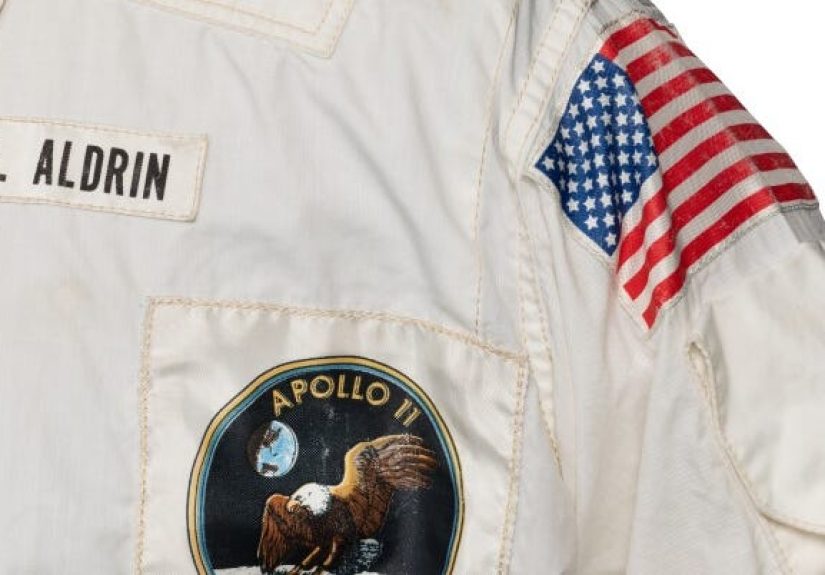
3) Buzz Aldrin’s Apollo 11 Inflight Coverall Jacket (Sold for $2,772,500)
Not every holy-grail artifact is gigantic. Sometimes it’s clothingspecifically, a white inflight jacket worn by a moonwalker
on the mission that made “one small step” a permanent part of human vocabulary. Buzz Aldrin’s Apollo 11 jacket sold for $2,772,500.
Why collectors lost their minds (politely, with paddles)
- Direct, personal connection: It’s from Aldrin himself, with rock-solid provenance and mission context.
- “Apollo 11” effect: The first Moon landing is the Mount Everest of space collecting.
- Wearability of the story: Clothing carries a visceral human presence that hardware sometimes doesn’t.
This is the kind of object that makes people whisper in galleries like they’re in a cathedral. The stitches feel louder.
The mission patch looks like it should be behind glass (because it is).
4) Neil Armstrong’s Apollo 11 Gold Robbins Medallion (Sold for $2,055,000)
Coins and medals usually conjure hobby-shop vibes and magnifying glasses. Then you meet an Apollo 11 gold Robbins medallion
carried by Neil Armstrongand the hobby becomes “history you can hold.” One such medallion sold at auction for $2,055,000.
Why a medal can beat a sports car
- Extreme scarcity: These mission-flown medals exist in tiny numbers.
- Mission prestige: Apollo 11 provenance is basically a cheat code for value.
- Condition + certification culture: Numismatics brings a mature ecosystem of grading and documentation.
And unlike some bulky artifacts, a medallion compresses meaning into a few centimeters: a miniature, golden “I was there,”
with the “there” being the Moon.
5) Apollo 11 Lunar Sample Return Bag (Sold for $1,812,500)
This is the artifact equivalent of finding a dusty grocery tote that once carried the first lunar material ever collected by humans.
A “Lunar Sample Return” bag associated with Apollo 11 sold for $1,812,500.
Why a bag beat a mansion down payment
- Function meets myth: It did a job on the most famous mission in space history.
- Physical trace: Reports often noted remnants of lunar dustan almost unfair advantage in emotional impact.
- Singularity: You can’t mass-produce “the first” after the fact.
The charm is that it’s not glamorous. It’s utilitarian, the way real exploration tends to be. Which makes it weirdly relatable:
even on the Moon, humans still need a bag for rocks.
6) The Apollo 15 Bulova Chronograph Worn on the Moon (Sold for $1,625,000)
Watches have long been a gateway drug into collecting. The difference here is that this Bulova chronograph was worn by astronaut David Scott
during Apollo 15including lunar surface activitybefore selling at auction for $1,625,000.
Why this watch is a category legend
- It’s mission-flown and mission-used: Not just carriedworn during the work.
- Cross-collector appeal: Space collectors and serious horology people show up for this kind of lot.
- Human scale: A spacecraft is heroic; a watch is intimatetimekeeping in a place where time feels unreal.
Also: it’s the perfect dinner-party artifact. You can say, “This watch has been to the Moon,” and enjoy the stunned silence
that follows as someone’s brain buffers.
7) Luna 16 Lunar Soil Samples (Sold for $855,000)
If Apollo is the superstar, Soviet robotic missions are the underappreciated indie band with a devoted fan base and incredible back catalog.
Luna 16 returned lunar material to Earth in 1970, and a tiny sample set connected to that mission sold for $855,000.
Why microscopic material can mean macroscopic money
- True extraterrestrial substance: This is literal Moon material, not a replica or a photo.
- Supply is essentially fixed: Most lunar samples are held by governments and institutions, not the open market.
- Science-adjacent mystique: People feel like they’re buying a lab-grade trophy from another world.
There’s also a psychological effect: when the object is tiny, the price feels even more absurd… which somehow makes it more iconic.
It’s like buying a diamond the size of a breadcrumbexcept the diamond is the Moon.
8) Sputnik-1 Full-Scale EMC/EMI Lab Model (Sold for $847,500)
Sputnik isn’t just a satellite; it’s a historical jump-scare. One beep in 1957 helped trigger a global shift in science, education,
defense priorities, and imagination. A full-scale Sputnik-1 EMC/EMI lab model sold for $847,500.
Why a “test model” still hit near seven figures
- Symbol power: Sputnik is shorthand for “the Space Age begins.”
- Rarity and provenance: Authentic models are limited, heavily documented, and fiercely pursued.
- Display dominance: This is the kind of object that makes a room feel like a museum instantly.
It’s also a reminder that in collecting, “original” can mean more than “flew.” For a cultural turning point like Sputnik,
authenticity and era-correct construction can be enough to send the bidding into orbit.
9) Flown Apollo 11 Summary Flight Plan (Sold for $819,000)
If you’re collecting space history, mission documentation is where you go to feel like you’re holding the mission itself.
A flown Apollo 11 summary flight plancovering major mission phasessold for $819,000.
Why paper can be priceless
- It’s operational: This isn’t a souvenir brochure; it’s a tool for doing the impossible.
- High narrative density: Few objects summarize Apollo 11’s arc so completely.
- Flown status: “Flown” turns documentation into a participant, not just a record.
There’s a delicious irony here: the mission that required rockets, computers, and lunar modules also generated
paper that, decades later, can buy you a literal rocket’s worth of money.
10) Apollo 11 Lunar Module Systems Activation Checklist (Sold for $567,000)
Checklists are the quiet heroes of aerospace. They’re also the quiet heroes of auctions, apparently.
A flown Apollo 11 Lunar Module systems activation checklist sheet sold for $567,000.
Why a checklist can outmuscle flashier collectibles
- Mission-critical content: It’s a map for waking up a lunar modulecasual stuff.
- Human fingerprints of the mission: Annotations, handling wear, and flight context make it feel alive.
- Collecting “truth”: The more functional the object, the more authentic it feels to serious buyers.
Think of it as a recipe card for landing on the Moonexcept the ingredients include courage, math, and not panicking.
11) Apollo 11 LM EVA Checklist Three-Piece Cue-Card Set (Sold for $352,800)
Spacewalks look poetic on video. On paper, they look like what they are: procedures, steps, and a strong preference for not drifting away forever.
A three-piece Apollo 11 Lunar Module EVA checklist cue-card set sold for $352,800.
Why these cue cards matter
- Direct EVA connection: The checklist relates to the work of walking on another world.
- Flown artifacts bridge science and theater: They’re practical, but they also feel ceremonial.
- Scarcity: Items that both survived and remained in private hands are limited.
The best part? It’s proof that even in the most technologically advanced mission of its time, humans still relied on
the same thing you use when assembling furniture: a step-by-step guide.
Patterns Behind the Biggest Prices
These 11 lots look wildly differenta capsule, a jacket, a meteorite, some paperbut the market logic is surprisingly consistent.
When space artifacts hit record prices, a few factors usually show up together.
1) Provenance that could survive cross-examination
Catalog notes, mission logs, chain-of-custody documents, astronaut inscriptions, institutional verificationbuyers want a story
that’s documented, not just dramatic.
2) “First,” “largest,” or “only”
Collectors pay for superlatives because superlatives don’t get diluted. The largest Martian meteorite. The first lunar mission.
A capsule tied to the dawn of human spaceflight. These labels turn into value anchors.
3) Human connection
Anything directly associated with a named astronaut (and especially an Apollo 11 astronaut) often outperforms a comparable object
without that personal link. Space history is big, but collecting is personal.
4) Display power
Museums think in galleries, and many serious private collectors think the same way. A capsule or Sputnik model is a “centerpiece” object.
A meteorite has instant visual drama. Even paper wins when it’s iconic and framed by an irresistible story.
If You Ever Want to Bid on Space Memorabilia, Read This First
You don’t need to be a billionaire to enjoy space collecting. But you do need to be prepared, because the space category has
enough legal nuance and authenticity pitfalls to make a spacecraft checklist look relaxing.
Practical tips collectors swear by
- Know what “price realized” means: Hammer price and total price (with premium) can be different animals.
- Ask for documentation: Provenance isn’t a vibeit’s paperwork.
- Understand the category: “Flown,” “carried,” “used,” “training,” and “replica” are not interchangeable words.
- Plan for conservation: Textiles, paper, and hardware all have different storage needs (humidity and light are sneaky villains).
- Remember the real costs: Shipping, insurance, taxes, display casesspace collecting has “mission support.”
Bonus: of Auction-Day Experience (So You Can Feel the Heat Without Spending a Mortgage)
Watching a space auctionwhether in person, on a livestream, or through those rapid-fire lot updatesis a strangely emotional sport.
The room (or the chat window) has the vibe of a museum, a science fair, and a championship game all at once. You’ll see bidders who look
like they just came from a board meeting sitting next to people who very clearly know the difference between Gemini and Apollo from twenty paces.
Everyone is calm until the bidding starts, and then suddenly the atmosphere changes like someone cracked open the airlock.
The first jolt is realizing how much storytelling is built into the cadence. Auction specialists don’t just describe an artifact; they
frame it as an event you can own a piece of. A capsule is introduced like a returning hero. A jacket becomes a time machine with seams.
A checklist gets treated like a sacred textbecause, honestly, when a checklist kept humans alive on the Moon, it kind of is.
And then you learn the collector’s paradox: the more ordinary the object looks, the more your brain struggles to accept the price.
A bag. A sheet of paper. A few grains of dust. The numbers climb anyway, because the history is doing the heavy lifting.
The second jolt is how fast “estimate” stops mattering once two people decide an item is their item. Bidding wars don’t feel like
shopping; they feel like competitive identity. One bidder wants the most important Apollo 11 document on the market.
Another bidder wants to be the person who saved it for posterity (and also, yes, owns it). You’ll hear increments snap upward with
the rhythm of a countdown, and it’s not unusual to see the crowd react to a new figure the way a stadium reacts to a game-winning shot
except everyone is whispering because the artifact is older than their inside voice.
Then comes the quiet part: the moment right after the hammer falls. There’s a beat where everyone mentally recalculates their understanding
of value. Not just money valuemeaning value. Because in a space auction, you’re not buying utility; you’re buying proximity to a human boundary
we crossed once, carefully, at great cost. The winner may never touch the Moon, but they now own something that did, and that’s the closest
thing modern life offers to purchasing goosebumps.
If you ever want to “participate” without bidding, here’s the secret: read the catalog notes like short stories, follow the provenance like a detective,
and treat the final prices as a kind of cultural weather report. When a Martian meteorite or an Apollo-flown artifact breaks a record,
it’s not just a flexit’s proof that the idea of space still pulls on people the way gravity pulls on everything else.