Table of Contents >> Show >> Hide
- What Are Classical Art Memes (and Why Do They Hit So Hard)?
- Where Do People Get the Art Images (Legally)?
- How to Make a Classical Art Meme That Actually Works
- “This Meeting Could’ve Been An Oil Painting”: 75 Meme-Ready Classical Art Captions
- Why Classical Art Memes Feel So Relatable (Even If You “Don’t Know Art”)
- 500 More Words of “Yep, I’ve Lived This”: Meeting-as-a-Painting Experiences
- Conclusion
- SEO Tags
You know that moment in a meeting where everyone’s camera is on, nobody’s soul is present, and the chat is filling up with “Sorry, I was on mute” like it’s a group confession? That’s the exact moment your brain whispers, This could’ve been an oil painting.
Because somehow, a 400-year-old masterpiece can perfectly capture how you feel when your calendar invite says “quick sync” (it is never quick), your coworker says “circling back” (they are circling nothing), and your to-do list is doing parkour on your mental health. Classical art memes take the most dramatic faces and gestures in art history and pair them with modern problemsturning daily chaos into something oddly beautiful, slightly unhinged, and extremely shareable.
This article breaks down why classical art memes work, where creators find legal-to-use images, andmost importantlydelivers 75 meme-ready caption ideas inspired by the vibe of old paintings: Renaissance side-eye, Baroque panic, Rococo “I’m fine,” and that one saint who looks like they just saw your unread email count.
What Are Classical Art Memes (and Why Do They Hit So Hard)?
Classical art memes are typically made by pairing a public-domain artwork (often European Renaissance, Baroque, or Rococo paintings, plus classical sculpture) with a modern caption. The humor comes from the contrast: a solemn, sacred, or heroic scene suddenly “speaks” like someone in a group chat at 11:58 p.m. trying to finish a project due at midnight.
They’re basically reaction images… with better lighting
Classical paintings are loaded with exaggerated expressionswide eyes, clutching hands, dramatic fainting, and intense “I have seen the spreadsheet” stares. Painters weren’t shy about emotion. That makes these artworks perfect as reaction images: the visuals already communicate feelings before you add a single word.
They compress complicated feelings into one punchline
The best memes do two things at once: (1) describe a familiar situation and (2) make you feel less alone for reacting the way you do. Research has suggested that memes and humor can help people cope with stress by offering emotional relief and a sense of shared experiencebasically, “I’m not the only one losing it.” That’s why a well-timed classical art meme can feel like a tiny pressure valve for your brain.
Where Do People Get the Art Images (Legally)?
Here’s the good news: you don’t need to screenshot a random image and hope nobody notices. Many major museums and cultural institutions in the U.S. provide open access images for public-domain works, often under CC0 (Creative Commons Zero). That means you can download, remix, and share those imagesoften even for commercial usewithout asking permission (though you should still check each item’s rights statement).
- The Met (New York): Offers a huge open-access collection of public-domain artworks under CC0.
- National Gallery of Art (Washington, D.C.): Provides open-access images free for use and download.
- Art Institute of Chicago: Shares tens of thousands of CC0 public-domain images.
- Smithsonian Institution: Releases millions of digital items under CC0 through Smithsonian Open Access.
- Getty (Los Angeles): Makes high-resolution images of public-domain art freely available via its Open Content Program.
- Library of Congress: Offers “Free to Use and Reuse” sets and many rights-cleared items in its digital collections.
Translation: the internet has handed you a museum-sized toolbox for meme-making, and it’s surprisingly legit.
How to Make a Classical Art Meme That Actually Works
1) Match the emotion first, not the “pretty”
Don’t start with the most famous paintingstart with the feeling. Overwhelmed? Look for chaos. Defensive? Find a saint who looks caught. Passive-aggressive? There is an entire art-historical genre called “side-eye in velvet.”
2) Keep captions short and punchy
The painting already does half the job. Your caption should be the final twist, not a full-length memoir. If you need three paragraphs to explain the joke, you’ve accidentally made corporate training.
3) Use “modern language” against “old drama”
The funniest classical art memes often use plain, current phrasing“bestie,” “it’s giving,” “per my last email,” “no thoughts, just vibes”because it collides beautifully with the seriousness of the scene.
4) Bonus points for accessibility
If you’re posting online, add alt text describing the image and the joke. It’s good practice, and it also forces you to clarify your own punchline (which is a sneaky way to improve your meme).
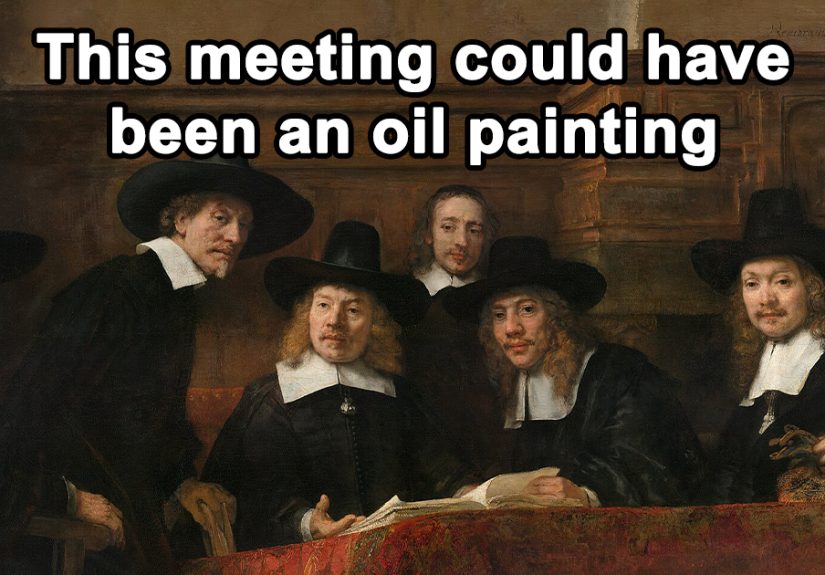
“This Meeting Could’ve Been An Oil Painting”: 75 Meme-Ready Classical Art Captions
Below are 75 original, relatable caption ideas designed to pair with classical paintings and sculptures. Think of them as prompts you can match to any artwork with the right facial expressionno plagiarism, no copy-paste, just fresh chaos.
A) Meeting & Workplace Memes (1–20)
- When the agenda says “quick update” and it’s a 47-slide spiritual journey.
- Me nodding like I understand, while my brain is buffering at 3%.
- “Let’s go around and introduce ourselves” (I have already emotionally left the room).
- When you say “I can take that” and immediately regret having hands.
- That one coworker who asks a question you answered 12 minutes ago.
- When your boss says “circle back” and you start circling the drain.
- Me pretending the project timeline is reasonable.
- When someone says “Can we do this live?” and you feel your soul evaporate.
- “We’re like a family here” (the family: stressed, loud, and allergic to boundaries).
- When you’re praised for doing the bare minimum because everyone is exhausted.
- “Any questions?” (I have many, but I also want peace.)
- When the meeting ends and five more meetings appear like hydra heads.
- “Just add a little more detail” (the detail: another week of my life).
- When you realize the meeting could’ve been an email, a text, or a whisper into the void.
- Me muttering “love that for us” while everything is actively on fire.
- When you’re asked to “own” something you did not create and do not want.
- “Let’s align” (I am a human being, not a printer cartridge).
- When your calendar is a crime scene and you are the evidence.
- When “optional” attendance somehow becomes mandatory in spirit.
- Me smiling politely while my will to live files a resignation letter.
B) Email, Chat, and “Per My Last Message” Energy (21–35)
- When you see “Following up on my previous email” and it’s from five minutes ago.
- Me rereading my message 14 times to make sure it’s not accidentally rude.
- When someone replies-all “Thank you!” and now 26 people do it too.
- “Please advise” (I advise you to stop.)
- When your typo changes the entire tone and now you live in shame.
- Me: sends a calm message. Also me: waits like it’s a life-or-death verdict.
- When you type “Sure!” but your face says “Absolutely not.”
- That moment you realize you’ve been arguing with the wrong group chat.
- “Seen 2:03 PM” (so we’re enemies now, got it).
- When you accidentally react with the wrong emoji and can’t undo it fast enough.
- Me trying to sound professional while my coffee is doing nothing.
- When you draft the email in your head all day and still send “Hi” first.
- “As discussed” (it was not discussed, but okay).
- When the thread has 63 replies and none of them answer the actual question.
- Me sending a voice note because typing feelings is hard.
C) Deadlines, Productivity, and Creative Panic (36–50)
- When you planned to start early, but your procrastination had other plans.
- Me, opening the document: “Who wrote this?” (it was me).
- When inspiration arrives exactly three minutes before the deadline.
- “Just a small change” (the small change: rebuild the universe).
- Me making a to-do list instead of doing the to-do list.
- When you’re busy all day and can’t explain what you did.
- That sweet moment when you finish one task and six more spawn.
- When your brain wants a nap but your schedule wants excellence.
- Me negotiating with myself like I’m a difficult client.
- When you can’t focus, so you clean one (1) surface and call it self-care.
- “I’ll do it tomorrow” (tomorrow is now today, and today is judgment).
- When you need motivation so you buy a new notebook like that’s the problem.
- Me trying to be productive while my phone whispers nonsense.
- When you hit “send” and immediately find the mistake.
- That panic where you suddenly remember something you forgot on purpose.
D) Social Life, Group Plans, and Modern Romance-without-the-romance (51–60)
- When you say “We should hang out soon!” and both of you mean “Never.”
- Me watching the group chat plan something without me like it’s live theater.
- When you arrive and everyone already has an inside joke.
- “No worries!” (I am worries.)
- When you cancel plans and feel joy and guilt at the same time.
- That friend who’s late, but in a confident way.
- Me trying to leave politely while someone starts a brand-new story.
- When you laugh at something and realize you don’t know why.
- When you practice your “normal face” before walking into the function.
- Me: “I’ll just stay for an hour.” Also me: becomes furniture.
E) Everyday Drama: Errands, Money, and Tiny Existential Crises (61–75)
- When you go to the store for one thing and leave with 18 mysteries.
- Me checking my bank account like it’s going to apologize.
- When the self-checkout asks if you want to donate and you are the one in need.
- That “I forgot why I walked into this room” moment, but make it historic.
- When you’re hungry, but nothing feels edible.
- Me trying to drink water like it’s a personality trait.
- When the weather changes and your body reacts like it’s personal.
- When you finally sit down and remember 12 things you should be doing.
- Me reading the recipe and deciding vibes are enough.
- When your package says “Delivered” but reality says “Good luck.”
- Me trying to be responsible, but the couch is persuasive.
- When your alarm goes off and your soul says “absolutely not.”
- That moment you realize you’ve been holding your breath for no reason.
- When you do one productive thing and feel worthy of a medal.
- Me, at 2 a.m., remembering something embarrassing from 2014.
Why Classical Art Memes Feel So Relatable (Even If You “Don’t Know Art”)
You don’t need an art history degree to laugh at a dramatic figure clutching their chest like they just read “Can you hop on a quick call?” Classical art memes work because they lean on universal human signals: facial expressions, posture, and the theatrical language of emotion. The caption simply updates the context.
There’s also something comforting about using “serious” art to talk about “silly” problems. It turns your daily frustrations into something shareable and communallike a group exhale. And humor, in general, has been studied as a way people manage stress and anxiety; memes can be a bite-sized, social form of that relief when they resonate with real life.
500 More Words of “Yep, I’ve Lived This”: Meeting-as-a-Painting Experiences
If you’ve ever sat through a meeting that felt like it was staged by a dramatic 17th-century painter, you’re not imagining itmodern work life has a surprising amount in common with classical art. Picture the scene: a grid of faces on a video call, each one lit from below like a candle is doing all the emotional labor. Someone’s background is suspiciously perfect, like a Renaissance interior, while someone else is framed by a laundry pile that deserves its own still-life genre.
The meeting begins with a ceremonial greeting that feels like a royal court introduction. Then the sacred rite occurs: “Can everyone see my screen?” You watch the presenter scroll, and scroll, and scrolllike an endless fresco unfoldinguntil you realize you have traveled through three eras, two side quests, and at least one emotional breakdown. Someone asks a question that was answered on slide two, which is now a distant memory, like a lost civilization. Another person is frozen mid-expression, and their face becomes an accidental masterpiece: Portrait of a Colleague Who Definitely Heard That but Chose Peace.
And the reactions! Classical painters loved a good gesture. In meetings, we have the modern equivalents: the slow nod that says “I support this” and also “I am barely here,” the hand-to-forehead rub that screams “budget season,” and the tight smile that translates to “I will handle this, but my therapist will hear about it.” Even the mute button creates drama. The instant you finally speak, someone says, “You were on mute,” and it hits like a tragic plot twist. Suddenly you’re the main character in a cautionary tale titled The Folly of Confidence.
The funniest part is how quickly the brain starts casting roles. There’s always the optimistic one who believes the meeting will end earlyan innocent angel figure, hands folded in hope. There’s the person who drops a complicated acronym and leaves without explanationyour villain in a velvet cape. There’s the friend who private-messages you “help” when things get weirdyour loyal companion in the margins of the painting, whispering commentary like it’s a museum tour.
That’s why “this meeting could’ve been an oil painting” feels so accurate: meetings have built-in pageantry, tension, and awkward human theater. Classical art memes let you take that theater and turn it into a punchline. They don’t erase the stress, but they reframe itlike you’re not trapped in a never-ending calendar invite, you’re simply starring in an exquisite historical scene called Consensus, Suffering, and the Quest for a Shared Document.
Conclusion
Classical art memes are proof that humans haven’t changed as much as we pretendwe’ve just swapped plague-era letters for email threads and replaced royal courts with Slack channels. If a centuries-old painting can capture your exact mood during a “quick meeting,” that’s not random. It’s the universal language of expression meeting the universal chaos of modern life.
Want to make your own? Start with open-access museum images, match the emotion, keep the caption short, and let the drama do the heavy lifting. Your next group chat favorite might be hiding in a Baroque masterpiece, clutching its chest, ready to whisper: “Per my last email.”