Table of Contents >> Show >> Hide
- Why a Drawer Organizer Works So Well
- Step 1: Choose the Right Drawer to Start With
- Step 2: Measure Before You Buy
- Step 3: Empty the Drawer Completely
- Step 4: Sort Everything Into Categories
- Step 5: Use the Drawer Organizer as a Boundary
- Room-by-Room Drawer Organizer Ideas
- How to Make the Drawer Stay Organized
- Common Drawer Organizer Mistakes
- What to Look for When Buying a Drawer Organizer
- Small Drawer, Big Impact
- Real-Life Experience: What Happens When You Actually Use One
- Conclusion
Every home has at least one drawer with a secret identity. On the outside, it looks innocent: a smooth front, a neat handle, maybe even a stylish finish. But pull it open and suddenly you are staring into a tiny domestic jungle of rubber bands, old receipts, batteries, tangled chargers, lip balm, takeout soy sauce packets, mystery keys, and one lonely button that has been “important” since 2018.
The good news? You do not need a full weekend, a professional organizing team, or a dramatic before-and-after montage to fix it. You need one smart drawer organizer, a little sorting strategy, and the courage to admit that five dried-out pens are not a stationery collection. A drawer organizer may look simple, but used correctly, it turns chaos into categories, makes daily routines smoother, and helps your home feel calmer from the inside out.
Whether you are organizing a kitchen utensil drawer, bathroom vanity, dresser, nightstand, home office, or the infamous junk drawer, this guide will show you how to use a drawer organizer to declutter like a prowithout making your home look like a storage catalog exploded in it.
Why a Drawer Organizer Works So Well
A drawer organizer works because it creates boundaries. Without dividers, everything slides around every time the drawer opens and closes. That is how a tape measure ends up snuggling with birthday candles, and why your favorite pen disappears right before you need to sign something important.
Drawer organizers solve three common clutter problems at once: they separate items by category, keep small things visible, and limit how much can fit in each section. That last point matters more than most people realize. A drawer is not just storage; it is a decision-making space. When each item has a home, you spend less time searching and less energy wondering where things belong.
The Professional Organizer Mindset
Professional organizers rarely begin by buying the biggest bin on the shelf. They start by asking: What is this drawer supposed to do? A drawer near the stove should support cooking. A bathroom vanity drawer should support getting ready. A desk drawer should support focused work. Once the purpose is clear, the drawer organizer becomes a toolnot a pretty container for a prettier mess.
The trick is not to organize everything you own. The trick is to organize what you actually use, where you actually use it, in a way your real life can maintain. That is the difference between a drawer that looks good for one afternoon and a drawer that still behaves itself three months later.
Step 1: Choose the Right Drawer to Start With
Start with one drawer, not the whole house. The best first drawer is one you open every day and complain about at least twice a week. That might be your kitchen utensil drawer, your makeup drawer, your sock drawer, or the “everything drawer” that has slowly become a museum of small household confusion.
Starting small builds momentum. A single drawer can be emptied, sorted, cleaned, and reorganized quickly. You get a visible win without turning your living room into a donation center. Once you feel the joy of opening a drawer and seeing exactly what you need, you will probably want to organize another one. That is how the decluttering bug starts. Harmless at first. Then suddenly you are measuring your spice drawer at 10:47 p.m.
Step 2: Measure Before You Buy
Before choosing a drawer organizer, measure the inside width, depth, and height of the drawer. This sounds boring, but it saves money, frustration, and the classic “almost fits” heartbreak. A beautiful bamboo organizer is not useful if the drawer will not close. Clear acrylic bins lose their charm when they wobble like tiny storage boats.
Measure the usable interior space, not just the drawer front. Some drawers have rounded corners, interior rails, or shallow clearance. Write the numbers down before shopping. If you are buying adjustable drawer dividers, check their expandable range. If you are buying trays or modular bins, leave a little breathing room so pieces can be lifted out for cleaning.
Best Drawer Organizer Types
Different drawers need different systems. Adjustable dividers are excellent for kitchen utensils, office supplies, and dresser drawers because they let you customize compartments. Expandable trays work well for flatware and cooking tools. Small modular bins are ideal for bathroom items, makeup, batteries, craft supplies, and junk drawers. Fabric organizers are useful for socks, underwear, baby clothes, scarves, and workout gear. Clear containers are helpful when you want to see everything at a glance.
The best drawer organizer is not always the most expensive one. It is the one that fits your drawer, fits your items, and fits your habits.
Step 3: Empty the Drawer Completely
Do not try to organize around clutter. Empty the drawer completely and place everything on a clear surface. Yes, it may look worse before it looks better. That is normal. Clutter is very dramatic when exposed to daylight.
Once the drawer is empty, wipe it down. Crumbs, dust, hair ties, makeup powder, and mysterious drawer grit tend to collect in corners. A clean drawer makes the entire project feel more intentional. If the drawer is rough, sticky, or stained, consider adding a washable liner. A liner helps protect the drawer and keeps organizers from sliding around.
Step 4: Sort Everything Into Categories
Now group similar items together. In the kitchen, that might mean flatware, serving tools, measuring spoons, peelers, clips, and bottle openers. In a bathroom drawer, categories might include daily skincare, makeup, hair accessories, dental care, first aid, and travel-size products. In a desk drawer, group pens, sticky notes, cords, paper clips, stamps, chargers, and tech accessories.
Sorting reveals the truth. You may discover that you own three vegetable peelers, eleven lip balms, four tape rolls, and enough pens to open a tiny office supply store. This is not a personal failure. It is just what happens when items do not have assigned homes.
Ask Three Decluttering Questions
For each item, ask: Do I use this? Do I need this in this drawer? Would I look for it here first? If the answer is no, remove it. Some items belong in another room. Some belong in a donation box. Some belong in the trash, especially dried-out pens, expired makeup, old receipts, broken gadgets, duplicate tools, and random cords that no longer match anything you own.
Be realistic, not ruthless. The goal is a drawer that supports your life, not an empty drawer that makes you afraid to own scissors.
Step 5: Use the Drawer Organizer as a Boundary
Here is where the drawer organizer becomes powerful: each compartment becomes a boundary. A section for pens should hold the pens you actually use. A section for hair ties should not become a retirement home for every elastic that ever entered your house. A section for kitchen gadgets should fit the gadgets you reach for regularly.
If a category does not fit comfortably, edit it. Do not force the organizer to hold more than it should. Overstuffed compartments are just clutter wearing a uniform. Leave a little open space so items can be removed and returned without a wrestling match.
Room-by-Room Drawer Organizer Ideas
Kitchen Drawers
Kitchen drawers work best when organized by task. Keep everyday flatware near the dishwasher or dining area. Store cooking utensils near the stove. Place measuring spoons, thermometers, peelers, and small prep tools near your main food-prep zone. Use adjustable dividers for long tools and smaller bins for clips, corn holders, reusable straws, or tea accessories.
Avoid keeping every kitchen gadget in one drawer. If you use a garlic press once a year, it does not need prime real estate next to the spatula. Top drawers should serve daily habits. Less-used items can move to a lower drawer, cabinet, or storage bin.
Bathroom Vanity Drawers
Bathroom drawers collect tiny things fast: tweezers, cotton swabs, lip products, razors, nail clippers, skincare samples, hair clips, and travel-size bottles that multiply in darkness. Clear drawer organizers are especially helpful here because you can see products before buying duplicates.
Keep morning-routine items in the easiest-to-reach section. Separate makeup from skincare, hair items from dental care, and first-aid items from beauty products. Toss expired cosmetics, dried mascara, old sunscreen, empty containers, and anything that smells suspicious. Bathroom drawers should feel fresh, not like a science experiment with moisturizer.
Dresser Drawers
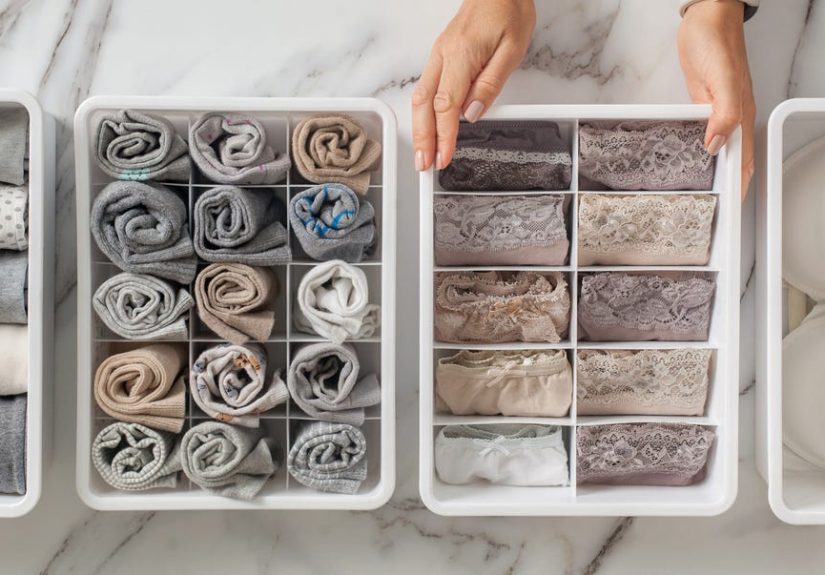
For clothing drawers, fabric organizers and dividers make small items easy to control. Use them for socks, underwear, bras, scarves, belts, workout accessories, and baby clothes. File-folding shirts or pajamas helps you see each item from above instead of digging through a pile.
Bulky items, such as heavy sweaters and jeans, may work better on shelves or hangers. Drawers are usually best for thinner, smaller, flexible items. When clothes are easy to see, they are more likely to be wornand less likely to become forgotten fabric lasagna.
Desk and Office Drawers
Desk drawers should protect focus. Keep everyday supplies in the top drawer: pens, highlighters, sticky notes, earbuds, charging cords, and a small notepad. Use small compartments for clips, USB drives, stamps, and rubber bands. Bundle cords before storing them, and label mystery chargers immediately or release them into the electronic afterlife.
Avoid using the desk drawer as a paper graveyard. Receipts, old envelopes, manuals, and random printouts can take over quickly. Create a separate paper system so the drawer remains useful for tools, not paperwork panic.
Junk Drawers
A junk drawer is not bad. In fact, a well-organized utility drawer can be one of the most useful spots in the house. The problem is not the concept; it is the lack of limits. A good junk drawer might hold scissors, tape, a small screwdriver, batteries, a flashlight, labels, matches, and a few household essentials.
Use modular bins to create zones. Keep batteries in one container, tools in another, tape and adhesive items together, and small hardware in a labeled pouch or mini box. Remove expired coupons, loose screws with no purpose, old takeout menus, broken pens, dead batteries, and cords that belong to devices you no longer own.
How to Make the Drawer Stay Organized
Organizing a drawer once is satisfying. Keeping it organized is where the real magic lives. The easiest maintenance rule is the one-minute reset. When a drawer starts looking messy, spend one minute returning items to their compartments. Because everything has a home, the reset is quick.
Another helpful habit is the one-in, one-out rule. If you buy a new lipstick, remove one you no longer wear. If you bring home new pens, discard the dead ones. If you upgrade a kitchen gadget, let the old version go. This keeps the drawer from slowly expanding beyond its boundaries.
Label Only Where Labels Help
Labels can be useful, especially in shared spaces. A labeled battery section, cord bin, or first-aid compartment helps everyone return items correctly. But not every drawer needs labels. If the categories are obvious, skip them. Your spoons do not need a sign that says “spoons” unless your household is unusually committed to mystery.
Common Drawer Organizer Mistakes
The first mistake is buying organizers before decluttering. If you organize items you do not need, you simply create a tidier version of the same problem. The second mistake is choosing compartments that are too small or too specialized. Tiny sections can look neat but may not fit real-life items.
The third mistake is ignoring the drawer’s purpose. A drawer near the front door should hold grab-and-go essentials, not old craft supplies. A bedside drawer should support sleep and nighttime needs, not become a second junk drawer. The fourth mistake is overfilling. If the drawer needs to be shoved closed, the system is not working.
What to Look for When Buying a Drawer Organizer
Look for durability, flexibility, easy cleaning, and a good fit. Bamboo organizers look warm and polished, making them great for kitchens and dressers. Clear acrylic organizers are sleek and practical for bathrooms, makeup, and office supplies. Plastic bins are affordable, lightweight, and easy to wipe clean. Fabric dividers are soft and useful for clothing.
Adjustable dividers are especially versatile because they can evolve with your needs. If your drawer changes from baby socks to school supplies, or from makeup to medicine, the dividers can change too. Modular organizers are another smart choice because you can rearrange pieces like a storage puzzleminus the missing corner piece under the couch.
Small Drawer, Big Impact
A drawer organizer may seem like a small upgrade, but small systems often create the biggest daily relief. Think about how many times you open drawers each week. When each one works better, your routines feel easier. You can cook faster, get ready with less stress, find office supplies without muttering, and stop rebuying items you already own.
Decluttering is not only about having fewer things. It is about having fewer obstacles between you and the life you are trying to live. A drawer organizer removes tiny points of friction. It gives your belongings a place to land and gives your brain one less mess to manage.
Real-Life Experience: What Happens When You Actually Use One
The first time you properly organize a drawer, you may feel a little ridiculous. After all, it is just a drawer. No one is awarding trophies for “Most Improved Spatula Storage.” But then something strange happens: you open that drawer the next day, and everything is still exactly where it should be. The scissors are in the scissors section. The measuring spoons are not hiding under a whisk. The batteries are not rolling around like tiny metal logs. It feels peaceful in a way that is hard to explain until you experience it.
One of the most useful lessons from using drawer organizers is that visibility changes behavior. When you can see your items, you use them. When you cannot see them, you buy duplicates, forget what you own, or waste time searching. In a bathroom drawer, clear sections make it obvious when you have enough lip balm to survive a mountain expedition. In a desk drawer, small compartments show you that you do not need another pack of black pens. In a kitchen drawer, dividers stop the daily clatter and make cooking feel less like a treasure hunt.
Another experience many people notice is that drawer organizers make cleaning easier. Instead of removing a giant pile of mixed objects, you can lift out one tray, wipe the drawer, and put it back. This is especially helpful in kitchens and bathrooms, where crumbs, powder, toothpaste residue, and product spills tend to appear as if summoned by household elves.
The emotional part is surprising too. A messy drawer is small, but it can create a constant low-level annoyance. You may not think about it all day, but every time you open it, your brain has to process disorder. A neat drawer gives the opposite signal: handled, simple, under control. That does not mean your entire life becomes flawless because your binder clips are in a tiny bin. Unfortunately, drawer organizers do not answer emails or fold laundry. But they do create a small daily moment of competence, and those moments add up.
The best approach is to treat your first organizer as an experiment. Do not chase perfection. Arrange the drawer, live with it for a week, then adjust. Maybe the hair ties need a bigger section. Maybe the spatulas work better on the left. Maybe the “miscellaneous” compartment is already turning into a clutter swamp and needs to be split into real categories. That is normal. A good system is not frozen in place; it learns your habits.
If you share your home, the organizer also becomes a quiet communication tool. Instead of reminding everyone where the tape goes, the drawer shows them. Instead of asking where the charger belongs, there is a compartment waiting for it. This reduces the tiny household negotiations that can turn a calm morning into a group investigation.
The biggest experience-based tip is this: do not fill every inch. Empty space is not wasted space. It is what allows the drawer to function. A drawer packed to maximum capacity may look efficient, but it will become messy the second real life touches it. Leave room for hands to move, items to breathe, and future you to return things without sighing dramatically.
After using drawer organizers for a while, you start seeing drawers differently. They are no longer random storage holes. They are tiny workstations. A kitchen drawer helps you cook. A vanity drawer helps you get ready. A desk drawer helps you focus. A dresser drawer helps you get dressed without creating a sock avalanche. Once each drawer has a job, decluttering becomes less about throwing things away and more about making your home easier to use.
Conclusion
Using a drawer organizer to declutter like a pro is not about creating a perfect home. It is about creating a home that works better. The process is simple: choose one drawer, measure it, empty it, clean it, sort everything by category, remove what does not belong, and use the organizer to create practical boundaries. Once every item has a clear place, the drawer becomes easier to use and easier to maintain.
The beauty of this system is that it works almost anywhere: kitchen, bathroom, bedroom, office, entryway, craft station, or junk drawer. Start with the drawer that irritates you most. Give it a purpose. Add the right organizer. Edit what goes inside. Then enjoy the quiet luxury of opening a drawer and not being personally attacked by clutter.
A tidy drawer may be small, but it can change the rhythm of your day. And honestly, if a few dividers can make mornings smoother, cooking calmer, and junk drawers less suspicious, that is a home upgrade worth celebrating.