Table of Contents >> Show >> Hide
- Meet Nishita: A Landscape Storyteller in Three Paint Types
- Why Gouache + Watercolor + Acrylics Works So Well for Landscapes
- What to Look For in These 72 Landscapes (Even If You’re “Just Browsing”)
- 72 Standout Landscape Paintings to Study and Swoon Over
- How to Try This Mixed-Media Landscape Style at Home
- Conclusion
- Bonus: of Real-World Painting Experience (Without Pretending I Own a Cabin in the Alps)
Some landscape paintings feel like a postcard. Others feel like a full-on memory you didn’t know you hadright down to the smell of wet pine needles and the exact shade of “sunset that makes you text your ex.”
The secret sauce is often the medium… or, in this case, three of them.
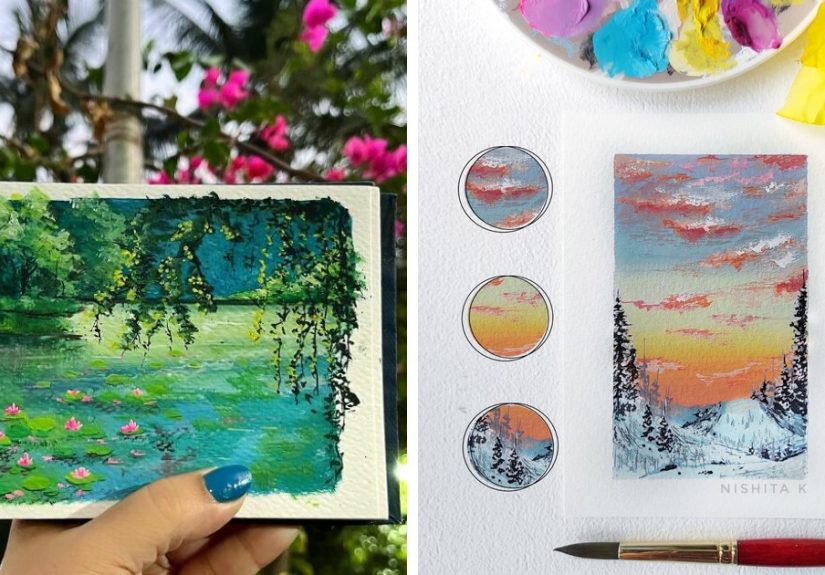
Meet Nishita, a landscape painter known for bright, mood-rich scenes built with gouache, watercolor, and acrylics. That trio is a power combo:
watercolor brings the glow, gouache brings the punch, and acrylics bring the “this layer is staying put whether you like it or not.”
The result? Mini worldssunsets, meadows, rivers, starry skiespainted with the kind of color that makes your eyeballs happy.
Meet Nishita: A Landscape Storyteller in Three Paint Types
Nishita’s landscapes are built for maximum mood with minimum fuss: a fiery sky, a winding river, a field of poppies, a dreamy night skyeach one feels like a quick trip somewhere better than your email inbox.
Her approach is especially fun because she doesn’t treat materials like rigid rules. She treats them like a well-stocked snack table: take what you need, mix what you want, and don’t apologize for going back for seconds.
Why Gouache + Watercolor + Acrylics Works So Well for Landscapes
Watercolor: Light, Atmosphere, and “Accidental Magic”
Watercolor is famous for luminous washes and soft transitionsperfect for skies, fog, distant hills, and reflections. It can suggest atmosphere fast: one big wash, a tilt of the paper,
and suddenly you’ve got weather. The trade-off is that watercolor is also… adventurous. It likes to bloom, back-run, and do its own thing when you turn your head.
(Like a toddler with a marker.)
Gouache: The Opaque Superpower (aka “Watercolor With Confidence”)
Gouache is often called “opaque watercolor” for a reason. It uses a similar water-soluble system, but it’s generally formulated to cover more, dry matte, and let you paint light shapes on top of dark ones.
In landscape work, that means you can drop in crisp clouds, bright snow highlights, or bold flower fields without fighting transparency for 45 minutes.
Another reason artists love gouache in landscapes: it’s forgiving. You can simplify, correct, sharpen, and restate shapes.
If watercolor is the poet, gouache is the editor with a red penand honestly, sometimes you need both.
Acrylics: Permanent Layers, Texture, and Deep Color Glazes
Acrylics dry into a durable film, which makes them great for building layers that won’t lift when you keep working. They also shine when you want texture (rocks, foliage, shoreline foam)
or when you want to glaze transparent color over a dry base to deepen shadows and enrich skies.
Landscape painting is basically “layers of decisions,” and acrylics are excellent at locking those decisions in place.
What to Look For in These 72 Landscapes (Even If You’re “Just Browsing”)
If you’ve ever stared at a landscape painting and thought, “Okay, but how does it look so real and so dreamy at the same time?”here are the main tricks to watch for:
1) Atmospheric Perspective: Distance Gets Softer
Distant mountains don’t need more detailthey need less contrast, softer edges, and slightly cooler color. That’s how you create believable depth without drawing every leaf like it owes you money.
2) Value Grouping: Big Simple Shapes First
The strongest scenes tend to read from across the room: a sky shape, a land shape, a water shape, then the details. If everything is equally sharp and equally dark,
your painting will look busy instead of beautiful.
3) Edges: Sharp Where You Want Attention, Soft Where You Want Mood
Soft edges are fog, distance, and calm. Sharp edges are focus, drama, and “look here!” Many of these landscapes use that contrast on purpose:
crisp silhouettes against glowing skies, soft hills behind detailed foreground grasses.
4) Color Temperature: Warm Light, Cool Shadows
Warm sunsets push oranges and pinks; shadows often tilt cooler (violet, blue-green) to keep the scene lively. Even a simple meadow looks richer when you shift the temperature instead of just adding black.
72 Standout Landscape Paintings to Study and Swoon Over
Below is a curated “best of” list inspired by the kinds of scenes that shine in Nishita’s mixed-media landscapes. Each entry is a quick study promptsomething to notice, steal (politely),
and try in your own sketchbook.
- Cotton-candy sunset over a winding river, pine silhouettes framing the glow.
- A poppy-red field under a calm blue sky, a footpath cutting through.
- An aurora ribboning across a starry night, icy hills glowing faintly below.
- Fog rolling into a pine forest, with one brave cabin window lit.
- A turquoise creek zigzagging through meadow grass, tiny birds in the distance.
- Pink-and-purple twilight with a thin crescent moon and lacey branch silhouettes.
- A lone sailboat on glassy water, soft watercolor ripples fading to white.
- Golden-hour wheat fields with dark tree lines, a sky that looks like sherbet.
- Snow-dusted mountains with crisp gouache highlights and shadowy valleys.
- A quiet lakeside dock at dusk, reflections broken by gentle brush taps.
- Rainy-day street lights in a small town, puddles catching neon-like color.
- Desert dunes at sunrise, peach shadows and sharp acrylic edge control.
- A waterfall tucked in emerald foliage, mist suggested with dry-brushed white.
- An alpine lake so blue it feels illegal, rimmed by firs and stone.
- A storm cloud shelf over open plains, dramatic value shifts doing the heavy lifting.
- Cherry blossoms around a hillside temple, petals implied with quick dots.
- A moonlit forest clearing with fireflies, speckled gouache stars at ground level.
- Sunbeams slicing through morning fog, soft edges keeping it dreamy.
- A winding mountain road, one tiny carbecause scale is a love language.
- Rolling hills in layered greens, each farther ridge cooler and lighter.
- Sea cliffs at high tide, foam edged in opaque white and pale lavender.
- A lighthouse against a brooding sky, the horizon line perfectly behaved.
- Autumn woods with orange canopies, trunks simplified into confident strokes.
- A marsh at sunset, reeds like calligraphy over mirrored orange water.
- City skyline at blue hour, windows dabbed like confetti (but organized).
- A pastel canyon scene, glazing layers giving rock faces depth.
- A snowy village lane, warm window squares balancing all that cool blue.
- A tropical lagoon with palm silhouettes, bright midtones doing the vacation work.
- A field of lavender, rows converging into perspective like they paid rent.
- A misty mountain lake with floating fog bands, edges softened intentionally.
- Night sky with the Milky Way, speckles and splatters under control (mostly).
- A barn in a sunflower field, red paint popping against green-gold.
- A cliffside path with wildflowers, foreground texture turned up to 11.
- A river bend under thunderheads, tiny highlights suggesting wind on water.
- A sunrise over a city park, trees backlit and simplified to shapes.
- A winter sunset where snow turns peach, shadows turning gently violet.
- A calm beach with footprints fading, wet sand gradients smooth as butter.
- A canyon river at midday, hard edges and bright planes for heat.
- A forest in rain, vertical strokes suggesting trunks and falling water together.
- A lake cabin in autumn, a plume of chimney smoke drifting sideways.
- A mountain meadow with scattered boulders, each one a little value lesson.
- A coastal sunset with seabirds, tiny V-shapes adding life without chaos.
- A bright spring orchard, blossoms clustered with stippled gouache.
- A river under a stone bridge, reflections bent and believable.
- A snowy pine line under a pink sky, minimal shapes, maximum mood.
- A hidden cove with teal water, rocks glazed for depth.
- A sunflower-close-up foreground, then a landscapebecause drama is allowed.
- A rolling prairie with a lone tree, negative space doing a mic drop.
- A field after rain, puddles reflecting clouds like nature’s mirror app.
- Mountains at dawn with a low cloud inversion, gradients kept silky.
- A rocky shoreline with tide pools, tiny highlights like sequins.
- A twilight meadow with a crescent moon, distant hills soft and cool.
- A canyon at sunset, warm-to-cool transitions staged like theater lighting.
- A path through tall grass, directional strokes leading the eye politely.
- A lake with lilypads, greens varied so it doesn’t look like spinach soup.
- A snowy trail with footprints, subtle shadows showing depth.
- A misty pine valley, atmospheric perspective turning distance into poetry.
- A bright seaside village, simple shapes and confident color blocks.
- A riverbank with reeds, warm foreground against cool middle distance.
- A mountain pass in storm light, highlights placed sparingly but effectively.
- A soft sunrise with layered clouds, edges feathered like whispers.
- A desert night with a huge moon, matte gouache glow on sand.
- A meadow at noon, saturated greens tamed with neutral shadows.
- A waterfall at twilight, white gouache sparkle over dark acrylic base.
- A quiet orchard in fall, apples hinted with tiny red accents.
- A lakeshore with distant sailboats, scale cues making it feel vast.
- A snowy rooftop scene, icicles painted with one brave stroke.
- A forest path in autumn fog, soft values keeping it cinematic.
- A sunset sky framed by telephone wires, everyday details stealing the show.
- A river delta from above, abstract shapes that still read as nature.
- A windswept plateau with tiny horse silhouettes, scale turned into story.
- A storm clearing over the coast, a faint rainbow doing the victory lap.
How to Try This Mixed-Media Landscape Style at Home
You don’t need a fancy studio to experiment with this trio. You just need a plan that respects how each medium behaves.
Here’s a practical “stack” that keeps the process fun instead of frustrating.
Step 1: Start on the Right Surface
If you’re using lots of water (and you will), choose heavier papersomething around 140 lb / 300 gsm helps reduce warping.
Cold press gives you a friendly texture for washes; hot press gives smoother gradients and sharper detail. Pick the one that matches your personality:
“soft and dreamy” vs. “I want crisp lines and control.”
Step 2: Block In the Atmosphere With Watercolor
Paint the sky first with a simple gradient. Drop in soft clouds while the wash is still damp. Keep distant hills light and low-contrast.
Don’t over-detail anything yetthis stage is about mood and big shapes.
Step 3: Build Midground Shapes With Gouache
When the watercolor is dry, use gouache for stronger shapes: tree lines, mountains, shoreline edges, and bold flower fields.
Because gouache can cover, you can refine silhouettes and fix awkward shapes without repainting the entire sky.
Step 4: Add Punch and Permanence With Acrylics
Use acrylics for final accents and textures: sparkling highlights on water, bark texture, sharp rock edges, and crisp foreground grasses.
If you want extra richness, glaze a thin layer of transparent acrylic color over a dry area to deepen shadows or warm a sunset.
Let layers dry fully between passes so you don’t muddy the party.
Conclusion
The reason these landscapes feel so satisfying isn’t just the color (though yes, the color is doing the most).
It’s the smart use of materials: watercolor for glow, gouache for clarity, acrylics for depth and staying power.
Study the scenes above like little masterclasses in atmosphere, edge control, and valueand then try a tiny version yourself.
Worst case: you end up with paint on your fingers and a sky that looks like cotton candy. That’s not a crisis. That’s a weekend.
Bonus: of Real-World Painting Experience (Without Pretending I Own a Cabin in the Alps)
If you’ve never painted a landscape with gouache, watercolor, and acrylics together, the first session is going to feel like hosting three friends who don’t know each other
and all of them brought opinions. Watercolor shows up early, spreads out on the couch, and immediately starts changing the vibe. Gouache arrives with a tidy haircut and says,
“Great, now let’s clean up those edges.” Acrylics stroll in last, taps the table, and announces: “Once I dry, I’m not moving. Plan accordingly.”
The nicest surprise is how fast you can get to “this looks like a place.” With watercolor, the first wash can create a believable sky in under a minute. You’ll tilt your paper,
watch pigment drift into soft gradients, and suddenly you have atmosphere. It’s also the moment you learn humility: one extra brushstroke can turn “soft sunset” into
“mysterious bruise cloud.” The trick is to stop early and let the paper do the blending. Watercolor is happiest when you’re not hovering like a helicopter parent.
Gouache is where confidence returns. The first time you paint a pale cloud over a darker sky and it actually shows up, you’ll feel like you unlocked a secret level.
This is also the stage where your landscape gets readable: distant hills, tree silhouettes, a shoreline that finally looks like it belongs to the water.
Gouache’s matte finish is a vibe all on its ownespecially for night scenes. Stars, moonlight, and mist can be suggested with tiny opaque touches that feel crisp without being harsh.
Just remember: if you keep scrubbing at half-dry gouache, it can lift and go chalky. Think “layer gently,” not “sand the wall.”
Acrylics are the closer. They’re fantastic when you want that last 10%sparkle on the water, texture in the rocks, a few foreground grasses that make everything feel closer.
Acrylic glazing is especially addictive: a thin transparent layer over a dry base can deepen color without repainting the whole area. It’s like turning the contrast knob on a photo,
but with a brush. The catch is speed: acrylics can dry quickly, so work in smaller sections or use mediums when you want more time.
The best “mixed-media” feeling comes from choosing one job per medium. Watercolor for the air. Gouache for the shapes. Acrylic for the final punch.
When you stick to that division of labor, your painting process becomes calmer, and your results look surprisingly intentionaleven if you were absolutely improvising
while listening to a podcast about true-crime baking disasters. (Don’t judge. Art is about balance.)