Table of Contents >> Show >> Hide
- The Onion’s Tiny Chemical Booby Trap (A Love Story Between Enzymes and Chaos)
- What Happens When the Tear Gas Reaches Your Eyes
- Do Some Onions Make You Cry More Than Others?
- The 2025 “Onion Mist” Insight: It’s Not Just Gas, It’s Droplets
- Treatments That Actually Help: How to Cut Onions Without Crying
- 1) Use a sharp knife and cut more gently
- 2) Create airflow: fan > hope
- 3) Put up a physical barrier: goggles, glasses, or contacts
- 4) Keep the root end intact until the end
- 5) Chill the onion… maybe (here’s the nuance)
- 6) Water methods: rinsing, damp towels, and “onion containment”
- 7) Try a light oil coating (messy, but interesting)
- 8) Acid tricks (lemon or vinegar): helpful in the right dish
- Myths, Half-Truths, and “My Aunt Swears This Works”
- Are Onion Tears Bad for You?
- Tearless Onions: The “No-Cry” Dream (With a Possible Flavor Tax)
- Experiences From the Real World: Onion Tears, Triumphs, and Tiny Kitchen Victories (Extra 500+ Words)
- Conclusion
You walk into the kitchen feeling confident. You’ve got a plan. You’ve got a recipe. You’ve got a cutting board.
And then you pick up an onion… and suddenly you’re starring in a low-budget drama called Tears: The Director’s Cut.
The weird part is that onions aren’t “spicy” the way chili peppers are spicy, and they’re not “smelly” the way some cheeses are… assertive.
Yet one quick slice and your eyes act like they’ve been personally offended. This isn’t weakness. This is chemistry.
Specifically: a tiny, efficient chemical booby trap built into onion cells, triggered by the one thing you were always going to docut the onion.
The Onion’s Tiny Chemical Booby Trap (A Love Story Between Enzymes and Chaos)
Step 1: The onion keeps reactive ingredients separated
An intact onion is basically a calm, well-organized neighborhood. Inside its cells, it stores sulfur-containing compounds (often described as cysteine
sulfoxides or amino acid sulfoxides) in one place, and enzymes in another. As long as the onion’s cells are unbroken, those ingredients stay apart,
like two people who should never sit next to each other at the same dinner party.
Step 2: Cutting ruptures cells and starts the reaction
When you slice, dice, or crush an onion, you break cell walls. Those separated compounds finally meet, and the enzyme alliinase
gets to work. Alliinase helps transform the stored sulfur compounds into unstable intermediates called sulfenic acids.
Think of sulfenic acids as the kitchen equivalent of “this seems fine” while the stove is actively on fire: they don’t stay put for long.
Step 3: A special onion enzyme turns that intermediate into a tear gas
Here’s the onion’s signature move. In many alliums (and in garlic), sulfenic acids tend to go down pathways that create flavorful, pungent sulfur
compounds. Onions, however, have a particularly annoying twist: an enzyme called lachrymatory factor synthase (often shortened to LFS).
LFS rearranges the sulfenic acid into the onion’s famous tear-inducing chemical:
syn-propanethial S-oxide (also called propanethial S-oxide or the “lachrymatory factor”).
That’s why “why do onions make you cry” isn’t really about your feelings. It’s about a volatile compound created within seconds of cuttingone that
readily becomes airborne and heads straight for your eyes like it’s late for an appointment.
What Happens When the Tear Gas Reaches Your Eyes
Your eyes are protected by a thin moisture layer (your tear film). When onion vapors reach that wet surface, they can create an acidic, stinging
sensation. Your cornea is loaded with sensory nerves, and it does not enjoy surprise chemical visitors. The nerves send a message that basically says,
“Flush the systemnow.”
That triggers your lacrimal glands to produce tears. This isn’t “sad crying.” It’s a defense reflex designed to dilute and wash away
irritants. In other words, your eyes are doing housekeeping. Dramatic housekeeping, but still.
Fun side note: the stinging from onions is closely related to how we sense “burning” and irritation in general. Some of the same sensory pathways that
react to pungent compounds (like the ones in spicy foods) can also be involved when onion chemicals irritate your eyesyour nervous system tends to treat
“chemical sting” and “painful heat” as cousins at the family reunion.
Do Some Onions Make You Cry More Than Others?
Yesand it’s not your imagination, your mood, or Mercury in retrograde. Onion pungency is heavily tied to sulfur chemistry. Onions pull sulfur from the
soil as they grow, and that sulfur becomes part of the compounds that later turn into flavor… and tears.
Generally, yellow, white, and red onions are more likely to bring the waterworks because they tend to have more of the sulfur-related
precursors that feed the lachrymatory pathway. Sweet onions often cause fewer tears because they’re typically milder and may accumulate
less sulfur-based “chemical ammunition,” depending on variety and growing conditions. Scallions and green onions can also be gentler in many kitchens.
Translation: the onion that tastes “sharper” raw often has more potential to make you cry, because flavor and tears come from closely related chemistry.
The onion isn’t trying to ruin dinner. It’s trying to discourage hungry animals from biting it in the dirt. You just happen to be the animal holding a chef’s knife.
The 2025 “Onion Mist” Insight: It’s Not Just Gas, It’s Droplets
For years, the basic story was, “Cut onion → chemical becomes airborne → eyes sting.” Truebut recent research has added a surprisingly physical detail:
cutting can eject a mist of tiny droplets that carry tear-inducing compounds. In other words, you’re not only dealing with vapor; you may be
dealing with a microscopic onion spray.
A 2025 Cornell report described onion cutting as ejecting pungent aerosols that can travel up to about two-thirds of a meter.
That helps explain why you can feel fine one second and thentwo chops lateryour eyes are sending evacuation notices.
The same line of work emphasizes something cooks have shouted for generations (usually while sniffling):
knife sharpness and cutting speed matter. Dull blades and aggressive chopping can increase damage and pressure in onion layers, which can
lead to more energetic droplet ejection. A sharp knife and slower cutting can reduce that spray.
The practical takeaway is refreshingly unromantic: to cut onions without crying, it’s not enough to “be brave.”
You need a sharp blade and a calmer pacelike you’re slicing an onion, not auditioning for a cooking competition montage.
Treatments That Actually Help: How to Cut Onions Without Crying
Let’s call them “treatments” because “anti-onion tear strategies” makes you sound like you’re filing a lawsuit. These methods work by doing one of three things:
(1) reducing how much lachrymatory factor gets produced, (2) keeping it from reaching your eyes, or (3) moving it away before it can settle in.
1) Use a sharp knife and cut more gently
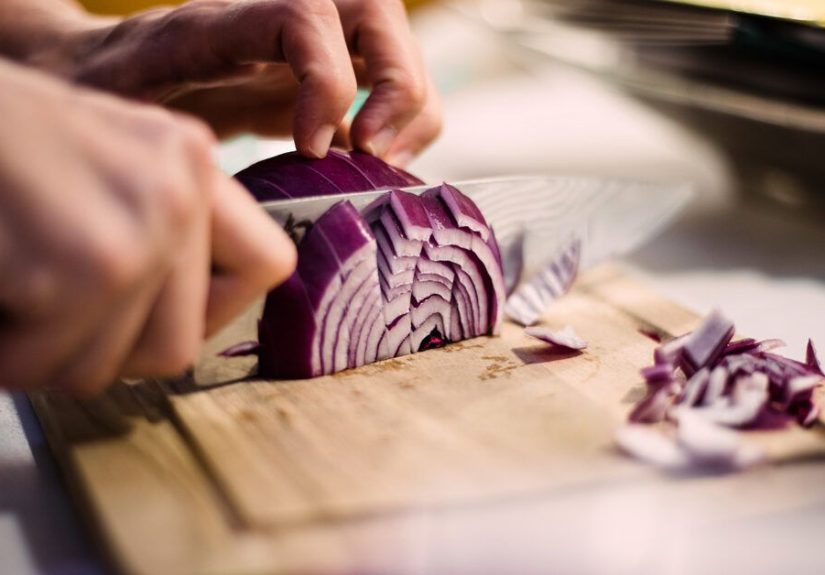
A sharp knife slices cleanly instead of crushing. Less crushing can mean fewer ruptured cells and less chaotic release. Bonus: it’s also safer.
Slow down a bit, toorecent findings suggest slower cuts can reduce how much tear-inducing material gets launched into the air.
2) Create airflow: fan > hope
If the problem is onion chemicals drifting up into your eyes, the solution can be as simple as: don’t let them drift up into your eyes.
Put a small fan on the counter and aim it so it blows the air across the cutting board and away from your face.
Ventilation doesn’t stop the chemistry, but it can keep the results from camping out around your eyeballs.
3) Put up a physical barrier: goggles, glasses, or contacts
The most consistently effective fix is also the least glamorous: protect your eyes. Snug-fitting goggles (even swim goggles) block the onion mist/vapor.
Regular glasses can help a little. Contact lenses can act like a partial barrier for some people.
If you’ve ever wanted to look like you’re about to perform a very small, very emotional science experimentthis is your moment.
4) Keep the root end intact until the end
Many cooks swear the root end is “tear central.” The idea is that the root area can be more concentrated in the compounds and enzyme activity that feed
pungency. Practically, leaving the root intact while you slice can reduce how much you disturb that region early on, and it also helps hold the onion
together for safer cutting.
5) Chill the onion… maybe (here’s the nuance)
You’ll see chilling recommended everywhere: pop onions in the fridge or freezer briefly to slow enzyme activity and reduce the volatile sting.
That advice is common, and many home cooks report it helps.
But newer reporting on a 2025 study suggests chilling can sometimes increase the release of droplets when cut.
How can both be true? Because “tears” isn’t just chemistryit’s also physics. Temperature can affect enzyme speed and tissue behavior.
Your best approach is practical: if chilling helps you, use it. If it makes things worse, skip it and focus on the sharp-knife + airflow combo.
6) Water methods: rinsing, damp towels, and “onion containment”
Water can help trap airborne irritants. Some people cut onions under running water, rinse slices briefly, or place a damp paper towel near the cutting
board. The concept: water captures some of the onion compounds before they reach your eyes.
The tradeoff is flavor and texturerinsing can mellow raw onions (which is great for some dishes, not great if you want full punch). Also, cutting under
running water can be awkward and slippery, so think safety first.
7) Try a light oil coating (messy, but interesting)
A recent “kitchen physics” suggestion is lightly coating the onion’s cut surface with oil to help trap droplets/mist. This isn’t an everyday method for
most people (hello, slippery onion), but it may help reduce what becomes airborneespecially when you’re prepping a big batch.
8) Acid tricks (lemon or vinegar): helpful in the right dish
Acid can change the environment enzymes like alliinase operate in. Some cooks find that a little lemon juice or vinegar near the cut onion can reduce
pungency. This tends to make the most sense when the onion is destined for a dish where a little acidity belongs anyway (like salsa, salad, or quick pickles).
Myths, Half-Truths, and “My Aunt Swears This Works”
Onion tears have inspired more folk remedies than the common cold. Some are harmless, some are silly, and some are “please do not do that in a small kitchen.”
Here are a few you’ll hear often:
- “Hold bread in your mouth.” Unclear mechanism, inconsistent results, high chance of looking like a confused pelican.
- “Chew gum.” Might change breathing patterns slightly, but it’s not a reliable shield against airborne irritants.
- “Put a spoon in your mouth.” Same issue: it doesn’t block your eyes, which are the entire problem.
- “Light a match nearby.” Some claim it helps, but open flame around cooking prep isn’t a universal winespecially when a fan and sharp knife exist.
If a method doesn’t reduce cell damage, trap the irritant, or keep it away from your eyes, it’s mostly just kitchen theater.
Sometimes entertaining theaterbut still.
Are Onion Tears Bad for You?
For most people, onion-induced tearing is uncomfortable but not harmful. Your eyes are doing what they’re designed to do: flushing an irritant.
The sting usually fades quickly once you step away, rinse your face, or improve ventilation.
That said, a few situations deserve extra caution:
- Allergy or sensitivity: If onions cause hives, intense itching, swelling, or breathing trouble, treat that as a medical issue, not a cooking quirk.
- Contact lens irritation: Contacts may block some irritant, but they can also trap discomfort if your eyes get dryuse lubricating drops if you normally do, and take breaks.
- Eye conditions: If you have chronic dry eye or eye inflammation, onion vapors can feel extra harsh. Goggles and airflow help a lot here.
Tearless Onions: The “No-Cry” Dream (With a Possible Flavor Tax)
Scientists have explored ways to reduce onion tears by targeting the biochemical pathwayespecially the role of lachrymatory factor synthase.
Meanwhile, growers have also produced milder onions through breeding and cultivation methods. One well-known example in U.S. grocery stores is
Sunions, marketed as sweet, mild, and “tearless.”
Here’s the catch: the same sulfur chemistry that leads to tears is closely tied to onion flavor and aroma. Reduce the tear factor too far, and you may
also reduce that bold onion “kick” that makes French onion soup worth the effort in the first place.
For many cooks, the sweet spot is a milder onion for raw use and a sharper onion for cookingplus a sharp knife and a fan for emotional stability.
Experiences From the Real World: Onion Tears, Triumphs, and Tiny Kitchen Victories (Extra 500+ Words)
Ask five people how they handle onions, and you’ll get seven answers and at least one story that begins with “Okay, so I thought I was tougher than an onion.”
Onion tears are so universal that they’ve become a kitchen rite of passagelike burning your first pancake or discovering that “one clove of garlic” is a
fictional unit of measurement.
One of the most common experiences is the delayed reaction. You start chopping, you feel fine, you get cocky… and then the onion’s chemistry
catches up like a prank you forgot you signed up for. Suddenly your eyes sting, your nose runs, and your family wanders in asking, “Are you okay?” while you
insist, with complete dignity, “Yes. I just really love onions.” It’s a weirdly specific kind of emotional misunderstanding that happens to cooks everywhere.
In busy home kitchens, people often notice a pattern: the first onion is the worst. Once the air is already moving (or once you’ve opened a
window in self-defense), subsequent onions may feel easier. It’s not that you “built tolerance” in five minutesit’s usually that the room airflow improved
and you’re no longer cutting into a cloud of onion leftovers.
Restaurant and catering prep adds another twist. When you’re chopping a mountain of onions for soup, chili, stuffing, or caramelized onions, the tears aren’t
a one-time surprisethey’re a slow, steady soundtrack. People who prep onions professionally often develop habits that look funny at home but make perfect
sense on the line: setting up a fan before the first slice, keeping knives scary-sharp, and positioning the cutting station so the air moves across the board
instead of up into the face. It’s not dramatic. It’s survival.
Then there’s the goggles moment. Many cooks resist goggles until the day they have to chop onions for a big family meal. At some pointusually
around onion number threepride collapses. Swim goggles appear. Everyone laughs. And then… nobody cries. The laughter turns into a quiet respect for the power
of simple solutions. It’s the same emotional arc as finally using oven mitts instead of “just being careful.” You weren’t weak; you were just learning.
Some experiences are surprisingly personal. People who rarely cry in life will find themselves tearing up over onions and feel weirdly betrayed by their own
faces. Others tear up instantly and think it’s “just them,” until they try a fan and realize they’ve been fighting physics with willpower.
Onion tears can even feel nostalgic: you remember a parent or grandparent chopping onions for dinner, wiping their eyes with the back of a wrist, and insisting
they weren’t cryingwhile you, as a kid, believed them because grown-ups are obviously immune to vegetables.
And if you’ve ever made French onion soup the traditional wayslowly caramelizing onions until they’re deep golden and sweetyou’ve likely had the full onion
saga: tears during chopping, relief during cooking, and then triumph when the house smells like comfort. The irony is that the part that makes you cry is the
beginning. The rest is the reward. That’s why onion tears are so easy to forgive: they’re annoying, yes, but they’re also the opening act for a lot of very
good meals.
Conclusion
Onions make you cry because cutting them triggers a rapid chemical chain reaction: separated sulfur compounds meet enzymes (like alliinase), unstable
intermediates form, and then lachrymatory factor synthase helps create the tear-inducing compound syn-propanethial S-oxide. That volatile irritant reaches
your eyes, stings your corneal nerves, and your lacrimal glands respond by producing tears to flush it out.
The best “treatments” are practical and science-friendly: use a sharp knife, cut more slowly, move air across the cutting board, and consider goggles if you
want the most reliable tear prevention. If chilling helps you, use itjust know results can vary. Most importantly: you’re not being dramatic. You’re being
chemically accurate.