Table of Contents >> Show >> Hide
- From Sidewalk Slabs to Super-Concrete
- What the Strongest Bombs Are Actually Designed to Do
- Why Performance Military Concrete Is So Hard to Crack
- Bombs vs. Concrete: The Modern Arms Race
- Why “Uncrackable” Isn’t the Goal
- Real-World Experiences and Lessons from the Field
- Conclusion: The Silent Power of Modern Military Concrete
If you’ve ever watched an action movie where a single bomb magically wipes out a secret underground base,
you might be surprised to learn that reality is much less dramatic. Modern “performance military concrete”
think ultra-high-performance, fiber-reinforced, carefully layered structures is specifically engineered
so that even the strongest conventional bunker-buster bombs struggle to crack it.
That doesn’t mean military bunkers are indestructible. But it does mean that there’s a constant arms race
between better bombs and better concrete, and lately, the concrete has been holding its own. Let’s unpack
why some of the most powerful bombs ever built still have a hard time defeating high-performance military
concrete.
From Sidewalk Slabs to Super-Concrete
Regular Concrete vs. “Performance” Concrete
When most people think of concrete, they picture sidewalks or driveways with the occasional crack and
weed growing through. That’s ordinary structural concrete, with a typical compressive strength around
4,000–5,000 psi (pounds per square inch). It’s strong, but it’s not designed to stand up to bombs,
high-velocity impacts, or repeated shock waves.
Performance military concrete is a very different animal. Ultra-high-performance concrete (UHPC) and
high-performance fiber-reinforced concretes (HPFRCs) can reach compressive strengths of 20,000–40,000 psi
or more sometimes eight times that of conventional mixes. This is achieved by:
- Using ultra-fine powders and low water content for a dense, low-porosity matrix.
- Adding steel, synthetic, or PVA microfibers to control cracking and improve toughness.
- Carefully controlling curing conditions to optimize strength development.
The result is not just “harder” concrete but a material that combines strength with ductility it can
soak up and redistribute energy instead of shattering like a brittle rock.
Fibers: The Hidden “Rebar Hair” Inside the Wall
Traditional reinforced concrete uses steel rebar to take tension. In blast-resistant mixes, engineers go
further by adding millions of tiny fibers throughout the concrete. These fibers act like an internal safety net:
- They bridge microcracks, keeping them from turning into large fractures.
- They hold broken pieces together, reducing dangerous spalling (chunks flying off the back face).
- They allow the structure to deform slightly instead of failing catastrophically under blast pressure.
Think of it as giving concrete a “backup plan.” Even when pushed past its elastic limit, it doesn’t fall apart
all at once which is exactly what you want when a blast wave or penetrating warhead hits.
What the Strongest Bombs Are Actually Designed to Do
Bunker-Buster Basics
Modern bunker-buster bombs are essentially very heavy, very tough projectiles wrapped around an explosive core.
Instead of exploding on the surface, they’re designed to:
- Penetrate soil, rock, and concrete using kinetic energy and a hardened nose.
- Delay detonation until they reach a certain depth or encounter a target void.
- Release a powerful explosive charge to crush or collapse underground structures.
Some of the most capable bombs in service today can penetrate many feet of reinforced concrete with conventional
strength ratings. But that’s the key: those penetration numbers are usually quoted for more ordinary grades
of concrete, not cutting-edge UHPC or multi-layered protective systems.
The Physics Limit: Kinetic Energy vs. Resistance
No matter how sophisticated a bomb is, it still has to obey basic physics:
- Mass and velocity give the penetrator its kinetic energy.
- Target material strength and thickness determine how quickly that energy is absorbed.
- Shape and nose design control how efficiently the bomb can “push” its way in.
As performance concrete gets stronger and tougher, it absorbs more energy over a shorter distance. That means
the bomb slows faster and may not reach its intended depth before running out of momentum. In simple terms:
the concrete “wins the tug-of-war” between kinetic energy and resistance.
Why Performance Military Concrete Is So Hard to Crack
1. Extreme Compressive Strength
High-performance military concretes have compressive strengths that regular structural engineers used to
consider science fiction. By densely packing cement particles, silica fume, and other fine materials, and
optimizing the water–cement ratio, these concretes can reach 30,000–40,000 psi or above in lab and field
applications.
For a penetrating bomb, that’s like trading a stack of foam mats for a wall of tool-steel density. The harder
the concrete, the more energy the bomb must burn through just to maintain its forward motion. If the structure
is thick enough, even a massive bunker-buster may stop or slow so much that its explosive charge detonates
short of the critical target.
2. Fiber Reinforcement and Ductility
Strength alone isn’t enough; glass is strong in compression, but one good hit and it shatters. The secret of
performance military concrete is that it combines high strength with ductility, thanks to fibers:
- Steel fibers improve tensile capacity and help prevent macrocracks.
- Synthetic or PVA fibers enhance energy absorption and reduce back-face spalling under blast.
- Hybrid fiber systems balance stiffness, toughness, and crack control across different strain levels.
Under impact or blast, the concrete may crack, but the fibers hold everything together like the mesh inside
safety glass. That means fewer large fragments, less structural pull-out, and more residual capacity even
after a hit.
3. Layered and Redundant Protection
High-value military structures rarely rely on a single thick wall and call it a day. Instead, engineers use
layered systems designed to:
- Slow and blunt the penetrator in outer layers of soil, rock, or concrete.
- Redirect blast waves through air gaps, tunnels, or sacrificial chambers.
- Protect inner shells made from UHPC, steel liners, or composite materials.
By the time the bomb reaches those inner layers if it reaches them at all its velocity and energy can be
dramatically reduced. The design philosophy is similar to modern body armor: multiple layers, each doing a
specific job, rather than relying on one monolithic block.
4. Smart Geometry and Structural Detailing
Performance military concrete structures aren’t just “thick slabs.” Their geometry and reinforcement patterns
are carefully tuned to handle:
- Localized impact from a bomb’s nose or high-velocity fragments.
- Global blast waves reflected through tunnels and caverns.
- Progressive collapse, ensuring a single hit doesn’t bring down an entire facility.
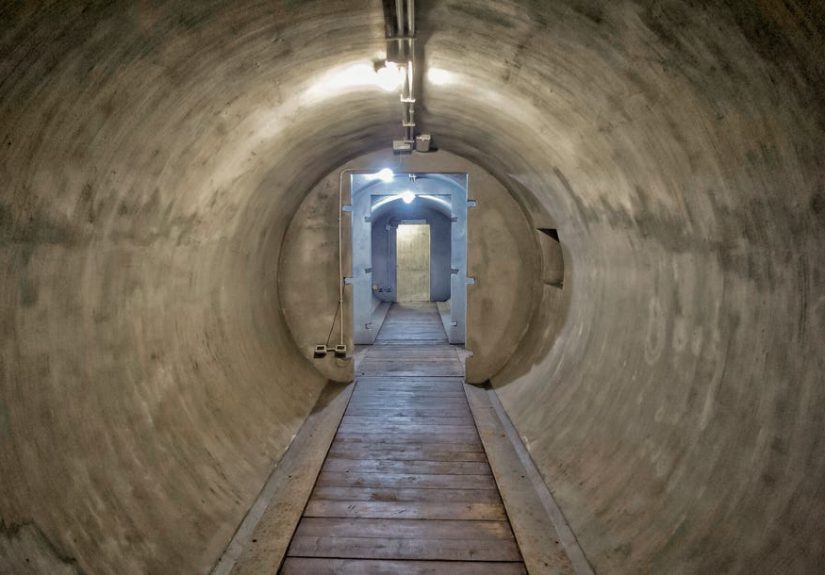
Curved walls, buried domes, and strategically placed stiffeners help spread forces and avoid stress
concentrations. The more the load is distributed, the less likely a single hit will cause a catastrophic
failure even if the bomb itself is extremely powerful.
Bombs vs. Concrete: The Modern Arms Race
Why “Stronger Bomb” Isn’t Always the Answer
On paper, you might think the obvious solution is to simply build an even bigger bomb with more explosive.
But there are practical limits:
- Aircraft payload and range: Only certain aircraft can carry the heaviest bunker-busters.
- Penetration vs. explosion trade-off: Too much explosive and not enough structural strength can
cause a bomb to break up before reaching its target depth. - Precision and targeting: Deeply buried sites may require multiple direct hits on small, hardened
access points or shafts.
Meanwhile, it’s often easier and cheaper for defenders to add more layers of rock and concrete or upgrade to
higher-performance mixes than it is for attackers to design, test, and field a new generation of weapons.
Concrete’s Secret Advantage: It’s Adaptable
Military engineers can tweak mix designs, fiber types, and structural details relatively quickly compared with
the long development cycles of advanced munitions. When testing reveals that a certain bomb performs well
against a specific design, defenders can:
- Increase concrete strength or thickness in critical zones.
- Add steel or composite liners on the protected side.
- Alter geometry to make direct penetration more difficult.
Over time, that adaptability means performance military concrete can evolve faster than the weapons designed
to defeat it which is one reason the “strongest bombs” sometimes look surprisingly mortal against new
protective systems.
Why “Uncrackable” Isn’t the Goal
Protection, Not Invincibility
It’s important to be clear: no serious engineer claims that any bunker is absolutely bomb-proof. Given enough
time, information, and resources, a determined attacker can usually design a weapon or strategy to defeat a
specific structure.
The real goal of performance military concrete is to:
- Buy time for occupants to respond, evacuate, or relocate.
- Force attackers to expend disproportionate resources to achieve limited effects.
- Limit damage and prevent catastrophic collapse, even when a hit occurs.
In that sense, the fact that the strongest bombs can’t easily crack modern military concrete isn’t about
creating an invulnerable fortress. It’s about creating enough resistance that the cost, risk, and complexity
of attacking such a structure become strategically unattractive.
Real-World Experiences and Lessons from the Field
While exact details of modern bunker design and bomb performance are usually classified, open-source
information, engineering research, and historical reports give us some valuable insights into how this
concrete-versus-bomb battle plays out in practice.
When Testing Reveals the Limits of Ordinary Concrete
Defense agencies and civil research institutions regularly test concrete panels and slabs under controlled
blast and impact conditions. In many test series, standard reinforced concrete panels show severe cracking,
spalling, and loss of load-bearing capacity after close-in detonations or high-velocity impacts. In contrast,
UHPC or fiber-reinforced panels of similar thickness may develop fine cracking patterns but remain largely
intact, with far less material ejected from the back face.
Engineers who participate in these tests often comment on the visual difference: conventional panels look
“blown apart,” whereas performance concrete panels look “beaten up but still standing.” That visual contrast
reflects a deeper difference in energy absorption and damage mechanics the fibers and dense matrix change
how cracks form and propagate, dramatically improving residual capacity.
Underground Facilities and the “Depth Game”
Another lesson from real-world fortified facilities is that depth is still one of the most reliable defensive
tools. Many hardened military and strategic sites are built under mountains or thick layers of rock and soil,
with high-performance concrete used to line and reinforce internal caverns, tunnels, and vaults.
In practice, this means a bomb has to fight its way through multiple media: air, soil or rock, outer
reinforced concrete shells, internal voids, and then more concrete or steel inside. Every interface robs the
penetrator of some energy, changes its trajectory, or risks premature detonation. Engineers who analyze
post-test or post-event data often find that penetrators may reach impressive depths but still fail to
transfer enough explosive energy to the most critical components of the facility.
Operational Experience: Multiple Hits, Limited Structural Failure
Open reporting on strikes against hardened facilities over the last few decades shows a recurring pattern:
even when powerful penetrators are used, planners often assume they will need multiple direct hits to
meaningfully degrade or collapse a deeply buried target. That’s partly due to targeting challenges, but it’s
also a reflection of how well-designed concrete structures absorb damage.
Performance military concrete is typically detailed with redundancy in mind. Critical areas may have thicker
walls, additional fiber-reinforced layers, or separate compartments that can continue to function even if
one segment is heavily damaged. Engineers working on post-event assessments often report localized
destruction near impact points, but the overall facility may remain structurally stable or partially
operational, especially if it was designed with compartmentalization and alternative access routes.
What Engineers Take Away from These Experiences
For military and protective design engineers, these experiences reinforce several key lessons:
-
Material choice matters: Upgrading from conventional to performance concrete can be the
difference between catastrophic failure and controlled damage. -
Details are critical: Fiber content, reinforcement layout, and geometry all influence
whether a structure cracks gracefully or breaks apart. -
Redundancy and layers win: Multiple defensive layers concrete, rock, air gaps, steel often
matter more than a single “super-thick” wall. -
Real testing beats theory alone: Full-scale and field tests reveal complex behaviors that
computer models can miss, helping refine concrete mixes and designs over time.
Perhaps the most important takeaway is that performance military concrete is not a one-time invention but an
evolving technology. Each round of testing, each real-world strike, and each new research paper adds to the
collective understanding of how to make protective structures tougher, more efficient, and more resilient.
That constant evolution is a big reason why even the strongest bombs sometimes find themselves outmatched by
a material that, on the surface, still just looks like “concrete.”
Conclusion: The Silent Power of Modern Military Concrete
The idea that “the strongest bombs can’t crack performance military concrete” isn’t a claim of absolute
invincibility. It’s a reflection of how far materials science and structural engineering have come. Ultra-high
compressive strength, fiber reinforcement, layered protection, smart geometry, and continuous research have
turned military concrete from a passive barrier into an active, highly engineered defensive system.
In the ongoing contest between bombs and bunkers, the spotlight often falls on the weapons: new guidance
systems, heavier warheads, and more sophisticated fuzes. But behind the scenes, quiet slabs of gray material
are doing incredibly complex work redistributing forces, absorbing energy, and preventing catastrophic
collapse. That humble concrete is one of the main reasons why, in many scenarios, even the most powerful
conventional bombs discover that cracking a truly modern military structure is anything but easy.