Table of Contents >> Show >> Hide
- Before You Introduce Anyone: A 60-Second Rulebook
- Way #1: The “Context-Rich” In-Person Introduction
- Way #2: The Low-Pressure “Small Hang” That Does the Work for You
- Way #3: The “Double Opt-In” Digital Introduction (Text, Group Chat, or Email)
- Troubleshooting: What If It Gets Weird?
- Real-Life Experiences: What I’ve Learned from Playing “Friend Matchmaker” (500+ Words)
- Conclusion
Introducing friends to other friends sounds simpleuntil you’re standing there like a human Bluetooth pairing screen:
“Searching… searching… connection failed. Try again later.” The truth is, mixing friend groups can be awesome:
it can widen everyone’s circle, create new inside jokes, and turn your social life into a cozy little ecosystem where
people actually know each other at birthdays instead of politely asking, “So how do you know the host?” for the 800th time.
But it can also be awkward if you do it like a magician forcing a trick: “Ta-da! You two are friends now!”
The goal isn’t to manufacture instant bestiesit’s to create a comfortable bridge so people can decide, naturally,
whether they click.
Below are three practical, low-cringe ways to introduce friends to other friendsplus scripts, examples, and the “please
don’t do this” pitfalls that turn a friendly intro into an accidental social science experiment.
Before You Introduce Anyone: A 60-Second Rulebook
1) Get consent (especially for digital intros)
If you’re connecting people by text, group chat, or email, ask first. Nobody wants to be surprise-dropped into a thread
with strangers like it’s an escape room. A quick “Want me to connect you two?” protects privacy and prevents the dreaded
“I’m swamped and now I feel guilty” situation.
2) Lead with a shared hook
Names alone don’t spark conversation. A shared hook does. Think: hobby, neighborhood, job field, favorite show, mutual
friend, or even a very specific obsession like “ranking gas-station snacks.” Your job is to hand them something to hold.
3) Be inclusive, then gracefully exit
Make the introduction, give them a conversational on-ramp, and then step back. Hovering is how you accidentally become
a social chaperone. Your presence should feel like a helpful bridge, not a referee.
4) Don’t oversell the relationship
Avoid big claims like “You two are going to be best friends.” That creates pressure. Keep it light: “I thought you might
enjoy meeting” is plenty.
Way #1: The “Context-Rich” In-Person Introduction
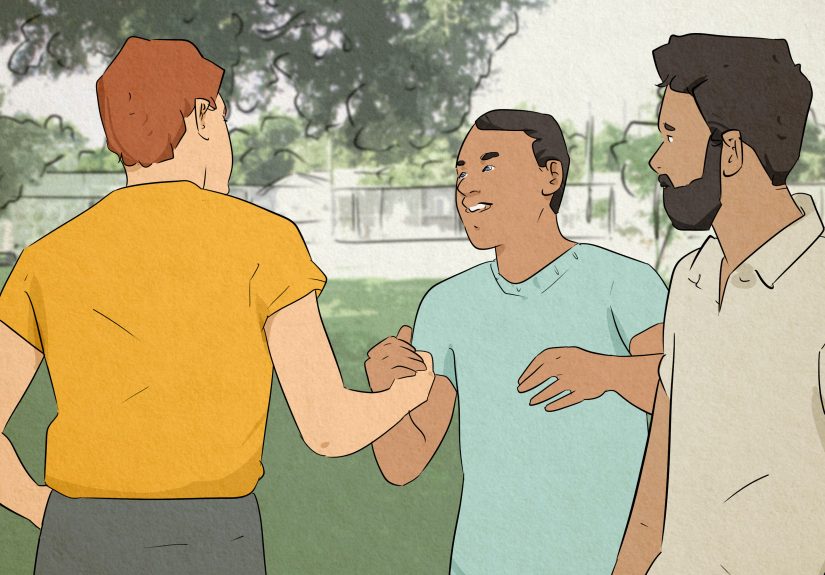
This is the classic, face-to-face methoddone correctly. It’s fast, natural, and works anywhere: parties, coffee shops,
the gym lobby, school pickup lines, or that moment when two of your friends unexpectedly collide in the grocery aisle
next to the avocados.
How it works
- Say both names clearly (and don’t mumble like you’re hiding from your own social plans).
- Add one sentence of context about each person or your connection to them.
- Offer a shared hook they can grab immediately.
- Give them a first question or topic if the moment feels stiff.
- Step aside so they can actually talk.
What it sounds like (scripts you can steal)
Script A: The simple bridge
“Jordan, this is MayaMaya and I used to work together. Maya, this is Jordan, my friend from the hiking group.
You both love weekend trails and complaining about how stairs are the enemy.”
Script B: The shared-interest spark
“Chris, meet Talia. Talia is the person who got me into sourdough. Chris is the person who has strong opinions about
butter. I feel like this is fate.”
Script C: The ‘party rescue’ intro
“Heyhave you two met? This is Sam, my neighbor who knows every good food spot in town. And this is Priya, who just tried
to convince me that spicy noodles are a personality trait. Compare notes.”
Make it smoother with “HEFE” conversation starters
When you’re unsure what hook to offer, use a simple mental checklist: Hobbies, Entertainment, Food, Environment.
It’s a quick way to pull a topic that almost anyone can talk about without feeling like they’re in a job interview.
Examples:
- Hobbies: “You both climb.”
- Entertainment: “You’re both into sci-fi.”
- Food: “You both have strong taco opinions.”
- Environment: “This place is packedhow do you even order here?”
Common mistakes (and easy fixes)
-
Mistake: “This is Alex… and… uh…”
Fix: If you blank on a name, be honest and quick: “I’m sorrymy brain just rebooted. Say your name again?” -
Mistake: Introducing people and immediately walking away with no hook.
Fix: Add one shared detail or a starter question: “How did you get into that?” -
Mistake: Sharing private info as “fun facts.”
Fix: Keep it public: interests, contexts, harmless quirksnot personal history.
Way #2: The Low-Pressure “Small Hang” That Does the Work for You
If your friend groups are very different (or your friends are shy, or you’re shy, or everyone is shy and you live in a
mutual agreement to pretend small talk doesn’t exist), the easiest approach is to create a small, structured hangout.
Think: 4–8 people, one simple activity, and a vibe that doesn’t scream “NETWORKING EVENT.”
Why this works
People relax when they know what’s happening. A tiny plantacos, board game, trivia night, a walk, a casual brunch
gives everyone a shared focus so conversation can be natural instead of forced. It also prevents the “two friends cling
to you all night like you’re the only familiar piece of furniture” situation.
The best formats for mixing friends
- Food + one activity: pizza + a short game, dessert + a walk, coffee + a farmers market stroll.
- Bring-a-thing gatherings: “Bring your favorite snack” creates instant conversation.
- Theme-lite: not “full costume party,” more “everyone bring a song to add to the playlist.”
- Co-hosting: if you’re nervous, share hosting duties with one friend so you’re not running the show alone.
How to host without making it weird
- Start small. A few people from each circle is easier than mixing 20 personalities at once.
- Set expectations in the invite. Make it casual and friendly.
- “Bookend” the hang. Have a clear start activity (welcome drink/snack) and a gentle close (dessert, last song, quick group pic).
- Do a few intentional intros early. The first 15 minutes matter most.
- Build a “shared center.” A game, playlist, trivia, or even a simple question jar helps break the ice.
Invite message examples (copy/paste friendly)
Invite A: Simple and warm
“I’m doing a super casual hang on Fridaysnacks, music, zero pressure. I’m inviting a couple people from different parts
of my life because you’re all solid humans. Want to come?”
Invite B: Activity-based
“I’m hosting a low-key taco night + a quick card game. Nothing intensejust food and laughs. I’d love for you to meet a
few friends I think you’d get along with.”
Party-flow tips that quietly reduce awkwardness
- Make the “landing zone” obvious: tell guests where to go when they arrive (kitchen, living room, patio).
- Keep food/drinks easy: complicated setups steal your attention when you should be welcoming people.
- Use micro-roles: “Can you help me pick the playlist?” gives a shy guest a purpose and an easy entry point.
- Have a few starters ready: “What’s a show you’re into right now?” beats “So… what do you do?” every time.
Way #3: The “Double Opt-In” Digital Introduction (Text, Group Chat, or Email)
Sometimes your friends don’t live in the same placeor your schedule is chaosor one friend needs a recommendation and
another friend is basically a walking recommendation machine. Digital intros can be incredibly helpful, but only if you
do them with consent and clarity.
The golden rule: ask both people first
A “double opt-in” means you check with each person before connecting them. It respects time, privacy, and bandwidth.
It also prevents awkward situations like: “Why am I here?” or “Wait, how did you get my number?”
Step-by-step
- Ask Friend A privately if they want to be introduced and what they’re hoping for.
- Ask Friend B privately the same question.
- Make the intro with a short, specific reason they should connect.
- Hand off the conversation (don’t stay in the thread forever unless asked).
Text templates
Template 1: Asking permission (DM)
“Quick questionwould you be open to me introducing you to my friend Riley? You both love [shared interest], and I think
you’d genuinely get along. No pressure at all.”
Template 2: The actual introduction (group text)
“Hey Riley and Jordan! With both your OKs, I’m connecting you two. RileyJordan’s the friend I mentioned who’s into
weekend hiking and trying every coffee shop in town. JordanRiley’s the one who’s always finding great trails (and also
has strong pastry opinions). I’ll let you two take it from here.”
Template 3: If it’s more practical
“Hey! Introducing you two because you’re both looking into [topic]. Friend A has experience with it, Friend B is exploring it.
Thought a quick chat could save time. If now’s not a good time, totally fine.”
Group chat etiquette (aka: don’t “ambush-add” people)
Adding someone to a group chat without asking is like grabbing their hand and dragging them into a room of strangers.
Instead, invite them first, explain what the chat is for, and give them a choice. Your future self will thank you.
Troubleshooting: What If It Gets Weird?
If one friend is shy and clings to you
Give them a “role” and a buddy moment. Introduce them to one person at a time (not a whole cluster), and ask a question
that lets them talk about something comfortable: “You were telling me about that new showtell them your hot take.”
If your friends click and you feel left out
It can sting when two people bond and you feel like you accidentally introduced yourself out of the conversation. Try not
to assume it’s personal. Sometimes your best friend move is being the connector. You can still keep individual time with
each friendand you can also join the new dynamic without acting like you need a reservation.
If they don’t click
That’s normal. You’re introducing humans, not matching socks. Keep it light, don’t force chemistry, and remember: a “meh”
meeting is still a polite, harmless momentnot a social catastrophe.
Real-Life Experiences: What I’ve Learned from Playing “Friend Matchmaker” (500+ Words)
I used to think introducing friends was a single momentnames, handshake, done. Then I learned it’s more like setting up
a tiny stage and making sure everyone’s mic is on. The introduction is the start, but the comfort is what makes it work.
One of my earliest “mixing friends” attempts was a classic overreach: I invited two friends to a busy group event where
I knew I’d be bouncing around. In my head, they’d instantly bond over their shared love of fitness. In reality, one of
them arrived late, didn’t know anyone, and spent the first 20 minutes scanning the room like a lost tourist. I did a quick
“Oh hey, you two should meet!” introduction and then got pulled away. When I circled back, they were both being polite,
but you could tell they hadn’t found an easy conversational ramp. Lesson learned: if you’re going to mix friends in a big
setting, you either need a shared hook that’s immediately usable, or you need to hang around long enough for the
first few minutes to get traction.
Another time, I did the oppositeand it went beautifully. I invited a couple friends from different circles to a small
“snacks and something to do” hang. The activity was ridiculously simple: everyone brought a favorite snack and explained
why they loved it. Sounds cheesy, right? But it instantly gave shy people a script, created built-in laughter, andmost
importantlymade it normal for everyone to speak early. Nobody had to fight their way into the conversation. By the end,
two people were swapping restaurant recommendations, and someone else had recruited a new walking buddy. Lesson: structure
doesn’t have to be intense. It just has to exist.
The biggest upgrade I ever made was learning the power of the “context sentence.” It’s the difference between “This is
Taylor and this is Morgan” (which leaves people floating) and “Taylor is the friend who’s always planning weekend trips,
and Morgan is the friend who actually knows how to find cheap flights” (which gives them instant direction). I’ve even
used it at random momentslike introducing a friend who loves gardening to someone who just moved into a place with a sad
little balcony plant. Suddenly they’re talking soil, sunlight, and whether basil is secretly dramatic (it is).
Digital introductions taught me another lesson: permission is kindness. I used to believe that connecting two people was
always helpful. Now I know timing matters. I once introduced two friends via text because they worked in similar fields.
One of them was in the middle of a brutal deadline week and felt obligated to respond quickly, even though they didn’t
have the bandwidth. Nothing terrible happened, but the vibe was strained and slow. After that, I started asking first,
and I started offering an easy “no” exit: “No pressuretotally fine if now isn’t a good time.” People visibly relax when
you give them that.
And here’s the most surprising thing: the best introductions aren’t always about similarity. Sometimes the magic is
complementary differences. The friend who loves planning meets the friend who loves spontaneity. The quiet listener meets
the enthusiastic storyteller. The person who’s new to town meets the person who knows everyone. When you introduce friends
like you’re building a tiny support systemrather than trying to clone personalitiesyou create space for real connection.
So now, when I introduce friends, I treat it like setting up a great first chapter, not writing the whole book. I make
the opening easy, I keep expectations light, and I let people decide what happens next. That’s the sweet spot: thoughtful,
simple, and just confident enough to feel natural.
Conclusion
The best way to introduce friends to other friends is the one that respects everyone’s comfort level. In-person intros
work when you add context and a shared hook. Small, low-pressure hangs work when you keep the group manageable and give
people something to do. Digital intros work when you use a double opt-in, keep it short, and let people choose the pace.
Do those things, and you won’t just be “the person who knows everyone.” You’ll be the person who helps everyone feel like
they belongwithout turning it into a forced social audition.