Table of Contents >> Show >> Hide
There are funny artists who try to impress you, and then there are funny artists who make you feel alarmingly seen. Chaz Hutton belongs in the second camp. His cartoons do not arrive dressed like grand masterpieces. They stroll in wearing the visual equivalent of a wrinkled sticky note, shrugging as if to say, “You’ve done this too, right?” And that is exactly why they work.
The appeal of a collection like “37 Sharp-Witted Illustrations By Chaz Hutton That Might Make You Chuckle And Relate” is not just that the jokes are clever. It is that they are familiar in the most inconvenient way possible. These illustrations look at procrastination, adult responsibility, workplace absurdity, social awkwardness, tiny daily failures, and the weird emotional weight of modern life, then turn all of it into something funny enough to share. In other words, they perform a public service. They make chaos feel communal.
That may sound dramatic for a bunch of simple cartoons, but that is the trick. Hutton’s work is light on visual fuss and heavy on recognition. You are not staring at elaborate fantasy worlds or dazzling technique. You are staring at a tiny diagram that somehow explains your entire relationship with deadlines, groceries, or the false confidence that comes right before opening an unread email you should have answered three days ago.
And that is what makes this kind of relatable comic art so sticky. It does not beg to be admired from a distance. It practically elbows you in the ribs and says, “Be honest. This is you.” Usually, annoyingly, it is.
Why Chaz Hutton’s Illustrations Hit So Hard
Chaz Hutton has built a recognizable style out of a few ingredients that should not work as brilliantly as they do: simple lines, dry observations, charts that look too official for the nonsense they contain, and the emotional truth of someone who has clearly spent a fair amount of time watching people panic quietly in ordinary settings. His cartoons often feel like meeting minutes from the boardroom of the human brain, if the board were underqualified, overcaffeinated, and one bad notification away from collapse.
That is why collections built around his work travel so well online. These are not jokes that require specialized knowledge. You do not need a Ph.D. in art history, finance, or the dark science of assembling flat-pack furniture. You just need to have existed in the modern world for a while. Maybe you have tried to be productive and ended up reorganizing a drawer. Maybe you have stared at a “quick errand” that somehow swallowed half your day. Maybe you have convinced yourself that making a to-do list counts as completing the to-do list. Hutton understands this territory like a field reporter embedded deep behind enemy lines.
His humor also feels generous. Even when the joke is about failure, laziness, overthinking, or social weirdness, the cartoons rarely punch down. They do not sneer at human flaws. They gently roast them over a low, even flame. That matters. The best witty illustrations do not merely mock life; they translate it. Hutton’s cartoons say, “Look at this ridiculous pattern we all participate in,” and the result is a laugh that sounds suspiciously like relief.
The Joke Is Small, But the Recognition Is Huge
A lot of comedy online aims for volume. Louder caption, bigger reaction, more chaos, more extremes. Hutton works almost in reverse. He notices the tiny hinge points of everyday life: the moment motivation turns into avoidance, the micro-drama of domestic chores, the invisible negotiations people have with themselves every morning, every Monday, every time a calendar reminder pops up like a judgmental pigeon.
That smallness is not a limitation. It is the engine. The humor lands because it comes from details people usually think are too minor to mention. A productive morning derailed by one unnecessary coffee. A life plan that looks suspiciously like wandering around while pretending to have one. A decision tree that begins with confidence and ends in snacks. These are not giant tragedies. They are manageable embarrassments. But stitched together, they form the emotional wallpaper of adulthood.
And that is why a title promising 37 sharp-witted illustrations feels so right for Hutton’s work. His comedy thrives in clusters. One cartoon is funny. Ten cartoons become a worldview. Thirty-seven cartoons start to feel like a suspiciously accurate psychological profile.
What These 37 Illustrations Are Really About
At a glance, a set like this looks like a roundup of funny drawings. Spend a little more time with it, and it becomes clear that the cartoons are less about random jokes and more about recurring human patterns. Hutton keeps returning to a handful of themes because, frankly, the rest of us keep performing them with remarkable consistency.
1. Productivity Theater
Some of the strongest Chaz Hutton cartoons tap into the weird pageantry of modern productivity. The ritual of looking busy. The fantasy version of the day versus the day that actually happens. The way “just getting organized” can become an impressively elaborate way of not starting. His humor understands that many adults now spend an astonishing amount of energy choreographing the appearance of progress.
That is fertile comic ground because it is both ridiculous and real. We live in an era of calendars, apps, notifications, dashboards, personal systems, color-coded ambitions, and cheerful advice from people who somehow wake up at 4:45 a.m. with a glowing sense of purpose. Hutton’s illustrations puncture all of that with one well-placed visual joke. He does not argue with the cult of optimization. He simply draws the emotional aftermath.
2. Adulting, Which Is Mostly Administrative Acrobatics
Another reason these illustrations feel so relatable is that they treat adulthood as it often deserves to be treated: not as noble maturity, but as a chaotic stack of errands, low-level dread, and accidental meals. Hutton captures the fact that being an adult is often less about wisdom and more about remembering passwords, pretending you understand insurance language, and deciding whether the thing in the fridge is “still fine” or “an exciting new threat.”
This is where his observational comics become especially sharp. He understands that adulthood is full of minor humiliations that are too universal to be private and too silly to be tragic. So he gives them shape. Suddenly a vague feeling becomes a clean visual joke. Suddenly your daily incompetence has structure. What a gift.
3. Social Awkwardness in Polite Clothing
Hutton is also excellent at exposing how much social life runs on invisible panic. Small talk, group settings, workplace etiquette, public confidence, overanalyzed texts, saying “no worries” while internally combusting, all of it appears in his work with a level of recognition that feels almost rude. He seems to know that modern life requires a lot of public composure and even more private nonsense.
These cartoons resonate because they show the split screen people live with every day: external calm, internal circus. In that sense, Hutton’s humor is not just funny; it is diagnostic.
4. The Everyday Absurdity We Usually Ignore
One of Hutton’s recurring strengths is his ability to find comic architecture in things people stop noticing. The logic of routines. The absurdity built into shopping, commuting, relaxing, planning, or “taking a quick break.” A good Chaz Hutton cartoon can make an ordinary habit look like a ritual invented by a civilization that vanished for good reason.
That perspective is what turns funny illustrations about everyday life into something more than disposable internet content. The cartoons do not just summarize behavior. They reveal the nonsense hidden inside normality. Once you see it, you cannot unsee it. You may also laugh harder the next time you stand in your kitchen opening the fridge for absolutely no strategic reason.
The Low-Fi Style Is Part of the Genius
Hutton’s work would not hit the same way if it looked too polished. The visual simplicity is not merely a brand choice; it is part of the joke delivery system. The sticky-note feel, the stripped-down line work, the chart-like layouts, the deliberately unfussy compositions, all of it creates the impression that these ideas were caught in the wild before they could be overthought.
That matters because overdesigned comedy can feel distant. Hutton’s drawings feel immediate, like the joke was sketched in the exact moment the absurdity occurred. The medium reinforces the message: life is messy, ridiculous, half-planned, and often funnier when captured quickly than when turned into something slick and perfect.
There is also a democratic charm to his visuals. They do not intimidate the reader. They invite the reader in. A polished illustration can inspire admiration, but a minimal one can create identification. You do not just think, “That artist is talented.” You think, “Oh no, that is my brain on paper.” The second reaction is far more shareable.
Why the Charts and Diagrams Work So Well
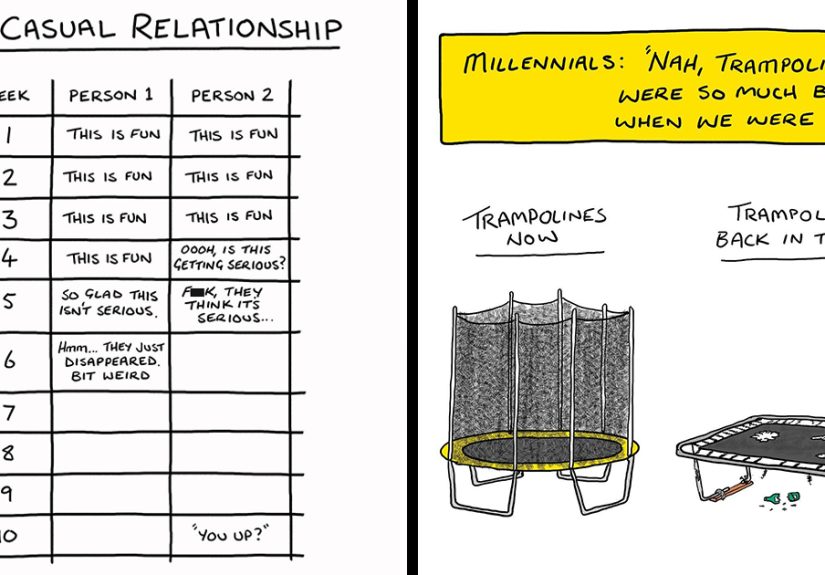
Hutton’s use of charts, maps, rankings, and decision trees deserves special mention because it plays with the language of certainty. We are used to diagrams promising order. Clarity. Solutions. Measurable outcomes. Then Hutton hijacks that visual grammar and uses it to explain nonsense, anxiety, indecision, and human irrationality. It is the bureaucratic tone of a serious presentation welded to the emotional reality of a gremlin with Wi-Fi.
That contrast is funny because it mirrors modern life. So many people are expected to organize themselves like efficient systems while still being gloriously, inconveniently human. Hutton’s best cartoons know that no flowchart on earth can protect a person from procrastination, awkwardness, or the seductive power of doing literally anything else.
Why Readers Keep Sharing This Kind of Humor
The internet is crowded with content, but relatable humor still cuts through because it offers two pleasures at once. First, there is the joke. Second, there is the social function of recognition. Sharing a cartoon like this is a way of saying, “I am like this,” or “you are like this,” or, perhaps most honestly, “we are all barely holding it together, and I think that deserves a little ceremony.”
That is why Chaz Hutton’s cartoons feel more durable than a lot of trend-driven comedy. They are not shackled to one headline, one platform update, or one viral format. They are grounded in repeating human behavior. People will continue to overpromise on Monday, panic by Wednesday, and reward themselves on Friday for surviving a week they helped complicate. As long as that remains true, this style of humor will keep landing.
There is something comforting about comedy that does not pretend to fix you. Hutton’s illustrations do not arrive with a self-improvement sermon attached. They do not insist that every flaw is secretly a superpower. They simply observe. They laugh. They keep moving. That restraint is a big part of their charm.
What It Feels Like to Live Inside a Chaz Hutton Cartoon
If there is one reason these illustrations linger after the laugh, it is because they are not just about behavior. They are about experience. They feel like the visual record of all the small, unglamorous moments people rarely confess out loud. The half-begun task. The bold plan that collapses before lunch. The performative burst of discipline that lasts exactly long enough to justify a snack. The weirdly emotional relationship with inanimate objects, unused groceries, unopened messages, and the mountain of things you swear you will handle “later,” as if Later were a reliable employee and not a deeply chaotic intern.
That is the emotional territory Hutton understands so well. His cartoons capture the experience of trying to function in a world that keeps asking for competence while also supplying endless distractions, vague dread, social obligations, digital noise, and the occasional need to decide what to do with a single sad onion in the kitchen. They are funny because they are honest, and they are honest because they pay attention to things most people are too busy living to describe.
There is also something strangely reassuring about seeing your own habits reduced to a simple sketch. In real life, overthinking can feel private, embarrassing, or unnecessarily dramatic. In a cartoon, it becomes manageable. Cute, even. The mess is still there, but now it has shape. It has pacing. It has a punchline. And a punchline can do a lot of emotional heavy lifting.
That is probably why so many readers react to Hutton’s work with the same blend of laughter and accusation. You laugh because the joke is good. You feel attacked because the joke is accurate. Then, almost immediately, you feel better because accuracy has company. Other people are doing this too. Other people are also standing in the grocery store pretending to make adult decisions while internally free-falling toward crackers and something vaguely cheese-adjacent. Other people are also writing to-do lists with the optimism of a war general and the follow-through of a tired raccoon.
And maybe that is the real value of collections like this one. They do not just entertain. They normalize the unheroic parts of being a person. They remind readers that modern life is full of tiny absurdities, and that noticing them is not failure. It is awareness. It is perspective. It is also, on a good day, comedy.
In that sense, Chaz Hutton’s illustrations are doing something bigger than just being funny. They are documenting the emotional furniture of everyday life: procrastination, awkwardness, low-stakes ambition, self-aware avoidance, mild panic, unexpected tenderness, and the ongoing effort to look more put together than you actually feel. That is not just relatable. That is practically a public archive of contemporary adulthood.
So yes, these 37 illustrations might make you chuckle. But they also do something sneakier. They make readers feel recognized without making them feel judged. They hold up a little hand-drawn mirror and somehow make the reflection bearable, maybe even lovable. That is not a bad trick for a few lines on a page.
Conclusion
“37 Sharp-Witted Illustrations By Chaz Hutton That Might Make You Chuckle And Relate” works as a title because it promises exactly what Hutton delivers best: humor with a pulse. Not abstract cleverness. Not random weirdness for its own sake. Real-life comedy distilled into diagrams, doodles, and visual one-liners that understand how people actually move through the world. His illustrations turn procrastination into structure, social discomfort into shared language, and adult life into a series of hilariously familiar patterns.
That is why his work continues to connect. It is smart without showing off, simple without feeling thin, and funny without losing its humanity. In an internet full of noise, Chaz Hutton’s cartoons still manage to do something rare. They make people laugh, nod, and mutter the same two words under their breath: “too real.”