Table of Contents >> Show >> Hide
- Before You Start: Pick Your Egg, Pick Your Mission
- 45 Creative Easter Egg Ideas to Display This Spring
- How to Display Easter Eggs Like You’re Hosting a Spring Photoshoot
- Pro Tips: Make Your Eggs Look Expensive (Even If They’re Not)
- Common Mistakes (and the Quick Fix)
- Real-Life Easter Egging: “Been There, Dyed That” Wisdom (500-ish Words of Helpful Reality)
- Conclusion
Easter eggs have one job: show up for spring like they own the place. Whether you’re hosting brunch, building a
mantel moment, or just trying to make your dining table look like it has a publicist, a handful of
creative Easter egg ideas can do a surprising amount of heavy lifting. And the best part?
You don’t need a craft room the size of a Target aisle. You need eggs (real or faux), a few supplies,
and a willingness to embrace the very specific chaos of dye water and glitter that will somehow end up on your elbow.
Below you’ll find 45 Easter egg decorating ideasfrom upgraded dye techniques to no-dye designs,
natural looks, and modern “I definitely have my life together” stylesplus smart, easy ways to display them
as spring decor. Let’s make something that looks expensive, even if it came from your junk drawer.
Before You Start: Pick Your Egg, Pick Your Mission
Real eggs vs. blown eggs vs. faux eggs
-
Hard-boiled eggs: Great for decorating + eating (if you use food-safe colorants). Best for
short-term displays. -
Blown eggs (emptied shells): Lightweight, long-lasting, and ideal for hanging displays (egg trees,
garlands). They’re also fragiletreat them like tiny porcelain drama queens. -
Faux eggs (wood, plastic, paper mache): Perfect for paint, decoupage, and long-term decor. Bonus:
you can store them for next year without a science experiment happening in your fridge.
Quick safety note if you plan to eat them
If you’re decorating hard-boiled eggs, keep them refrigerated and don’t leave them out at room temperature
for more than about 2 hours (less time if it’s very hot).[1] For best quality, use refrigerated
hard-cooked eggs within about a week.[2] If you’re using non-food-safe paints, markers, or fabric-dye
transfer techniques, label those eggs “decor only” and keep snack eggs separate (no one wants mystery-crayon mayo).
45 Creative Easter Egg Ideas to Display This Spring
A. Dye Techniques (Classic, But Make It Interesting)
-
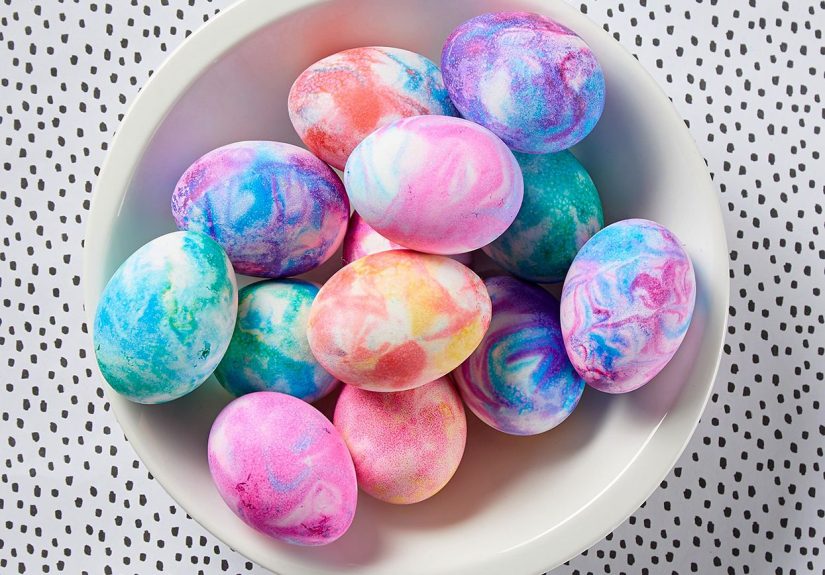
Baking soda “fizz” eggs: Drop dye onto baking-soda-coated shells and spritz with vinegar for a
marbled, speckly look that feels like a science fair you actually enjoyed. -
Oil-marble eggs: Add a little cooking oil to dye for swirly, stone-like veining. Subtle, fancy,
and shockingly forgiving. -
Ombre dip eggs: Dip the egg in dye at different depths, holding longer at the bottom for a smooth
gradient. Instant “designer pastel.” -
Two-tone split eggs: Dye one half, let it dry, then flip and dye the other half in a contrasting
color (think blush + sage, sky + butter). -
Speckled “robin’s egg” finish: Dye a pale base, then flick cocoa-water (or diluted paint on faux
eggs) with a toothbrush for delicate speckles. -
Rubber-band resist: Wrap bands around eggs before dyeing. Remove for clean stripes and geometric
surprises. -
Sticker resist silhouettes: Apply tiny stars, dots, or flower stickers, dye the egg, then peel
for crisp negative space. -
Wax-resist batik: Draw patterns with a white candle/crayon, dye, then buff dry. The wax resists
color for a classic folk-art vibe. -
Watercolor-wash eggs: Use diluted watercolor paint (best on faux or blown eggs) for soft blooms,
bleeds, and dreamy gradients. - Dip-dye stripes: Mask lines with tape, dye, remove tape, and repeat for crisp bands.
-
Salt-texture eggs: While the dye is wet (or on paint), sprinkle a little salt to create subtle
mottling and texture. -
Ink-dropped “galaxy” eggs: On faux eggs, dot alcohol ink and blend for cosmic swirlsthen add
tiny white “stars.”
B. No-Dye & Low-Mess Ideas (Because Your Sink Deserves Peace)
- Washi tape stripes: Wrap thin strips around eggs for instant patternno drying time, no drama.
-
Washi tape color-block: Cover half the egg with tape and paint the other half; peel for a crisp
line. -
Sharpie doodle eggs: Draw tiny icons (flowers, bees, bunnies) on white eggs. Simple, cute,
surprisingly addictive. -
Paint-pen “modern lines”: Use paint pens to draw abstract faces, minimalist squiggles, or
checkerboard patterns. -
Chalkboard eggs: Paint faux eggs with chalkboard paint and write names, menu items, or tiny spring
quotes. -
Decoupage napkin eggs: Apply pretty napkin layers with craft glue for “boutique decor” energy
without boutique prices. -
Scrapbook paper wrap: Wrap eggs with patterned paper strips, sealing edges with glue for a tidy
patchwork effect. -
Glitter-dipped bottoms: Paint on glue at the base and dip into fine glitterlike tiny party shoes
for eggs. -
Confetti dot eggs: Use a hole punch to make paper dots, then glue them on in clusters or a full
“sprinkle” pattern. -
Button eggs: Glue a band of small buttons around the middle for a vintage-craft-meets-jewelry
look. - Lace stencil eggs: Wrap lace around an egg and lightly sponge paint over it for delicate texture.
-
Fabric-wrapped eggs: Wrap scraps of cotton or linen around faux eggs and secure with a ribbon or
twine bow. -
Stamped pattern eggs: Use small rubber stamps (dots, leaves, tiny florals) with acrylic paint to
create neat repeats.
C. Nature-Inspired Looks (Spring, But Make It a Little Cottagecore)
-
Natural dye eggs with kitchen scraps: Use beet, onion skins, turmeric, or red cabbage for a soft,
earthy palette.[3] -
Onion-skin botanical prints: Press small leaves or flowers to the shell, wrap in onion skins and
cloth, then simmer for a vintage, printed look. -
Herb “bundle” eggs: Tie rosemary sprigs or thyme around an egg (decor-only if not food-safe) for
a rustic, fragrant centerpiece. - Pressed-flower eggs: Glue tiny pressed blooms onto faux eggs and seal with a clear craft sealer.
-
Watercolor florals: Paint loose petals and stems, letting colors bleed softly for an
artist-sketch feel. -
Mossy nest eggs: Pair plain eggs with preserved moss and twigs in a shallow bowl; the “idea” is
the styling. -
Terracotta-and-cream eggs: Paint faux eggs in warm clay tones and add white speckles for a muted,
modern-natural look. -
“Garden label” eggs: Write herb names (BASIL, MINT) on eggs and display them in mini pots like
plant markers. -
Mini landscape eggs: Paint a simple horizon line, a tiny tree, and a few cloudslike a postcard,
but egg-shaped.
D. Glam, Graphic & Modern (For the “My House Is a Pinterest Board” Crowd)
- Gold-leaf accents: Add torn gold leaf flakes over a matte base color for instant luxury.
-
Metallic-drip eggs: Paint a “drip” line at the top in metallic gold or copperlike frosting, but
make it chic. - Monogram eggs: Add a single letter in a bold font; perfect as place cards with names on the back.
- Checkered eggs: Use a paint pen to create a checkerboardmodern, playful, and very photogenic.
-
Polka-dot perfection: Dot with the eraser end of a pencil for evenly sized circles (yes, your
school supplies still have dreams). - Color-block triangles: Tape off triangles, paint, peel, repeat. Clean lines = instant “designer.”
- Abstract “brushstroke” eggs: Add thick, confident strokes in 2–3 colors for a gallery-wall vibe.
- Jadeite-inspired eggs: Paint glossy green and add raised white dots for a vintage dishware look.
-
Black-and-white eggs: Keep it monochrome with stripes, dots, and tiny icons; it works with any
spring tablescape. - Pastel “spray” eggs: On faux eggs, lightly splatter diluted paint for a soft, airy confetti effect.
-
Silk-tie pattern transfer: Wrap eggs with 100% silk fabric and simmer to transfer intricate
patternsstunning, but treat as decorative if dyes aren’t food-safe.[4]
How to Display Easter Eggs Like You’re Hosting a Spring Photoshoot
Decorating is half the fun. Displaying is where your eggs go from “craft project” to “seasonal centerpiece that
makes people ask where you bought it.”
1) The easy centerpiece bowl
Fill a low bowl with moss, raffia, or paper grass; tuck in 9–15 eggs (odd numbers look naturally styled). Add a few
tulips or a sprig of eucalyptus and pretend it was effortless.
2) An egg tree (the show-off option)
Use branches in a vase (real or faux). Hang blown or faux eggs with ribbon loops. Keep colors in one family
(pastels, neutrals, or monochrome) for a cohesive “store display” look.[5]
3) A cloche moment
Put 3–5 feature eggs on a cake stand, cover with a glass cloche, and add moss at the base. Suddenly your eggs are
“curated.”
4) Place settings that do the most (in a good way)
Use monogram eggs or chalkboard eggs as place cards. Nestle each on a napkin ring or a tiny wreath of greenery.
Your guests will feel both welcomed and lightly intimidated (the ideal hosting balance).
5) A simple garland
String blown or lightweight faux eggs with twine. Hang along a mantel, window, or shelf edge. Mix in felt balls or
mini pom-poms for texture.
Pro Tips: Make Your Eggs Look Expensive (Even If They’re Not)
- Choose a palette: 2–4 colors is the sweet spot. Too many and your eggs look like they’re arguing.
- Repeat a motif: Dots, stripes, botanicalsrepeat it across eggs for a cohesive set.
- Mix finishes: Pair matte eggs with one metallic accent egg to create contrast.
- Use drying “stands”: Egg cartons, skewers in foam, or a cooling rack prevent smudges and fingerprints.
- Seal for longevity: Faux eggs can be sealed with a clear craft sealer so the design lasts year after year.
Common Mistakes (and the Quick Fix)
- Blotchy dye: Wipe shells with vinegar before dyeing to remove oils, then don’t rush drying time.
- Fingerprints everywhere: Handle eggs with a paper towel or gloves until fully dry.
- Tape pulling paint off: Use low-tack tape, burnish gently, and peel back slowly at a sharp angle.
- Decoupage wrinkles: Use a small brush and work from center outward; thinner napkin layers behave better.
- Cracked eggs: If you’re boiling, start eggs in cold water and heat gradually; sudden temperature shifts invite cracking.
Real-Life Easter Egging: “Been There, Dyed That” Wisdom (500-ish Words of Helpful Reality)
If you’ve ever decorated eggs with other humanskids, roommates, that one friend who “doesn’t craft” but still wants
to participateyou already know this is less of a calm hobby and more of a seasonal event. It usually starts
optimistically: a clean counter, a nice color plan, maybe even a little music. Then someone dips an egg too fast,
the dye splashes, and suddenly your hand is “accidentally” lavender until May. Welcome. You’re doing it right.
One of the most common learning moments is timing. Dye looks darker in the cup than it dries on the shell, so
people often over-correct: dip longer, dip again, and now the egg is a color that can only be described as “bold
email signature.” A better approach is to do a quick test egg first, then commit. If you want deep color, multiple
shorter dips with drying in between tends to look smoother than one epic soak.
Another classic: fingerprints. Eggs feel dry way before they’re truly safe to handle. This is where “drying
stations” become the unsung heroesegg cartons, a cooling rack, even skewers stuck into a piece of foam. When each
egg has a spot, you stop doing that awkward balancing act where you hold three eggs at once like you’re auditioning
for a spring circus.
If you’re crafting with kids, markers and tape are the secret shortcut. Dye is fun, but it can be a lotspills,
stained sleeves, and the inevitable question: “Can we dye the dog?” (No.) Washi tape stripes, sticker resist, and
paint-pen doodles still feel magical, and you can finish a whole set without turning your kitchen into a tie-dye
crime scene. Save the liquid dye for one “big wow” batch, then let low-mess techniques carry the rest.
Displays are where people often surprise themselves. A single gorgeous egg is cute; a group of eggs styled with
intention looks like decor. People usually notice that repeating two or three patternssay, speckles + stripes +
one floralmakes the whole display look coordinated, even if every egg was made by a different personality. And
spring decor loves texture: moss, raffia, linen napkins, a little greenery. The eggs don’t have to do everything.
Sometimes the most “creative Easter egg display ideas” are really just smart styling choices.
Lastly: give yourself permission to keep it imperfect. A slightly uneven stripe can read “handmade charm,” and a
weird accidental speckle might become your signature look. The goal isn’t museum perfectionit’s a cheerful spring
moment that makes your space feel lighter, brighter, and a little more fun. If someone smiles when they see your
eggs, congratulations: you nailed it.
Conclusion
Whether you go full glam with gold-leaf accents, keep it cozy with botanicals and natural dyes, or stick to
no-dye tape patterns that won’t wreck your kitchen, these 45 creative Easter egg ideas give you
plenty of ways to make spring decor feel fresh. Pick a few techniques, choose a color palette, and display them
with intentionyour eggs will look less like a one-day craft and more like a seasonal statement.