Table of Contents >> Show >> Hide
- Who Is David Hotson?
- The David Hotson Design Philosophy: Space First, Style Second
- SkyHouse: David Hotson’s New York Masterpiece in the Clouds
- The Greenwich Village Loft: Light as Architecture
- The Park Avenue Townhouse: Hidden Expansion, Visible Craft
- Collaborations: Maya Lin, Ghislaine Viñas, and the Art of Making Difficult Things Real
- Beyond New York: Saint Sarkis and the Global Reach of a Local Practice
- What Makes David Hotson’s New York Work SEO-Worthy and Design-Worthy?
- Experiences Related to “Architect Visit: David Hotson in New York”
- Conclusion: Why David Hotson Still Matters in New York Architecture
New York has a funny way of testing architects. It gives them narrow lots, landmarked facades, eccentric clients, impossible mechanical chases, neighbors with opinions, and buildings old enough to have seen several design movements come and go. Then it says, “Great, now make something luminous.” Few architects answer that challenge with as much precision and mischief as David Hotson.
David Hotson, founder of David Hotson Architect in New York City, has built a reputation around spaces that feel both technically disciplined and delightfully unexpected. His work does not shout for attention with trendy shapes or decorative drama. Instead, it tends to unfold. A room catches daylight from an unlikely direction. A staircase becomes sculpture. A loft turns a dark corner into a glowing plane. A penthouse at the top of a historic skyscraper becomes a vertical playground with a stainless-steel slide. Yes, a slide. Architecture, apparently, is allowed to have a sense of humor.
This architect visit looks at Hotson’s New York world: his background, his design language, his famous SkyHouse penthouse, his Greenwich Village loft, his Park Avenue townhouse, and the lessons homeowners, design lovers, and architecture students can take from his work. The result is a portrait of an architect who treats space as something alivesomething to be shaped, sharpened, brightened, and occasionally sent zooming down four stories in polished metal.
Who Is David Hotson?
David Hotson is a New York-based architect whose practice was founded in 1991. He studied environmental design at the University of Waterloo in Canada and earned a Master of Architecture from the Yale School of Architecture. That academic background matters because his work often balances two forces: the practical systems thinking of environmental design and the conceptual rigor associated with Yale’s architectural culture.
After establishing his practice, Hotson collaborated with Maya Lin, the acclaimed artist and designer best known for the Vietnam Veterans Memorial. Those early collaborations helped shape a career comfortable with artists, designers, complex details, and architectural ideas that need more than a standard contractor’s shrug to become real. Over the years, the office has worked on residential, cultural, institutional, religious, and private projects, with a strong presence in New York and work extending well beyond the city.
What makes Hotson especially interesting is that his portfolio does not fit neatly into one box. He can design a serene loft, an elaborate townhouse, a Manhattan penthouse, a United Nations office renovation, and a church campus in Texas inspired by Armenian sacred architecture. The common thread is not style in the superficial sense. It is a deeper commitment to volumetric clarity, natural light, technical craft, and memorable spatial experience.
The David Hotson Design Philosophy: Space First, Style Second
Many interiors begin with finishes. Someone chooses marble, wood flooring, cabinet color, and lighting fixtures, then calls the result architecture. Hotson’s work appears to begin earlier and deeper: with space itself. Where does the body move? Where does the eye travel? How does daylight enter? What happens when a narrow room needs to feel generous? How can an old building support a new way of living without losing its soul?
This “space first” approach explains why his projects often feel clean but not cold. The geometry may be exact, the surfaces carefully detailed, and the volumes crisply defined, but the result is rarely sterile. There is usually a moment of surprise: a translucent wall, a hidden route, a stair that seems to twist through the house like a ribbon, or a view framed so dramatically that the city outside becomes part of the room.
Technical Rigor With a Wink
Hotson’s architecture is serious, but it is not humorless. That distinction is important. In a city where luxury design can sometimes become a parade of beige sofas and very expensive silence, Hotson’s best-known projects have personality. They feel tailored to real people, not just imaginary magazine readers wearing linen and whispering near a stone island.
The famous SkyHouse penthouse is the clearest example. It is architecturally sophisticated, structurally demanding, and spatially complex. It is also fun. The project includes a multi-story slide, climbing elements, glass floors, and unexpected passages. These are not gimmicks pasted onto a dull plan. They are part of a larger architectural idea: that vertical living can be kinetic, playful, and immersive.
SkyHouse: David Hotson’s New York Masterpiece in the Clouds
No article about David Hotson in New York can avoid SkyHouse, nor should it try. SkyHouse is a private residence built within the previously unused penthouse structure at the top of an early surviving skyscraper in Lower Manhattan. The building, historically associated with the American Tract Society, dates to the 1890s and belongs to the era when New York was learning how to stretch upward with steel-frame construction.
The original penthouse was not designed as a normal apartment. It was more like an ornamental crown: dramatic, elevated, and architecturally potent, but not immediately practical as everyday living space. Hotson’s challenge was to transform that unusual volume into a home while preserving the thrill of inhabiting a piece of New York’s vertical history.
A Home Suspended in the City
SkyHouse works because it treats height as an experience, not just a real-estate statistic. In many luxury apartments, “views” simply means large windows and a high price tag. Here, the view becomes part of the architecture. The rooms are arranged to emphasize vertical movement, unexpected sightlines, and the sensation of hovering above the city.
The project was designed in collaboration with interior designer Ghislaine Viñas, whose colorful and witty sensibility helped turn Hotson’s spatial framework into a livable home. The result is a rare combination: rigorous architecture with actual joy in it. There are white sculptural forms, bold colors, playful details, and an almost cinematic sense of movement from one level to the next.
The Slide Everyone Talks About
Let’s be honest: people remember the slide. A polished stainless-steel tube connects multiple levels of the penthouse, giving residents and guests an alternative to the stairs. It is the sort of feature that makes adults pretend they are too sophisticated to be impressed, right before asking, “So… can I try it?”
But the slide is more than a viral design moment. It expresses something central to Hotson’s work: architecture can choreograph behavior. A stair asks you to walk. An elevator asks you to wait. A slide asks you to surrender, laugh, and arrive with your dignity slightly rearranged. In a private home, that kind of spatial invitation can change the emotional atmosphere of the entire project.
The Greenwich Village Loft: Light as Architecture
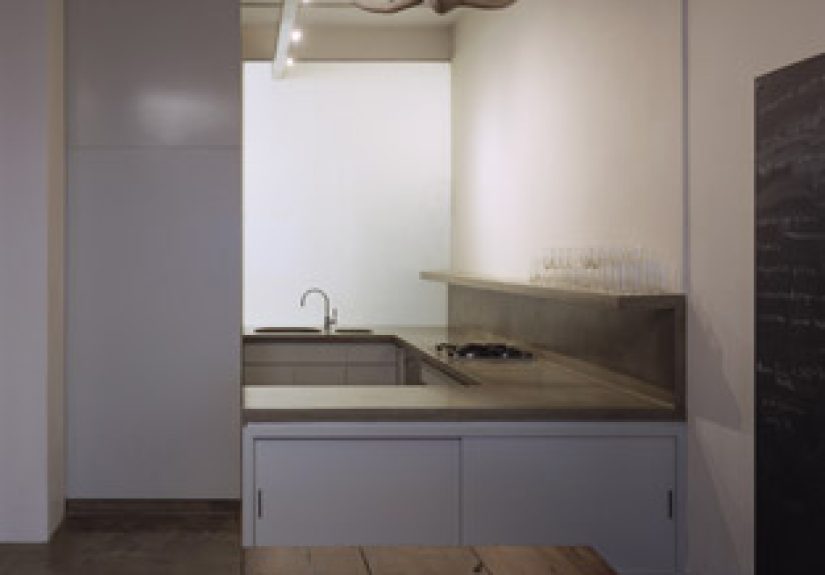
Before SkyHouse became the project people passed around with wide eyes, Hotson’s Greenwich Village loft showed another side of his talent. The loft was deep and narrow, with limited access to natural light in the interior zones. Instead of treating the darker end as a problem to hide, the design used laminated glass to separate the kitchen and bathroom, allowing light to filter through and giving the interior a soft glow.
This is a classic Hotson move: a technical solution that also becomes a poetic one. A bathroom wall is not merely a bathroom wall. It becomes a luminous surface, a light diffuser, and a way to make a difficult plan feel intentional. The design proves that small interventions can transform how a space behaves.
Why the Loft Still Feels Relevant
New York lofts are often romanticized, but anyone who has lived in or renovated one knows the challenges. They can be long, dark, awkward, acoustically lively, and full of building systems that appear exactly where you wish they would not. Hotson’s approach offers a useful lesson: do not fight the loft’s proportions with fake rooms and visual clutter. Instead, clarify the plan, let light travel, and use materials that amplify depth rather than closing it down.
For homeowners, the Greenwich Village loft is a reminder that good design does not always require theatrical gestures. Sometimes the smartest move is a translucent plane, a carefully placed kitchen, or a bathroom that borrows light like a polite neighbor asking for sugar.
The Park Avenue Townhouse: Hidden Expansion, Visible Craft
Hotson’s Park Avenue townhouse demonstrates his ability to work within New York’s strict historic and zoning conditions. The project involved a rare Queen Anne townhouse, where additional stories were added under a raked roofline designed to remain hidden from street level. In other words, the house grew without making a scene.
Inside, a new staircase became the organizing element, moving through the house as a sculptural spine from the lower levels to the rooftop studio. The cellar was excavated to add wellness spaces, and the home was rebuilt to support contemporary family life, creative work, gatherings, and the kind of daily use that historic houses were not always prepared to handle gracefully.
Respecting History Without Freezing It
The best townhouse renovations in New York understand that preservation is not the same as paralysis. A historic building should not be stripped of character, but it also should not be forced to live forever as a museum of outdated habits. Hotson’s townhouse work shows how an architect can respect the street-facing identity of a building while radically improving the interior experience.
This balance is one of the hardest things to achieve in residential architecture. Too much intervention, and the house loses its memory. Too little, and the family ends up living inside a beautiful inconvenience. Hotson’s solution is to make the new work precise, purposeful, and spatially ambitious, while allowing the building’s original presence to remain legible.
Collaborations: Maya Lin, Ghislaine Viñas, and the Art of Making Difficult Things Real
David Hotson’s career includes significant collaborations, and that matters because architecture is rarely a solo performance. Even the most elegant drawing eventually meets engineers, fabricators, craftspeople, clients, budgets, codes, and the unforgiving reality of gravity.
His collaboration with Maya Lin placed him in a world where architecture and art overlap. Lin’s residential work explored transformation, movement, and highly controlled detail. Hotson’s role as associated architect on private Manhattan residences helped demonstrate his ability to translate ambitious spatial ideas into built form.
In SkyHouse, the partnership with Ghislaine Viñas brought another kind of creative tension. Hotson’s architecture provided bold spatial order; Viñas introduced color, wit, and domestic energy. The project works because neither side erases the other. The architecture remains powerful, but the home feels inhabited, personal, and alive.
Beyond New York: Saint Sarkis and the Global Reach of a Local Practice
Although this article focuses on New York, Hotson’s work beyond the city helps explain his architectural range. Saint Sarkis Armenian Church and Community Center in Carrollton, Texas, designed by David Hotson Architect with collaborators, has received major recognition from architecture organizations. The church draws inspiration from the ancient Armenian church of Saint Hripsime, while using contemporary materials and digital fabrication strategies to create a facade rich with cultural memory.
This project shows that Hotson is not limited to private residential spectacle. He is also interested in architecture as a carrier of history, ritual, identity, and collective meaning. In that sense, Saint Sarkis and SkyHouse are less different than they first appear. One is sacred and communal; the other is private and domestic. Yet both ask how architecture can intensify experience through space, light, and crafted surfaces.
What Makes David Hotson’s New York Work SEO-Worthy and Design-Worthy?
From a web publishing perspective, “Architect Visit: David Hotson in New York” is a strong topic because it combines several search-friendly themes: New York architecture, contemporary residential design, loft renovation, townhouse renovation, penthouse design, SkyHouse, David Hotson Architect, and architectural interiors. But the topic is not just keyword-rich. It is genuinely rich.
Hotson’s work gives readers something useful to think about. For architecture lovers, it offers a case study in spatial invention. For homeowners, it provides renovation ideas that go beyond paint colors. For designers, it shows how discipline and play can coexist. For New Yorkers, it reveals how the city’s difficult buildings can become extraordinary homes when approached with intelligence and imagination.
Key Design Lessons From David Hotson’s Work
First, light is a building material. In the Greenwich Village loft, borrowed and filtered light transforms a deep interior. In SkyHouse, daylight and skyline views define the emotional drama of the home.
Second, circulation can be memorable. Stairs, slides, passages, and vertical routes are not merely ways to move around. They shape how people understand and enjoy a building.
Third, historic buildings can handle bold ideas. Hotson’s projects show that preservation and invention can share the same address, provided the design is thoughtful and technically skilled.
Fourth, humor belongs in architecture. A home can be elegant without being stiff. It can be expensive without being boring. It can be carefully detailed and still make someone laugh.
Experiences Related to “Architect Visit: David Hotson in New York”
Visiting or studying a David Hotson project, even through photographs and published project descriptions, creates a different kind of architectural experience from browsing standard luxury interiors. Many high-end homes are easy to admire but hard to remember. They have beautiful stone, custom millwork, soft lighting, and the emotional range of a very tasteful hotel lobby. Hotson’s work tends to linger because it gives the mind something to climb through.
Imagine stepping into a New York loft where the deepest part of the plan does not feel like a forgotten cave but glows with borrowed light. That experience changes how you think about renovation. It teaches you to look at constraints not as design enemies but as invitations. A lack of windows can inspire translucent partitions. A narrow footprint can produce a clearer sequence. A strange corner can become the best moment in the room if the architect treats it with curiosity instead of embarrassment.
Now imagine entering SkyHouse, high above Lower Manhattan. The experience is not simply “large apartment with nice view.” It is more layered than that. You are inside the ornamental crown of a historic skyscraper, surrounded by the city’s vertical energy. The rooms are bright, sculptural, and unexpected. The stairs and slide make movement feel like part of the design story. The home turns daily circulation into an event. Even if you never take the slide, you know it is there, quietly daring the house to take itself too seriously.
For design students, Hotson’s New York work offers a valuable lesson in architectural courage. It is not enough to draw dramatic spaces; those spaces must survive construction. They must meet codes, support bodies, hide systems, handle wear, and still feel effortless. The more playful the final result appears, the more discipline usually sits behind it. A slide in a penthouse is funny. Making it safe, elegant, coordinated, and integrated into a multi-level residence is not funny at allit is hard work wearing a grin.
For homeowners, the experience is more practical. Hotson’s projects encourage people to ask better questions before renovating. Instead of “What style do I want?” ask, “How should this space make me feel?” Instead of “Where do I put the sofa?” ask, “Where does the light arrive, and how do we honor it?” Instead of copying a magazine image, ask what the existing building is trying to become. A good architect does not merely decorate desire; a good architect clarifies it.
There is also a distinctly New York lesson in Hotson’s work: the city rewards patience with complexity. Old buildings contain weird surprises. Landmark rules can be strict. Contractors must solve problems in tight spaces. Elevators are small. Neighbors are close. Nothing is as simple as it looked in the first meeting. Yet these pressures often create the most original architecture. In New York, the best design is rarely born from blank-slate freedom. It comes from negotiationwith history, structure, light, money, and the stubborn personality of the building itself.
That is why an architect visit with David Hotson feels like more than a tour of handsome rooms. It becomes a reminder that architecture is not only about surfaces. It is about sequence, surprise, memory, and motion. It is about making a home that understands both the seriousness of construction and the joy of living. If a project can respect a 19th-century skyscraper, frame the skyline, organize a family’s life, and still make room for a slide, it has earned the right to be called memorable.
Conclusion: Why David Hotson Still Matters in New York Architecture
David Hotson’s New York work stands out because it refuses to choose between intelligence and delight. His projects are technically careful, spatially ambitious, and deeply aware of context. At the same time, they make room for surprise. They remind us that architecture can be rigorous without becoming rigid, luxurious without becoming lifeless, and historic without becoming trapped in nostalgia.
From the luminous Greenwich Village loft to the sculptural Park Avenue townhouse and the unforgettable SkyHouse penthouse, Hotson’s architecture shows what happens when an architect treats space as the main event. The result is not just beautiful rooms, but memorable experiencesplaces that invite movement, curiosity, and a little wonder. In New York, where every square foot has an opinion, that is no small achievement.