Table of Contents >> Show >> Hide
- Meet the Artist Behind the Reversed-Role World
- What If Animals Did to Us What We Do to Them?
- Why These Illustrations Feel So Uncomfortable (And Why That’s the Point)
- From Viral Post to Real-World Reflection
- How to Look at This Series Without Looking Away
- Experiences and Reflections: Living With the Reversed-Role Images
- Conclusion: When a Drawing Becomes a Mirror
You’re lazily scrolling through Bored Panda, fully prepared to waste a few guilt-free minutes, when suddenly you’re staring at an image of a cow calmly eating dinner… and on the plate is you. Knife, fork, napkin. Human on the menu. Your brain does a hard reboot.
That’s the energy behind the series often shared under the title “Artist Creates Illustrations Where The Roles Of Humans And Animals Are Reversed, And The Reality Is Thought-Provoking (50 Pics).” In these striking black-and-white illustrations, the usual hierarchy gets flipped: animals farm humans, experiment on humans, parade humans in circuses, and treat us exactly the way our species often treats them in the real world.
The result is darkly funny, deeply uncomfortable, and surprisingly effective. Instead of lecturing, the art asks one simple question: “How would you feel if this were you?” Once you’ve seen a pig force-feeding a human in a wire cage, it’s a lot harder to shrug off factory farming as “just the way things are.”
Meet the Artist Behind the Reversed-Role World
The illustrations widely shared under this headline are often connected to the work of artist Barbara Daniels, known for her series sometimes referred to as “Dominion over Man.” In her intricate black-and-white pen drawings, Daniels imagines a parallel universe in which animals hold all the power and humans are reduced to resources, entertainment, or test subjects.
Instead of gentle barnyard scenes, you get:
- Cows in lab coats strapping humans to tables for experiments.
- Chickens crowding humans into stacked cages, feeding them through bars.
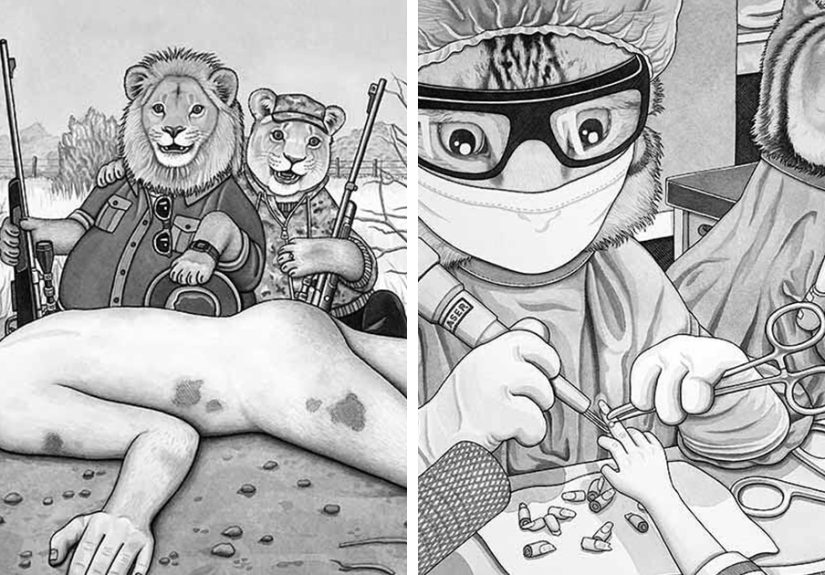
- Foxes proudly posing with “trophy humans” after a hunt.
- Elephants forcing humans to perform tricks in a circus ring.
The drawings are detailed, almost documentary-like. That’s part of why they hit so hard: the situations might be absurd, but the staging feels painfully familiar. Each scene echoes real-life photos from factory farms, animal testing labs, circuses, and roadside zoosonly this time, the roles are swapped.
This role-reversal has a long tradition in animal rights art and satire. From cartoons that show lab mice studying humans, to short films like The Meatrix that parody pop culture to expose industrial farming, artists have been flipping the script for decades. Here, Daniels’ work blends that tradition with a stark, fine-art aesthetic that’s perfect for sharing, reposting, and… quietly haunting your thoughts later.
What If Animals Did to Us What We Do to Them?
The core concept is simple: take an everyday human practice involving animals and reverse it. Suddenly, the things that felt “normal” become ridiculous, creepy, or downright horrifying. That’s the whole point.
1. Factory Farming, But Make Humans the Livestock
One of the most striking themes in these illustrations is industrial farming. We see humans:
- Packed into tiny cages where they can’t stretch or turn.
- Force-fed to fatten them up faster.
- Marked with identification tags, barcodes, or ear clips.
- Loaded onto trucks headed toward an obviously grim destination.
Replace the humans with chickens, pigs, or calves and you’ve got a typical day in many real-world factory farms. The drawing doesn’t exaggerate what happensit simply swaps who it happens to. That tiny shift forces us to ask why we’re okay with this level of suffering when it’s animals, but instantly outraged when it’s us.
2. Fashion, Beauty, and “Just a Coat”
Another common motif: humans skinned or shaved for clothing, with animals strutting around in human “fur” coats. Glamorous foxes try on sleeves made from arms. A wolf in a boutique admires a “100% human leather” handbag.
Satirical fashion images like these mirror real-life fur ads and leather campaigns, right down to the lighting and poses. When the product is a human body, the slogan “It’s just a coat” sounds monstrous. The uncomfortable truth is that, for many animals, that’s exactly what their lives are reduced to: fabric, trim, or a status symbol.
3. Entertainment: Circuses, Zoos, and Trophy Hunting
In other scenes, animals become ringleaders, hunters, and tourists:
- A lion cracks a whip at humans balancing on tiny platforms in a circus tent.
- Families of bears take selfies in front of humans trapped in glass enclosures.
- Elegant predators pose with rifles beside a human “trophy,” smiling for the camera.
None of this is exaggerated beyond what humans already do to animals. That’s why it’s so unsettling. When the roles are reversed, “harmless fun” suddenly looks like cruelty dressed up as leisure.
4. Lab Testing and “For Science” Excuses
Perhaps the most chilling scenes depict humans in sterile laboratories, strapped into restraint devices while animals in lab coats inject, observe, and record. The humans are clearly terrified. The animals are calm, clinical, and emotionally detached.
These illustrations echo real documentation of animal testing in cosmetics, drug research, and universities. The message isn’t necessarily that all research is evil, but that the moral math gets very shaky when sentient beings are treated as disposable tools. When you imagine your own body in the restraint chair, phrases like “necessary sacrifice” suddenly beg a lot more questions.
Why These Illustrations Feel So Uncomfortable (And Why That’s the Point)
When people first encounter this series, reactions are intense and immediate: shock, anger, guilt, sadness, or sometimes defensive jokes. That’s because the art doesn’t attack us with statistics; it attacks us with empathy.
Several things are happening at once:
- Forced perspective shift: We’re used to being the powerful species. These scenes flip the hierarchy, forcing us into the vulnerable position animals usually occupy.
- Cognitive dissonance: Many of us love animals, share cute pet videos, and also regularly consume meat, dairy, leather, and entertainment that cause animal suffering. These pictures put those contradictions on one page.
- Moral clarity: When it’s a human in the cage, right and wrong feel suddenly obvious. The question becomes: was it actually less wrong when the victim was an animal?
Animal ethicists and philosophers have long argued that our treatment of animals doesn’t match our values. We say we oppose cruelty, yet collectively support systems that normalize it. Art like this acts as a shortcut to that realization. It doesn’t tell you what to think; it makes it nearly impossible not to think.
From Viral Post to Real-World Reflection
It would be easy to dismiss these illustrations as “just another viral Bored Panda post.” But art like this has a way of escaping its original context. It gets pinned on Pinterest, reposted on Instagram, debated on Reddit, and used in blog posts, classroom discussions, and animal welfare campaigns.
This series sits in a broader ecosystem of culture that uses humor and shock to talk about animal rights. Cartoons, short films, and documentaries have all experimented with role reversal and satire to highlight the realities of:
- Factory farming and industrial agriculture.
- Fur and exotic-skin fashion.
- Animal entertainment industries like circuses and marine parks.
- Lab testing and scientific research on animals.
What makes these particular illustrations stick is how simple they are: no speech bubbles, no complex storylines. Just one arresting scene at a time, leaving your imagination to fill in the rest.
How to Look at This Series Without Looking Away
It’s tempting to glance at a few images, think “wow, that’s dark,” and then move on to something lighter. But if you want the series to be more than a momentary shock, it helps to sit with the discomfort a little bit longer.
Here are a few ways to engage more deeply:
- Pick one image and describe it in detail. What exactly is happening? Who has power? Who has none? How does each character likely feel?
- Identify the real-world practice it mirrors. Is it factory farming, hunting, lab testing, fashion, or entertainment? What are the real animals behind this visual metaphor?
- Ask, “Where do I intersect with this system?” Do you buy products, tickets, or foods that rely on similar treatment of animals?
- Consider one tiny change. Maybe it’s skipping one type of product, choosing a cruelty-free brand, or learning more about where your food comes from.
The goal isn’t perfection; it’s awareness. These drawings aren’t a purity test. They’re an invitation to zoom out, notice the patterns we’ve normalized, and decide whether they still fit the kind of humans we want to be.
Experiences and Reflections: Living With the Reversed-Role Images
Spend enough time with this kind of art, and you start to realize that it doesn’t just live on your screenit moves into your habits. People often report that once they’ve really looked at these illustrations, certain everyday moments feel different.
For example, imagine walking down the meat aisle at the grocery store after seeing an image of humans wrapped in plastic on foam trays. The fluorescent lights, neat rows, and bright labels are still the same, but now your brain quietly overlays that drawing on top of reality. You’re suddenly aware that every package was once a living being with a heartbeat and a will to live. The art doesn’t scream at you; it just stands in the background, raising an eyebrow.
Or think about visiting a zoo or marine park. Where you might once have simply admired the animals, you may now catch yourself noticing the walls, the glass barriers, the pacing, the boredom. After seeing illustrations where bears take pictures of humans in cages, it’s hard not to wonder what the animals think when they look back at us. Are we really the ones doing the watching, or are we also on display?
These experiences can be uncomfortable, but they’re also strangely empowering. Instead of drifting through life on autopilot, you’re paying attention. You start connecting dots: the burger in your hand, the leather shoes at the store, the “funny” circus clip on social media. They all belong to the same story about how our species treats others. The reversed-role art doesn’t give you a script, but it gives you the questions.
For some people, that shift shows up in small, quiet decisions. Maybe they choose the plant-based option once in a while. Maybe they swap a product for a cruelty-free alternative. Maybe they stop sharing videos that show animals being frightened “for laughs.” These are not world-shattering gestures, but culture is often madeand changedin these tiny, repeated choices.
For others, the images become a conversation starter. It’s easier to talk about animal rights when you can point to a drawing and ask, “Okay, but what if this were us?” The conversation becomes less abstract and more personal. Friends who would roll their eyes at a lecture might actually sit with a picture that makes them both laugh and cringe.
Ultimately, the impact of “Artist Creates Illustrations Where The Roles Of Humans And Animals Are Reversed” isn’t measured by how many people go vegan overnight or swear off leather forever. Its power lies in the way it lingers at the edge of your awareness. The next time you see a billboard, a menu, or a circus ad, a part of your mind quietly flips the roles. For a moment, you’re not just the consumeryou’re the potential “animal” on the other side.
That’s the quiet magic of this art. It doesn’t demand that you become a perfect person. It simply nudges you toward becoming a more conscious one. And once you’ve seen the world through these reversed eyes, it’s very hard to go back to seeing animals as background characters in a story that belongs only to us.
Conclusion: When a Drawing Becomes a Mirror
On the surface, this Bored Panda–famous series is “just” a collection of 50 clever drawings. Look closer, and it’s a mirror held up to our species. By reversing the roles of humans and animals, the artist doesn’t just expose cruelty; they expose our assumptions about power, value, and who deserves empathy.
Whether you end this journey rethinking your shopping list, your entertainment choices, or simply the way you talk about animals, the images have already done their work. They made you pause. They made you feel. They made you ask, “What if this were me?”
And once that question lodges itself in your mind, the world never looks quite the same again.