Table of Contents >> Show >> Hide
- What Is the Chandra X-ray Observatory?
- Why Astronomers Need an X-ray Telescope in Space
- How Chandra Works
- What Chandra Has Discovered
- Why Chandra Still Matters Decades After Launch
- Engineering Meets Imagination
- The Legacy of Chandra X-ray Observatory
- Experiences Related to the Chandra X-ray Observatory
- SEO Tags
Some telescopes give us the universe in glittering starlight. Chandra gives us the universe with the polite mask ripped off. Instead of soft, dreamy views of the cosmos, the Chandra X-ray Observatory shows where space gets wild: black holes snacking on nearby matter, exploded stars leaving behind glowing wreckage, and galaxy clusters colliding like the universe forgot to use its turn signal.
That is exactly what makes Chandra so important. Since its launch in 1999, NASA’s flagship X-ray telescope has helped astronomers study the hottest, most energetic, and most dramatic places in the universe. It does not look for gentle moonbeams or pretty visible-light sunsets. It looks for X-rays, which are produced by environments so extreme they make a campfire look like a lukewarm cup of tea.
For anyone interested in astronomy, astrophysics, or simply the big question of how the universe works, Chandra is one of the most fascinating scientific machines ever built. It combines elegant engineering, long-term scientific value, and a steady stream of discoveries that keep reminding us the cosmos is not just beautiful. It is busy, violent, and gloriously weird.
What Is the Chandra X-ray Observatory?
The Chandra X-ray Observatory is a NASA space telescope designed to detect X-ray emissions from some of the hottest regions in the universe. Those regions include supernova remnants, neutron stars, gas swirling around black holes, and giant clusters of galaxies filled with shock-heated plasma. In plain English, Chandra studies places where matter is being crushed, blasted, accelerated, or otherwise having a very intense day.
Chandra is part of NASA’s famous “Great Observatories” program, alongside the Hubble Space Telescope, the Compton Gamma Ray Observatory, and the Spitzer Space Telescope. Each observatory focuses on a different part of the electromagnetic spectrum, and Chandra owns the X-ray neighborhood. That matters because visible light can only tell part of the story. If you want to understand the hottest gas, the fastest particles, and the strongest gravitational environments, X-rays are where the action is.
The observatory was named after Subrahmanyan Chandrasekhar, the Nobel Prize-winning astrophysicist whose work transformed our understanding of stars and compact objects. Naming a high-energy space observatory after “Chandra” feels fitting because his legacy is woven into many of the questions the telescope continues to explore, from stellar death to black hole physics.
Why Astronomers Need an X-ray Telescope in Space
Here is the problem with X-rays: Earth’s atmosphere blocks them. That is great news for life on our planet and bad news for scientists who want to observe X-ray sources from the ground. If Chandra sat in a desert observatory next to a giant optical telescope, it would be about as useful as a snorkel in a sandstorm.
To do its job, Chandra has to operate far above the atmosphere. Once in space, it can collect X-rays from extremely hot cosmic material that would otherwise be invisible to us. This includes gas heated to millions of degrees, matter falling into black holes, and the aftermath of stellar explosions. Chandra helps astronomers answer questions such as:
- How do black holes grow and affect their surroundings?
- What happens when massive stars explode?
- How is matter distributed in galaxy clusters?
- What evidence can we gather about dark matter?
- How does high-energy radiation shape galaxies over time?
That list is a reminder that X-ray astronomy is not a niche hobby for people who enjoy graphs with intimidating labels. It is central to modern astrophysics. X-rays reveal the invisible machinery behind many of the most important processes in the universe.
How Chandra Works
Its Mirrors Are a Masterclass in Precision
Chandra’s design is impressive because X-rays are not easy to focus. Normal telescope mirrors do not work well for X-rays, which tend to either pass through material or get absorbed rather than reflect in the friendly way visible light does. To solve this, Chandra uses grazing-incidence mirrors. X-rays hit the mirrors at very shallow angles, more like a stone skimming across water than a baseball hitting a wall.
The observatory’s High Resolution Mirror Assembly includes four nested pairs of ultra-smooth mirrors. That engineering choice lets Chandra produce exceptionally sharp X-ray images. In fact, its angular resolution became one of the mission’s signature strengths. This sharpness is the reason Chandra has remained scientifically valuable for so long. In astronomy, better resolution often means better science. Sometimes it also means arguing less in meetings.
Its Instruments Do More Than Take Pretty Pictures
Chandra is not just an X-ray camera floating around in style. It carries major science instruments that allow astronomers to record images, measure X-ray energies, and study how sources change over time. The Advanced CCD Imaging Spectrometer, or ACIS, is especially useful for imaging and spectroscopy. The High Resolution Camera, or HRC, provides extremely fine spatial and timing information. Chandra also uses transmission gratings to spread X-rays into spectra, helping researchers study the chemical composition, temperature, and motion of cosmic material.
This combination is why Chandra can do serious detective work. It can reveal not only where the high-energy action is happening, but also what kind of physical process is causing it. That difference is huge. A dramatic picture may inspire awe, but a spectrum can tell you whether you are looking at hot gas, accelerated particles, or matter falling toward a compact object.
Its Orbit Was Built for Long Looks
Chandra follows a highly elliptical orbit around Earth. That unusual path takes it far from our planet for much of each orbit, allowing long, uninterrupted observations. This is one of the mission’s underappreciated strengths. Astronomers do not always want quick snapshots. They often need to stare at a source for hours in order to catch subtle changes, faint emissions, or periodic signals.
By spending much of its time above Earth’s radiation belts, Chandra can perform extended observations with fewer interruptions. In practical terms, that means better data and deeper studies of faint, distant, or variable objects. For an observatory designed to study extreme environments, patience is part of the technology.
What Chandra Has Discovered
Black Holes Became Less Abstract
Black holes tend to dominate headlines because they sound dramatic, and to be fair, they are. Chandra has played a major role in studying both stellar-mass black holes and the supermassive monsters that live at the centers of galaxies. X-rays are especially useful here because matter heating up as it spirals inward can glow intensely in X-ray wavelengths.
Chandra observations have helped scientists examine accretion disks, jets, and feedback from active galactic nuclei. That feedback matters because black holes do not just sit in the middle of galaxies looking mysterious. They can influence star formation, heat surrounding gas, and reshape the evolution of entire galactic systems. Chandra helped turn black holes from theoretical villains into observable cosmic engines.
Supernova Remnants Became Laboratories
One of Chandra’s most famous early targets was Cassiopeia A, the remnant of an exploded star. Its “first light” image quickly showed that the mission was going to be special. Chandra’s X-ray view revealed structure, shock fronts, and chemical detail with remarkable clarity. Since then, observations of supernova remnants have helped astronomers trace the debris of stellar explosions and understand how elements are distributed through space.
This is not a small detail. The elements forged in stars and scattered by supernovae are the ingredients for planets, atmospheres, and living things. In a poetic sense, Chandra studies cosmic wreckage and helps explain why your bones, your phone, and your coffee mug all contain atoms made in ancient stars. Science can be moving like that when it is not being buried under paperwork.
Galaxy Clusters Revealed Their Hidden Drama
Galaxy clusters are the largest gravitationally bound structures in the universe, and Chandra has been extraordinary at observing the hot gas that fills them. That gas shines brightly in X-rays, making Chandra an ideal tool for mapping cluster structure, measuring temperatures, and identifying shock waves and cavities.
One of the most famous examples is the Bullet Cluster. Chandra’s X-ray data helped show where the hot normal matter was located during a collision between galaxy clusters, while gravitational lensing mapped most of the mass elsewhere. The separation between the X-ray-emitting gas and the dominant mass became one of the clearest visual pieces of evidence supporting the existence of dark matter. That discovery gave astrophysics one of its most memorable “well, that is hard to ignore” moments.
Chandra Helped Build the Multiwavelength Universe
Modern astronomy works best when telescopes collaborate. Chandra data are often combined with observations from Hubble, Webb, radio observatories, and ground-based instruments. This multiwavelength approach allows scientists to compare hot gas, stars, dust, magnetic fields, and gravitational structure in a single object.
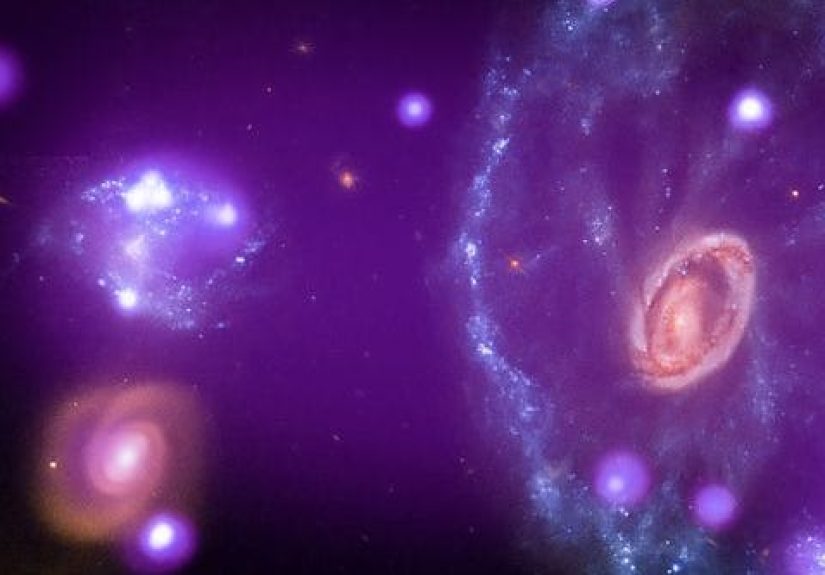
That is why some of the most striking astronomy images of the past two decades are composites that include Chandra data. Those glowing blue, pink, or purple regions in famous space images are not there for decoration. They often represent the hottest and most energetic components of the system. Without Chandra, many of those pictures would still be beautiful, but they would leave out the part of the story where the universe is throwing sparks.
Why Chandra Still Matters Decades After Launch
Plenty of spacecraft have heroic beginnings and forgettable middle age. Chandra has managed the opposite. It launched with high expectations and then kept delivering, year after year, far beyond the sort of lifespan people casually imagine when they hear “space mission.” That continued usefulness says a lot about the observatory’s design, operations, and scientific value.
Its longevity matters for another reason: astronomy rewards patience. Long-running observatories can track change over time. They can revisit supernova remnants, compare evolving jets, monitor black hole outbursts, and build archives rich enough for future scientists to ask questions that were not even on the whiteboard when the mission began.
Chandra’s data archive is a major part of its legacy. Researchers can mine old observations, combine them with new ones, and uncover patterns that individual images would never reveal on their own. That archival strength turns Chandra from a telescope into a scientific library written in high-energy light.
The observatory also remains relevant because high-energy astrophysics is still one of the liveliest fields in science. Questions about dark matter, black hole growth, cosmic feedback, and the evolution of galaxies are not solved. Chandra continues to supply the kind of evidence that keeps those debates honest.
Engineering Meets Imagination
There is something deeply satisfying about Chandra as a piece of engineering. It is elegant in the way great scientific instruments often are. Every design choice serves a purpose: the mirror geometry, the instruments, the orbit, the calibration, the long mission planning. None of it is flashy for the sake of being flashy. It is all in service of extracting difficult information from one of the hardest parts of the electromagnetic spectrum to observe.
And yet Chandra’s impact is not limited to specialists. Its images have reached classrooms, museums, documentaries, and social media feeds around the world. A telescope built to solve astrophysical problems has also helped millions of people feel a little more connected to the strange grandeur of the universe. Not bad for a machine whose specialty is radiation most humans cannot see.
The Legacy of Chandra X-ray Observatory
The Chandra X-ray Observatory matters because it changed how we study the energetic universe. It sharpened X-ray astronomy, expanded our view of black holes and supernova remnants, provided compelling evidence in the study of dark matter, and built a vast scientific archive that will remain useful for years to come. It is both a technical triumph and a scientific workhorse.
If Hubble helped the public fall in love with the visible universe, Chandra helped us appreciate the universe’s rougher side: the collisions, shock waves, particle acceleration, and high-temperature chaos that shape cosmic history. Together, those views remind us that the cosmos is not a still photograph. It is a living, evolving system filled with energy, violence, structure, and surprise.
In other words, Chandra did not just give us new pictures. It gave us a sharper understanding of how the universe behaves when conditions become extreme. And in astronomy, the extremes are usually where the best stories live.
Experiences Related to the Chandra X-ray Observatory
For many people, experiences related to the Chandra X-ray Observatory begin not with equations or spacecraft diagrams, but with a single image. You see a glowing remnant of a dead star, a violent jet from a black hole, or a cluster of galaxies wrapped in hot gas, and your first reaction is usually simple: Wait, space does that? Chandra has a way of turning abstract science into something unexpectedly personal. It takes ideas that sound distant and technical and makes them feel immediate.
Students often experience Chandra as a gateway telescope. They may start with colorful composite images and then discover that those colors represent invisible X-ray energy rather than ordinary visible light. That moment can be eye-opening. Suddenly, astronomy is not just about looking up at stars. It becomes about learning that the universe has layers, and that humans have built instruments capable of sensing what our eyes never could. For a young person interested in science, that realization can be unforgettable.
Museum visitors and science-center audiences often have a similar experience. Chandra exhibits and visualizations do more than explain data. They create perspective. You stand in front of an image of a supernova remnant and realize you are looking at the aftermath of a stellar explosion whose debris may eventually help form future stars and planets. That can make the universe feel less like empty distance and more like a connected story. It is a humbling feeling, but also a strangely comforting one.
There is also the experience of following Chandra discoveries in the news. When astronomers use Chandra to study dark matter, map hot gas in galaxy clusters, or examine black hole growth in the early universe, the telescope becomes part of an ongoing human conversation about reality. You are not just reading old facts from a textbook. You are watching knowledge being built in real time. That sense of participating, even as a reader, is part of the observatory’s cultural impact.
For amateur skywatchers, Chandra creates a fun contrast between what is visible in the night sky and what is hidden. You might look up and see a calm patch of stars, while knowing that in X-rays the same region could contain shock waves, collapsed stellar cores, or hot gas at millions of degrees. That layered understanding changes the experience of stargazing. The sky starts to feel richer, deeper, and more active than it appears at first glance.
Even for people outside science, Chandra-related experiences can be surprisingly emotional. The observatory’s work reminds us that destruction and creation are linked in space. Exploded stars scatter elements. Black holes influence galaxies. Violent events shape future structure. There is something powerful about that idea. It suggests that the universe is not tidy, but it is profoundly creative. Chandra lets people experience that truth through science instead of metaphor, which may be the most impressive trick of all.