Table of Contents >> Show >> Hide
- The Short Answer
- Womb Development Timeline: When Hearing Starts and Improves
- Weeks 1 to 13: Building the parts, not hearing the playlist
- Weeks 14 to 18: The hearing system gets organized
- Weeks 19 to 21: First sound detection begins
- Weeks 22 to 24: Startles, shifts, and early reactions
- Weeks 25 to 27: Familiar voices start to matter
- Weeks 28 to 30: Hearing becomes more consistent
- Weeks 31 to birth: Fine-tuning for the outside world
- What Does a Fetus Actually Hear in the Womb?
- Can a Fetus Recognize Your Voice?
- Should You Talk, Read, or Sing to Your Baby?
- Common Myths About Fetal Hearing
- Why This Timeline Matters
- Experiences Parents Commonly Describe as Fetal Hearing Develops
- Conclusion
- SEO Tags
Pregnancy comes with plenty of mystery, wonder, and at least three daily moments of, “Wait, was that normal?” One of the most fascinating questions parents ask is this: When can a fetus hear? In other words, when does your baby go from floating in a cozy, watery studio apartment to actually noticing the soundtrack around them?
The answer is not a single dramatic moment when your baby suddenly hears you belting out a power ballad in the shower. Fetal hearing development happens in stages. The ears, inner ear structures, auditory nerves, and brain pathways all need time to form and connect. Sound detection begins before hearing becomes reliable, and hearing becomes more refined as pregnancy progresses.
If you have been wondering whether your baby can hear your voice, your heartbeat, your dog barking, or your blender staging a kitchen rebellion, the short answer is yes, eventually. But the womb development timeline matters. Some sounds are noticed earlier than others, and what your baby hears in the womb is softer, lower, and much more muffled than what you hear on the outside.
Here is what to expect, week by week, plus what a fetus can actually hear, how voice recognition develops, and what parents often experience as this milestone unfolds.
The Short Answer
A fetus may begin to detect sound around 18 to 20 weeks of pregnancy, especially internal sounds such as your heartbeat, blood flow, breathing, and digestive noises. By the early-to-mid 20s in pregnancy, babies may respond to louder sounds and may begin reacting to familiar voices. By about 27 to 29 weeks, hearing from outside the womb becomes much more noticeable, and by full term, hearing is functioning well enough that your baby can recognize familiar voices and speech patterns.
So if you are looking for the simplest possible answer, it is this: a fetus starts hearing in the second trimester, but hearing becomes much more consistent in the third trimester.
Womb Development Timeline: When Hearing Starts and Improves
Weeks 1 to 13: Building the parts, not hearing the playlist
During the first trimester, the basic structures that will become the ears begin forming. This is the architectural phase. Think framing, wiring, and rough plumbing, except the project is a human being and the contractor never sleeps.
At this stage, your baby is not hearing in any meaningful way. The body is busy creating the outer ears, inner ear structures, and early nervous system pathways that will later make hearing possible. The hardware is under construction, but the sound system is not online yet.
This is why the idea that a fetus is listening to full songs or memorizing your favorite podcast during the first trimester is more wishful thinking than science. Early development is crucial, but hearing is still a future skill.
Weeks 14 to 18: The hearing system gets organized
In the late first trimester and early second trimester, the ears continue moving into place and becoming more developed. The inner ear is forming rapidly, and the auditory system is getting closer to working order.
By around 16 to 18 weeks, many pregnancy guides describe the fetus as beginning to develop the capacity to hear. That does not mean your baby is enjoying clear sound the way a newborn does. It means the structures needed for basic sound detection are becoming functional enough that the earliest responses may begin.
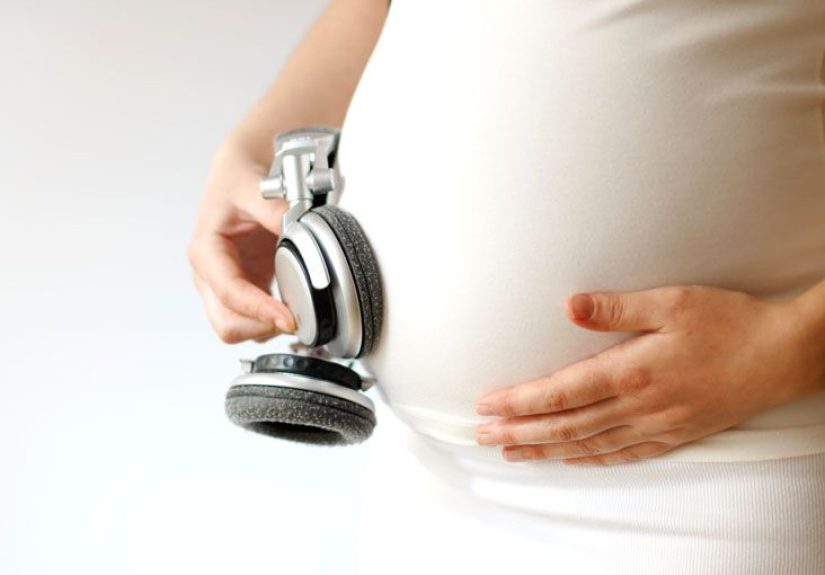
If you imagined your baby wearing tiny imaginary headphones in there, this is your cue to picture them more as a sound intern than a full-time listener. They are entering the room, not running the meeting.
Weeks 19 to 21: First sound detection begins
By this point, many experts say a fetus can hear or detect sound, especially lower-frequency sounds that travel well through the body. Internal sounds come first because they are close, constant, and strong. Your baby is surrounded by the rhythm of your body all day long.
That means the earliest sounds a fetus is likely to notice include:
Your heartbeat. Your blood flow. Your breathing. Your stomach rumbling like it missed lunch. These sounds create the fetal version of background noise, except it is not really background because it is the main event.
This is also the point when some parents begin wondering whether the baby is reacting to their voice. The answer is: possibly, but mostly in a muffled, low-frequency way. Your voice travels through your body differently from sounds in the room, so your baby is exposed to it often and early.
Weeks 22 to 24: Startles, shifts, and early reactions
In the 22-to-24-week range, fetuses may start responding more noticeably to sound. Parents sometimes report a sudden movement after a loud noise, a shift during music, or a little kick after talking. These responses are not guaranteed on command, and they do not mean the baby is judging your singing. They simply suggest the auditory system is becoming more responsive.
This is an important point in the fetal hearing timeline: hearing is not just about the ears. The brain has to receive and interpret signals, even in a very early way. As the nervous system matures, responses to sound become easier to observe.
At this stage, louder and lower-pitched sounds often get through more effectively. A deep voice may travel differently than a higher voice, and repetitive sounds may become familiar even if they are still muffled.
Weeks 25 to 27: Familiar voices start to matter
By around 25 to 27 weeks, many babies show stronger reactions to familiar sounds, especially the pregnant parent’s voice. This is when the question often changes from “Can my baby hear anything?” to “Can my baby hear me?”
That answer becomes more encouraging here. Your baby may move in response to your voice or to other familiar sounds you hear often every day. Reading, talking, and singing can all become part of a gentle bonding routine. No theatrical performance is required. A normal speaking voice is plenty interesting.
This is also the stage when some studies and clinical observations suggest babies may be laying down the early groundwork for voice recognition and language rhythm. They are not learning vocabulary in the womb, but they may be getting used to patterns of sound, stress, and intonation.
Weeks 28 to 30: Hearing becomes more consistent
Once pregnancy reaches the late second trimester and early third trimester, responses to sound become more reliable. Research suggests consistent movement responses to certain sound stimuli show up around this point, which is why many experts describe the third trimester as the period when fetal hearing becomes much more established.
That does not mean every loud noise will trigger a karate demonstration. Babies have sleep-wake cycles, personality differences, and varying positions in the womb. But in general, hearing is no longer a tentative work in progress. It is a functioning sense that is still being refined.
If you have ever felt a dramatic jump after a door slams or a burst of laughter, this is the stage where that kind of response makes the most sense.
Weeks 31 to birth: Fine-tuning for the outside world
In the last stretch of pregnancy, hearing continues to sharpen. By full term, your baby can hear at a level that is much closer to what they will use after birth. Sounds are still filtered by the uterus, amniotic fluid, and your body, but your baby has had weeks of exposure to recurring patterns.
That is one reason many newborns seem calmed by familiar voices after birth. The voice is not brand-new. It is more like meeting the star of a podcast they have been listening to in low resolution for months.
What Does a Fetus Actually Hear in the Womb?
This is where things get especially interesting. A fetus does not hear the world in crystal-clear surround sound. Sound is softened and filtered by tissue and fluid. Lower frequencies tend to travel better than higher ones, and rhythm carries more clearly than detailed speech sounds.
So what reaches your baby most clearly?
First, internal body sounds. Your heartbeat, breathing, digestive noises, and blood flow are loud, regular, and impossible to mute. Second, your voice. Because it travels through both air and your body, it is one of the most common and meaningful sounds your baby experiences. Third, outside voices and music, though these arrive more muffled and less detailed.
This means your baby may not hear the exact lyrics of every song, but they may pick up on rhythm, melody, repeated patterns, and the emotional rise and fall of speech. In plain English: your baby may not understand your words, but they can still get the vibe.
Can a Fetus Recognize Your Voice?
By the third trimester, there is good reason to think babies become familiar with the pregnant parent’s voice. After birth, newborns often show preference for familiar voices and speech patterns they heard repeatedly in the womb.
That does not mean the baby is reviewing your opinions in there. It means exposure matters. Repetition matters. The combination of hearing your voice daily and feeling your body’s rhythms likely helps make that voice especially recognizable.
Partners and siblings can matter too. If one voice is heard often enough, it may also become familiar before birth. So yes, talking to the baby can be a sweet bonding habit, and no, you do not have to sound like a storybook narrator to make it count.
Should You Talk, Read, or Sing to Your Baby?
For many parents, this is the practical question behind the science. Once you know your baby may hear you, it is natural to wonder whether talking, reading, or singing is worth doing.
It can be. Not because it turns your bump into a language lab with test scores, but because it creates consistency, connection, and calm. Reading aloud can help you slow down. Singing can become part of a bedtime routine. Talking to your baby can make pregnancy feel more real, especially during the weeks when movement and milestones are becoming noticeable.
If it feels good, keep it simple. Read a chapter. Narrate your walk. Sing the same lullaby. Tell your baby about your day, even if your day mostly involved emails, laundry, and trying to remember where you put your water bottle for the fifth time.
There is no prize for volume, no need for elaborate equipment, and absolutely no evidence that your baby expects a private concert series. Consistency beats drama here.
Common Myths About Fetal Hearing
Myth 1: A fetus hears perfectly once the ears form
Not quite. Ear structures form before hearing becomes reliable. Hearing improves in stages as the auditory system and brain mature.
Myth 2: Babies in the womb hear everything clearly
Nope. Sounds are filtered and muffled. Rhythm and lower frequencies travel better than crisp speech detail.
Myth 3: Loud music is necessary for bonding
Not at all. A normal speaking or singing voice is enough. Your baby is already getting plenty of sound exposure from everyday life.
Myth 4: Movement after sound always means the baby likes it
Not necessarily. Movement may simply mean the baby noticed the sound or was startled by it. A kick is not a review score.
Why This Timeline Matters
Understanding when a fetus can hear helps make sense of pregnancy milestones. It explains why reactions to sound may begin in the second trimester, why outside voices matter more later on, and why newborns can seem comforted by familiar sounds after birth.
It also reminds us that fetal development is gradual. There is no single magical switch that flips hearing from “off” to “on.” Instead, there is a beautifully layered process in which body structures form, signals travel, the brain matures, and responses become stronger over time.
That gradual process is often how pregnancy works in general. One week brings a new organ system, another brings movement, another brings hearing, and somewhere along the way you realize there is a whole tiny person preparing for the outside world while you are just trying to tie your shoes without making sound effects.
Experiences Parents Commonly Describe as Fetal Hearing Develops
One of the most relatable parts of this topic is that many parents notice changes before they fully understand the science. A pregnant person may be halfway through a grocery run when a cart slams into a display, and suddenly there is a sharp little movement from the baby. Another may laugh loudly at dinner and feel a flutter right afterward. Someone else may turn on music during a long drive and notice that the baby seems more active than usual. None of these moments can prove exactly what the baby heard or understood, but they often line up with the stage of pregnancy when sound response becomes more likely.
Many parents also describe a special connection with nightly routines. They might read the same book before bed, play the same gentle song, or simply talk while getting ready to sleep. Over time, those repeated sounds can feel meaningful. The baby may move during the familiar routine one night and stay quiet the next, but the ritual still becomes part of the emotional landscape of pregnancy. It is less about creating a genius and more about building a sense of closeness before birth.
Another common experience involves the pregnant parent’s voice versus someone else’s. Some families swear the baby moves more when one particular person talks. A partner may lean in, say hello, and get an immediate kick, then spend the next month acting like they have already become the favorite. Is that scientific proof? No. Is it a cherished family story that will absolutely be repeated for years? Very likely.
Parents also often notice that loud, sudden sounds feel different from steady sounds. A slammed door, barking dog, or blender explosion may trigger a quick jolt of movement, while soft talking or singing may be linked with calmer motion. That makes sense. Sudden noise can startle, while familiar, repeated sound may simply become part of the baby’s environment. In other words, your baby may not be critiquing your playlist, but they may be noticing whether the sound is abrupt or soothing.
There are emotional experiences tied to this too. For some people, learning that the baby can hear makes pregnancy feel more real. They begin talking to the baby more often, not because they think the baby understands every word, but because it creates a bridge between imagination and reality. Saying, “Good morning,” or “We are almost home,” can make the relationship feel tangible in a new way.
For others, this milestone brings comfort after a stressful day. Reading aloud or singing can become calming for the parent as much as for the baby. That matters. Pregnancy is not only a medical timeline; it is also a lived experience full of ritual, anticipation, and tiny moments of connection. Sometimes the value of talking to your baby is not that it changes development in a dramatic way, but that it helps you feel bonded, present, and less overwhelmed.
And then there are the funny moments, because pregnancy rarely misses a chance to be humbling. Some babies kick during a serious work meeting. Some go quiet the second a parent tries to “show” someone that they respond to a certain song. Some seem to wake up right when the household is finally settling down. By the time parents start noticing sound-related reactions, they also start discovering that this tiny future person may already have impeccable timing, a stubborn streak, or a strong preference for chaos. At the very least, the baby is getting an early introduction to family life.
Conclusion
So, when can a fetus hear? The best answer is: hearing begins to emerge around 18 to 20 weeks, becomes more noticeable in the low-to-mid 20s, and grows much more consistent by around 27 to 29 weeks and beyond. Early on, babies mainly hear internal sounds like heartbeat and blood flow. Later, they begin responding to louder outside sounds and familiar voices. By full term, hearing is well developed and ready for the noisy, bright, unforgettable world outside the womb.
If you want to connect with your baby during pregnancy, simple is enough. Talk. Read. Sing. Repeat a favorite phrase. Let your voice become part of the background music your baby gets to know before birth. No special performance required. Your baby is not asking for a stadium tour. They are just getting to know you, one muffled sentence at a time.