Table of Contents >> Show >> Hide
- Meet the Designer Behind the Butterfly Spell
- Where the Butterfly Dresses Came From (And Why They Took Off)
- The Design Recipe: How a Dress Becomes a “Real-Life Fairy”
- Butterflies as a Symbol: Why “Transformation” Feels Built Into the Look
- 23 Pics, 23 Moments: What the Viral Butterfly Dress Set Shows
- How to Style a Butterfly Dress Without Overdoing It
- Beyond Pretty: The Conservation Conversation These Dresses Can Spark
- Why This Trend Feels Timeless (Even If the Photos Go Viral for a Week)
- Experience Section (+): What It’s Like to Step Into the Butterfly-Fairy Aesthetic
- Conclusion
If you’ve ever looked at a butterfly and thought, “Wow, nature really went full couture today,” you’re not alone.
And one designer decided to stop thinking it and start sewing itturning fluttery wings into wearable, camera-ready fantasy.
The result? Butterfly dresses that make grown adults look like they’re about to float off into a moonlit garden and file a change-of-address form with the fairy realm.
In this story, we’re diving into the “butterfly dress” phenomenon popularized by the designer behind Bibian Blue,
why these gowns read as instant magic on screen, how the details create that “real-life fairy” effect, and what the viral 23-photo set
teaches us about design, styling, and the psychology of transformation.
Meet the Designer Behind the Butterfly Spell
The designer most associated with these viral butterfly gowns is Bibiana Berenguer, the creative force behind Bibian Blue.
Her work sits at a crossroads of couture craft, fantasy styling, and bold artistic referencesthink corsetry structure, dramatic textures, and storytelling silhouettes.
If “wearable art” ever needed a poster child, it would probably be wearing one of these dresses and refusing to come down from the chandelier.
Berenguer’s fashion path is often described as rooted in craftsmanship and subculturebuilding from gothic couture influences and evolving into made-to-measure atelier work.
In interviews and features, her process is framed as slow, detailed, and custom-driven: designs are frequently made to fit a specific client rather than forcing a client to fit the garment.
That matters, because the “real-life fairy” vibe is not just printit’s proportion, movement, and confidence engineered into the build.
Where the Butterfly Dresses Came From (And Why They Took Off)
Butterfly motifs are everywhere in fashion, but these gowns hit differently because they don’t just feature butterflies
they’re designed to feel like wings became fabric, got dramatic, and decided to attend a gala.
A real origin story: fairies, Art Nouveau, and a love for wings
The butterfly dress concept is tied to an earlier creative thread: a collection inspired by Art Nouveau, fairies, and ornate vintage aesthetics.
Over time, experimentation with digital printing (and the freedom to design custom fabrics) pushed the butterfly idea from “pretty pattern”
to “full transformation costumeminus the need for a wand license.”
Why the internet loves them
The dresses photograph like a dream because butterflies already come with built-in visual advantages:
symmetry, high-contrast patterning, gradient color shifts, and instantly recognizable shapes.
When those elements are placed strategicallyacross a bodice, along a skirt panel, or draped into cape-like “wings”your eye reads it as movement,
even in a still image. In other words, the dress does half the posing for you. (Influencers everywhere: “Finally.”)
The Design Recipe: How a Dress Becomes a “Real-Life Fairy”
Let’s break down the design mechanics. Because magic is great, but knowing why it works is even better.
1) Corsetry structure + winglike drama
Many butterfly gowns lean on a corset-inspired silhouette: a defined bodice that creates a strong centerline,
paired with volume, drape, or panels that “flutter” outward.
This contrast is key. A stable, sculpted torso gives the floating elements something to play off oflike a stage for the wings.
2) Placement printing (aka: patterns that know where they’re going)
A random butterfly print is cute. But these gowns often look engineered: wing edges align near hems,
spots cluster where the body curves, and gradients flow with the garment’s direction.
The effect is less “fabric from a bolt” and more “butterfly anatomy translated into couture.”
3) Sheer layers that mimic real wings
Butterfly wings can appear delicate, translucent, or luminous depending on light and angle.
Designers echo that with sheer overlays, tulle-like textures, lightweight drapes, and layered edges.
When the model moves, the dress doesn’t just swishit flutters. That’s the fairy part.
4) Extra “flutter pieces” for motion
One reason these dresses look alive in photos is the use of trailing fabric elementssmall attachments, capes, or caplet-like sleeves.
They catch air and create a wing illusion without literally strapping on a costume rig. (Your shoulders say thank you.)
Butterflies as a Symbol: Why “Transformation” Feels Built Into the Look
The butterfly is basically the world’s most popular metaphor with wings.
Its life cycle is a ready-made story about change, emergence, and becoming.
When you wear butterfly imageryespecially in a dramatic, full-body wayyou’re not only wearing a pattern.
You’re wearing a narrative: growth, glow-up, and the emotionally satisfying idea that you can reinvent yourself and still look fabulous doing it.
That symbolism matters in fashion, because clothing is rarely just functionalpeople use it to communicate identity.
These butterfly gowns amplify that: they’re not shy pieces. They’re “I have arrived” pieces.
And in a world where so many outfits are optimized for blending in, a dress that says “I am the main character of an enchanted greenhouse”
is practically public service.
23 Pics, 23 Moments: What the Viral Butterfly Dress Set Shows
The viral “23 pics” format works because each image offers a slightly different take on the butterfly fantasy:
different species-inspired color stories, different silhouettes, and different styling moods.
Below are 23 descriptive “stops” inspired by the kinds of looks featured in popular photo sets of butterfly gownslike a gallery tour,
but you don’t have to whisper or pretend you understand modern sculpture.
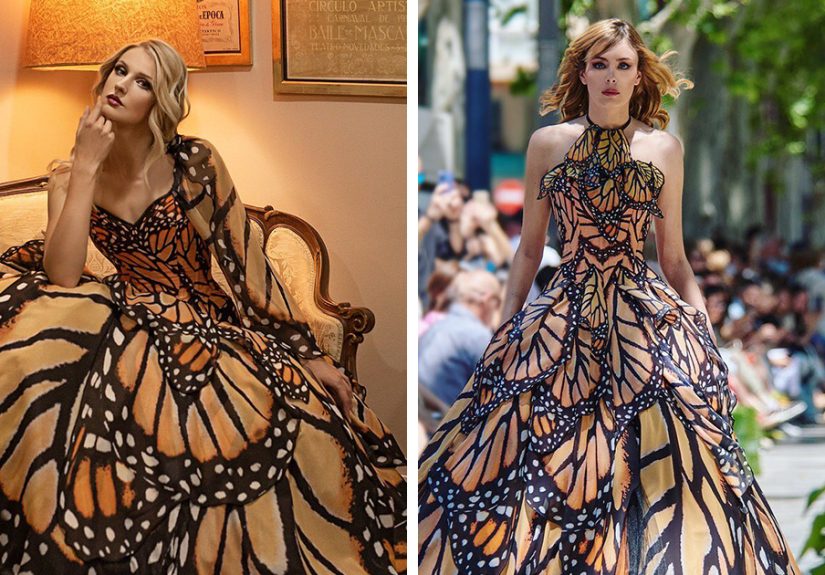
- The Monarch Moment: Warm orange-and-black wing patterning arranged to read bold, regal, and unmistakably iconic.
- Midnight Moth Energy: Dark, moody tones with delicate markingsromantic, mysterious, and slightly “spellbook chic.”
- Blue Morpho Illusion: Electric blues that feel luminous, especially when paired with sheer layers that catch light.
- Wing-Edged Hemline: A skirt that finishes with a scalloped, winglike borderlike the dress has its own silhouette signature.
- Cape-as-Wings: A cape or caplet that creates a literal “takeoff” vibe when arms lift or turn.
- Soft Pastel Fairy: Light pinks, creams, or lilacs for the “garden sprite who journals in calligraphy” aesthetic.
- High-Contrast Spots: Spot patterns (like ocelli) placed to emphasize movement and contour.
- Panel-Printed Precision: Wing sections aligned across the bodice so the anatomy reads intentional, not accidental.
- Vintage Fairy Dress Nod: A silhouette that hints at antique romancestructured top, flowing skirt, dreamy details.
- Floating Streamers: Thin fabric attachments that lift with motion for “caught by a gentle breeze” photos.
- Two-Tone Metamorphosis: A gradient shift from dark to light that mirrors transformation themes.
- Wings at the Shoulders: Details placed near the shoulder line to suggest “emergent wings” without bulky props.
- Cathedral Drama: Longer trains or sweeping skirts for maximum runway fantasy and maximum photographer happiness.
- Garden-Party Version: A more wearable silhouette that still carries the wing motif but feels less “gala at 9, forest portal at 10.”
- Gothic Fairy Variant: Dark lace styling, sharper contrast, and a mood that says, “Yes, I sparkle. Menacingly.”
- Romantic Corset Focus: A bodice that anchors the look and gives the print a clean, sculptural canvas.
- Back View Reveal: Wing placement that’s most striking from behinddesigned for the dramatic exit shot.
- Glove + Corset Styling: Accessories that deepen the fantasy and sharpen the editorial vibe.
- Soft-Focus Bridal Butterfly: A lighter palette and delicate textures that read wedding-ready with a twist.
- Editorial Lighting Magic: A look that changes personality depending on warm vs. cool lighting (great designs do that).
- Nature-Set Photoshoot: The gown placed in a garden, forest, or wildflower setting for full narrative payoff.
- Minimal Accessories, Maximum Print: Letting the wing motif do the talkingbecause it’s already shouting (beautifully).
- The “I’m Actually a Fairy” Finale: The most winged, the most flowing, the most “call my agent, I’m joining a fantasy film.”
How to Style a Butterfly Dress Without Overdoing It
When a dress is already serving “enchanted transformation,” your job is to support the storynot compete with it.
Here are styling approaches that keep the look elevated instead of costume-y.
Hair and makeup
- Soft romantic: loose waves, luminous skin, subtle shimmer near the eyes.
- Editorial bold: defined liner or a deeper lip, but keep one feature the hero.
- Nature-inspired: warm bronzes, petal tones, and delicate highlight placement.
Accessories
- Go light: small earrings or a simple ring often works bestthese dresses are already the main event.
- Choose one fantasy cue: a headpiece or dramatic gloves or a capepick one star, not an entire constellation.
- Shoes matter less than posture: if the skirt is full, prioritize comfort and stance so you can move like the wings belong to you.
Photo tips (because these dresses love a camera)
- Turn, don’t freeze: gentle rotation creates flutter and shows off drape.
- Use wind sparingly: a small fan is your friend; a leaf blower is your enemy.
- Show the back: wing placement often looks stunning from behindplan for at least one over-the-shoulder shot.
Beyond Pretty: The Conservation Conversation These Dresses Can Spark
Butterflies aren’t just aesthetic iconsthey’re also pollinators, and many species face habitat pressures.
The monarch, in particular, is widely discussed in conservation circles because of migration, habitat needs, and population declines.
While a couture dress won’t solve ecological threats, it can do something powerful: make people care.
Fashion has always borrowed from nature. The best versions of that borrowing also encourage respectwhether it’s planting native flowers,
reducing pesticide use in gardens, supporting pollinator habitat, or simply learning the story behind the wings that inspired the look.
In that sense, a butterfly dress can be both a fantasy and a gentle reminder: the real butterflies need a world where they can keep flying.
Why This Trend Feels Timeless (Even If the Photos Go Viral for a Week)
Viral content moves fast, but the butterfly dress taps into themes that don’t age out:
transformation, beauty, fragility, power, and the desire to feel extraordinary.
Add couture-level structure and smart surface design, and you get something that reads “mythic” even on a phone screen.
The bigger takeaway is this: the most memorable fashion doesn’t just decorate the body.
It creates a character, a mood, a story you can step into. These butterfly gowns do exactly that
and they do it with enough technical intention that the fantasy feels believable.
Experience Section (+): What It’s Like to Step Into the Butterfly-Fairy Aesthetic
Even if you never wear a couture butterfly gown, the experience of the butterfly-fairy aesthetic is surprisingly accessibleand honestly, kind of therapeutic.
People are drawn to it for the same reason they love garden walks, candlelight, or looking up at trees like they’re in a music video: it interrupts the ordinary.
The “real-life fairy” vibe isn’t about pretending you’re not a regular human with errands. It’s about giving your brain a tiny vacation to somewhere softer,
prettier, and more hopeful.
The first “experience” many people have with this style is through images: a model in a wing-printed gown, turning slightly so the fabric catches air.
Your mind fills in the movement. You can almost hear the flutter. That’s the trickgood design and good photography collaborate to create sensation.
The dress becomes a mood generator. You don’t just see it; you feel it.
If you’ve ever tried on a dramatic outfitsomething with a structured bodice or flowing layersyou know the posture shift that happens automatically.
Your shoulders roll back. Your steps slow down. You start moving like the outfit deserves a soundtrack.
That’s not vanity; it’s feedback. Clothing changes body language, and body language changes emotion.
Butterfly dresses amplify that because the motif itself carries meaning: transformation, emergence, “I’m allowed to become someone new.”
In photoshoots, the butterfly-fairy aesthetic tends to reward gentle motion more than aggressive posing.
Small turns, a slow lift of the arms, a walk that lets the skirt breathethose actions turn fabric into “wings.”
And there’s something surprisingly grounding about focusing on movement instead of perfection.
It’s not “hold still and be flawless.” It’s “move and be alive.” That’s a pretty great metaphor to wear, if you think about it.
The setting also becomes part of the experience. Put winglike textures against a hard urban background and the look reads editorial: contrast, edge, drama.
Put the same dress near greenery and it reads storybook: a creature of the garden, temporarily visible to humans.
Either way, you’re building a narrative, and narrative is what makes fashion feel personal instead of just decorative.
And here’s the best part: you don’t need an actual butterfly gown to borrow the feeling.
A butterfly hair accessory, a wing-printed scarf, a sheer capelet, or even a color palette inspired by monarch orange or morpho blue can bring the same energy.
The experience is less about owning a specific piece and more about letting yourself playstyling as self-expression, not self-judgment.
If you walk away from this trend with one lesson, let it be this: sometimes “dressing like a fairy” is just another way of saying,
“I’m giving myself permission to feel light.”