Table of Contents >> Show >> Hide
- Why Drew Barrymore’s Wellness Room Feels So Different
- The Color Story: Calm, but Make It Interesting
- Furniture That Says “Stay Awhile”
- Wellness Without the Gym Vibe
- The Bigger Design Lesson: A Wellness Room Should Engage the Senses
- How to Recreate Drew Barrymore’s Wellness Room Energy at Home
- What It Actually Feels Like to Spend Time in a Room Like This
- Conclusion
If a hug, a deep breath, and a really good cup of cucumber water somehow became a room, it would probably look a lot like Drew Barrymore’s wellness space. For the 2025 REAL SIMPLE Home, Barrymore helped create a retreat that feels warm, grounded, and deeply humannot in a “don’t-touch-the-furniture” kind of way, but in a “please sit down, exhale, and remember you are a person, not a to-do list” kind of way.
That is what makes this room so appealing. It is not chasing the icy, ultra-minimal spa look that can feel more intimidating than relaxing. Instead, Drew’s design leans into softness, terracotta warmth, curated comfort, and approachable luxury. It is stylish, yes, but it also feels emotionally intelligent. And in a world where “wellness” is often marketed with a side of expensive guilt, that is a refreshing plot twist.
The space reportedly takes cues from a spa waiting room, but the finished idea goes beyond aesthetics. It reflects a bigger shift in home design: people increasingly want rooms that support mental calm, daily rituals, and genuine restoration. Drew Barrymore’s wellness room is a celebrity-designed space, surebut it is also a surprisingly useful lesson in how to create a home that helps you lower your shoulders, unclench your jaw, and maybe stop doom-scrolling for 12 whole minutes.
Why Drew Barrymore’s Wellness Room Feels So Different
The genius of this room starts with its mission. Barrymore did not approach wellness as a sterile, one-size-fits-all concept. She approached it as an invitation. That is a big difference. Instead of designing a room that shouts “perform self-care now,” she shaped one that gently suggests, “Hey, maybe don’t forget yourself today.” That emotional tone matters.
Her style for the space is also intentionally eclectic. Drew has spoken about loving different design languages at oncemidcentury pieces, florals, Moroccan influence, antiques, and vibrant color. In lesser hands, that mix could feel like a garage sale with delusions of grandeur. In this room, it works because everything is filtered through one mood: calm. Nothing seems to compete. The room does not feel flat, but it also does not feel noisy. That balance is harder to achieve than it looks.
There is another reason the design rings true: it aligns with Barrymore’s public persona and personal habits. She has previously shared a meditation closet, even describing it as a kind of “room of revelations,” decorated with affirming messages. So this wellness room does not read like a random branding exercise. It feels like an extension of the emotional openness, optimism, and self-reflection people already associate with her.
The Color Story: Calm, but Make It Interesting
Let’s discuss the terracotta. Because if this room had a lead actor besides Drew, it would be the walls.
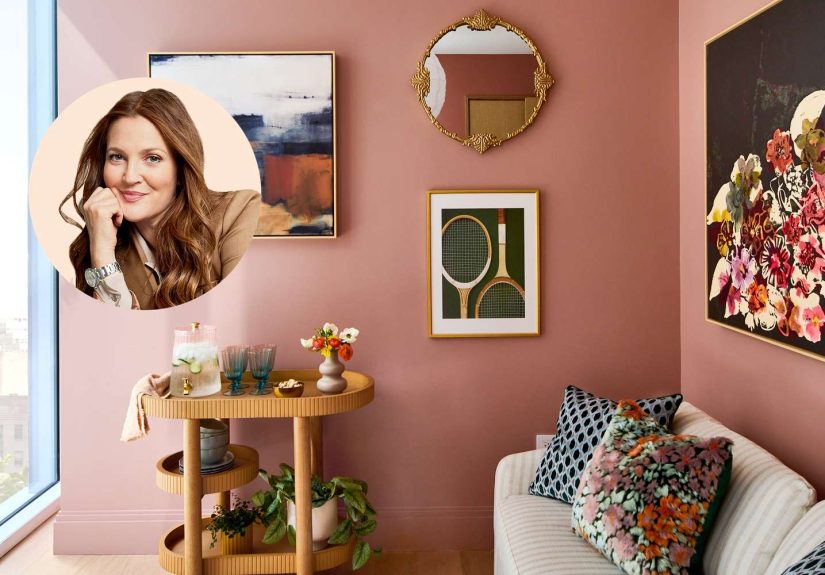
Instead of relying on default wellness shades like white, cream, or pale gray, the room is wrapped in a terracotta-leaning pink: Valspar’s Rosy Sandstone. It is earthy, warm, and quietly cocooning. Most important, it proves a point many homeowners miss: a calming room does not have to be beige enough to disappear into the witness protection program.
Terracotta works because it brings in warmth without becoming overstimulating. It has enough pigment to feel alive, yet enough earthiness to stay grounded. That sweet spot is exactly what makes wellness-oriented design more livable. You want a room that calms the nervous system, not one that looks like it has been medically sedated.
This choice also fits with broader home trends. Wellness-forward interiors increasingly favor comforting color palettes, natural textures, and spaces that feel restorative rather than merely photogenic. Drew’s room taps into that shift beautifully. The color does not just decorate the space; it sets the emotional temperature.
Why the palette works so well
The supporting tones matter, too. Preview coverage of the room pointed to light brown, tan, gold, mauve, wood accents, and patterned textiles. That mix softens the terracotta and gives it dimension. Warm metals add polish. Natural wood keeps things grounded. Textiles prevent the room from feeling visually flat. It is a layered palette, which is exactly why it feels rich instead of trendy.
Furniture That Says “Stay Awhile”
The room’s striped linen couch is one of the smartest choices in the whole design. Wellness spaces often make a classic mistake: they are technically beautiful but functionally awkward. A room can have perfect candles, a yoga mat, and a plant that is somehow thriving despite modern lifebut if there is nowhere comfortable to sit, the vibe collapses.
This sofa fixes that immediately. It tells you the room is meant to be used, not admired from a respectful distance like a museum exhibit about hydration. The stripe adds a gentle rhythm, the linen keeps things airy, and the scale makes the room feel welcoming rather than precious.
Across the room, an arched bookshelf adds both display and concealed storage. That combination is quietly brilliant. Open shelving gives the room personality through vases, plants, books, and a journal. Closed storage hides the not-cute but necessary stuff. That is the real secret sauce of a soothing room: beauty in sight, chaos out of sight.
And then there is the bar cartreimagined not for cocktails, but for spa-style comfort. Barrymore reportedly envisioned cucumber water and little bowls of nuts, which sounds both luxurious and hilariously specific in the best way. It is a reminder that wellness is often sensory and ritual-based. A room starts feeling restorative when it includes tiny experiences that make you pause.
Wellness Without the Gym Vibe
One of the most practical things about Drew Barrymore’s wellness room is that it includes movement without turning the room into a punishment chamber full of ugly equipment. That is not a small detail. Exercise tools are useful, but many of them have the visual charm of airport infrastructure.
Barrymore’s solution was to include aesthetically appealing gear, including Bala Balance Blocks and a Stakt fitness mat. That choice captures a larger truth about wellness design: if you want healthy habits to stick, your environment has to support them without making the space feel harsher. Put differently, if your wellness room looks like a storage closet attached to a boutique gym, you may admire it, but you probably will not linger there.
In Drew’s version, movement is integrated into the room’s personality. The fitness pieces do not scream for attention. They coexist with the seating, the styling, and the soft atmosphere. That makes the room feel holistic. Wellness here is not just exercise. It is stretching, reading, journaling, drinking water, breathing, sitting still, and yes, doing all of that in a place that does not assault your eyeballs.
The Bigger Design Lesson: A Wellness Room Should Engage the Senses
What makes a space calming is rarely one object. It is usually a combination of sensory signals. Designers and wellness experts alike keep coming back to the same ingredients: softer lighting, reduced clutter, tactile comfort, natural references, and moments that encourage mindfulness. Drew’s room works because it checks those boxes without becoming formulaic.
1. Light matters more than people think
Harsh overhead lighting can make even a lovely room feel like a dentist’s office with better throw pillows. Wellness-minded interiors benefit from indirect lighting, a softer glow, and layered illumination that feels warm and adaptable. Drew’s room embraces that cozy, eyelids-get-heavy atmosphere instead of a bright, “let’s answer emails in here” energy.
2. Clutter is not neutral
There is a reason decluttering advice shows up in both design coverage and psychology conversations. Visual chaos can feel mentally loud. That does not mean every home should look empty, but it does mean soothing spaces need some editing. Drew’s room avoids overload. Styled items feel chosen, not dumped. Storage is built into the design. The room breathes.
3. Natural elements do heavy lifting
Biophilic designthe practice of bringing in nature-inspired materials, light, and greenerycontinues to shape wellness interiors for good reason. Plants, earthy tones, wood, and organic textures all help a room feel more grounded. Barrymore’s room does not need to cosplay as a rainforest to capture this effect. A few living plants, natural surfaces, and a warm palette are enough to create that connection.
4. Softness is a strategy
Linens, cushions, rugs, and tactile surfaces are not decorative fluff. They tell the body that a room is safe to settle into. Designers making spa-like environments often emphasize texture because the nervous system notices it. Drew’s wellness room gets this. The comfort is visible before you even sit down.
5. Sound and stillness deserve attention
Many calming spaces fail because they only think visually. But sound shapes mood, too. The most restorative rooms often use fabric, rugs, curtains, and upholstered pieces to absorb harsh noise. Even when a room is not designed specifically for sleep, borrowing a few bedroom-like sound-softening ideas can make it feel significantly more peaceful.
How to Recreate Drew Barrymore’s Wellness Room Energy at Home
You do not need celebrity access, a penthouse, or a suspiciously photogenic stack of wellness books to borrow from this design. What you need is a corner, a purpose, and a little intention.
Start with one emotional goal
Do you want your space to feel grounding, uplifting, sleepy, quiet, cozy, or reflective? Barrymore’s room is successful because it knows exactly what it wants to do: soothe. Pick one emotional job for your own room and let that guide every choice.
Choose color before accessories
A calming paint color will do more for your space than 17 trendy objects ever could. If terracotta feels too bold, try muted clay, dusty rose, warm mushroom, olive, or soft brown. The point is warmth and comfort, not sterile perfection.
Add one anchor piece you genuinely love
That could be a comfortable chair, a low sofa, a daybed, or even a cushioned bench. A wellness room should welcome your body first. Pretty comes after comfortablenot because style does not matter, but because comfort is the style in a room like this.
Create a ritual station
Drew’s bar cart idea is gold because it turns wellness into an action. Try a tray with tea, water, a candle, a notebook, hand cream, or a speaker for calming music. Tiny rituals are what make a room feel alive.
Hide the visual mess
Use baskets, cabinets, lidded boxes, or furniture with closed storage. Peaceful rooms are not always empty. They are just edited well.
Let movement live there, too
A folded mat, a pair of hand weights, or yoga blocks can belong in the room if they are integrated thoughtfully. Wellness is easier to practice when it lives in plain sight without looking chaotic.
What It Actually Feels Like to Spend Time in a Room Like This
Imagine walking into a space at the end of a long day when your brain still has 46 tabs open. One is work. One is laundry. One is that text you forgot to answer. Three are existential. Then you step into a room like this.
The first thing you notice is not an object. It is the absence of tension. The light is soft. The color wraps around you instead of bouncing off the walls like a fluorescent tennis match. The room does not demand anything. It does not ask you to be productive, prettier, fitter, more efficient, or more optimized by sunrise. It just lets you arrive.
You sit down on the striped couch and, almost immediately, your breathing changes. Not in a dramatic movie-montage way. Just enough to notice. The kind of breath where your chest finally gets the memo that the emergency is over. There is a glass of water nearby, maybe something citrusy or cucumber-infused if you are feeling fancy, and maybe a bowl of almonds pretending to be a life philosophy. Somehow, it all works.
Your eyes move around the room and nothing feels aggressive. A plant leans casually from a shelf. A journal waits without judgment. The bookshelf holds beautiful things, but not so many that you feel visually heckled by decor. Even the exercise equipment looks approachable, like movement is an option rather than a moral performance. You could stretch here. You could read. You could do absolutely nothing and still count it as time well spent.
That may be the most powerful part of a room like this: it restores permission. Permission to pause. Permission to be quiet. Permission to have a home that gives something back to you instead of constantly asking for upkeep, output, and maintenance. In that way, the room becomes bigger than design. It becomes a daily reset button.
A well-made wellness room also changes how time feels. Five minutes in it feels longer than 20 minutes slumped over your phone. You notice textures. You hear less noise. You become aware of your own energy in a gentler way. Maybe you light a candle. Maybe you write down one sentence in a notebook. Maybe you just stare at the wall and let your thoughts untangle like earbuds finally pulled from a pocket. That counts, too.
And because this particular room is tied to Drew Barrymore’s sensibility, it carries a certain emotional warmth. It does not feel polished into coldness. It feels personal, hopeful, a little eclectic, and deeply kind. That kindness is easy to underestimate, but it is exactly what many rooms are missing. Plenty of interiors are beautiful. Far fewer are reassuring.
So yes, on paper, this is a celebrity-designed wellness room in a showcase home. But in practice, it is a very relatable idea. We all need one place that tells us to soften a little. One place that says the day can wait five minutes. One place that does not care whether we came in wearing matching loungewear or carrying emotional chaos and a half-finished granola bar. Drew Barrymore’s room captures that feeling. And that is why it lingers in your mind long after you stop looking at the pictures.
Conclusion
Drew Barrymore’s wellness room succeeds because it understands something many “calming” spaces miss: peace is not created by emptiness alone. It is created by warmth, sensory comfort, emotional intention, and small rituals that make daily life feel more humane. From the terracotta walls and cozy striped sofa to the journal, plants, bar cart, and design-friendly fitness gear, every element works toward one feeling: exhale here.
That is what makes the room memorable. It looks beautiful, but it also feels useful. It does not just show off decor; it models a better relationship with home. In a culture obsessed with doing more, Drew Barrymore designed a room that reminds us to be more present. Frankly, that might be the most luxurious feature of all.