Table of Contents >> Show >> Hide
- What Is GGWave, Exactly?
- How GGWave Turns Data Into Sound
- Why Developers Keep Falling for Sound-Based Data Transfer
- Real-World Use Cases That Make GGWave More Than a Party Trick
- GGWave and Data Sonification: Cousins, Not Twins
- What GGWave Does Better Than You Might Expect
- The Limits Matter, Too
- Why “The Songs of Your Data” Is More Than a Metaphor
- Hands-On Experiences With GGWave and Sound-Based Data
- Conclusion
- SEO Tags
Some technologies arrive in a blaze of billion-dollar buzzwords. Others stroll in like a clever street musician, make your laptop chirp like a tiny robot bird, and quietly steal the show. GGWave belongs in the second category. It is one of those delightfully nerdy tools that makes you stop, listen, and ask, “Wait, did my computer just send data through sound?” Yes. Yes, it did.
At first glance, GGWave feels like a retro modem wearing modern sneakers. It takes digital data, translates it into carefully structured tones, and sends that information through speakers and microphones. But calling it “just an audio modem” is like calling a sushi knife “just a sharp object.” Technically true, emotionally incomplete. GGWave sits at the intersection of acoustic data transmission, short-range device communication, lightweight IoT creativity, and the broader idea of turning information into sound.
That makes the title GGWave Sings The Songs Of Your Data more than a cute phrase. It is a surprisingly accurate description. GGWave gives data a voice. Not a dramatic Broadway solo, maybe more like a crisp sequence of digital chirps, but still: your payload becomes something you can hear, capture, decode, and use.
What Is GGWave, Exactly?
GGWave is a compact data-over-sound library designed to send small chunks of information between nearby devices using ordinary audio hardware. Instead of depending on Bluetooth, NFC, QR codes, or a local network setup for every interaction, GGWave can move short messages through the air with sound alone. If a device has a speaker and another device has a microphone, the conversation can begin.
That design makes GGWave especially interesting for lightweight, local, and sometimes delightfully weird workflows. Think device pairing, one-to-many broadcast, sound-based triggers, quick command transfer, air-gapped message passing, and experimental projects that need a tiny communication channel without the overhead of traditional networking. It is not trying to replace Wi-Fi. It is trying to do a very specific trick remarkably well.
And yes, there is a practical ceiling. GGWave is built for small amounts of data, not giant files or streaming cat videos in surround sound. Its transmission rate is modest, which is exactly why it works so well for small payloads like tokens, commands, identifiers, contact snippets, pairing data, or little bursts of machine-readable information. In other words, it is less “Netflix over a kazoo” and more “smart handshake through chirps.”
How GGWave Turns Data Into Sound
The magic is not actually magic, which is rude but expected. Under the hood, GGWave uses a frequency-shift keying approach to encode data into tones. The payload gets broken into smaller pieces, and those pieces are mapped onto carefully chosen frequencies. A receiver listens, analyzes the incoming sound, detects which frequencies are present, and reconstructs the original information.
Small Data Chunks, Multiple Tones, Clever Framing
One of the elegant parts of GGWave is the way it organizes data into small bit chunks and transmits several tone components together. That multi-tone structure helps the receiver understand not just the value being sent, but also where each value belongs inside the packet. The result is a protocol that feels compact, methodical, and far less chaotic than random beeps from a haunted fax machine.
In practical terms, GGWave treats sound like a structured transport layer. Each transmitted burst is not merely noise with ambition. It is a designed signal with markers, expected timing, and a decodable frequency layout. That is why it can work across laptops, phones, browsers, and small microcontroller projects without demanding exotic hardware.
Error Correction Is the Unsung Hero
Real rooms are noisy. Speakers distort. Microphones sulk. Users cough at the worst possible moment. GGWave accounts for that reality by using error correction, which helps recover the original payload even when the transmission is not perfectly clean. This is the difference between a neat demo and a tool that can survive actual physical air, which is famously full of nonsense.
GGWave also uses start and end markers so the receiver can detect when a valid transmission begins and ends. That framing matters. Without it, a decoder would be stuck guessing whether it was hearing a data packet, a ringtone, or someone accidentally launching a synth app.
Why Developers Keep Falling for Sound-Based Data Transfer
There is something immediately charming about acoustic communication. It feels human-scale. You can hear it, test it, and demo it in seconds. It does not disappear behind invisible radio stacks or obscure device permissions. It is tangible in the most literal way: the information becomes sound waves moving through a room.
That charm, however, is backed by legitimate technical value.
- No specialized radio required: speakers and microphones are everywhere.
- Great for nearby-device workflows: the physical range becomes part of the security and user experience story.
- Useful for air-gapped or lightly connected situations: small payloads can move without a conventional network session.
- Simple demos and prototypes: GGWave works nicely in browsers, Python environments, and microcontroller experiments.
- One-to-many broadcasting: a single sound emission can be heard by multiple nearby receivers.
This is where GGWave stops being a novelty and starts becoming a platform idea. Once developers realize they can trigger actions, pair devices, pass short messages, or bootstrap local interactions through sound, the imagination kicks in. Suddenly the same library can support a toy project, a kiosk setup, an IoT prototype, or a clever local-first user experience.
Real-World Use Cases That Make GGWave More Than a Party Trick
1. Device Pairing Without Extra Friction
Pairing is one of the most obvious wins. Instead of asking users to scan a QR code, type a code, or grant a pile of permissions, a device can emit a short sound payload that another device recognizes. That can be useful for companion apps, second-screen experiences, temporary trust setup, or nearby-device discovery. The whole interaction feels quick because it is quick.
2. Browser-to-Browser and Local Web Experiences
GGWave’s browser-friendly story is one of its most appealing strengths. With Web Audio support and browser demos, developers can build sound-based interactions that run without asking users to install heavyweight native software. That opens the door to experiments where one browser shares minimal signaling data with another nearby browser, helping establish a local relationship before larger data channels take over.
It is a clever bridge between the physical room and the web stack. Your webpage does not just display information anymore. It can literally sing instructions to another device.
3. Microcontrollers and IoT Projects
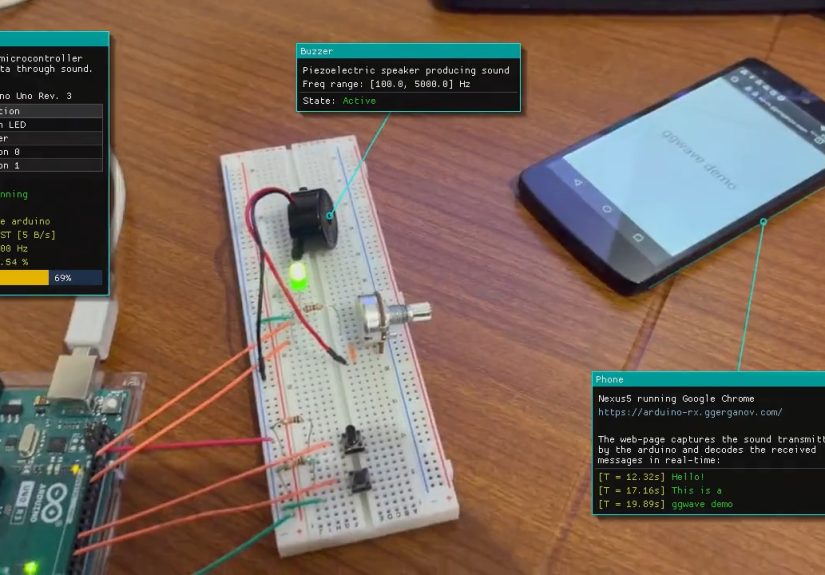
GGWave also shines in embedded projects. A piezo buzzer, a small mic, and a modest board can suddenly participate in acoustic messaging. This is especially attractive for hobbyists and prototype teams because it reduces the hardware burden. You can create devices that broadcast short commands, identifiers, or status messages without adding a full wireless stack for every experiment.
That is why sound-based communication keeps popping up in maker circles. It is cheap, visible, testable, and fun. Also, let us be honest, nothing improves a demo quite like a gadget that chirps secret data into the air and gets understood by another gadget across the room.
4. Audio QR Codes and Broadcast Tokens
The phrase “audio QR code” gets people’s attention because it captures the value proposition fast. Like a QR code, the payload is short and purposeful. Unlike a QR code, the user does not need a camera or careful framing. The receiving device just listens. For broadcasts such as tokens, links, commands, or identifiers, that can be surprisingly convenient.
GGWave and Data Sonification: Cousins, Not Twins
The title of this article leans into the poetry of data becoming sound, but it is worth drawing an important distinction. In the strict research sense, data sonification often means mapping data relationships into auditory patterns so people can interpret trends, structures, movement, or meaning by listening. NASA, biomedical researchers, and auditory display designers use sonification to make data more accessible, more engaging, or more analyzable.
GGWave overlaps with that world, but it serves a different primary purpose. Traditional sonification is often about human interpretation. GGWave is mostly about machine-readable transmission. In plain English: sonification asks humans to hear meaning in data, while GGWave asks machines to recover data from sound. One is often interpretive. The other is communicative.
Still, the overlap is fascinating. Both approaches prove that sound is not just decoration. Audio can carry structure, state, relationship, and instruction. It can support accessibility, multitasking, ambient awareness, and local interaction. So even if GGWave is not a sonification framework in the academic sense, it absolutely belongs in the wider conversation about how sound can become an information channel rather than just a soundtrack.
What GGWave Does Better Than You Might Expect
GGWave’s biggest surprise is how modern it feels despite using a communication medium that seems almost old-fashioned. There is something elegant about solving present-day problems with nothing more exotic than speakers and microphones. Nearby-device communication, local pairing, and lightweight signaling all benefit from that simplicity.
It also benefits from platform flexibility. A technology becomes much more interesting once it can move between phones, browsers, Python scripts, desktop tools, and embedded boards. GGWave does not trap itself in one ecosystem. That portability is a major reason it keeps showing up in demos and discussions. Developers like tools that can escape the lab.
Another strength is psychological. Sound-based transfer creates obvious user feedback. When a device emits a packet, everyone in the room can tell that something is happening. That feedback makes prototypes easier to understand and troubleshoot. Compare that with many wireless workflows, where everything important happens invisibly and users are left staring at a loading spinner like it owes them rent.
The Limits Matter, Too
GGWave is clever, but it is not a universal answer to communication. Its bandwidth is intentionally low. Background noise can interfere. Hardware quality matters. Ultrasonic modes exist, but not every speaker and microphone handles them equally well. Acoustic channels also have physical quirks that make them very different from radio-based networking.
So the right way to think about GGWave is not “How do I replace Bluetooth with chirping?” The better question is “Which small, local, structured interactions become easier, cheaper, or more playful when I can send a short message through sound?” That framing keeps expectations realistic and helps teams spot the use cases where GGWave is genuinely brilliant.
Why “The Songs of Your Data” Is More Than a Metaphor
Data is usually silent. It hides in packets, buffers, fields, logs, and APIs. GGWave gives it an audible body. A string, token, or signal becomes a sequence of tones that travels through space, lands in a microphone, and becomes meaningful again on the other side. That is both technically practical and strangely beautiful.
There is also a deeper lesson here. We often treat interfaces as visual by default. But modern computing is richer than screens alone. Sound can notify, guide, encode, instruct, reveal patterns, and help people interact in new ways. GGWave is a reminder that the ear is not merely an accessory to computing. Sometimes it is part of the protocol.
And maybe that is why GGWave keeps resonating with developers, educators, makers, and curious tinkerers. It is useful, yes. But it is also delightful. It turns abstract digital transfer into something physical, audible, and just a little theatrical. Your data does not simply move. For a brief second, it performs.
Hands-On Experiences With GGWave and Sound-Based Data
The most memorable thing about experimenting with GGWave is how quickly the concept stops feeling theoretical. Reading about sound-based communication is one thing. Hearing a laptop emit a short burst of tones and then watching another device decode the message is something else entirely. The room changes. Suddenly software feels less like a hidden process and more like an event.
A common first experience is playful disbelief. You send a short word, hear a robotic chirp, and wait for the receiving device to respond. When it does, the reaction is usually half engineering satisfaction and half “No way, do it again.” That emotional loop matters because it makes the learning curve feel rewarding. Developers understand protocols faster when they can hear the protocol happen.
Another experience that stands out is how GGWave encourages disciplined thinking about payload design. Because the channel is intentionally small, you stop wasting bytes. You ask better questions. What truly needs to be sent? Can the message be shorter? Should this tone carry a token, a command, a session hint, or a compact ID instead of a bloated structure? GGWave teaches efficiency the way a tiny apartment teaches furniture discipline.
In browser experiments, the experience often feels surprisingly futuristic. A webpage becomes more than a page. It becomes a transmitter or receiver, using the audio stack as part of the interface. That makes web prototypes feel alive in a way that forms and buttons rarely do. You are not just clicking submit. You are launching a brief acoustic handshake into the world.
On the hardware side, GGWave can be even more charming. A simple embedded board with a buzzer suddenly gains a communication personality. Instead of blinking an LED to say “I exist,” it can identify itself, trigger a workflow, or broadcast a tiny message. The result feels whimsical, but also practical. Low-cost devices get a lightweight channel for local interaction without dragging in a full networking configuration on day one.
There are frustrations, too, which is honestly part of the fun. Rooms are noisy. Cheap speakers can be dramatic. Some microphones behave like they are auditioning for a role as “unreliable narrator.” Ultrasonic modes may work beautifully on one setup and refuse to cooperate on another. But those rough edges make the successful moments more satisfying. You learn to respect acoustics, timing, volume, and environmental noise in a very hands-on way.
Perhaps the most interesting experience is conceptual rather than technical: GGWave changes the way you think about interfaces. Once you see data travel as sound, you start noticing opportunities everywhere. Kiosks, museum exhibits, toy devices, classroom demos, second-screen interactions, temporary device pairing, and local-first workflows all begin to look different. You start asking whether a short sound can do the job before reaching for a heavier stack.
That is the lasting impression GGWave leaves behind. It is not merely a library. It is a perspective shift. It reminds you that information does not have to stay trapped in text fields, packets, and dashboards. Sometimes information can chirp, sing, pulse, and move through the air like a tiny mechanical melody. And once you have experienced that, normal software starts to feel a little too quiet.
Conclusion
GGWave proves that acoustic data transmission can be more than a quirky throwback. It is a practical, creative, and surprisingly elegant way to send short messages between nearby devices using hardware most people already have. By turning payloads into structured tones, GGWave makes computing feel audible, physical, and immediate.
Whether you care about browser demos, embedded projects, device pairing, local-first workflows, or the broader relationship between sound and information, GGWave offers a compelling idea: data does not always have to travel invisibly. Sometimes the smartest packet in the room is the one that arrives with a chirp, leaves with a purpose, and sounds just enough like a tiny robot to make you smile.