Table of Contents >> Show >> Hide
- Table of Contents
- What Is Gua Sha?
- Gua Sha Benefits: What the Evidence Actually Suggests
- 1) Increased microcirculation (aka more local blood flow)
- 2) Short-term pain relief for tight, cranky muscles (especially the neck)
- 3) Temporary reduction in puffiness (likely via fluid movement + massage effects)
- 4) Stress relief and jaw/neck relaxation
- 5) Other researched uses (small studies; promising, not definitive)
- Facial Gua Sha Expectations: What It Can (and Can’t) Do
- Choosing a Gua Sha Tool (and Not Getting Scammed by a Sparkly Rock)
- Safety, Side Effects, and Who Should Skip It
- How To Do Facial Gua Sha (Step-by-Step)
- How To Do Body Gua Sha (At-Home Basics)
- Common Mistakes (and How to Fix Them)
- FAQ
- Conclusion
- Real-World Gua Sha Experiences (What It Feels Like in Everyday Life)
Gua sha (pronounced “gwah-shah”) has gone from “ancient wellness secret” to “your neighbor’s new bedtime ritual”
in record time. One minute it’s a traditional East Asian technique used for sore muscles and “stuck” feelings in
the body; the next it’s a rose-quartz heart-shaped tool living in everyone’s skincare drawer like it pays rent.
Here’s the real deal: gua sha can feel amazing, may support circulation, and can be a surprisingly effective
way to relax tight musclesespecially in the neck and jaw. But it’s not magic, it’s not supposed to hurt, and it
definitely shouldn’t leave you looking like you got into a fight with your bathroom counter (unless you’re doing
traditional body gua sha with a trained practitioner, where temporary redness and petechiae can be expected).
This guide breaks down what gua sha is, what benefits have actual evidence (and what’s mostly hype), and exactly
how to do it safely on your face and bodystep by step.
What Is Gua Sha?
Gua sha is a technique where a smooth-edged tool is stroked along the skin in a controlled way. Traditionally,
it’s used on the body with firmer pressure to address tension and pain and intentionally raises temporary
redness or petechiae (“sha”). Modern facial gua sha is typically much gentlermore like a glide than a scrape.
Face vs. Body Gua Sha: Same idea, very different intensity
-
Body gua sha: Often performed by trained practitioners. Pressure can be moderate to firm, and
temporary redness/petechiae may be part of the method. -
Facial gua sha: Light pressure only. The goal is to avoid tugging the skin. Think “massage,” not
“sandpaper audition.”
Gua Sha Benefits: What the Evidence Actually Suggests
Research on gua sha is still limited, but we do have some helpful studies plus clinical guidance on where it may
fit as a complementary practice. Here are the benefits with the most reasonable support.
1) Increased microcirculation (aka more local blood flow)
Multiple sources describe gua sha as increasing local microcirculationblood flow through small vessels near the
surface. In plain English: the area you work on may temporarily get more circulation, which can contribute to a
warm, “awake” feeling in tissues. That’s one reason people report a post-gua-sha glow on the face and a looser
feel in tight muscles.
2) Short-term pain relief for tight, cranky muscles (especially the neck)
One of the better-studied areas is musculoskeletal pain. In a randomized controlled trial on chronic neck pain,
participants who received a gua sha session improved more over the following week than those who used heat pads.
That doesn’t mean gua sha is a curebut it suggests it can be a useful add-on for tension-related discomfort,
especially when paired with posture work, mobility, and smart strengthening.
3) Temporary reduction in puffiness (likely via fluid movement + massage effects)
The internet loves to promise “snatched” cheekbones in 90 seconds. Realistically, facial gua sha may help
temporarily reduce puffiness by encouraging fluid movement and relaxing facial tension. If you’re puffy
from salty food, poor sleep, or crying at a movie trailer (no judgment), gentle massage can make your face look
a little less “I just woke up in economy class.”
4) Stress relief and jaw/neck relaxation
Many people carry stress in the jaw, temples, and neck. A slow, mindful gua sha routine can act like a mini
downshift for your nervous system. Even when a benefit is partly from relaxation, that’s not “fake”it’s your
body responding to care.
5) Other researched uses (small studies; promising, not definitive)
Smaller studies and clinical discussions have explored gua sha for issues like breast engorgement discomfort and
perimenopausal symptoms. The takeaway: it may help some people, but the evidence base isn’t large enough to make
big guarantees. If you’re dealing with medical symptoms, treat gua sha as supportivenot a replacement for care.
Facial Gua Sha Expectations: What It Can (and Can’t) Do
What facial gua sha can do
- Depuff temporarily (especially under-eye and cheek fluidiness)
- Relax facial tension (jaw, temples, brow)
- Boost a short-term glow by increasing circulation
- Help products spread (because you’re using oil/serum and reducing friction)
What facial gua sha can’t do (despite what your feed says)
- Change your bone structure or “move” fat permanently
- Replace injectables or treat medical skin conditions on its own
- Fix chronic swelling from an underlying health issue (that needs evaluation)
The most reliable results come from consistency and gentleness. If you do it like you’re trying to erase a
Sharpie mark, you’ll get irritationnot cheekbones.
Choosing a Gua Sha Tool (and Not Getting Scammed by a Sparkly Rock)
Material: jade, rose quartz, stainless steeldoes it matter?
The biggest factor is not the crystal’s “vibe,” it’s the tool’s shape, smoothness, and hygiene.
Many materials work. Natural stones can feel cool and soothing. Stainless steel is durable and often easier to
clean thoroughly. Pick something that feels comfortable in your hand and glides without sharp edges.
Shape: what to look for
- Curved “wing” edge: great for jawline and cheeks
- Notch/V-shape: designed to hug the jaw or cheekbone
- Smaller edge: helpful around the eyes (very gently)
How to clean your gua sha tool
Basic rule: if it touches your face, it shouldn’t be crusty. Wash with gentle soap and warm water after use,
dry it, and store it clean. If you’re doing body gua sha with enough pressure to cause petechiae or possible
micro-bleeding, hygiene standards become much more importantdon’t share tools, and disinfect properly.
- Everyday facial use: soap + warm water, then dry
- Extra caution: wipe with 70% isopropyl alcohol (if tool material allows)
- Replace it: if chipped or cracked (rough edges can irritate skin)
Safety, Side Effects, and Who Should Skip It
When done correctly, gua sha is generally considered safe, but it can cause temporary redness, bruising, or
skin discolorationespecially with too much pressure. It should never be performed over irritated or inflamed
skin (think: sunburn, rashes, open wounds).
Be extra careful (or avoid) if you:
- Take blood thinners or have a bleeding/clotting disorder
- Have circulation issues or certain chronic health conditions
- Have active eczema/psoriasis flares or very inflamed acne
- Are pregnant (ask your clinician first)
- Recently had surgery or have fragile skin
Also: if it hurts, stop. Gua sha should feel like “ahhh,” not “call my lawyer.”
How To Do Facial Gua Sha (Step-by-Step)
Facial gua sha is best done slowly, with light pressure, on lubricated skin. The goal is glidenot drag.
Before you start
- Cleanse your face and wash your hands.
- Apply slip: use a facial oil or a serum that gives glide (avoid tugging).
- Hold the tool almost flat to the skin (a low angle helps reduce pulling).
- Use one direction per stroke (don’t saw back and forth).
The simple 5–10 minute routine
Do 3–5 slow strokes per line. Go lighter than you think you needespecially near the eyes.
-
Neck (prep the pathway):
Start behind the ear and glide gently down the side of the neck toward the collarbone.
Repeat on both sides. -
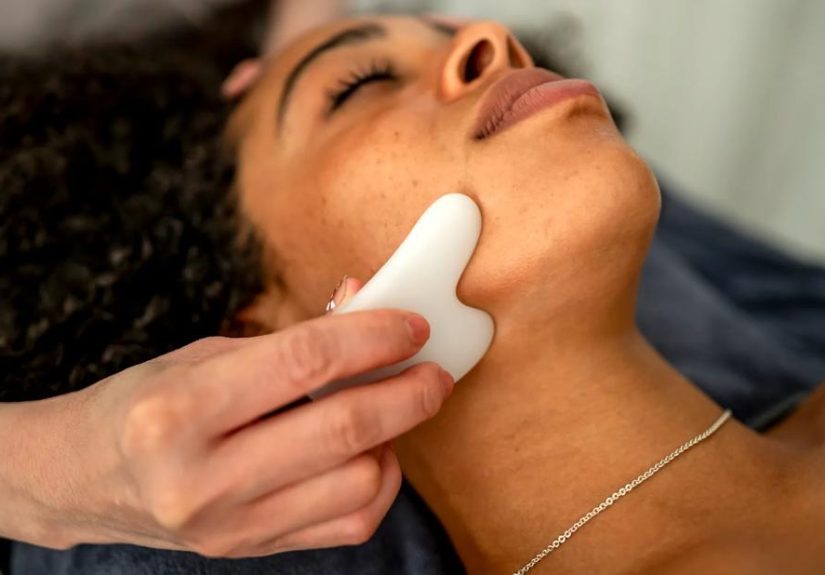
Jawline:
Place the tool at the chin and glide along the jaw toward the ear. Keep pressure light to moderate. -
Cheeks:
Start near the side of the nose or mid-cheek and glide outward and slightly upward toward the ear. -
Under-eye (ultra gentle):
Use the smallest, smoothest edge. Start at the inner under-eye area and glide outward toward the temple.
If your skin stretches, reduce pressure and angle. -
Brow and forehead:
Glide from the brow area upward toward the hairline, then from the center of the forehead outward. -
Finish:
Do a few soothing downward neck strokes again to end calmly (and to avoid ending your routine like a caffeinated squirrel).
How often should you do facial gua sha?
Many people do it a few times per week, and some prefer a brief daily routine if their skin tolerates it.
Start with 2–3 times weekly and adjust based on redness, sensitivity, and how your skin feels the next day.
How To Do Body Gua Sha (At-Home Basics)
Body gua sha can be more intense and is often best learned from a trained practitionerespecially if you’re
aiming to address pain. If you’re doing gentle at-home work, keep it conservative.
Body gua sha rules that keep you out of trouble
- Use lubrication: body oil or lotion to reduce friction.
- Stroke toward the heart (for limbs) with steady, controlled movement.
- Avoid bony areas and do not scrape over varicose veins.
- Don’t chase “more color” as proof you did it right.
Example: neck and shoulders (desk-body special)
- Apply oil to the upper trapezius (the “I answer emails for a living” muscle).
- With a rounded edge, glide from the shoulder area toward the base of the neck using light-to-moderate pressure.
- Keep strokes one-directional. Do 5–10 passes, then reassess. Looser? Great. Sore or bruising? Too much.
If you have persistent pain, numbness, tingling, or weakness, don’t self-treat indefinitelyget evaluated.
Common Mistakes (and How to Fix Them)
Mistake 1: Using too much pressure on the face
Fix: lighten up. Facial gua sha should be gentle. If you see bruising or broken capillaries, back off and give
your skin time to recover.
Mistake 2: Tugging dry skin
Fix: add more slip. Use oil/serum. If the tool drags, your skin will not thank you with “anti-aging.”
Mistake 3: Going back and forth like you’re sanding a table
Fix: use smooth, one-direction strokes. It’s calmer, kinder, and more consistent with common technique guidance.
Mistake 4: Ignoring hygiene
Fix: wash the tool after each use. Don’t share it. If your skin is broken, treat it like any other situation
where infection risk matters.
Mistake 5: Expecting permanent contouring after one session
Fix: treat gua sha like brushing your teeth: small, consistent habits add up. Results are often subtle and
temporary, especially for puffiness.
FAQ
Is gua sha supposed to leave marks?
Traditional body gua sha may intentionally create petechiae. Facial gua sha generally should not bruise.
Some temporary redness can happen, but pain and bruising are signs you’re doing too much.
Can gua sha help with headaches?
Some people report relief, possibly due to muscle relaxation and circulation changesespecially if headaches are
linked with neck/jaw tension. Evidence exists but is limited, so treat it as a supportive option rather than a
guaranteed fix.
Can I do gua sha if I have fillers or Botox?
Ask your injector for timing guidance. In general, avoid aggressive facial massage immediately after cosmetic
procedures. When in doubt, pause and get professional advice.
When will I see results?
Puffiness changes can be quick (minutes to hours). Muscle relaxation can feel immediate. Longer-term “glow”
benefits tend to be about consistency and supporting habits (sleep, hydration, skincare routine), not a single
miracle session.
Conclusion
Gua sha works best when you treat it like a smart, gentle practicenot a viral challenge. The most believable
benefits include increased local circulation, relaxation of tight muscles (especially in the neck/jaw), and
temporary reduction in puffiness. Keep your pressure light on the face, use plenty of slip, move in one
direction, and treat hygiene like it matters (because it does).
If you want the best of both worlds, learn the basics at home for facial relaxation and consider a trained
practitioner for body painespecially if you’re tempted to go harder. Your skin and your future self will
appreciate the restraint.
Real-World Gua Sha Experiences (What It Feels Like in Everyday Life)
If you’re curious whether gua sha is “worth it,” it helps to think in terms of experiences, not miracles.
Most people who stick with it don’t do so because it turned them into a different person overnightthey do it
because it fits neatly into real life in a way that feels good.
For example, one of the most common “aha” moments happens on a puffy morning. You know the kind: you slept fine,
but your face looks like it attended a salty-food festival without you. A gentle five-minute facial routineoil,
slow strokes, light pressurecan leave your skin looking calmer and more “awake.” The change is usually subtle
rather than dramatic, but it can be enough to make you feel more put together on a video call. People often
describe it as the difference between “fresh” and “I just woke up and chose chaos.”
Another frequent experience is jaw and temple relief. If you clench your teeth while concentrating, or if your
stress shows up as a tight face, gua sha can act like a physical exhale. The routine forces you to slow down,
and that alone is powerful. The combination of gentle pressure and repetitive motion can make your jaw feel less
“locked,” your temples less tense, and your whole head a little quieter. It’s not a medical treatment for
serious TMJ disorders, but as a calming practice, many people find it genuinely comforting.
Desk workers often notice the biggest payoff when they use gua sha on the neck and shoulders carefully (or
better, with a professional). After a day of hunching over a laptop, the upper traps can feel like two stressed
-out bricks. When gua sha is done conservatively with oil and controlled strokes, the area can feel warmer and
loosersimilar to the after-effect of a massage. The key experience here is “release,” not “bruising.” People
who overdo it tend to report soreness and discoloration, while those who keep it moderate report a sense of
mobility and comfort.
There’s also the “ritual effect,” which is real even if it sounds fluffy. Many people pair gua sha with other
habitslike turning down bright lights, playing relaxing music, or doing a few deep breaths. Over time, the tool
becomes a cue: “We’re winding down now.” That conditioning can make it easier to fall asleep or transition out
of work mode. In that sense, gua sha becomes less about the tool and more about the routine you build around it.
Finally, a practical experience that surprises beginners: your technique gets better fast. The first few times
might feel awkwardlike you’re trying to use a tiny spatula to sculpt your face. But once you find the angles
that work for your cheekbones and jaw, it becomes almost automatic. Most people end up customizing: fewer strokes
on sensitive areas, more time on the jawline, extra gentle work under the eyes. The “best” routine is the one
that leaves your skin calm, your muscles relaxed, and your brain a little less loud.
Bottom line: the most consistent real-world benefit is that gua sha can help you feel better in your bodyless
tense, less puffy, more relaxed. And honestly, if a small daily ritual helps you show up calmer, that’s a pretty
solid return on investment for a tool that fits in your palm.