Table of Contents >> Show >> Hide
- What does “yet” mean?
- Where to put “yet” in a sentence
- “Yet” vs. “still” vs. “already” (the quick sanity check)
- Punctuation with “yet” (commas, commas everywhere)
- Common mistakes with “yet” (and how to fix them)
- 40 example sentences using “yet”
- “Yet” in negative sentences (time / up to now)
- “Yet” in questions (time / expected to happen)
- “Not yet” as a complete answer
- “Yet” as a conjunction (contrast / nevertheless)
- Emphasis: “yet another,” “yet more,” “yet again”
- Milestones: “best yet,” “fastest yet,” “biggest yet”
- Formal placement: “not yet” inside the sentence
- Mini practice: choose the best “yet”
- Quick checklist: how to use “yet” correctly
- Conclusion
- Real-life writing scenarios with “yet” (extra )
“Yet” is one of those tiny English words that looks harmlesslike a single potato chip. Then you use it once, and suddenly your sentence has flavor, timing, and a little bit of “plot twist.” If you’ve ever wondered where to put “yet,” when to add a comma, or why “Are we there yet?” feels so different from “We’re not there yet,” you’re in the right place.
In this guide, you’ll learn how to use yet in a sentence with clear grammar rules, easy placement tips, and lots of copy-and-paste-ready examples (the legal kind). We’ll also compare yet vs. still vs. alreadybecause those three love to start drama.
What does “yet” mean?
“Yet” can play two main roles in standard American English: it can act as an adverb (talking about time or emphasis) or a coordinating conjunction (showing contrastbasically a cousin of “but”).
1) “Yet” as an adverb: time, expectation, or emphasis
As an adverb, “yet” often means “up to now” or “so far”usually in negative sentences or questions. It also appears in emphasis phrases like “yet another” and “yet more,” and in milestone phrases like “best yet.”
- Time / up to now: “I haven’t heard back yet.”
- Question / expected to happen: “Have you finished yet?”
- Emphasis: “We found yet another missing sock behind the dryer.”
- Milestone: “That was your best performance yet.”
2) “Yet” as a conjunction: contrast (“but,” “nevertheless”)
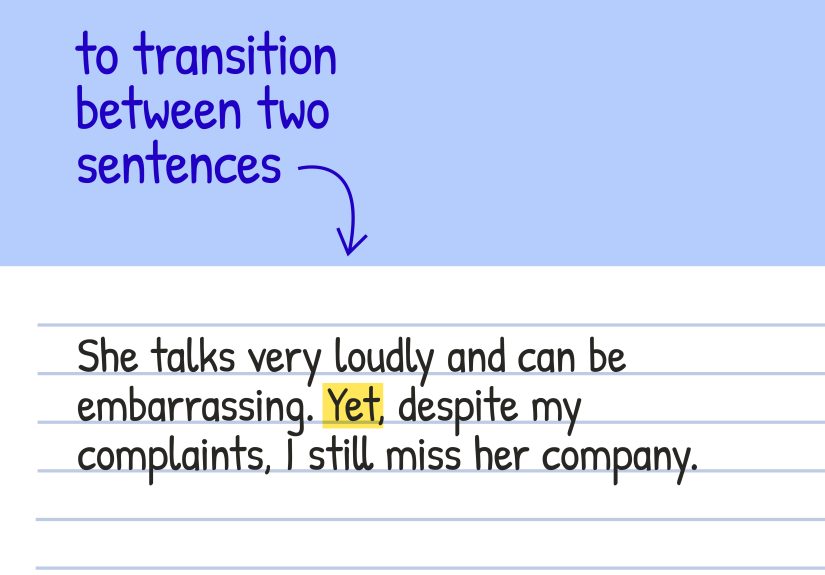
As a coordinating conjunction, “yet” connects ideas of equal grammatical weight and signals contrast: “despite that”, “but”, “nevertheless”. Think of it as “but” wearing a slightly nicer jacket.
Example: “The instructions were simple, yet I still managed to assemble the bookshelf upside down.”
Where to put “yet” in a sentence
Placement is the #1 reason people feel unsure about “yet.” The good news: English has strong patterns for it, especially when “yet” means “up to now.”
Placement pattern A: End of the sentence (most common)
When “yet” means “up to now,” it often goes at the end of a negative sentence or question. This is the classic, everyday usage.
- “They haven’t arrived yet.”
- “I don’t know yet.”
- “Are you ready yet?”
- “Has the meeting started yet?”
Tip: This end-position “yet” pairs naturally with the present perfect (“have/has + past participle”) when you’re talking about something expected but not completed: “We haven’t decided yet.” It can also appear with simple present/past depending on context.
Placement pattern B: After “not” or before the main verb (more formal)
You’ll sometimes see “yet” placed earlier in a sentence, especially in more formal writing: “They have not yet responded.” This can sound crisp and professionalgreat for emails, reports, and any situation where you want to sound calm while quietly panicking.
- “The team has not yet approved the budget.”
- “I have not yet received the updated file.”
- “The results are not yet available.”
Placement pattern C: Middle of the sentence as contrast (conjunction “yet”)
When “yet” is a conjunction meaning “but/nevertheless,” it typically appears between two balanced parts: clause + “yet” + clause (or phrase + “yet” + phrase).
- “The plan is ambitious, yet achievable.”
- “He’s quiet, yet surprisingly funny.”
- “We practiced for weeks, yet opening night still felt terrifying.”
Placement pattern D: Before “more,” “another,” “again” (emphasis)
“Yet” also works as an intensifierespecially in set phrases that add a sense of “can you believe it?”
- “We got yet another software update at 4:59 p.m.”
- “Please don’t ask for yet more revisions.”
- “The printer broke down yet again.”
“Yet” vs. “still” vs. “already” (the quick sanity check)
These three often live in the same neighborhood (time and expectation), but they bring different vibes. Use this section when your brain says, “Words are made up and I’m leaving.”
Yet
- Common meaning: “up to now” (often in negatives/questions)
- Typical feel: neutral, factual timing
- Examples: “I haven’t eaten yet.” “Are you done yet?”
Still
- Common meaning: something continues; in negatives, it emphasizes “this should’ve happened by now”
- Typical feel: impatience, surprise, persistence
- Examples: “I’m still working.” “They still haven’t called.”
Already
- Common meaning: earlier than expected; it has happened by now
- Typical feel: “wow, that was fast” or “yes, yes, I did it”
- Examples: “I already finished.” “Have you eaten already?”
A simple comparison table
| What you mean | Best choice | Example |
|---|---|---|
| Not happened up to now (expected later) | yet | “They haven’t replied yet.” |
| Continues (or “should’ve happened by now”) | still | “They still haven’t replied.” |
| Happened earlier than expected / by now | already | “They’ve already replied.” |
Punctuation with “yet” (commas, commas everywhere)
Here’s the punctuation rule that saves lives (and grades): when “yet” is a coordinating conjunction connecting two independent clauses, you usually put a comma before “yet.”
Use a comma before “yet” when it joins two complete sentences
Independent clause + comma + yet + independent clause. Both sides can stand alone as complete sentences.
- “I wanted to leave early, yet I stayed to help.”
- “The app looked finished, yet it crashed on launch.”
- “We trained hard, yet we still felt unprepared.”
No comma needed when “yet” joins words or phrases (usually)
If “yet” connects two adjectives, two verbs, or two phrasesnot two full independent clauses you generally don’t need a comma.
- “The solution was simple yet effective.”
- “She is young yet wise.”
- “He spoke calmly yet firmly.”
Can you start a sentence with “Yet”?
Yes. In modern American writing, starting with a conjunction can be acceptable when done intentionally. “Yet” at the beginning often reads like a dramatic pivot: “And yet…” or simply “Yet…” It works best when the contrast is clear and the rhythm fits the paragraph.
- “Yet I couldn’t shake the feeling we’d missed something.”
- “Yet that’s exactly why the idea worked.”
Just don’t do it every other sentence unless you’re auditioning for a noir narrator role.
Common mistakes with “yet” (and how to fix them)
Mistake 1: Forgetting the comma in a compound sentence
Wrong: “I studied all night yet I forgot my calculator.”
Better: “I studied all night, yet I forgot my calculator.”
Mistake 2: Using “yet” in a positive statement when you mean “still”
Sometimes people write: “I yet need help” when they mean “I still need help.” In everyday American English, “I yet need help” sounds very formal or old-fashioned. Prefer “still” unless you’re going for a deliberately formal tone.
Mistake 3: Confusing “yet” (time) with “yet” (contrast)
Time “yet” typically answers When? Contrast “yet” answers Despite what?
Time: “Have you called yet?” (When?)
Contrast: “I called, yet no one answered.” (Despite calling…)
Mistake 4: Overusing “yet” for drama
“Yet” is powerful. Powerful words are like hot sauce: a little makes things exciting; too much and your reader needs a glass of milk and a new hobby.
40 example sentences using “yet”
Here are practical “yet” examples grouped by type. Mix and match depending on whether you want time, contrast, or emphasis.
“Yet” in negative sentences (time / up to now)
- “I haven’t decided yet.”
- “They aren’t ready yet.”
- “She hasn’t emailed me yet.”
- “We don’t have the final numbers yet.”
- “The package hasn’t arrived yet.”
- “I can’t confirm that yet.”
- “The results are not available yet.”
- “He hasn’t apologized yet, but I’m hopeful.”
“Yet” in questions (time / expected to happen)
- “Are we there yet?”
- “Have you eaten yet?”
- “Has the meeting started yet?”
- “Did you hear back yet?”
- “Is it time to go yet?”
- “Have they announced the winner yet?”
- “Do you understand it yet?”
- “Are you done yet, or should I make coffee?”
“Not yet” as a complete answer
- “Have you finished?” “Not yet.”
- “Is the report ready?” “Not yet, but it’s close.”
- “Did you call them?” “Not yetdoing it now.”
“Yet” as a conjunction (contrast / nevertheless)
- “The movie was long, yet I never got bored.”
- “He’s strict, yet fair.”
- “The instructions were clear, yet the device wouldn’t turn on.”
- “I wanted to say yes, yet something felt off.”
- “She was nervous, yet she spoke with confidence.”
- “The solution is simple, yet it works.”
- “We planned carefully, yet we hit surprises.”
- “The room was tiny, yet it felt cozy.”
- “I apologized, yet the tension lingered.”
- “The project was risky, yet the payoff was worth it.”
Emphasis: “yet another,” “yet more,” “yet again”
- “We got yet another password reset email.”
- “He offered yet more reasons to postpone.”
- “The alarm went off yet again.”
- “That’s yet another reason to back up your files.”
- “And thenbecause life is comedyanother meeting, yet again.”
Milestones: “best yet,” “fastest yet,” “biggest yet”
- “This is our best launch yet.”
- “That was your fastest mile yet.”
- “It’s the biggest crowd yet.”
- “Her latest draft is the strongest yet.”
Formal placement: “not yet” inside the sentence
- “The committee has not yet reached a decision.”
- “I have not yet received the updated schedule.”
- “The product is not yet available nationwide.”
Mini practice: choose the best “yet”
Try these quick “yet” sentence fixes. (Answers are right belowno suspense torture.)
- “I haven’t seen the new episode ____.”
- “The idea sounded odd, ____ it worked.”
- “Are you finished ____?”
- “We got ____ another survey request.”
- “They have not ____ responded to the ticket.”
Answers: (1) yet (2) yet (3) yet (4) yet (5) yet
Yes, that’s a lot of “yet.” Welcome to the club.
Quick checklist: how to use “yet” correctly
- Use yet at the end for most negatives/questions: “I haven’t called yet.”
- Use not yet earlier in formal writing: “We have not yet confirmed.”
- Use comma + yet when joining two independent clauses: “I tried, yet I failed.”
- Skip the comma when it’s just phrases: “simple yet effective.”
- Use emphasis phrases sparingly: “yet another,” “yet more,” “yet again.”
Conclusion
“Yet” is small, but it does big jobs. Use it to talk about something that hasn’t happened up to now, to ask whether something has happened so far, or to introduce a clean contrast that feels sharper than plain old “but.”
If you remember just one thing, remember this: time “yet” often lives at the end (“not yet,” “have you… yet?”), and contrast “yet” often needs a comma when it joins two complete sentences. Now go forth and write sentences that are clearyet stylish.
Real-life writing scenarios with “yet” (extra )
Knowing the rule is one thing. Using “yet” in real writing is anotherbecause real writing happens in the wild: in emails, texts, customer support chats, cover letters, essays, and that one group project document where five people type at once like it’s a competitive sport. Here are some common scenarios where “yet” shows up, plus how to make it sound natural.
1) The “polite follow-up” email
You’re waiting on an update, and you want to sound professional, not haunted. This is where “yet” shinesespecially with “not yet” in a calm, matter-of-fact line: “I haven’t received the file yet.” If you want a more formal tone (or you’re writing to someone with a very impressive title), try: “I have not yet received the file.” The meaning is the same, but the second version sounds like it’s wearing a blazer.
2) The “Are we there yet?” conversation (a.k.a. time has stopped)
In everyday speech, “yet” often lives at the end because it keeps the sentence light and rhythmic: “Are you done yet?” “Is it ready yet?” “Did they respond yet?” It’s short, it’s direct, and it keeps the focus on the moment. If you move “yet” earlier (“Are you yet done?”), you’ll sound like you time-traveled from a Victorian novel and are about to faint on a chaise lounge.
3) Storytelling and “plot twist” contrast
Writers love conjunction “yet” because it creates contrast without the heavy pause of “however.” Compare: “It was raining; however, we went hiking.” That’s correct, but formal. Now: “It was raining, yet we went hiking.” That feels smoother and more narrativelike the sentence is moving forward instead of filing paperwork. In fiction, “yet” can also add emotional tension: “She smiled, yet her eyes looked tired.” Same scene, more depth.
4) The workplace “yet another” moment
If you’ve ever sighed at an inbox full of surprises, you’ve met emphasis “yet”: “yet another meeting,” “yet another change request,” “yet another portal login.” Used sparingly, it’s funny and relatable. Used too often, it can sound like you’re narrating your own villain origin story. A good trick is to reserve it for moments you want to highlight as repetitive or absurd, and keep your other sentences neutral for contrast.
5) Academic writing: clean, controlled timing
In essays or reports, “not yet” is great for describing a state that may change: “The data are not yet conclusive.” It signals “up to now” without making a dramatic promise. It’s especially useful when you want to be accurate: you’re not claiming the answer is impossible; you’re saying it isn’t available so far. That’s the kind of careful wording teachers and editors tend to appreciatebecause it’s clear, precise, and honest.
Bottom line: in real-life writing, “yet” helps you sound natural, precise, and occasionally witty. Use it for timing when something hasn’t happened so far, and use it for contrast when you want a smooth “but” that doesn’t feel blunt. Master that, and your sentences will be simpleyet memorable.