Table of Contents >> Show >> Hide
- Why Home Workouts Actually Work
- How Much Exercise You Need Each Week
- What You Need to Start a Home Workout Routine
- How to Build a Balanced Home Workout
- Beginner-Friendly Weekly Home Workout Plan
- How to Progress Without Burning Out
- Home Workout Safety Tips
- Common Home Workout Mistakes (and Fixes)
- of Experience-Based Insights About Working Out From Home
- Conclusion
Working out from home used to sound like a backup plan. Now it’s a real planand for a lot of people, it’s the best one. No commute. No waiting for a machine. No mystery puddle near the dumbbell rack. Just you, your space, and a routine that actually fits your life.
The good news is you do not need a garage gym, a celebrity trainer, or a motivational speech from an action movie to get results. A smart home workout routine can improve strength, cardio fitness, energy, balance, and consistency using mostly body weight and a few basic items. The real secret is not fancy equipment. It’s structure.
In this guide, you’ll learn exactly how to work out from home with a simple system: what to do, how often to do it, how to stay safe, and how to keep going when your couch starts whispering “maybe tomorrow.”
Why Home Workouts Actually Work
Home workouts work because they remove the biggest barriers to exercise: time, travel, cost, and friction. When your workout space is ten steps away, it’s easier to start. And starting is half the battle (the other half is pretending squats are fun).
Bodyweight training is especially effective at home because it is flexible and scalable. Beginners can use wall push-ups, chair squats, and short walking sessions. Intermediate exercisers can use circuits, tempo training, unilateral movements, and jump-based progressions. You can also make workouts more challenging without buying much equipment by increasing reps, slowing the tempo, or reducing rest time.
Another big advantage: home workouts often improve consistency. You are not dependent on gym hours, weather, traffic, or whether every treadmill is mysteriously occupied. Consistency beats intensity over time. A 25-minute workout done four times a week will outperform a “perfect” two-hour session you only do once every other Thursday.
How Much Exercise You Need Each Week
If you want a clear target, use this simple benchmark for adults:
- At least 150 minutes of moderate-intensity aerobic activity per week (or 75 minutes vigorous, or a mix)
- Muscle-strengthening work at least 2 days per week
- Move more and sit less throughout the day
That may sound like a lot, but it becomes manageable when you break it down. For example:
- 30 minutes a day, 5 days a week
- Or 25 minutes a day, 6 days a week
- Or short sessions (10–15 minutes) spread across the day
If you’re just getting started, don’t wait until you can do the “ideal” amount. Start with what you can do now. Ten minutes counts. A brisk walk in place counts. A quick bodyweight circuit counts. Progress comes from building the habit first, then increasing the dose.
What You Need to Start a Home Workout Routine
Here’s the surprisingly short shopping list for a great home workout:
- Comfortable clothes and supportive shoes
- A little floor space (even a small room works)
- Water
- A timer (your phone is fine)
- A sturdy chair or countertop for modifications
- Optional: resistance bands, dumbbells, yoga mat
That’s it. No chrome machines. No giant mirror required. (Though if you do have a mirror, it helps with checking form and making dramatic post-workout faces.)
If you want to level up later, resistance bands and a few dumbbells are a great first upgrade. They don’t take much space and make it easier to add progressive overload. But bodyweight alone can take you a long way.
How to Build a Balanced Home Workout
A good home fitness plan includes five pieces:
- Warm-up
- Strength training
- Cardio or conditioning
- Mobility and/or balance work
- Cool-down
1) Warm Up First (5–10 Minutes)
Skipping the warm-up is like revving your car in winter and immediately driving uphill. Technically possible. Not a great idea.
A warm-up prepares your muscles, joints, breathing, and heart rate for exercise. Keep it simple and dynamic:
- March or jog in place
- Arm circles
- Hip circles
- Bodyweight good mornings
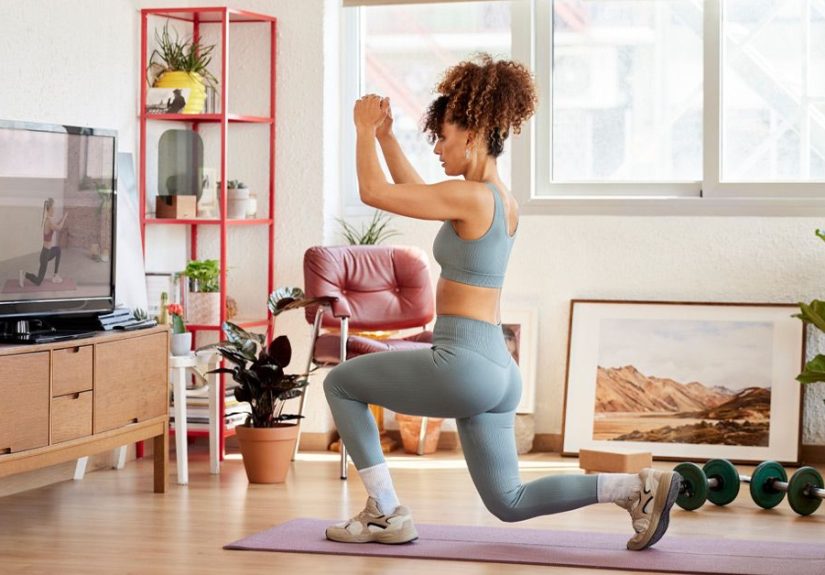
- Alternating lunges
- Easy squats
Start easy and gradually increase the pace. The goal is to feel warmer and looser, not exhausted before the workout begins.
2) Strength Training at Home
Strength training is the anchor of a good home routine because it improves muscle, joint support, daily function, and long-term health. You do not need barbells to build strength. You need controlled movement, enough effort, and repeat exposure.
Focus on basic movement patterns:
- Squat: chair squats, bodyweight squats, goblet squats
- Hinge: glute bridges, hip hinges, Romanian deadlifts (with dumbbells or bands)
- Push: wall push-ups, incline push-ups, floor push-ups
- Pull: band rows, towel rows (secure setup only), dumbbell rows
- Core: planks, dead bugs, side planks
- Balance: single-leg stand, step-ups, split squats
For beginners, a solid starting point is:
- 5–7 exercises
- 1–3 sets each
- 8–15 reps per set (or 20–45 seconds per movement)
- Rest 30–90 seconds between sets
- Train 2–4 days per week
Choose a difficulty level where the last few reps feel challenging but your form still looks good. If your push-up turns into a collapsing walrus impression, use an easier variation and keep moving.
3) Cardio at Home (Without a Treadmill)
Cardio at home does not have to mean running in place until you question your life choices. You have options:
- Brisk walking (indoors or outdoors)
- Marching in place
- Stair climbing
- Jump rope
- Low-impact cardio circuits
- Dance workouts
- Shadow boxing
- Bike or rower (if you have one)
To estimate intensity, use the “talk test”:
- Moderate intensity: you can talk, but breathing is heavier
- Vigorous intensity: talking is difficult; only short phrases
This helps you stay in the right zone without needing fancy gadgets.
4) Mobility and Balance Matter More Than You Think
A lot of people only focus on calories and sweat. Smart people also focus on movement quality.
Mobility work helps you move better and feel less stiff. Balance work helps with coordination and control. Both are especially helpful if you sit a lot, work at a desk, or feel “tight” all the time.
Great home options include:
- Hip flexor stretch
- Calf stretch
- Thoracic rotation
- Hamstring stretch
- Single-leg balance
- Heel-to-toe walk
- Yoga or Pilates sessions
5) Cool Down (5 Minutes)
Cooling down helps your body transition out of workout mode. It does not need to be complicated.
- Walk slowly for 2–3 minutes
- Breathe deeply
- Stretch major muscle groups (legs, chest, shoulders, back)
Save longer stretching for after workouts, not before explosive exercise. Post-workout is when your muscles are warmer and usually more cooperative.
Beginner-Friendly Weekly Home Workout Plan
Here’s a practical 7-day example you can follow. It balances strength, cardio, recovery, and consistency.
Day 1: Full-Body Strength (25–35 minutes)
- Warm-up (5 minutes)
- Chair or bodyweight squats – 2 sets of 10–12
- Incline push-ups – 2 sets of 8–12
- Glute bridges – 2 sets of 12–15
- Band or dumbbell rows – 2 sets of 10–12
- Front plank – 2 rounds of 20–30 seconds
- Cool-down (5 minutes)
Day 2: Cardio + Mobility (20–30 minutes)
- Brisk walk, march, dance, or stairs – 15–20 minutes
- Mobility work – 5–10 minutes
Day 3: Full-Body Strength (25–35 minutes)
- Warm-up (5 minutes)
- Reverse lunges or split squats – 2 sets of 8–10 each side
- Wall or incline push-ups – 2 sets of 8–12
- Hip hinge or deadlift pattern – 2 sets of 10–12
- Side plank – 2 rounds of 15–25 seconds each side
- Bird-dog – 2 sets of 8 each side
- Cool-down (5 minutes)
Day 4: Active Recovery
- Easy walk
- Stretching or yoga
- Frequent movement breaks if you sit for long periods
Day 5: Cardio Intervals (20–25 minutes)
Try 30 seconds of faster movement + 60 seconds easy pace for 10–12 rounds. Use marching, step-ups, shadow boxing, or low-impact cardio moves.
Day 6: Strength + Core (20–30 minutes)
- Squats – 2–3 sets
- Rows – 2–3 sets
- Push-ups (modified as needed) – 2–3 sets
- Glute bridge or hinge – 2–3 sets
- Dead bug or plank – 2–3 rounds
Day 7: Rest or Light Movement
Rest on purpose. Recovery is part of the program, not a sign you failed. A walk and some stretching is plenty.
How to Progress Without Burning Out
The best home workout plan is one you can keep doing. That means progressing gradually, not trying to “make up for lost time” in one heroic session.
Use this progression system:
- Week 1–2: Learn form and build the habit
- Week 3–4: Add reps or time
- Week 5–6: Add a set or reduce rest time
- Week 7+: Increase difficulty (harder variation, bands, dumbbells)
Pick only one variable to increase at a time. If you increase reps, sets, and intensity all in the same week, your body may file a formal complaint.
Also, schedule your workouts like appointments. Putting “Workout: 7:00 PM” on your calendar sounds simple, but it’s a powerful behavior trick. Home workouts fail most often because they stay vague. “I’ll do it later” is the cousin of “I forgot.”
Home Workout Safety Tips
- Start slow if you are inactive or coming back after a break
- Increase volume and intensity gradually
- Use stable surfaces for modifications (chairs, counters)
- Clear clutter so you don’t trip mid-lunge
- Stay hydrated, especially if you sweat a lot
- Stop and seek medical advice if you have chest pain, dizziness, or severe symptoms
- If you have a health condition, check with a healthcare professional before making major changes
Form matters more than speed. Controlled reps with good posture will beat sloppy reps every time. Think “smooth and strong,” not “chaotic and impressive.”
Common Home Workout Mistakes (and Fixes)
Mistake 1: Doing only cardio
Cardio is great, but strength training is essential too. Add at least two strength sessions weekly to protect muscle and improve function.
Mistake 2: Going too hard on Day 1
If your first workout leaves you unable to sit down comfortably for three days, your routine probably won’t last. Start at a level that feels doable.
Mistake 3: Skipping warm-up and cool-down
A few minutes before and after your workout improves comfort, safety, and consistency. It’s worth it.
Mistake 4: Not tracking anything
Write down your exercises, reps, and workout time. Progress is easier to see when it’s not floating around in your memory.
Mistake 5: Sitting all day and training for 20 minutes
Your workout matters, but so do movement breaks. Stand up, walk, stretch, and move throughout the day. The “sit less, move more” rule is underrated.
of Experience-Based Insights About Working Out From Home
One of the most common experiences people report when they start working out from home is surprisespecifically, surprise at how hard bodyweight exercises can be. A person may assume a home workout is “lighter” than a gym session, then do two rounds of squats, incline push-ups, and planks and suddenly need a minute to reconsider every life decision. That experience is useful because it resets expectations: home workouts are real workouts.
Another common experience is learning that motivation is unreliable, but routine is dependable. In the beginning, many people wait to “feel ready.” Then they discover that the best workouts happen when they start before they feel like it. People who succeed at home fitness often use the same strategy: they remove decisions. They pick a time, lay out clothes, keep a short plan visible, and begin. Once the warm-up starts, resistance usually drops. The hardest part is not the workoutit’s the first two minutes.
People also notice a strong mental benefit. A short home workout can create a clear “reset” in the middle of a stressful day. Someone working from home may feel foggy, stiff, or irritable after hours at a desk. A 15- to 20-minute sessionespecially one with walking, squats, and mobility workoften improves focus and mood fast. It doesn’t magically solve every problem, but it makes the rest of the day feel more manageable.
There is also a practical learning curve. Early on, people tend to overcomplicate things with long YouTube playlists, random exercises, and no structure. After a few inconsistent weeks, they usually settle into a simpler formula: repeatable workouts, a few favorite movements, and a weekly schedule. This is where real progress starts. Repeating the basics (squats, pushes, hinges, rows, core work, walking) builds confidence because improvements are easy to see. Reps go up. Rest time goes down. Balance improves. Stairs feel easier. Grocery bags feel lighter.
Many people also experience a shift in how they define success. At first, success may mean “sweat a lot” or “burn calories.” Over time, it becomes “I showed up,” “my knees feel better,” “I can do real push-ups now,” or “I don’t crash in the afternoon anymore.” That shift matters because it makes the habit sustainable. Home workouts work best when they support your life, not when they become a punishment for having a life.
Finally, there’s the home-environment challenge. Family, roommates, pets, deliveries, and laundry all have perfect timing when you start exercising. People who stick with home workouts learn to adapt instead of waiting for ideal conditions. They shorten the session, split it into two mini sessions, or switch to a quieter routine. Flexibility becomes part of the skill. That is probably the biggest lesson from real home workout experience: the best plan is not the fanciest one. It’s the one you can do consistently in real life, in a real house, on a real Tuesday.
Conclusion
If you’ve been wondering how to work out from home, the answer is simpler than most people think: start with a small space, a short plan, and a repeatable schedule. Build around strength, cardio, mobility, and recovery. Keep it realistic. Progress gradually. Track what you do. And remember that consistency is the real superpower.
You do not need the perfect setup. You need a workable one. Start where you are, use what you have, and let your routine get better over time. Your future self will be very impressedand slightly less sore.