Table of Contents >> Show >> Hide
- What Are Cluster Munitions?
- Why the U.S. Decided to Send Them to Ukraine
- Why the Decision Was So Controversial
- The Legal and Policy Workaround
- What Ukraine Promised About Their Use
- Will Cluster Munitions Change the War?
- The Bigger Lesson Behind the Debate
- Human Experiences Behind the Cluster Munitions Debate
- Conclusion
When the United States decided in July 2023 to send cluster munitions to Ukraine, the reaction was immediate and loud. Supporters called it a hard but necessary battlefield choice. Critics called it a moral own goal with a nasty aftertaste that could last for decades. Both sides, awkwardly enough, had a point.
Cluster munitions are among the most controversial weapons in modern war. They are designed to hit multiple targets over a wide area, which makes them useful against trenches, artillery positions, vehicles, and troop formations. That same wide-area effect is also what makes them terrifying. If used near populated places, they can kill civilians in the moment. And if some of the submunitions fail to explode, they can sit in the ground like tiny time bombs, waiting for a farmer, a child, or a cleanup crew to have a very bad day.
So why did Washington send them anyway? The short version is that Ukraine needed more artillery power, needed it fast, and was running low on standard shells. The longer version involves battlefield math, dwindling ammunition supplies, dug-in Russian defenses, a controversial legal workaround, and the grim reality that in war, governments often choose between bad options and worse ones.
This article breaks down what cluster munitions are, why the U.S. sent them to Ukraine, why so many countries oppose them, and why the debate is still one of the clearest examples of how military necessity and humanitarian concern can collide head-on.
What Are Cluster Munitions?
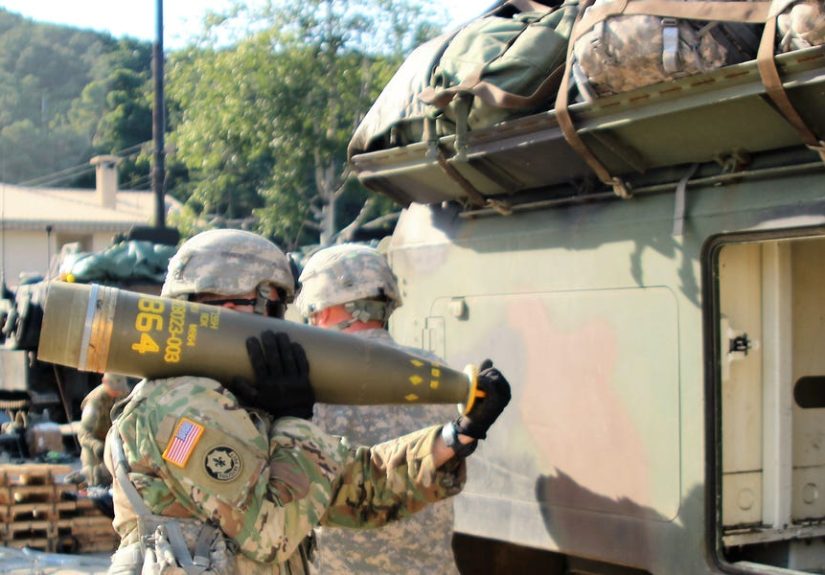
A cluster munition is a weapon that opens in the air and releases many smaller explosives, often called submunitions or bomblets, over a broad area. These weapons can be delivered by aircraft, rockets, missiles, or artillery shells. Instead of one blast at one point, cluster munitions spread multiple explosions across a target zone.
Military planners value them because a single round can strike several targets at once. If enemy troops are spread out in trenches, hiding in tree lines, or clustered around vehicles and artillery pieces, cluster munitions can cover ground faster than a standard shell. That is why they have long been seen as effective against what the military calls “area targets.” In plain English: groups of people or equipment spread over space rather than standing neatly in one cartoon-style pile.
The problem is built into the design. The bomblets do not politely ask who is a soldier and who is a civilian. They scatter. They explode where they land. And not all of them explode on impact. Those unexploded bomblets can remain dangerous long after the battle ends, effectively turning fields, roads, and neighborhoods into future hazard zones.
That long tail of danger is the core reason cluster munitions are so heavily criticized. The weapon is not controversial because people suddenly dislike explosions in war. It is controversial because the harm can outlive the military objective by years or even decades.
How the U.S. Version Differs
The munitions the United States sent to Ukraine were described as DPICM, short for Dual-Purpose Improved Conventional Munitions. These are artillery-fired cluster munitions designed to attack personnel and light armor. U.S. officials argued that the rounds selected for Ukraine were more reliable than older variants and had lower failure rates than many Russian cluster munitions already used in the war.
That distinction mattered politically. Washington’s argument was not that cluster munitions are harmless. It was that the specific rounds being transferred were less likely to leave behind large numbers of duds than the Russian munitions already littering Ukrainian land. Critics were not reassured. To them, “less bad” still sounded an awful lot like “still bad,” just with better packaging.
Why the U.S. Decided to Send Them to Ukraine
The Biden administration’s decision was driven by three overlapping realities: Ukraine’s need for ammunition, the nature of the battlefield, and the availability of U.S. stockpiles.
1. Ukraine Needed More Artillery, Fast
By mid-2023, Ukraine was burning through artillery ammunition at a punishing rate. That is not unusual in a large land war, but the scale mattered. Ukraine’s forces were fighting an artillery-heavy conflict against entrenched Russian troops, and Western production of standard 155mm shells was struggling to keep pace with demand. U.S. officials said openly that ammunition shortages were part of the reason the decision came when it did.
In other words, this was not Washington suddenly waking up one morning and deciding, “You know what would spice up Friday?” It was a stopgap move in a war where artillery volume often decides who advances, who stalls, and who survives.
2. They Were Seen as Useful Against Entrenched Russian Positions
Ukraine wanted cluster munitions because they are especially effective against dispersed infantry, trenches, artillery batteries, and vehicle convoys. That matched the battlefield problem Ukraine faced. Russian defenses included trenches, strongpoints, minefields, and layered positions designed to slow any counteroffensive.
A standard artillery shell hits one point. A cluster munition can affect a larger footprint. That makes it useful when the target is not a single bunker but a wider defensive area. Analysts noted that this wide-area effect could help Ukraine hit dug-in troops and disrupt formations that would otherwise require many more conventional rounds.
From Washington’s perspective, the logic was cold but simple: if Ukraine could fire fewer rounds to hit the same space, cluster munitions could help stretch limited ammunition supplies while increasing pressure on Russian defenses.
3. The U.S. Had Stockpiles It Could Send Quickly
There was also a logistics angle. The United States had stockpiles of DPICM rounds that could be transferred more quickly than waiting for conventional shell production to magically start behaving like a superhero origin story. Reuters reported that sending these munitions could ease pressure on supplies of standard 155mm rounds, which Washington had already been shipping in large quantities.
That matters because wars are not fought with headlines alone. They are fought with factories, inventories, transport schedules, and the unglamorous arithmetic of supply chains. In that sense, the cluster munitions decision was not just about tactics. It was also about what the U.S. could provide immediately.
Why the Decision Was So Controversial
If the military case was straightforward, the humanitarian case against the transfer was just as powerful.
The Civilian Risk Does Not End When the Shooting Stops
The biggest criticism of cluster munitions is the dud problem. When bomblets fail to detonate, they remain on the ground as unexploded ordnance. That means the danger does not stay on the front line or within the timeframe of a single battle. It lingers.
That is especially alarming in Ukraine, a country already heavily contaminated by mines and unexploded ordnance. Every additional weapon that can leave behind unexploded remnants increases the future burden on civilians, emergency responders, farmers, and demining teams. The war may end one day. The cleanup bill does not send its regrets and disappear with it.
Most of the World Has Moved Against These Weapons
Cluster munitions are banned under the 2008 Convention on Cluster Munitions, which prohibits their use, production, transfer, and stockpiling for states that join it. More than 120 countries have joined the convention. The United States, Russia, and Ukraine are not among them.
That legal fact created a political headache. Even if Washington was not violating a treaty it never joined, many of its allies are parties to the convention and see cluster munitions as beyond the pale. Several U.S. partners were uncomfortable with the transfer, even while continuing to support Ukraine more broadly. That made the episode a diplomatic balancing act: help Kyiv, preserve alliance unity, and avoid looking as though humanitarian norms are optional whenever the battlefield gets ugly.
Human Rights Groups Opposed the Transfer
Human Rights Watch and other advocacy organizations strongly criticized the U.S. decision. Their position was blunt: both Russia and Ukraine had already used cluster munitions, civilians had already suffered, and sending more of these weapons would deepen a long-term humanitarian problem rather than solve it.
This is an important part of the debate because it undercuts lazy whataboutism. The criticism was not merely “Russia bad, Ukraine good” or the reverse. Rights groups argued that cluster munitions are dangerous regardless of who fires them. That kind of consistency tends to annoy partisans on every side, which is often how you know an argument is serious.
The Legal and Policy Workaround
The U.S. decision was not politically simple even at home. American law had limited the export of cluster munitions with failure rates above 1 percent, which applied to nearly all of the U.S. stockpile. To move forward, President Biden invoked national security authority to bypass that restriction.
That move became one of the most debated parts of the policy. Supporters said it was a necessary exception in an extraordinary war. Critics said it weakened congressional intent and undermined Washington’s claim to uphold rules-based norms. In practical terms, the administration was arguing that Ukraine’s immediate need outweighed the normal constraint.
Whether that sounds like prudent leadership or dangerous precedent depends a lot on where you start morally. But either way, it was not a routine paperwork exercise. It was a deliberate policy choice to prioritize urgent battlefield needs over a standing restriction.
What Ukraine Promised About Their Use
To address concerns, U.S. officials said Ukraine had provided written assurances that it would use the munitions carefully. Ukrainian officials also laid out principles for how they said the weapons would be used: only on Ukrainian territory, not in urban areas, with records kept of where they were fired, and with future clearance efforts after those areas were retaken.
Those promises were politically important, but they did not settle the debate. Supporters pointed to them as evidence that Kyiv understood the risks and would try to limit harm. Critics replied that even careful use cannot erase the basic hazards of a weapon that scatters explosives over a wide area.
That is the uncomfortable truth here: guardrails can reduce risk, but they cannot turn cluster munitions into precision instruments. The entire dispute turns on whether the reduced risk is enough to justify the military advantage.
Will Cluster Munitions Change the War?
Probably not by themselves. Wars this large are rarely transformed by one weapons package alone. Cluster munitions were not a magic wand, a cheat code, or a plot twist pulled from a streaming drama in episode seven. They were one tool among many in a grinding war of artillery, drones, trenches, logistics, and attrition.
Still, they could matter tactically. Used against concentrated or semi-dispersed Russian positions, they offered Ukraine a way to hit more area with fewer rounds and potentially disrupt defenses during critical phases of combat. Even limited tactical gains can matter in a war where movement is slow and every kilometer is contested.
The broader point is that the U.S. did not send cluster munitions because it believed they would end the war overnight. It sent them because American officials believed they could improve Ukraine’s position in the near term when ammunition shortages and battlefield realities made every shell count.
The Bigger Lesson Behind the Debate
The fight over cluster munitions reveals a recurring truth about military aid: the closer a war gets to attrition, the more governments are tempted to reach for weapons they would prefer to keep in the moral basement. Not because the weapons become cleaner, but because the alternatives become uglier in different ways.
That was essentially the White House argument. Yes, cluster munitions carry serious risks. But so does allowing Russian forces to keep advancing while Ukraine runs short on artillery. In that framing, the administration was not choosing between clean and dirty. It was choosing between two forms of civilian risk: the future danger of unexploded bomblets and the immediate danger of more Russian occupation, shelling, and battlefield losses.
Critics answered that this logic is exactly how harmful weapons keep surviving from one war to the next. Every transfer becomes exceptional. Every exception becomes easier to defend the next time. And every battlefield justification makes the global norm against the weapon weaker.
That is why this issue still resonates. It is not only about Ukraine. It is about whether humanitarian norms can survive contact with a brutal conventional war when a powerful ally decides military necessity comes first.
Human Experiences Behind the Cluster Munitions Debate
To understand why this topic produces such fierce reactions, it helps to move beyond official statements and think about the lived experiences wrapped around the weapon.
For a Ukrainian soldier facing trenches, artillery fire, minefields, and entrenched Russian units, cluster munitions can look less like a geopolitical controversy and more like a survival tool. A weapon that can hit a broad defensive area may mean fewer friendly troops exposed during an assault. In that view, the debate in Washington, London, or Brussels can sound painfully abstract. The soldier is not writing an ethics seminar paper. The soldier is trying to stay alive long enough to see another sunrise.
For a medic or rescue worker, the experience is very different. Wide-area weapons mean chaos: multiple casualties, injuries spread across open ground, and confusion about where the next unexploded bomblet might be waiting. Even after the initial strike, danger can remain in roads, fields, and neighborhoods. Every response becomes slower, more careful, and more psychologically draining.
For civilians, especially families in or near contested areas, cluster munitions turn everyday space into suspicious space. A field is no longer just a field. A roadside is no longer just a roadside. Parents worry about children wandering too far. Farmers worry about tractors hitting unexploded submunitions. People returning home after fighting passes through may discover that the battle has technically moved on, but the danger has decided to keep renting the property.
Then there are deminers and clearance teams, whose experience is the least dramatic on television and maybe the most important over time. Their work is slow, technical, repetitive, and dangerous. It is the opposite of cinematic warfare. No triumphant soundtrack, no dramatic monologue, just painstaking effort to remove hidden explosives one by one. When critics say cluster munitions leave a long legacy, this is what they mean: years of labor, risk, and cost after the headlines have moved on.
Policy officials experience the issue differently too. For them, the question becomes a grim ledger. How much battlefield advantage is gained? How many standard rounds are unavailable? How reliable are the selected munitions? What promises has Ukraine made? What message does the decision send to allies, to Congress, to humanitarian groups, and to future conflicts? It is a world of memos, intelligence estimates, legal authorities, and strategic trade-offs. Clinical on paper, yes, but still packed with human consequences.
And finally, there is the experience of the public, which often swings between two emotional poles. One is outrage that such weapons exist and continue to be used. The other is frustration that moral clarity becomes harder when a country defending itself is asking for them. That tension is what keeps the cluster munitions debate alive. It forces people to confront a deeply uncomfortable possibility: that in real wars, the most honest answer is sometimes not a clean slogan but a wince.
That does not make every decision defensible. It does, however, explain why this particular decision was so divisive. Cluster munitions are not just a weapons story. They are a story about what soldiers fear, what civilians endure, what governments justify, and what comes back to haunt a country long after the battlefield maps stop changing.
Conclusion
The United States sent cluster munitions to Ukraine because Washington believed they could help fill an artillery gap, strike entrenched Russian positions more effectively, and support Ukraine at a moment when conventional ammunition supplies were under strain. That was the strategic case.
The humanitarian case against the transfer was equally serious. Cluster munitions spread explosive bomblets over a wide area, can leave unexploded ordnance behind for years, and have been stigmatized or banned by much of the world for exactly those reasons.
So the real answer to the question in this article’s title is not neat. The U.S. sent them because they were militarily useful and available. The world argues about them because usefulness does not erase consequence. Cluster munitions sit in that dark corner of modern warfare where tactical logic and moral discomfort stare at each other without blinking.
That is why this debate matters. It is not only about one weapons shipment to Ukraine. It is about how democracies justify hard wartime choices, how far humanitarian norms can bend under pressure, and what kind of legacy gets left in the ground when the shooting finally stops.