Table of Contents >> Show >> Hide
- The First Thing I Noticed Was How Solid It Still Felt
- Why A Farmhouse Like This Ends Up Abandoned
- Inside, The Rooms Felt Less Empty Than Expected
- Why Old Stone Buildings Can Survive So Much And Still Be In Danger
- Why Ruins Like This Fascinate Us So Much
- Exploring Abandoned Places Is Not A Free-For-All
- What The 18 Photos Really Capture
- Extended Experience: Walking Through The Farmhouse, Room By Room
- Conclusion
Some houses look abandoned. Others look like they are still deciding whether to trust you.
That was the feeling I got when I first stepped up to this several-hundred-year-old abandoned farmhouse in France. The shutters hung at odd angles, the stone walls had the color of old bread crust, and the doorway looked like it had spent the last century politely refusing modernity. It was quiet in that unusually dramatic way only the countryside can manage. No traffic. No voices. Just wind, weeds, and the kind of silence that makes you suddenly aware of your own shoelaces.
The 18 photos may be what pull people in, but the real story of a place like this lives in the details: worn beams, faded plaster, handmade tile, rusted hooks, a sink that probably heard more family gossip than any therapist ever has. An abandoned farmhouse in France is never just a creepy shell with photogenic peeling paint. It is a record of work, weather, family life, agricultural change, and the long, stubborn afterlife of good materials.
That is what made this discovery so fascinating. The farmhouse was empty, yes, but it was not erased. It still carried the logic of rural French living: practical rooms, thick walls, durable finishes, and that distinctly French ability to make utility look charming without trying too hard. American farmhouse style often shouts. A true old French farmhouse barely raises its voice, and somehow still wins the room.
The First Thing I Noticed Was How Solid It Still Felt
Old rural houses in France were built to last, and many of them were built from whatever the land gave them. Stone, lime plaster, timber, brick, terracotta, and worn metal details were not design trends back then. They were just Tuesday. That is part of why even abandoned farmhouses can remain so visually powerful long after the humans, chickens, carts, and arguments about harvest season have left the building.
This one had exactly that feeling. Even neglected, it had presence. The walls were thick enough to make you think, “Well, this place might outlive all of us, and probably with better posture.” The bones were not flimsy. They were agricultural, functional, and deeply rooted in the landscape.
You could also see the blend that makes French country architecture so compelling: rustic and refined at the same time. There were rough textures everywhere, but also proportion, grace, and traces of elegance. It was easy to imagine a farmhouse table in one room, copper cookware in the kitchen, baskets by the door, and boots tracking in mud while an antique mirror somehow still looked perfectly at home on the wall. That mix is the magic trick. It is never just “farm.” It is farm with standards.
Why A Farmhouse Like This Ends Up Abandoned
Whenever people see a place like this, they tend to jump straight to one of two theories: ghosts or inheritance drama. To be fair, inheritance drama is usually the more realistic option. But the truth is that abandoned buildings in rural France, like abandoned buildings almost anywhere, usually reflect a much messier combination of economics, geography, family change, and time.
Some houses empty slowly. Older generations pass away, younger relatives move to cities, and suddenly nobody wants to commit to the cost of restoring a drafty stone farmhouse that needs roof work, plumbing, wiring, drainage, and the patience of a saint. Some are affected by changes in farming itself. When agricultural life becomes less tied to one family compound, the buildings that once supported animals, storage, and seasonal labor no longer serve the same purpose.
Other places are abandoned for more dramatic reasons. France has examples of villages emptied by public policy, development decisions, or failed projects. That does not mean every farmhouse has a sensational backstory, but it does remind us that abandonment is not always romantic. Sometimes it is bureaucratic. Sometimes it is financial. Sometimes it is simply that no one had the money, agreement, or energy to keep fighting for a building that needed everything at once.
And old buildings are greedy in the most historic way possible. They want roof repairs, moisture control, structural attention, and endless small decisions. Ignore one leak for long enough and the house starts conducting a demolition program of its own.
Inside, The Rooms Felt Less Empty Than Expected
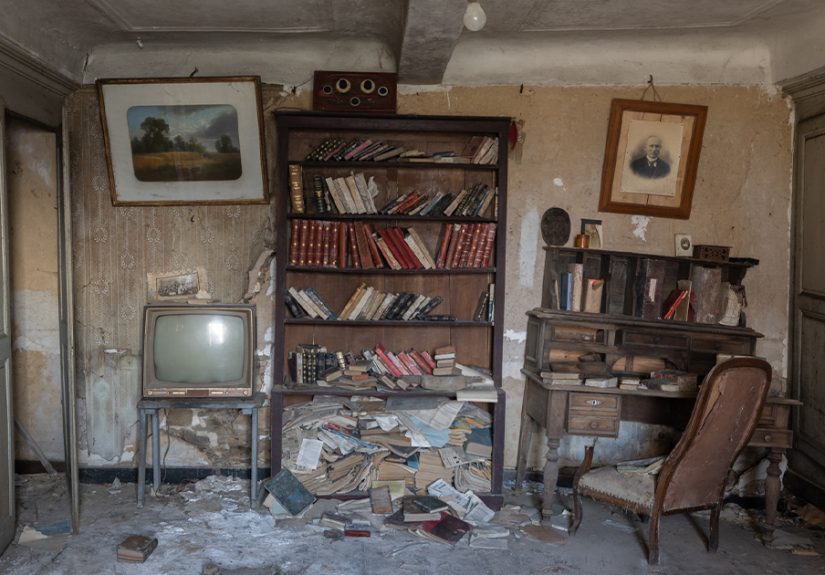
What surprised me most was how much the farmhouse still said without speaking. Abandoned interiors do not always look dramatic. Sometimes they just look interrupted. A chair in the corner. A shelf with nothing on it but dust. A hook with no coat. A kitchen fireplace blackened by years of use. A stair tread worn slightly low in the middle from people who climbed it thousands of times without ever imagining strangers would someday photograph it like an archaeological event.
The Kitchen Was the Emotional Center
Even empty, the kitchen felt like the anchor of the house. In many old French homes, the kitchen is where rustic practicality and visual charm shake hands and decide to become lifelong friends. You can almost picture the limestone floors, rough wood, terracotta, copper, herbs, and sturdy furniture that once made the room work as both workshop and gathering place.
In this farmhouse, the kitchen carried that same spirit. It was not glamorous in a magazine sense. It was better. It looked used, honest, and arranged for living rather than showing off. That made it easier to imagine the original rhythms of the house: soup simmering, bread cooling, boots by the door, and somebody muttering about rain.
The Bedrooms Felt More Fragile
Bedrooms in abandoned houses often hit differently. The public life of the home may linger in the kitchen or barn, but the private life seems to evaporate faster. Here, the upper rooms felt lighter, sadder, and more exposed. Faded walls and soft light gave them a strange gentleness. You could sense where daily life had once narrowed from labor into rest.
That is often the unsettling part of exploring an abandoned farmhouse. You are not just looking at architecture. You are brushing up against ordinary life after it has slipped out the back door.
The Utility Spaces Told The Hardest Truth
The barn-like sections, storage areas, and work rooms may have been the most revealing of all. Many restored farmhouses keep these spaces as reminders of what the house used to be, and for good reason. They tell the truth. These buildings were never only pretty stone shells in scenic regions of France. They were working machines for food, labor, weather, and survival.
That is why even modern restorations of old farmhouses often preserve chestnut beams, stone walls, feeding areas, and rough textures. Those pieces are not decorative afterthoughts. They are the biography of the building.
Why Old Stone Buildings Can Survive So Much And Still Be In Danger
One reason a centuries-old abandoned farmhouse can look strangely strong is that good stone construction ages with dignity. It cracks, settles, stains, and sulks a little, but it can endure. That said, “still standing” is not the same as “doing great.” Historic buildings often suffer quietly, and moisture is one of the biggest villains in the cast.
Once a roof fails, or drainage is poor, or damp rises through masonry, the house begins to lose the slow battle. Wood rots. Plaster fails. Salts move through porous materials. Metal corrodes. Floors weaken. Windows vanish. Then people strip what is left, and the process accelerates. A building that survived wars, winters, and family chaos can be brought down by years of water infiltration and neglect. Glamorous? No. Accurate? Very.
That is why preservation people tend to sound slightly obsessed with prevention. They are right. Once the weather gets inside, the romance of the ruin starts getting expensive fast.
Why Ruins Like This Fascinate Us So Much
An abandoned farmhouse in France hits a very specific nerve. Part of it is visual. The textures are irresistible: weathered wood, crumbly plaster, old iron, pale stone, wild grass, soft daylight. Part of it is cultural. French country houses have long represented a kind of lived-in elegance that feels less polished than a château and more intimate than a manor. And part of it is emotional. These places feel close enough to ordinary life that we can imagine ourselves in them, yet distant enough in time to seem almost mythic.
Ruins also give us what modern life rarely does: evidence of time. Real time. Not the algorithmic kind. Not the “before and after” renovation reveal designed for social media. A farmhouse like this lets you see how years accumulate in walls, floors, doorframes, soot, stains, and repairs. It reminds you that beauty does not always come from perfection. Sometimes it comes from survival.
There is also a reason people keep trying to bring places like these back. Across Europe, old rural properties and village buildings are often revived through restoration, adaptive reuse, hospitality projects, or simple stubborn affection. That makes sense. When done well, restoration does not erase a building’s past. It translates it.
Exploring Abandoned Places Is Not A Free-For-All
This is the part where the romantic fantasy needs a seat belt.
If you ever come across an abandoned farmhouse, admire it responsibly. Do not trespass. Do not steal. Do not move objects around for “better composition.” Do not geotag vulnerable places that can be stripped or vandalized. And absolutely do not assume that because a structure is old and photogenic, it is safe. Loose floors, unstable beams, mold, broken glass, hidden wells, animals, and water damage do not care about your content strategy.
The best way to appreciate these places is with restraint. Look carefully. Disturb as little as possible. Remember that even if a house is abandoned, it still belongs to a story, a family, a village, a legal owner, or all four at once.
What The 18 Photos Really Capture
The most compelling thing about the 18 photos is not that they show decay. Plenty of buildings decay. What makes these images memorable is that they capture a farmhouse in the strange space between loss and endurance. The house is no longer functioning as a home, but it has not lost its character. It still communicates. You can still read the logic of the rooms, the quality of the materials, and the quiet pride of the structure.
That is why abandoned places in France can feel so cinematic without trying. The architecture is already doing the storytelling. The stone carries history. The beams carry labor. The empty rooms carry absence. And the little surviving details, a latch, a sink, a shutter, a hearth, carry something even stronger: proof that ordinary life can leave extraordinary traces.
Extended Experience: Walking Through The Farmhouse, Room By Room
I remember stepping across the threshold and feeling the temperature change before my eyes adjusted. Outside, the afternoon felt broad and open. Inside, the farmhouse held the air differently, cooler, quieter, thicker somehow, as if the walls had been collecting weather and whispers for generations. There was dust, yes, but not the cartoon version people imagine. It was finer than that, settled into corners and creases like a final layer of punctuation.
The entry room was simple, but it had authority. The stone underfoot was uneven in the most reassuring way, polished not by machinery but by years of footsteps. Every old house has a point where you stop seeing “abandoned building” and start seeing “someone lived exactly here.” For me, it happened at the doorway between the main room and the kitchen. The wood frame was worn smooth where hands must have brushed it again and again. Not dramatically. Just habitually. That tiny detail made the whole house feel personal.
In the kitchen, I found myself imagining the invisible choreography that once filled the room. A pot on the fire. A loaf on the table. Someone coming in from outside with mud on their boots and weather on their face. The room did not feel staged for nostalgia. It felt built for repetition. Work, meals, conversation, cleanup, sleep, and then the same thing again when the sun came up. There is something deeply moving about spaces designed for usefulness that accidentally become beautiful.
Upstairs was quieter in a different way. The bedrooms seemed to hold light more delicately, and the silence there felt private rather than empty. I stood in one room with cracked plaster and a view over the fields and had the odd sensation that time had not vanished there, only thinned out. You could almost feel the outline of ordinary days still hanging in place. A curtain moving. A drawer opening. Somebody looking out the window to judge the weather before breakfast. Nothing grand. Just life.
The most haunting part, though, was not sadness. It was continuity. Wild plants had started claiming the edges outside. Rain had marked the walls. Pieces of the roof had clearly given up the fight. And yet the farmhouse was still unmistakably itself. It had not become generic ruin. It was still a farmhouse in France, still shaped by labor, materials, climate, and taste. Still dignified. Still stubborn.
When I finally stepped back outside, I did what everyone does after an experience like that: I turned around for one last look. The place did not suddenly reveal a secret or supply a neat ending. It just stood there in the late light, beautifully worn, a little wounded, and entirely unforgettable. That may be the real reason abandoned places stay with us. They do not offer closure. They offer evidence. Evidence that people were here, that they built carefully, that they lived fully, and that even after silence moves in, a house can keep telling the truth.
Conclusion
Discovering a several-hundred-year-old abandoned farmhouse in France feels thrilling at first because it looks like a hidden world. But the longer you look, the more it becomes something else: a lesson in architecture, memory, rural change, and the emotional weight of ordinary spaces. The 18 photos may capture the textures, the light, and the dramatic charm of the ruin, but what makes the farmhouse unforgettable is the life still visible in its structure.
That is the real pull of an old French farmhouse. It is not just picturesque decay. It is proof that beauty can survive use, weather, neglect, and time. And if that does not make you stare at stone walls like they are philosophers, I do not know what will.