Table of Contents >> Show >> Hide
- The Night Jon Stewart Turned a Book Tour Into a Media Trial
- Why the Clip Became Bigger Than the Show
- The Myth: Jon Stewart Single-Handedly Canceled 'Crossfire'
- Stewart’s Claim: It Was Ratings, Not a One-Man Takedown
- Why CNN May Have Needed a Convenient Flashpoint
- Was Stewart Being Fair to 'Crossfire'?
- The Tucker Carlson Factor
- Why the Story Still Matters
- So, Did Jon Stewart Cancel 'Crossfire'?
- Experience Section: What This Story Teaches Viewers, Writers, and Media Watchers
- Conclusion
Jon Stewart has spent much of his career puncturing myths, deflating egos, and making political television look like a very expensive school cafeteria argument. But one myth has followed him for more than two decades: the idea that he personally destroyed CNN’s Crossfire with one brutally memorable appearance in 2004.
It is a delicious story. Stewart walks into the lion’s den, tells Tucker Carlson and Paul Begala that their show is “hurting America,” refuses to play the cheerful guest, calls out cable-news theater, and thenpoofCNN cancels the show a few months later. In internet legend, he did not simply critique Crossfire. He marched in wearing the cardigan of doom and unplugged the whole machine.
But Stewart has pushed back on that version of events. His argument is not that the segment had no impact. It clearly did. The clip became one of the most famous political-media moments of the 2000s. His point is more practical, and less cinematic: CNN was already looking at ratings, revenue, brand direction, and the changing cable-news marketplace. According to Stewart’s more recent explanation, his appearance became a convenient flashpoint, not the sole cause of the cancellation.
So, did Jon Stewart kill Crossfire? The honest answer is more complicated than the legend. And, like most things involving cable news, part of the answer depends on whether you prefer drama, data, or a split-screen shouting match with commercial breaks.
The Night Jon Stewart Turned a Book Tour Into a Media Trial
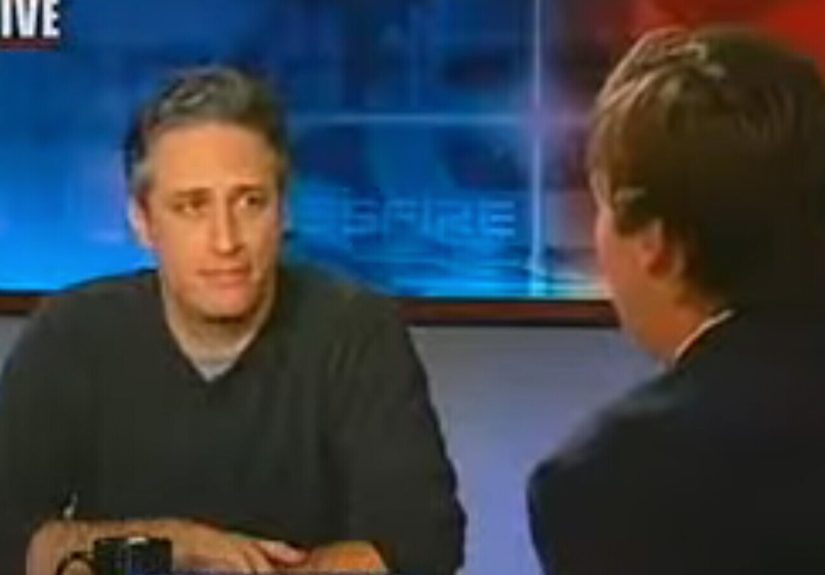
On October 15, 2004, Jon Stewart appeared on CNN’s Crossfire, the long-running political debate program built around left-versus-right confrontation. At the time, Stewart was hosting The Daily Show and promoting America (The Book): A Citizen’s Guide to Democracy Inaction. In theory, the segment could have been a lively promotional stop: a few jokes, a little election talk, maybe a polite plug for the book, and everyone goes home with television makeup still intact.
Instead, Stewart turned the interview into an intervention.
Rather than playing along with the program’s usual rhythm, Stewart criticized the format itself. He told hosts Tucker Carlson and Paul Begala that Crossfire was not merely bad television, but part of a larger problem in American political discourse. He argued that the show reduced politics to performance, rewarded partisan reflexes, and helped politicians and strategists avoid honest accountability.
The phrase that stuck was “hurting America.” It sounded dramatic, but Stewart’s complaint was specific. He was not saying that political disagreement was dangerous. He was saying that the kind of staged combat presented as debate was bad for viewers because it transformed civic life into team sports. Politics became jerseys, slogans, and point-scoring. The public got heat. The powerful got cover. The audience got a headache.
Why the Clip Became Bigger Than the Show
The Crossfire appearance spread at a time when online video culture was still finding its legs. YouTube had not yet become the central archive of public humiliation that it would soon become, but the internet was already very good at passing around moments that felt unscripted, uncomfortable, and strangely satisfying.
Stewart’s segment had all the ingredients of viral television before “viral television” became a marketing department’s favorite phrase. It had conflict, surprise, celebrity, media criticism, and a live audience reacting in real time. It also had Tucker Carlson in a bow tie, which gave the clip the visual energy of a prep school debate tournament that accidentally summoned a comedian with a grudge.
The exchange became famous partly because Stewart refused to accept the role assigned to him. Carlson repeatedly tried to turn the spotlight back on Stewart’s own interviews, especially his allegedly soft questions to Democratic presidential nominee John Kerry. Stewart’s defense was simple: The Daily Show was a comedy program, while Crossfire aired on CNN and presented itself as political debate. In other words: do not grade the puppet-adjacent comedy show on the same curve as the cable-news institution.
That distinction became one of the segment’s most important points. Stewart was not claiming to be neutral, saintly, or free of political influence. He was claiming that CNN had a different responsibility because it operated under the banner of news. His message was less “I am pure” and more “You are pretending this is public service when it is actually theater.”
The Myth: Jon Stewart Single-Handedly Canceled ‘Crossfire’
When CNN announced in January 2005 that Crossfire would be canceled and that the network would cut ties with Tucker Carlson, the timing seemed almost too perfect. Stewart appeared in October. The show was on the chopping block in January. The story practically wrote itself: comedian destroys cable-news institution.
It helped that CNN’s leadership appeared to validate Stewart’s criticism. Jonathan Klein, CNN’s president at the time, publicly said he agreed with Stewart’s overall premise and wanted to move the network away from “head-butting debate shows.” That statement gave the legend a sturdy backbone. It was no longer just fans connecting dots with a glitter pen; the head of CNN had essentially said Stewart had a point.
But single-cause explanations are usually too neat, especially in television. Shows are canceled for many reasons: ratings trends, advertising value, executive strategy, talent contracts, audience fatigue, production costs, and brand positioning. A viral embarrassment can accelerate a decision, but it rarely creates all the business conditions behind that decision from scratch.
That is where Stewart’s later comments matter. He has argued that Crossfire was already vulnerable. In his view, CNN used the moral language of public discourse to explain what was also, underneath everything, a business decision. His basic claim: if the show had been generating huge ratings and revenue, executives would probably have found a way to live with the criticism. Television executives, after all, are not famous for canceling profitable shows because a comedian made a persuasive civic argument.
Stewart’s Claim: It Was Ratings, Not a One-Man Takedown
Stewart’s explanation reframes the story. Instead of “Jon Stewart canceled Crossfire,” the more accurate version may be: “Jon Stewart exposed weaknesses in a show CNN was already willing to abandon.” That may be less heroic, but it is more believable.
By the early 2000s, cable news was changing fast. Fox News had built a powerful identity around conservative opinion programming. MSNBC would later move more heavily toward liberal commentary. CNN, meanwhile, was trying to define itself in a crowded field. Its traditional brand rested on breaking news, international reporting, and institutional seriousness. A loud debate show full of predictable partisan sparring may have seemed less like a strategic asset and more like a relic wearing shoulder pads from the 1980s.
Reports from the time noted that Crossfire had slipped in audience strength. The show was no longer the untouchable center of political conversation it had once been. CNN executives were also reassessing what kind of programming fit the network. That context supports Stewart’s argument: the cancellation was not a magical consequence of one appearance. It was a programming decision made inside a business environment.
Still, Stewart’s appearance gave CNN a story it could tell about the cancellation. Instead of saying, “The numbers are not where we want them,” the network could say, “We are elevating the conversation.” That sounds nobler. It also looks better on a press release. “We are improving democracy” has a nicer ring than “the spreadsheet coughed ominously.”
Why CNN May Have Needed a Convenient Flashpoint
Television networks do not just cancel shows; they manage narratives. When a familiar program disappears, executives prefer to frame the decision as part of a larger vision. In Crossfire’s case, Stewart’s critique gave CNN a useful framework: the network could present the move as a turn away from noisy confrontation and toward more substantive journalism.
That does not mean the argument was fake. Klein may genuinely have believed that Crossfire represented a tired format. Many viewers and critics agreed with Stewart that cable-news shouting matches had become exhausting. But business motives and editorial motives often travel in the same car. One sits in the front seat talking about democracy; the other sits in the back quietly checking ad rates.
The “convenient flashpoint” idea explains why Stewart’s takedown felt both influential and overstated. It influenced the conversation around the show. It gave journalists, viewers, and CNN executives a memorable symbol of what was wrong. But symbols are not the same as sole causes. Stewart did not sneak into CNN headquarters with wire cutters. He gave a name and a face to a dissatisfaction that already existed.
Was Stewart Being Fair to ‘Crossfire’?
Stewart’s critique has aged in interesting ways. At the time, many viewers saw Crossfire as the perfect villain: partisan, performative, and smug. Looking back, some commentators have argued that the show looks almost quaint compared with what came later. Cable news did not become calmer after Crossfire disappeared. If anything, opinion programming became more ideologically sorted, more personality-driven, and more optimized for outrage.
That raises a fair question: was Crossfire really the disease, or just an early symptom?
The program at least put opposing voices on the same set. Yes, the format was often theatrical. Yes, the arguments could be canned. Yes, everyone sometimes looked like they were auditioning for a debate club sponsored by antacid tablets. But later cable-news trends often moved away from cross-ideological debate and toward ideological comfort food. Instead of left and right arguing with each other, audiences increasingly watched hosts confirm what they already believed.
That does not make Stewart wrong. His warning about political theater remains sharp. But the aftermath suggests that removing one noisy debate show did not solve the deeper incentive problem. Outrage still sold. Conflict still got clipped. Audiences still rewarded certainty over complexity. The costume changed, but the circus stayed open.
The Tucker Carlson Factor
The segment also became a key chapter in the public story of Tucker Carlson. At the time, Carlson was a young conservative commentator known for his bow tie, sharp tongue, and willingness to spar on television. Stewart’s jab at Carlson became one of the most replayed moments of the exchange, especially because it punctured Carlson’s polished TV persona in front of a live audience.
After CNN, Carlson moved through several media roles, including MSNBC and PBS, before eventually becoming a dominant figure at Fox News. In hindsight, the Crossfire clash looks less like the end of Carlson’s career and more like an early scene in a much longer media evolution. The viral embarrassment did not bury him. If anything, it became part of the mythology surrounding him.
This is another reason Stewart’s “I didn’t cancel it” claim makes sense. The people involved did not vanish. The format did not vanish. The incentives did not vanish. Carlson became more influential. Partisan media became more powerful. Online clips became more central to political identity. The supposed death blow was followed by a much larger explosion of the same forces Stewart criticized.
Why the Story Still Matters
The Stewart-Crossfire story remains relevant because it captures a permanent tension in American media: audiences say they want substance, but conflict is easier to package. A calm discussion about policy design may be useful, but a televised argument creates instant emotional stakes. Viewers know who to root for. Producers know where to cut the promo. Social media knows which 12 seconds to circulate until everyone is angry before breakfast.
Stewart understood that tension. His complaint was not simply that Carlson and Begala argued. Debate is healthy. Democracy needs disagreement. His complaint was that the show’s structure rewarded shallow combat rather than genuine inquiry. The guests became props. The hosts became brand representatives. The audience became a scoreboard.
Today, that criticism applies far beyond Crossfire. It applies to cable panels, podcast feuds, viral debate clips, algorithmic outrage, and every online exchange where the goal is not to understand but to win the room. Stewart’s appearance endures because it diagnosed a media habit that never really went away. In fact, it bought a ring light and started posting daily.
So, Did Jon Stewart Cancel ‘Crossfire’?
The best answer is: not by himself. Stewart did not personally cancel Crossfire, but his appearance helped crystallize the case against it. He gave critics a memorable moment, gave CNN leadership a public rationale, and gave viewers a clip that turned media criticism into cultural folklore.
The cancellation was likely the result of several forces working together: declining ratings, changing CNN strategy, cable-news competition, Carlson’s career ambitions, and a growing sense that the show’s format felt stale. Stewart’s takedown was the lightning strike, but the building already had faulty wiring.
That distinction matters because it keeps the story honest. It is tempting to believe one perfect speech can topple a bad institution. Sometimes speeches matter. Sometimes they accelerate change. But institutions usually fall when internal weakness meets external pressure. Stewart supplied the pressure. CNN’s own business reality supplied the weakness.
Experience Section: What This Story Teaches Viewers, Writers, and Media Watchers
For anyone who writes about media, watches political television, or has ever yelled “That is not what the question was!” at a screen, the Crossfire story offers a useful lesson: always separate the dramatic moment from the structural cause. The dramatic moment is what people remember. The structural cause is what actually explains the outcome.
In content writing, journalism, and media analysis, this difference is everything. A headline may say Jon Stewart killed Crossfire, because that is clean, clickable, and satisfying. But a stronger article asks what was happening behind the clip. Were ratings declining? Was CNN changing direction? Did executives already have doubts? Was the show culturally vulnerable before Stewart arrived? Those questions turn a fun anecdote into useful analysis.
This is also a reminder that public narratives often simplify business decisions. Companies rarely say, “This product underperformed, the margins were weak, and our strategy changed.” They prefer moral language, visionary language, or audience-friendly explanations. In media, that might sound like “we are pursuing deeper storytelling.” In retail, it might be “we are refining the customer experience.” In normal human English, it often means “the numbers made a face at us.”
Stewart’s later claim is valuable because it complicates his own legend. Many public figures would happily accept credit for destroying a famous TV show. It is a pretty good résumé line, right between “hosted iconic satire program” and “made bow ties briefly feel legally risky.” But Stewart’s version is more grounded. He is saying that television is a business, executives protect revenue, and moral explanations often arrive after financial calculations have already entered the room.
For readers, the practical takeaway is to be suspicious of tidy media myths. When a story sounds too perfect, it probably needs a second look. That does not mean the story is false. It means the story is incomplete. Stewart’s Crossfire appearance was important, funny, uncomfortable, and culturally powerful. It helped define a conversation about cable news. But it was not a magic wand.
For writers, this topic is a great example of how to build a richer article. Start with the viral moment, then widen the lens. Explain the historical context. Compare the legend with the business reality. Add the personalities, but do not let them swallow the structure. Readers enjoy drama, but they trust analysis that respects complexity.
And for viewers, the experience is almost personal. Many people have watched political panels where everyone speaks in rehearsed bursts, nobody changes their mind, and the only clear winner is the migraine industry. Stewart’s frustration resonated because it felt familiar. He said out loud what many viewers had felt: this cannot be the best version of public debate. Two decades later, that feeling has not disappeared. It has merely upgraded to HD, podcasts, livestreams, and comment sections where nuance goes to recover from its injuries.
The enduring lesson of Stewart and Crossfire is not that one comedian can cancel a show. It is that one honest interruption can reveal what a show truly is. After that, the audience, the network, and the market decide what happens next.
Conclusion
Jon Stewart’s claim that he was not responsible for the cancelation of Crossfire does not erase the importance of his 2004 appearance. It makes the story better. Instead of a simple tale about one comedian defeating one television show, the real story is about media incentives, ratings pressure, executive decision-making, and the public hunger for someone to call out performative politics.
Stewart did not single-handedly bring down Crossfire. But he did something almost as powerful: he made the show explain itself. Once that happened, the weaknesses were hard to ignore. The clip became legendary because it captured a truth viewers already suspected. Cable news was not just informing the public; too often, it was staging conflict and calling it civic duty.
In the end, Crossfire was canceled by a mix of ratings, strategy, timing, and public criticism. Stewart supplied the unforgettable spark. CNN already had the dry wood. And television history, being television history, made sure the whole thing came with a punchline.