Table of Contents >> Show >> Hide
- Who Is the Physician Behind the Cartoons?
- Why Cartoons Work So Well in Patient Education
- The Problem With Traditional Medical Communication
- How Dr. Lerner’s Cartoon Approach Changes the Appointment
- Meet Scopey: The Cartoon Endoscope With a Job to Do
- Graphic Medicine: More Than Cute Drawings
- What Healthcare Teams Can Learn From Cartoon-Based Education
- Patient Education Should Feel Less Like a Final Exam
- Experience-Based Reflections: What Cartoons Can Teach Us About Better Care
- Conclusion: A Friendlier Future for Patient Education
Some doctors explain medicine with charts. Some use pamphlets. Some reach for a model of the human digestive system that looks suspiciously like it escaped from a middle-school science closet. And then there is Dr. Diana Lerner, a pediatric gastroenterologist who looked at the intimidating world of endoscopies, colonoscopies, inflammatory bowel disease, and medical jargon and thought: “You know what this needs? A friendly cartoon endoscope.”
That is how a medical education idea became something much warmer, funnier, and more memorable. Dr. Lerner, associated with the Medical College of Wisconsin and Children’s Wisconsin, helped develop animated patient education cartoons designed to teach children and families about gastrointestinal procedures and conditions in a way that actually makes sense. The project, known through CartoonGI, uses simple language, cheerful characters, and visual storytelling to turn scary medical topics into understandable stories.
At the center of this approach is a deceptively powerful idea: patients do better when they understand what is happening to them. That sounds obvious, but anyone who has ever nodded politely while a doctor said “mucosal inflammation,” “biopsy,” or “bowel prep” knows the truth. Medical language can sound like a secret club password. Cartoons break that password into pictures, feelings, and everyday words.
Who Is the Physician Behind the Cartoons?
Dr. Diana Lerner is a pediatric gastroenterologist who treats children with digestive conditions, including inflammatory bowel disease, reflux, eosinophilic esophagitis, and related gastrointestinal problems. Her patients are not just smaller adults. They are kids who may be anxious, confused, embarrassed, or overwhelmed. Their parents may be just as worried, especially when a procedure like an upper endoscopy or colonoscopy appears on the calendar.
During training and clinical practice, Dr. Lerner noticed a communication gap. Doctors often explain things carefully, but “carefully” does not always mean “clearly.” A physician may think a family understands what a colon is, what a scope does, or why bowel preparation matters. But children may leave with only fragments of the explanation, and parents may be too stressed to absorb every detail.
One patient story captures the problem beautifully. A teenager being treated for ulcerative colitis reportedly asked what a colon was after already being in the hospital for her condition. That kind of moment can make a thoughtful doctor pause. It is not a failure of intelligence on the patient’s part. It is a failure of translation. Medicine had spoken; the patient had not truly received the message.
Dr. Lerner’s answer was not to make a longer handout. It was to make a better doorway into understanding. She helped create animated cartoons that explain procedures and diseases using kid-friendly characters, narrative structure, and humor. In other words, she made the information less like a lecture and more like a story.
Why Cartoons Work So Well in Patient Education
Cartoons are not childish. They are efficient. A good cartoon can show a process, emotion, problem, and solution in seconds. That is why comics, animation, and graphic medicine have become increasingly useful in healthcare communication. When done well, a cartoon does not oversimplify medicine; it simplifies the path into medicine.
Think about a colonoscopy explanation. A text-heavy handout might say that a flexible tube with a camera is inserted to examine the colon and collect tissue samples if needed. Accurate? Yes. Comforting to an 8-year-old? Not exactly. A cartoon can show a smiling character named Scopey, explain that the doctor is “looking around,” and show that pictures may be taken. Suddenly, the idea feels less mysterious.
Visuals Reduce the Fear of the Unknown
Children often fear what they cannot imagine. A hospital room, a procedure table, anesthesia, medical tools, and recovery can feel like scenes from a movie they did not choose to star in. Animation gives them a preview. It says, “Here is what will happen. Here is who will be there. Here is why it matters. And yes, there may even be a popsicle afterward.” Never underestimate the motivational power of frozen sugar on a stick.
Visual communication also helps parents. When caregivers understand the steps of a procedure, they can reinforce the message at home. They can replay the cartoon, answer questions, and prepare the child emotionally. A family that understands the plan is less likely to feel helpless.
Stories Make Medical Information Stick
Facts are important, but stories are sticky. A child may forget a formal definition of inflammatory bowel disease, but remember cartoon white blood cells acting like confused police officers. That image creates a mental hook. It gives the child a way to understand that the immune system is reacting in a way that causes inflammation.
This is the heart of graphic medicine: combining images and words to communicate illness, treatment, and healthcare experiences. The field has grown because comics and cartoons can show not only anatomy, but also uncertainty, embarrassment, fear, relief, and hope. Medicine is not just a list of organs. It is a human experience, usually happening on a day when nobody feels their most relaxed.
The Problem With Traditional Medical Communication
Healthcare has a vocabulary problem. Doctors spend years learning precise language, and that precision is necessary. But the words that help clinicians communicate with one another can become barriers when used with patients. Terms like “adherence,” “lesion,” “sedation,” “chronic,” “prep,” and “inflammation” may be ordinary in a hospital, but they are not ordinary at the kitchen table.
Even highly educated patients can struggle with medical information when they are sick, worried, tired, or caring for a child. Stress shrinks attention. Anxiety interrupts memory. A parent may hear the first sentence of an explanation, then spend the next five minutes silently thinking, “Is my child going to be okay?” That parent is physically in the room, but emotionally wrestling an invisible bear.
Patient education must account for that reality. The best communication is not about sounding impressive. It is about being understood. That is why plain language, visuals, repetition, and teach-back methods matter. They help clinicians confirm that the message landed safely.
How Dr. Lerner’s Cartoon Approach Changes the Appointment
One of the biggest benefits of medical cartoons is that they can move basic explanations outside the exam room. A child can watch a video before the visit. Parents can review it at home. Grandparents, siblings, and caregivers can watch too. By the time the family meets the doctor, they already share a basic vocabulary.
That changes the appointment from “Let me explain everything from zero” to “Let us talk about your specific questions.” It makes the visit more productive. Instead of spending precious minutes defining every term, the clinician can focus on the child’s symptoms, treatment options, worries, and next steps.
This matters because healthcare visits are often short. Doctors are busy. Families are busy. Children are sometimes hungry, bored, or deeply committed to spinning on the exam stool until someone says, “Please stop doing that.” A clear educational cartoon can make the limited time feel less rushed and more useful.
Meet Scopey: The Cartoon Endoscope With a Job to Do
One of the memorable characters in Dr. Lerner’s educational work is Scopey, a cartoon endoscope. On paper, an endoscope is a long medical instrument used to look inside the body. In a child’s imagination, that description can become alarming fast. Scopey changes the emotional tone.
By giving the tool a face, personality, and role, the cartoon transforms an object of fear into a guide. Scopey is not there to scare the child. Scopey is there to help the doctor look, take pictures, and understand what is going on. That small creative decision does a lot of emotional work.
Good patient education often depends on this kind of reframing. The goal is not to hide reality. Children deserve honesty. The goal is to explain reality in a way that matches their developmental stage. A smiling animated tool will not erase every fear, but it can replace some dread with recognition. When the child later sees equipment or hears procedure-related words, they may think, “I know this story.”
Graphic Medicine: More Than Cute Drawings
Graphic medicine is the use of comics, cartoons, and visual storytelling in healthcare, medical education, and patient communication. It can help patients understand disease, help medical students develop empathy, and help clinicians process the emotional weight of their work.
Other physician-artists have also shown the power of cartoons in medicine. Dr. Grace Farris, a hospitalist and cartoonist, has used comics to explore hospital life, motherhood, and the human side of healthcare. Dr. Thomas Deisboeck at Harvard has discussed the need for more persuasive visual communication in public health. Dr. Shirlene Obuobi has used comics to reflect on medical training and the culture of medicine. These examples point to the same larger truth: pictures can say what medical jargon often cannot.
Cartoons can also make space for humor. That does not mean making light of illness. It means giving patients a breath. A gentle joke can lower the temperature in the room. It can help a child feel less trapped inside the seriousness of the moment. In pediatric care, that emotional shift can be powerful.
What Healthcare Teams Can Learn From Cartoon-Based Education
Dr. Lerner’s work offers lessons for every healthcare organization, even those that never create a single animated endoscope. The first lesson is that patient education should be designed with patients, not simply delivered to them. Dr. Lerner reportedly tested language and concepts with children, including asking whether words sounded like “normal people language.” That question should be printed on a poster in every medical office.
The second lesson is that accuracy and friendliness can coexist. Medical materials do not have to be cold to be credible. A cartoon can be scientifically accurate, emotionally sensitive, and easy to understand at the same time. In fact, that combination may be exactly what patients need.
The third lesson is that repetition matters. A spoken explanation happens once. A cartoon can be watched again and again. Families can pause it, replay it, and share it. For chronic conditions, repeated learning is especially important because patients may need to understand not just one procedure, but an ongoing relationship with symptoms, medications, diet, monitoring, and follow-up care.
Patient Education Should Feel Less Like a Final Exam
Too often, healthcare information feels like it was written by someone who forgot what it is like not to know healthcare information. Patients are handed instructions and expected to perform perfectly: take this medication, avoid this food, schedule this test, prepare this way, watch for these symptoms, call if this happens, do not panic, but also do not ignore anything. Simple, right?
Not really. That is why cartoon-based education feels refreshing. It respects the patient’s need for clarity. It does not assume that confusion equals carelessness. It recognizes that understanding is a clinical outcome, not a decorative extra.
When a child understands what a colonoscopy is, anxiety may decrease. When a parent understands why bowel prep matters, adherence may improve. When a family understands a chronic condition, they may feel more capable of managing it. These are not small wins. They are the difference between passive compliance and active participation.
Experience-Based Reflections: What Cartoons Can Teach Us About Better Care
Anyone who has sat in a medical waiting room with a nervous child knows that education begins before the doctor enters. The child studies the room. The parent studies the child. Everyone studies the clock. A cartoon shown before the visit can quietly change that atmosphere. Instead of waiting in a fog of uncertainty, the family has a shared reference point. “Remember what David did in the video?” becomes a calmer sentence than “Please stop worrying.”
In real-world care, the best educational tools often work because they create conversation. A child who watches a cartoon may ask, “Will I be asleep?” “Will the doctor take pictures?” “Can I bring my stuffed animal?” These questions are gold. They reveal what the child understood and what still needs explaining. Without the cartoon, the same child might stay silent, not because they feel fine, but because they do not know what to ask.
Parents benefit in a different way. Medical appointments can make caregivers feel as if they must become instant experts. A well-designed animation gives them a structure. It separates the big scary topic into smaller pieces: what the condition is, what the test does, what preparation looks like, what happens afterward, and when to ask for help. That structure helps parents move from panic mode into planning mode.
Clinicians benefit too. Doctors, nurses, child life specialists, and medical assistants often repeat the same explanations many times a day. Repetition is part of care, but it can become uneven. One family may receive a beautifully detailed explanation; another may get a rushed version during a packed clinic session. Standardized cartoons can create a consistent baseline while still leaving room for personalized discussion.
There is also an emotional lesson here. Cartoons remind medicine that patients are not just bodies receiving treatment. They are people trying to make sense of unfamiliar events. Children especially need explanations that respect both their intelligence and their imagination. A cartoon character like Scopey works because it meets kids where they are. It does not lecture from a mountaintop of expertise. It sits next to them on the couch and says, “Let me show you.”
The experience of using cartoons in patient education also shows that humor can be a bridge. A tiny joke, a friendly character, or a playful image can make a serious subject approachable without making it trivial. That balance is hard, but when it works, families remember it. They may forget the exact wording of a handout, but they remember the character who helped them understand.
For healthcare writers, designers, and clinicians, the takeaway is clear: education should be built for the person receiving it. Before creating a brochure, video, portal message, or discharge instruction, ask: Would a worried parent understand this? Would a child know what happens next? Would someone outside medicine know which part matters most? If the answer is no, the material is not finished.
Dr. Lerner’s cartoon-based approach is more than a charming side project. It is a reminder that creativity belongs in medicine. Not as decoration, but as a practical tool for trust, comprehension, and better care. Sometimes the most serious thing a doctor can do is draw a picture.
Conclusion: A Friendlier Future for Patient Education
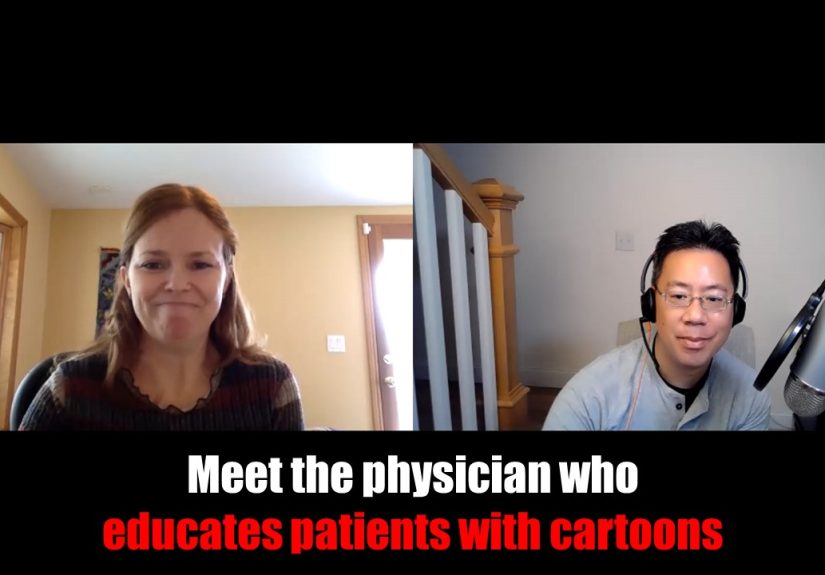
“Meet the physician who educates patients with cartoons” is more than a catchy title. It is a glimpse into a better model of healthcare communication. Dr. Diana Lerner’s work shows that when doctors combine medical expertise with storytelling, patients can feel less afraid and more informed. Cartoons make complex topics visible. They turn procedures into stories, tools into characters, and instructions into something families can remember.
In a healthcare world crowded with portals, paperwork, rushed appointments, and unfamiliar terminology, cartoon-based patient education feels refreshingly human. It says that understanding matters. It says that children deserve explanations made for them. It says that a doctor can be both scientifically serious and creatively playful. And honestly, if a smiling endoscope can help a child walk into a procedure with less fear, Scopey deserves a tiny white coat.