Table of Contents >> Show >> Hide
- Quick takeaways (read this if your kid is already putting on their shoes)
- Why the question changed: authorization vs. recommendation vs. reality
- What vaccines are available for kids under 5 in the U.S. right now?
- Moderna for ages 6 months–4 years: what the schedule typically looks like
- So where does Pfizer fit inif we’re talking “under 5”?
- Moderna vs. Pfizer: what used to be different (and why people still compare)
- Effectiveness: what protection looks like for little kids
- Safety and side effects: what parents commonly see (and what to watch for)
- Co-administration with other childhood vaccines
- How to decide for your child (a parent-friendly checklist)
- What to expect at the appointment (and how to make it less dramatic)
- Common myths (gently tossed into the trash)
- Bottom line for parents
- Real-world parent experiences (about )
If you searched “Pfizer vs. Moderna for kids under 5,” you probably expected a neat face-offtwo vaccines enter, one toddler leaves with a sticker.
Here’s the plot twist (and it matters): in the U.S. for the 2025–2026 season, children ages 6 months to 4 years have only one mRNA COVID-19 vaccine option: Moderna (Spikevax).
Pfizer-BioNTech (Comirnaty) starts at age 5 and up. So for under-5s, it’s less “Pfizer vs. Moderna” and more “Moderna vs. the nap schedule.”
That said, families still have real questions: What changed? What if your child previously got Pfizer when it was available? What does “updated formula” mean?
How many doses are needed? And how do you make a decision that feels confidentespecially when your child is small, squirmy, and allergic to doing anything on your calendar?
Let’s break it down in plain English, with the details that actually help at the pediatrician’s office.
Quick takeaways (read this if your kid is already putting on their shoes)
- Under 5 (6 months–4 years): For 2025–2026 in the U.S., Moderna (Spikevax) is the age-approved option.
- Age 5 and older: Pfizer (Comirnaty) is an option, along with Moderna (and Novavax for older ages).
- Most common schedule difference (historically): Moderna used a 2-dose primary series for younger kids; Pfizer used a 3-dose primary series for younger kids. Today, the practical “choice” under 5 is Moderna.
- Updated formula: Each season’s vaccine is updated to better match circulating variantsthink “flu shot logic,” but for COVID.
- Safety basics: Side effects are typically mild and short-lived (sore arm, fatigue, fever). Serious events are rare, but your clinician screens for risk factors and watches dosing carefully.
Why the question changed: authorization vs. recommendation vs. reality
There are three layers to COVID-19 vaccine guidance in the U.S., and they’re easy to mix up:
- FDA authorization/approval: Determines which products can be used for which ages.
- CDC/ACIP clinical guidance: Provides the schedule, intervals, and who is considered “up to date.”
- On-the-ground practice: What your pediatrician’s office stocks, what insurers cover, and what your state programs support.
For 2025–2026, the age “lane assignments” matter most for parents of under-5s:
Moderna (Spikevax) is authorized for ages 6 months and older, while Pfizer (Comirnaty) is authorized starting at age 5.
That’s why many recent “Pfizer vs. Moderna under 5” articles you remember reading don’t line up perfectly with what clinics are doing now.
What vaccines are available for kids under 5 in the U.S. right now?
For children 6 months through 4 years old, Moderna (Spikevax) is the available age-approved option for the 2025–2026 COVID-19 vaccine formula.
If your child is 5 years old, the conversation expandsPfizer can re-enter the chat, and your clinician can advise based on your child’s vaccine history.
Also important: when you hear “2025–2026 formula,” it’s not marketing fluff. The FDA advises manufacturers to update the vaccine to better match what’s circulating.
For fall 2025 and beyond, the U.S. moved to a monovalent, JN.1-lineage-based vaccine approach (with a preferred strain target identified by FDA guidance).
Translation: one updated target, instead of older multi-strain blends.
Moderna for ages 6 months–4 years: what the schedule typically looks like
Your child’s schedule depends on two things:
(1) their age today and (2) their prior COVID-19 vaccine history.
Your pediatrician will follow the CDC’s current season schedule and product-specific guidance.
If your child is unvaccinated
For many unvaccinated young children, Moderna’s primary series has commonly been structured as two doses spaced weeks apart.
In practice, clinics focus on completing the series on schedule, because spacing and dose count are designed to build a strong immune response (and because you do not want Dose #2 competing with birthday parties, swim lessons, and a surprise ear infection).
If your child has had prior COVID-19 vaccine doses
If your child previously received older-season COVID-19 vaccine doses, the current guidance often aims to get them “up to date” using the current-season formula.
The exact number of doses needed can varyespecially if your child started a series long ago, or if they received a different formulation in a prior season.
This is why your clinician asks for your child’s vaccine record before recommending the next step.
If your child recently had COVID-19
Many clinical guidance documents note that people who recently had SARS-CoV-2 infection may consider delaying vaccination for a period of time (often discussed as about three months in multiple protocols),
particularly to optimize timing of immune response. Your pediatrician can help decide whether to vaccinate now or wait based on:
your child’s risk factors, local transmission, daycare exposure, and upcoming travel or family events.
If your child is moderately or severely immunocompromised
Children with certain immune conditions or treatments may be recommended an expanded schedule (more doses and/or different intervals).
This is not a “because it’s unsafe” situation; it’s because immunocompromised bodies sometimes need extra practice reps to build protection.
Your child’s specialist and pediatrician will coordinate timing.
So where does Pfizer fit inif we’re talking “under 5”?
Today, Pfizer doesn’t fit for children under 5 in the U.S. because it is not authorized for ages 6 months–4 years in the current season guidance.
But parents still bump into Pfizer in two common real-life scenarios:
Scenario 1: Your child is turning 5 soon
A child who is 4 years and 10 months old today is still in the under-5 lane, which means Moderna is the age-approved option.
Once your child turns 5, Pfizer becomes an option. Whether you switch products depends on current guidance, availability, and your child’s vaccine history.
Many immunization schedules prefer completing doses with the same manufacturer when feasible, but there are also clinical allowances when the original product isn’t available.
Scenario 2: Your child previously received Pfizer when it was available for younger ages
If your child received Pfizer in the past under an older authorization, your clinician will use the current CDC schedule to determine what “up to date” means now.
This can involve moving forward with the currently authorized age-appropriate product and formulation.
Bring your child’s vaccination record (or your state registry printout) to make this easynobody wants to solve a vaccine logic puzzle from memory at 8:00 a.m.
Moderna vs. Pfizer: what used to be different (and why people still compare)
Even though Moderna is the practical under-5 option now, families still ask “which one is better?” because for a while, both brands were discussed for the youngest kids.
Historically, the differences parents heard about included:
1) Dose count and spacing
In younger children, Moderna’s primary series was commonly described as two doses, while Pfizer’s was commonly described as three doses.
That alone influenced family choices: two appointments feels like a manageable mini-series; three can feel like a trilogy with an unexpected spin-off.
The reasoning wasn’t “one is stronger”; it’s that the products and trial strategies differed, and schedules were designed to achieve adequate immune response for that age group.
2) Dose size (micrograms) and formulation approach
Both are mRNA vaccines, but pediatric doses were not simply “adult dose, but smaller kid.”
Dose amounts differ by age group and product, and the goal is the same: teach the immune system to recognize the virus without giving the child the full “adult” exposure.
This is why parents should never compare dose size alone as a shortcut for effectiveness.
3) Availability and clinic logistics
Real life matters. Some offices stocked one product more reliably, and some families preferred “whatever is available today, because my child is healthy right now and we’re here.”
The best vaccine is the one your child can actually receive on schedule.
Effectiveness: what protection looks like for little kids
When parents ask, “Will this keep my child from getting COVID?” the most honest answer is:
vaccines are designed primarily to reduce the risk of severe disease, hospitalization, and serious complications.
They can also reduce the chance of symptomatic infection, but protection against infection tends to change as the virus evolves and as time passes.
For young children, clinical studies and real-world monitoring have focused on:
immune response (antibodies), safety signals, and protection against severe outcomes.
While many vaccinated kids still get COVID at some point, vaccination can stack the odds in their favorespecially for children with underlying conditions or high exposure (daycare is basically a tiny conference center where everyone shares snacks and opinions).
Safety and side effects: what parents commonly see (and what to watch for)
Most kids do well. Typical short-term side effects after pediatric COVID vaccination can include:
- Sore arm or leg (depending on injection site)
- Fatigue or extra naps (a rare parenting win)
- Fever, irritability, or decreased appetite for a day or two
- Headache or chills in older children
Serious adverse events are uncommon, and vaccine safety monitoring in the U.S. is continuous.
Families sometimes ask about myocarditis/pericarditis (inflammation of heart muscle or surrounding tissue), which has been observed rarely after mRNA vaccines, more often in adolescent and young adult males than in very young children.
Your clinician weighs age-specific data, spacing, and medical history when advising your family.
Practical tip: plan a calm day after vaccination when possiblenothing intense, no “surprise trampoline park,” and maybe keep a thermometer and children’s fever medicine on hand
only if your pediatrician recommends it.
If you have concerns after vaccination, call your pediatricianespecially for symptoms that feel unusual or persistent.
Co-administration with other childhood vaccines
Parents often worry about “too many shots.” Clinically, COVID-19 vaccination can often be given alongside other routine vaccines.
Co-administering vaccines may reduce the number of visits (and the number of times your child has to be convinced that the exam table paper is not for origami).
Your clinician will choose injection sites appropriately and advise you on what to expect afterward.
How to decide for your child (a parent-friendly checklist)
If your child is under 5, you’re mostly deciding when to vaccinate and how to keep the schedule on track (since the product choice is Moderna in current U.S. guidance).
Here’s a simple checklist to bring to your child’s appointment:
Ask these questions
- What is my child’s “up to date” status under the current season guidance?
- How many doses are recommended for my child’s age and vaccine history?
- What spacing should we use, and what’s the “latest acceptable” window if we get delayed?
- Should we wait after a recent COVID infection, and if so, how long?
- Can we do COVID vaccine with other vaccines at the same visit?
Consider your child’s real-world risk
- Daycare/preschool attendance (high exposure)
- Underlying conditions (asthma, heart/lung disease, immune conditions, etc.)
- Household risk (new baby, older grandparents, medically fragile family members)
- Upcoming travel or large gatherings
Example: If your 2-year-old is starting daycare in two weeks and hasn’t had any COVID vaccines, many parents choose to begin as soon as possible to start building protection.
If your child had COVID very recently and is otherwise healthy, your clinician may discuss timing so the next dose happens when it’s most useful.
What to expect at the appointment (and how to make it less dramatic)
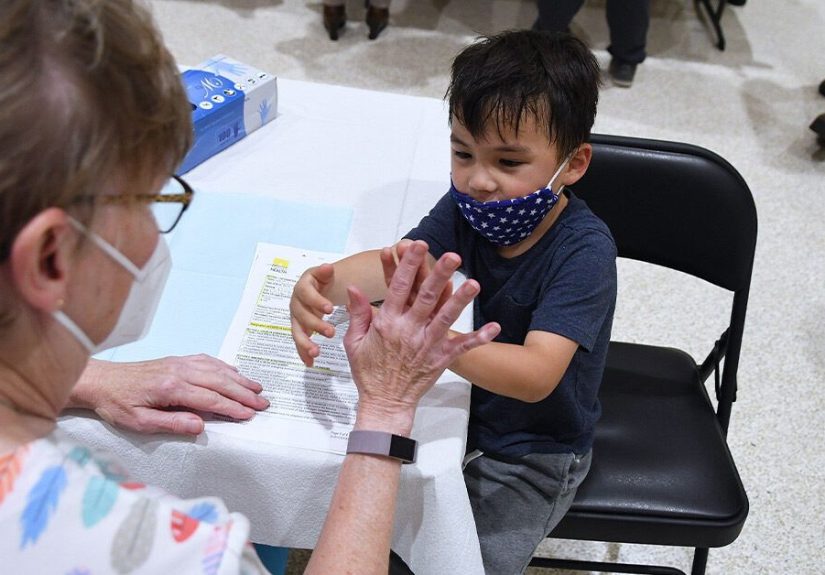
Vaccinating toddlers is half medicine, half stagecraft. Helpful strategies many parents use:
- Bring a comfort item (blanket, stuffed animal, or the one spoon your child considers sacred).
- Use distraction: videos, bubbles, snacks (if allowed), or a “count to five” game.
- Dress for easy access (short sleeves or pants that roll up quickly).
- Plan a low-key rest of the day, just in case your child feels tired.
Common myths (gently tossed into the trash)
Myth: “Kids don’t get very sick from COVID, so the vaccine is pointless.”
Many kids do have mild illness, but not all. Some children are hospitalized, and risk is higher for certain medical conditions and younger ages.
Vaccination is one layer of protection that can reduce the chance of severe outcomes and complications.
Myth: “If my child already had COVID, vaccination doesn’t help.”
Prior infection does provide some immunity, but protection can wane and variants change.
Vaccination after infection can broaden and strengthen immune protection, and clinical guidance often discusses timing so you get the most benefit.
Myth: “Bigger dose = better protection.”
Pediatric dosing is intentionally designed for immune response and safety at each age.
Dose size cannot be used as a simple “stronger/weaker” comparison across products.
Bottom line for parents
For U.S. families with children under 5, the most useful question today is not “Pfizer or Moderna?”
It’s: “What is the right Moderna schedule for my child’s age and vaccine history, and when should we start?”
If your child is turning 5 soon or previously received Pfizer in a prior season, your clinician will help you navigate the transition using current guidance.
Bring records, ask questions, and remember: the goal is simplehelp your child build protection against severe illness in the safest, most practical way.
Real-world parent experiences (about )
Parents rarely walk into a vaccine appointment feeling 100% chillespecially with kids under 5, where every decision feels like it should come with a pop quiz and a parenting grade.
A common experience is the “I’m not against vaccines, I’m just exhausted” feeling. Families often describe how hard it is to keep track of the current guidance, because COVID vaccine schedules have changed more often than a toddler’s favorite food. One week it’s “they’re picky,” the next week it’s “they only eat blueberries and vibes.” Vaccine updates can feel similar: you finally learn the rules, and then the rules update.
Another theme parents talk about is logistics. Many caregivers want to vaccinate but struggle with the practical barriers: limited appointment slots, a child who is always sick on clinic day, or two working parents juggling schedules. Some parents share that they choose vaccine visits that line up with quieter weekends, because they’d rather not discover “mild fever day” on a Monday morning when everyone is already late. Others plan for the “post-shot comfort kit”: favorite snacks, an easy dinner, and a backup plan if their child is extra cranky.
Parents also describe the emotional side: the moment the nurse brings out the syringe and your child suddenly becomes an Olympic-level negotiator. Many families say distraction is the MVPbubbles, a video, a special toy that only appears at medical appointments, or the classic “look at me, not at the needle” technique. Some parents prefer honest, simple language (“quick pinch, then we’re done”), while others swear by the “mystery sticker reveal” afterward. Either way, a lot of parents say the anticipation is worse than the shot itselfand that the recovery is usually smoother than they feared.
The “Pfizer vs. Moderna” confusion is another shared experience. Parents frequently mention reading older articles or social posts that suggest a choice between two under-5 products, only to arrive at the clinic and hear, “For your child’s age, we’re using Moderna.” That can feel jarring, like showing up to order from a menu and learning the restaurant now serves one entrée: “today’s special.” Families often feel better once a clinician explains the difference between older authorizations and the current season’s age approvals, and why the updated formula matters.
Finally, many parents say their decision becomes clearer when they focus on their child’s real life: daycare exposure, grandparents who visit often, a child with asthma, or a new baby at home. In those conversations, the vaccine stops being an abstract debate and starts being a practical toolone part of a bigger “keep our household functioning” strategy. Parents may not love making yet another medical decision, but they often describe feeling relief after they have a plan, a schedule, and a pediatrician they trust. And yesmany also report that the coveted post-vaccine sticker becomes the true hero of the day.