Table of Contents >> Show >> Hide
- What Is the Famous Particle Accelerator in This Story?
- The “Ghost” Is Really a Four-Dimensional Resonance
- Why Four Dimensions?
- How Physicists Finally Caught the Ghost
- Why Beam Loss Is a Big Deal
- Why This Discovery Matters for the Large Hadron Collider and Future Machines
- From Coffee Cups to Proton Beams: A Friendly Analogy
- The Role of Magnets in the Haunting
- Why the Discovery Took So Long
- What This Means for Everyday Readers
- Not a Ghost Particle, Not a Paranormal Claim
- Experience Section: What This Discovery Teaches Us About Working With Complex Systems
- Conclusion: The Ghost Was Mathematics All Along
Some ghosts live in old castles. Others prefer abandoned hotels, foggy graveyards, or the suspicious corner of your basement where every missing sock seems to end up. But the “ghost” recently tracked down by physicists was hiding in a far more dramatic place: CERN’s Super Proton Synchrotron, one of the most important particle accelerators in the world.
Before anyone grabs a proton-sized flashlight, let’s clear the air. This is not a paranormal story. No floating sheets. No rattling chains. No spectral scientist whispering, “Check the beamline.” The ghost in question is a hidden resonance structure inside the acceleratora subtle, invisible pattern that can nudge particles away from their ideal path and contribute to beam loss. In plain English: the machine was experiencing a mathematical haunting.
The discovery matters because particle accelerators depend on extreme precision. These machines guide beams of charged particles at nearly the speed of light using electric fields, magnets, vacuum systems, and timing so careful it makes a Swiss watch look like it has a casual relationship with punctuality. When tiny resonances build up inside that system, particles can drift, scatter, or escape the beam. For high-intensity machines like the Super Proton Synchrotron, even a small disturbance can become a big headache.
What Is the Famous Particle Accelerator in This Story?
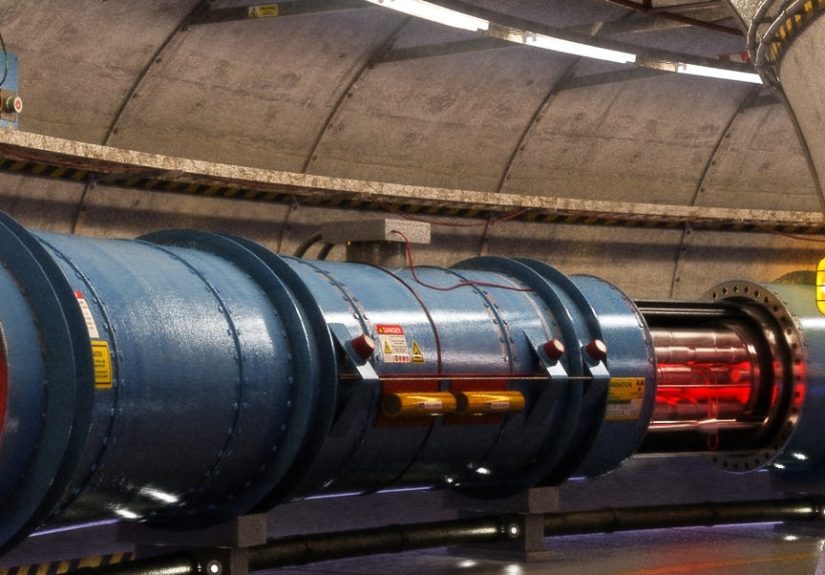
The star of this story is CERN’s Super Proton Synchrotron, often called the SPS. Located near Geneva, Switzerland, the SPS is a circular accelerator nearly 7 kilometers in circumference. It began operating in 1976 and has spent decades doing the scientific equivalent of lifting heavy boxes, opening cosmic doors, and helping other machines get ready for glory.
The SPS is one of the key machines in CERN’s accelerator complex. It receives particles from smaller accelerators, boosts them to much higher energies, and sends them onward to experiments or to the Large Hadron Collider, the world’s most powerful particle accelerator. The SPS has also supported famous research programs, including work connected to the discovery of the W and Z bosons in 1983, a milestone that helped confirm the electroweak theory of particle physics.
In other words, the SPS is not some forgotten tunnel with dusty switches and a coffee machine from 1976. It is a living, working, upgraded, essential part of modern high-energy physics. If the LHC is the headliner, the SPS is the veteran stage manager making sure the show actually happens.
The “Ghost” Is Really a Four-Dimensional Resonance
The word “ghost” is catchy, but the scientific term is more precise: physicists observed fixed lines induced by a nonlinear resonance. That phrase may sound like a spell from a physics-themed wizard academy, but the idea becomes friendlier when we start with resonance.
Resonance happens when a system receives repeated pushes at just the right rhythm. Push a child on a swing at the correct moment, and the swing goes higher. Walk with a cup of coffee at the wrong pace, and your beverage launches a tiny rebellion against your shirt. A tuning fork can make another tuning fork vibrate if their frequencies match. Resonance is everywhere, and it can be useful, beautiful, annoying, orin a particle acceleratorexpensive.
Inside an accelerator, particles do not simply glide around like obedient marbles in a perfect circle. They oscillate slightly as magnets guide and focus them. Their horizontal and vertical motion can become coupled. If the machine’s electromagnetic environment creates the right repeating pattern, certain particles can fall into a resonance. Instead of staying neatly in the beam, they may drift into less stable motion and eventually be lost.
Why Four Dimensions?
When physicists say the ghost is “four-dimensional,” they do not mean it is a monster from a sci-fi portal. They mean the structure exists in phase space, a mathematical way of describing a moving system. For a particle beam, it is not enough to know where a particle is horizontally and vertically. Scientists also need information about how it is moving in those directions.
That creates a four-parameter picture: horizontal position, horizontal momentum, vertical position, and vertical momentum. Trying to visualize this directly is difficult because humans are excellent at imagining pizza, decent at imagining three-dimensional rooms, and generally terrible at imagining four-dimensional phase-space structures before breakfast.
To make the invisible visible, scientists used advanced mathematical tools, including a Poincaré surface of section. Think of it as taking repeated snapshots of a complex motion at carefully chosen moments. Instead of watching a dizzying full movie of particle motion, researchers create a map that reveals the hidden structure beneath the chaos.
How Physicists Finally Caught the Ghost
The research team used the Super Proton Synchrotron itself as a laboratory. They excited transverse oscillations in a proton beam, then used beam position monitors around the accelerator to record how particles behaved over thousands of turns. These monitors allowed the scientists to reconstruct the beam’s motion in both horizontal and vertical planes.
That point is crucial. Accelerator physics has often treated motion in one plane at a time because it is simpler and, frankly, because reality occasionally has the manners to cooperate. But this resonance required a coupled view. The “ghost” was hiding in the relationship between planes, not in one direction alone.
By measuring the beam repeatedly and comparing the results with theory and simulation, the team confirmed the existence of fixed lines. These fixed lines are stable curves embedded in four-dimensional phase space. Particles affected by the resonance can become organized around these hidden curves, which helps explain why beam behavior can degrade in ways that are hard to spot using simpler models.
Why Beam Loss Is a Big Deal
Beam loss sounds harmless until you remember what kind of beam we are talking about. In a high-energy accelerator, a particle beam is not a polite flashlight beam. It is a concentrated stream of charged particles carrying enormous energy. The whole point is to keep that stream focused, stable, and predictable.
When particles are lost from the beam, several problems can follow. The beam becomes less intense, which can reduce the quality of data produced by experiments. Lost particles can activate machine components, increasing radiation levels and maintenance challenges. In extreme cases, uncontrolled beam loss can damage equipment. Particle accelerators are tough machines, but they are not fans of random energetic protons going on unscheduled field trips.
For facilities pushing toward brighter, more intense beams, understanding beam degradation is essential. The future of accelerator science depends not only on building bigger machines but also on making existing and future machines more precise. Sometimes progress means building a more powerful magnet. Other times, it means discovering that an invisible mathematical wrinkle has been quietly causing trouble for years.
Why This Discovery Matters for the Large Hadron Collider and Future Machines
The SPS feeds beams into the Large Hadron Collider, so improvements in SPS beam quality can benefit the LHC’s performance. A cleaner, brighter, more stable beam gives experiments better chances of producing useful collisions and capturing rare events. Since particle physics often depends on finding one unusual signal among mountains of ordinary data, beam quality is not a luxury. It is the price of admission.
This research also matters beyond CERN. Resonance and nonlinear dynamics are not unique to the SPS. Any circular accelerator that uses magnetic fields to guide particles can face similar issues. That includes current research facilities, synchrotron light sources, medical accelerators, nuclear physics machines, and future collider designs.
The more intense a beam becomes, the more important these effects can be. As scientists demand higher luminosity, better brightness, and more reliable operation, the invisible details of beam dynamics become impossible to ignore. The ghost in the SPS is therefore not just a local nuisance. It is a lesson for the entire accelerator community.
From Coffee Cups to Proton Beams: A Friendly Analogy
Imagine walking across a room with a full cup of coffee. If your steps accidentally match the natural sloshing rhythm of the liquid, the coffee begins to surge higher with each step. Suddenly, your morning caffeine is decorating your sleeve. The cup did not break. Gravity did not change. The coffee simply found a rhythm that amplified its motion.
Now replace the coffee with a proton beam, your walking rhythm with repeating electromagnetic effects, and your shirt with a billion-dollar accelerator complex. The stakes have increased slightly.
In the SPS, resonance can amplify specific patterns in particle motion. These patterns are not random. They follow mathematical rules. The challenge is that the rules operate in phase space, where motion is described by positions and momenta rather than everyday geometry. The “ghost” is spooky only because it is hard to see directly.
The Role of Magnets in the Haunting
Particle accelerators rely heavily on magnets. Dipole magnets bend beams around curves. Quadrupole magnets focus beams. Sextupole and octupole magnets correct imperfections and help control more complex behavior. The SPS contains more than a thousand conventional electromagnets, each contributing to the machine’s ability to steer particles through its long circular path.
But no real machine is perfectly ideal. Manufacturing tolerances, alignment limits, magnetic field variations, power-supply ripples, and nonlinear effects can all influence particle motion. These imperfections do not mean the machine is badly built. They mean it exists in the real world, where atoms, cables, temperature changes, and engineering tolerances all have opinions.
In high-precision beam physics, tiny effects matter. A small magnetic imperfection repeated over thousands or millions of turns can become significant. That is one reason resonance structures are so important: they reveal how small, repeated influences can accumulate into measurable beam behavior.
Why the Discovery Took So Long
The idea of these fixed lines was not invented yesterday. Theoretical predictions and simulations had suggested that such resonance structures should exist. The problem was proving it experimentally. Measuring a four-dimensional effect inside a working accelerator is not exactly like checking the tire pressure on a bicycle.
Researchers needed the right machine conditions, the right diagnostics, and the right mathematical framework. They had to excite the beam without ruining the experiment, collect enough data, reconstruct the motion accurately, and separate the resonance signal from other machine effects. That takes patience, expertise, and the sort of persistence usually associated with people assembling furniture using instructions translated through five languages.
The achievement is important because it brings theory, simulation, and experiment into alignment. When all three agree, scientists gain confidence that they understand the phenomenon well enough to predict it, manage it, and eventually reduce its harmful effects.
What This Means for Everyday Readers
At first glance, a four-dimensional resonance in a European particle accelerator may seem remote from daily life. Most people do not wake up wondering whether their local proton beam is having stability issues. Fair enough.
But particle accelerators have broad influence. They support fundamental discoveries, medical technologies, materials research, semiconductor development, sterilization processes, and industrial applications. Around the world, tens of thousands of accelerators are used for science, medicine, and technology. Better beam control can make these machines more efficient, reliable, and powerful.
The SPS ghost story also shows how modern science advances. Breakthroughs are not always flashy discoveries of brand-new particles. Sometimes they are deep improvements in how we understand the machines that make discoveries possible. It is science looking at its own tools and saying, “You know, that weird wobble deserves a closer look.”
Not a Ghost Particle, Not a Paranormal Claim
It is worth avoiding one common confusion. This “ghost” is not a ghost particle such as a neutrino, and it is not evidence for supernatural forces. The term is a metaphor for something invisible, elusive, and difficult to measure. The actual discovery belongs firmly to accelerator physics, nonlinear dynamics, and beam diagnostics.
That distinction matters because particle physics already has plenty of mysterious-sounding vocabulary. Quarks have “flavors.” Gluons carry “color.” Neutrinos are often called ghost particles because they pass through matter so easily. Add a haunted accelerator to the mix, and the public imagination naturally starts redecorating CERN as a Halloween attraction.
The real story is more interesting than the spooky version. It shows that even in one of the most advanced scientific facilities on Earth, hidden patterns can remain undiscovered until theory, instrumentation, and persistence finally line up.
Experience Section: What This Discovery Teaches Us About Working With Complex Systems
One practical lesson from the SPS ghost is that complex systems rarely fail in simple, cartoonish ways. In real life, the problem is often not a single broken part with smoke coming out of it. More often, it is a subtle interaction between parts that are individually working as designed. Anyone who has troubleshot a computer, repaired a car, tuned a musical instrument, or tried to figure out why the Wi-Fi works everywhere except one suspicious corner of the house can appreciate this.
The accelerator version is more advanced, but the pattern feels familiar. The SPS did not need a ghostbuster. It needed careful measurement, strong models, and people willing to question whether the beam’s motion was hiding a deeper structure. That is a useful mindset far beyond physics. When a system behaves strangely, the answer may not appear if we look only in the most obvious direction. Sometimes we need to measure the horizontal and vertical behavior together, so to speak.
This discovery also highlights the value of patience. The resonance structure had been predicted and simulated before it was directly observed. That gap between “we think this exists” and “we have measured it” is where a lot of science lives. It is not glamorous. It involves calibration, repetition, failed attempts, and a heroic amount of data analysis. But it is how knowledge becomes sturdy enough to build on.
There is a writing lesson here, too. The word “ghost” makes the story irresistible, but the science keeps it meaningful. Good science communication needs both: a doorway and a foundation. The doorway invites people in. The foundation makes sure they do not leave with the wrong idea. In this case, the ghost metaphor helps readers care about fixed lines, phase space, and nonlinear resonanceterms that would otherwise make many people suddenly remember they have laundry to fold.
The human side of the story is also encouraging. Machines like the SPS are built by generations of engineers, physicists, technicians, operators, programmers, and theorists. A discovery inside such a machine is not just a single “aha!” moment. It is the result of decades of accumulated skill. The accelerator becomes a kind of scientific ecosystem, where old infrastructure supports new questions, and new questions reveal fresh value in old infrastructure.
Finally, the SPS ghost reminds us that precision is not boring. Precision is adventure with better notebooks. A tiny resonance, invisible to ordinary senses, can influence beams moving near light speed inside a giant underground machine. Finding it required turning motion into data, data into maps, and maps into understanding. That is not just a technical achievement. It is a reminder that the universe still hides surprises in places we thought we already knew well.
Conclusion: The Ghost Was Mathematics All Along
The discovery of the ghost haunting CERN’s Super Proton Synchrotron is a perfect example of modern physics at its best: technically demanding, conceptually strange, and much cooler than the phrase “beam degradation” has any right to be. By observing fixed lines caused by nonlinear resonance, physicists have confirmed an elusive structure that can affect particle motion inside circular accelerators.
The result does not reveal a supernatural presence. It reveals something better: a hidden order inside a complicated machine. Understanding that order can help improve beam stability, reduce particle loss, and guide the design of future accelerators. The ghost, in the end, was not a monster in the tunnel. It was a map waiting to be drawn.