Table of Contents >> Show >> Hide
- What Does “Neurodivergent Love Languages” Mean?
- 1. Info-Dumping: “I Love You, So Please Enjoy This Encyclopedia”
- 2. Parallel Play and Body Doubling: “Let’s Be Alone Together”
- 3. Penguin Pebbling: “I Found This Tiny Thing and Thought of You”
- 4. Support Swapping and Spoon Sharing: “I’ll Help Where I Can”
- 5. Deep Pressure: “Please Make My Nervous System Stop Doing Jazz Hands”
- Why These Love Languages Are Easy to Misread
- How to Use Neurodivergent Love Languages in Real Relationships
- Common Mistakes to Avoid
- Extra Experiences: What These Love Languages Feel Like in Everyday Life
- Conclusion
Love can look like a candlelit dinner, a handwritten note, or someone remembering exactly how you like your coffee. But for many neurodivergent people, love may also look like sending a raccoon meme at 2:14 p.m., sitting quietly in the same room while doing totally separate hobbies, or delivering a 23-minute TED Talk about train routes, mushroom species, ancient coins, or why one very specific video game soundtrack is emotionally perfect.
Welcome to the world of neurodivergent love languages: affectionate, meaningful, sometimes delightfully quirky ways people express care when their brains process communication, energy, sensory input, and connection differently. These love languages are not an official clinical framework, and they do not replace the classic love languages many people know. Instead, they offer a community-created lens for understanding how autistic people, ADHDers, AuDHD folks, and other neurodivergent people may show affection in ways that are easy to miss if you are only looking for traditional signs.
The five commonly discussed neurodivergent love languages are info-dumping, parallel play or body doubling, penguin pebbling, support swapping or spoon sharing, and deep pressure. Each one says, in its own language, “I trust you,” “I want you near me,” “I thought of you,” or “You are safe with me.” And honestly? That is pretty romantic, friendly, and humanwithout requiring anyone to become a greeting card with legs.
What Does “Neurodivergent Love Languages” Mean?
The term neurodivergent refers to people whose brains work, learn, communicate, focus, or process sensory information differently from what society often considers typical. This can include autism, ADHD, dyslexia, dyspraxia, Tourette syndrome, and other neurological or developmental differences. Neurodivergence is not one single personality type. It is a wide umbrella, and everyone standing under it has their own weather.
That matters because relationships are built on communication, and communication is not limited to words. Some people show affection through constant verbal reassurance. Others show it by repairing your laptop, remembering your safe foods, lowering the volume without being asked, or letting you sit beside them in peaceful silence. For neurodivergent people, these gestures may be especially powerful because they respect real needs: sensory comfort, predictable support, shared enthusiasm, autonomy, and emotional safety.
The phrase “neurodivergent love languages” became popular online, especially in autistic and ADHD communities. It is playful, but it points to something serious: many relationship conflicts are not caused by a lack of care. They are caused by mismatched interpretations. One person thinks, “They never say the right thing.” The other thinks, “I sent them seven videos about frogs because I love them. How much clearer can I be?”
1. Info-Dumping: “I Love You, So Please Enjoy This Encyclopedia”
Info-dumping is the act of sharing a large amount of information about a favorite subject, special interest, or current fascination. To outsiders, it may look like overtalking. To the person doing it, it may feel like opening a treasure chest and inviting someone else to admire the gold.
For many neurodivergent people, especially autistic people and ADHDers, deep interests can be a major source of joy, regulation, identity, and connection. When someone info-dumps to you, they may not simply be delivering facts. They may be saying, “This lights up my brain, and I trust you enough to let you see it.” That is not small. That is emotional VIP access.
What info-dumping can look like
Info-dumping might sound like a detailed explanation of marine biology during lunch, a passionate breakdown of a favorite TV series, a long voice note about vintage cameras, or an excited message beginning with “Okay, so this is going to sound random, but…” Spoiler: it will be random, and it may also be adorable.
The key is not that every listener must become a full-time fan of the topic. The key is respect. You can say, “I want to hear about this, but I only have ten minutes right now.” That gives the speaker a boundary without treating their enthusiasm like a problem to be fixed.
How to receive this love language
Try asking one specific question: “What is your favorite part?” or “How did you get into this?” Specific questions are tiny bridges. They show interest without forcing you to pretend you have suddenly developed a PhD in medieval armor, Japanese stationery, or the emotional politics of animated penguins.
2. Parallel Play and Body Doubling: “Let’s Be Alone Together”
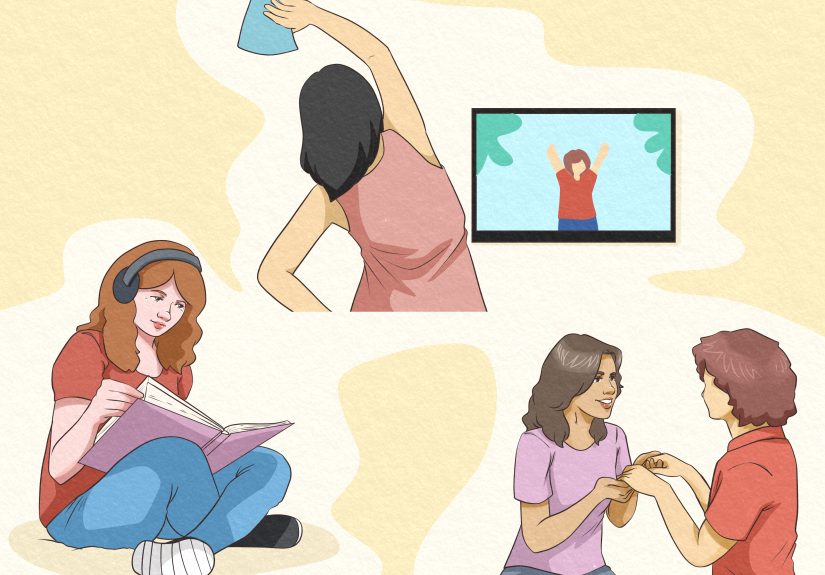
Parallel play means being near someone while doing separate activities. One person reads; the other sketches. One plays a game; the other folds laundry. Nobody is demanding constant conversation, eye contact, or performance. The love is in the shared presence.
This can be deeply comforting for people who enjoy connection but become drained by nonstop interaction. It says, “I like being around you, and I do not need you to entertain me.” In a world that sometimes treats silence like a social emergency, parallel play is a cozy little rebellion.
Body doubling is closely related. It is especially common in ADHD communities and means doing a task while another person is present. The other person may not help directly. Their presence creates structure, accountability, and momentum. For someone struggling with executive function, that quiet companionship can make starting a task feel less like pushing a refrigerator uphill.
Examples of parallel play and body doubling
A couple might sit on the couch together while one crochets and the other watches basketball. Friends might do homework on a video call with microphones muted. Roommates might clean different parts of the apartment at the same time. A parent and teen might share a table while one pays bills and the other draws. No grand speech is required. The message is simple: “Your presence helps.”
Why it matters
Parallel play respects both connection and autonomy. For neurodivergent people who mask heavily in public, being with someone without having to “perform normal” can feel like taking off shoes that were half a size too small. Relief is a love language, too.
3. Penguin Pebbling: “I Found This Tiny Thing and Thought of You”
Penguin pebbling is inspired by the way some penguins present pebbles as part of bonding behavior. In human terms, it means offering small tokens of affection: a meme, a cool rock, a sticker, a playlist, a photo of a weird cloud, a snack, a link, or a tiny object that says, “This reminded me of you.”
Penguin pebbling is not about price. In fact, expensive gifts may completely miss the point. The magic is in the personal connection. A five-dollar trinket chosen with eerie emotional accuracy can say more than a luxury item selected with all the personality of a hotel lobby.
What penguin pebbling can look like
It might be sending a friend a possum meme because possums are their brand. It might be bringing home a smooth stone because your partner likes natural textures. It might be saving the last red gummy because your sibling always picks those first. It might be forwarding an article about someone’s special interest with the message, “This made me think of you.”
For neurodivergent people who find direct emotional language difficult, pebbling can be a gentle way to communicate affection without forcing a dramatic heart-to-heart. It is love wearing casual sneakers.
How to appreciate pebbling
Notice the thought behind the gesture. A simple “You remembered!” or “This is extremely me” can mean a lot. If the pebbling becomes too frequentsay, 43 videos before breakfastit is okay to set a kind boundary: “I love that you think of me. Can you send your top three favorites instead of every single one?” Boundaries protect the connection; they do not cancel it.
4. Support Swapping and Spoon Sharing: “I’ll Help Where I Can”
Support swapping, sometimes called spoon sharing, is about exchanging practical care based on energy, capacity, and needs. The “spoon” idea comes from spoon theory, a metaphor often used in chronic illness and disability communities to describe limited physical, mental, or emotional energy.
Many neurodivergent people also relate to energy limits. Sensory overload, social masking, executive dysfunction, transitions, decision fatigue, and emotional regulation can all drain energy. So support swapping asks: “What do you have capacity for today, and what can I help carry?”
Examples of support swapping
One person may make the phone call because phone calls make the other person’s brain leave the building. Someone may cook dinner while the other handles the grocery list. A friend may send a reminder before an appointment. A partner may help break a large task into smaller steps. A sibling may sit nearby while someone writes an email they have been avoiding for three business weeks and one emotional century.
This love language is practical, but it is not cold. It is deeply caring. It says, “I see the invisible effort you are spending, and I do not expect you to pretend everything is easy.”
Keeping support healthy
Support swapping works best when it is mutual, clear, and respectful. It should not turn one person into a permanent caregiver or the other into a permanent project. Good support sounds like: “I can do dishes tonight, but I need help with planning tomorrow,” or “I am out of spoons today, but I can send you encouragement while you handle that task.” Love is not always fifty-fifty every day. Sometimes it is eighty-twenty, then twenty-eighty, and sometimes everyone orders pizza and calls it emotional sustainability.
5. Deep Pressure: “Please Make My Nervous System Stop Doing Jazz Hands”
Deep pressure refers to firm, calming sensory input, such as a tight hug, weighted blanket, compression clothing, firm hand pressure, or lying under a heavy comforter. Some neurodivergent people find deep pressure soothing because it can help regulate sensory overload or stress.
This love language must come with a giant neon sign that says: consent matters. Not everyone likes touch. Some people love firm pressure but dislike light touch. Some enjoy hugs only from trusted people. Some want no touch at all. The loving part is not the pressure itself; it is respecting the person’s sensory needs.
What deep pressure can look like
It may be asking, “Do you want a firm hug or space?” It may be handing someone their weighted blanket after a long day. It may be sitting close without touching. It may be learning that your loved one likes pressure on their shoulders but hates surprise touch. Details matter. Nervous systems are picky little housecats.
How to practice it safely
Use clear questions. “Is this okay?” “More pressure or less?” “Do you want me to stop?” These are not mood killers; they are trust builders. For teens, families, friends, and partners alike, physical affection should always be chosen, never assumed.
Why These Love Languages Are Easy to Misread
Neurodivergent affection can be misunderstood when people expect love to arrive in one approved costume. Info-dumping may be misread as self-centeredness. Parallel play may be mistaken for boredom. Pebbling may be dismissed as silly. Support swapping may look too practical. Deep pressure may be confusing to someone who does not experience sensory input the same way.
But once you learn the translation, the affection becomes much easier to see. The long explanation means, “I want to share my joy.” The quiet room means, “I feel safe beside you.” The meme means, “You crossed my mind.” The reminder means, “Your stress matters to me.” The weighted blanket means, “I want your body to feel safe, too.”
How to Use Neurodivergent Love Languages in Real Relationships
Start by asking better questions. Instead of “Why are you like this?” try “What does care look like for you?” Instead of “Why don’t you just say how you feel?” try “Is there another way you show affection?” Curiosity is much more useful than criticism, and it has fewer emotional splinters.
It also helps to make affection explicit. Neurodivergent and neurotypical people alike can benefit from saying, “When I send you articles, that is one way I show I care,” or “When I sit near you quietly, it means I like being close, not that I am ignoring you.” A little translation can prevent a lot of unnecessary drama.
Create a personal love-language menu
Try making a simple list with three columns: “Things that make me feel loved,” “Things that drain me,” and “Things I do to show love.” This can work for romantic partners, friends, siblings, parents, or roommates. The goal is not to diagnose anyone. The goal is to stop expecting people to read minds, because most minds do not come with subtitles.
Respect individual differences
Not every neurodivergent person enjoys all five love languages. Some hate deep pressure. Some do not info-dump. Some prefer direct words. Some love traditional gifts. Some want lots of conversation. Neurodivergence explains possibilities; it does not erase individuality.
Common Mistakes to Avoid
First, do not turn these love languages into stereotypes. Saying “All autistic people love parallel play” or “All ADHD people info-dump” is not accurate. People are people, not downloadable character templates.
Second, do not use neurodivergence as an excuse to ignore boundaries. If someone says they are overwhelmed by messages, the loving response is to adjust. If someone says they do not want touch, respect that immediately. Affection without consent is not affection; it is a boundary problem wearing a fake mustache.
Third, do not assume quiet means uncaring. Many people show love through presence, practical help, or remembering details. Pay attention to patterns, not just speeches.
Extra Experiences: What These Love Languages Feel Like in Everyday Life
In real life, neurodivergent love languages often show up in tiny scenes that would never make it into a dramatic movie trailer but absolutely belong in the relationship hall of fame. Imagine a friend who knows you are overwhelmed after school or work, so they do not ask twenty questions the second you walk in. They just slide a snack across the table and sit nearby. No grand announcement. No orchestra. Just quiet care with crackers.
Or picture two people on a video call, both doing separate chores. One is cleaning a desk. The other is sorting laundry. They barely talk, but every so often one says, “Still here,” and the other says, “Same.” For someone with ADHD, that small presence can make a boring task feel possible. For someone who struggles with loneliness, it can make the room feel less heavy. It is not flashy, but it works.
Penguin pebbling can be just as meaningful. A person might save a bottle cap because it has a color their friend loves. They might send a photo of a dog wearing sunglasses because it matches an inside joke from three months ago. To an outsider, it may look random. To the receiver, it says, “You remembered who I am when I was not even in the room.” That kind of remembering can feel incredibly tender.
Info-dumping has its own emotional texture. When someone shares their special interest, they may be offering a part of their inner world. Listening does not mean you must memorize every detail. It means you recognize the joy underneath the information. A good response might be, “I can tell this matters to you,” or “Show me your favorite part.” Those sentences are small, but they can land like sunshine.
Support swapping may look the least poetic, but it can be one of the most powerful. There is a special kind of love in someone saying, “I know forms stress you out, so I will sit with you while you fill it in,” or “You cooked, so I will handle cleanup.” Practical care tells the truth: life is easier when people stop pretending everyone has the same energy, skills, and stress limits.
Deep pressure, when wanted, can also become part of a person’s comfort routine. A weighted blanket after a noisy day, a firm hug from a trusted person, or a cozy hoodie that feels just right can help the body settle. The important part is choice. The best sensory support begins with asking, listening, and believing the answer.
These experiences reveal the heart of neurodivergent love languages: they are not about being unusual for the sake of being unusual. They are about being understood without having to translate every breath. They remind us that care can be quiet, practical, enthusiastic, sensory, silly, or wonderfully specific. Sometimes love says, “I adore you.” Sometimes it says, “I found this cool leaf and thought you needed to see it.” Both can count.
Conclusion
The five neurodivergent love languages help us notice affection that may otherwise be overlooked. Info-dumping shares joy. Parallel play and body doubling offer comforting presence. Penguin pebbling turns tiny objects, memes, and links into thoughtful reminders. Support swapping respects real energy limits. Deep pressure, when welcomed, supports sensory comfort and regulation.
The big lesson is simple: love does not always speak in polished speeches or movie-style gestures. Sometimes it arrives as a shared silence, a carefully chosen meme, a firm hug with permission, or help with a task that felt impossible alone. When we learn to recognize these signals, relationships become less about guessing and more about understanding. And frankly, understanding is attractive. It has excellent lighting.