Table of Contents >> Show >> Hide
In SaaS, every year has a personality. Some years are loud, overfunded, and convinced that hiring faster than your onboarding docs can keep up is a brilliant strategy. Then there is 2024: smarter, stricter, and far less interested in your “vibes-based” revenue story.
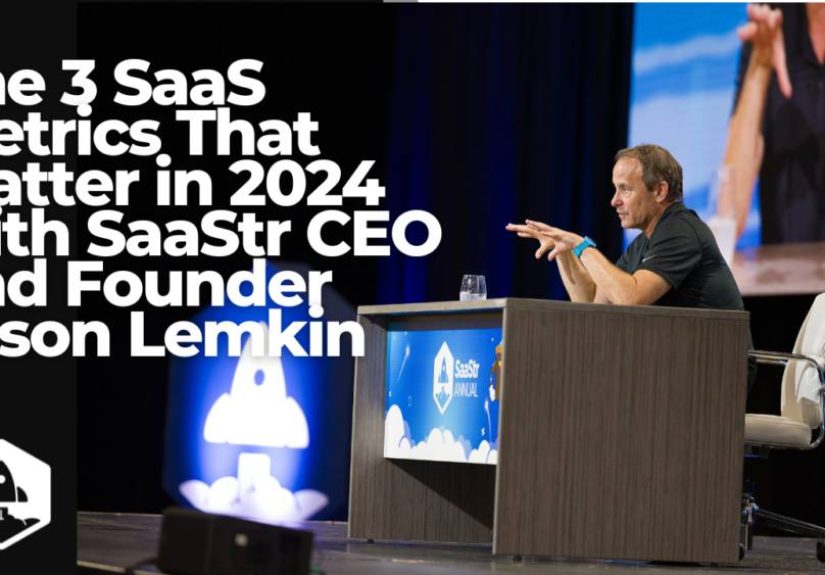
That shift is exactly why Jason Lemkin, founder and CEO of SaaStr, has been emphasizing three SaaS metrics that matter most in 2024: net new customer count, growth versus efficiency, and the bar to IPO. On the surface, those sound simple. In practice, they cut right through the fluff. They tell you whether your company is still winning fresh business, whether that growth is financially sane, and whether you are building something the public markets would actually respect rather than politely ignore.
This framework lands at the perfect moment. SaaS is no longer in the easy-money era where every chart just had to point up and to the right while everyone nodded thoughtfully. Benchmarks across the market in 2024 show a more disciplined environment: growth has stabilized but remains lower than the boom years, retention matters more than ever, and efficiency is no longer a side quest. It is the main storyline.
So let’s break down these three metrics the way an operator would: what they mean, why they matter, where founders get them wrong, and how to use them without turning your company into a spreadsheet wearing a hoodie.
Why 2024 Changed the SaaS Scoreboard
Before we get into the three metrics themselves, it helps to understand the market backdrop. In 2024, SaaS companies are operating in a world where growth is steadier but harder won. Private-company survey data points to annual recurring revenue growth around the high teens, while public SaaS growth has hovered closer to the low-to-mid teens. That is not a collapse, but it is a far cry from the hypergrowth party years when software companies acted like every quarter came with free champagne and a valuation upgrade.
At the same time, retention has become even more important. Expansion revenue is carrying more weight for more mature SaaS businesses, and companies with stronger net revenue retention continue to outperform weaker peers. In plain English: if your customers stick around, buy more, and grumble less, you have a real business. If they churn after the sales team leaves the Zoom call, you have a slide deck.
Efficiency has also muscled its way into every boardroom. Companies cut sales and marketing spend, scrutinized CAC payback, and focused more on gross retention, net retention, and cash flow. Investors still like growth, of course. They have not become monks. But they now want growth that can survive contact with reality.
Metric #1: Net New Customer Count
Lemkin’s first metric is net new customer count, and it may be the sneakiest important metric on the list. Founders often get hypnotized by ARR growth, especially when expansion revenue is doing the heavy lifting. That can make the business look healthier than it really is.
Here is the problem: if your revenue is growing mostly because existing customers are spending more, but your logo count is flattening or shrinking, your future pipeline may be weaker than you think. You are eating well today because your best customers keep ordering dessert. That is nice. But eventually, you still need new people entering the restaurant.
Net new customer count matters because it shows whether your go-to-market engine is still opening new doors. It tells you whether demand is broadening, whether your sales motion is repeatable, and whether your product is relevant beyond a handful of loyal accounts. It is a reality check against the seductive power of a healthy NRR number.
Why logo growth matters more in a tougher market
In softer markets, expansion can cover a lot of sins. A company may post respectable revenue growth simply because its largest customers keep adding seats, buying modules, or accepting annual price increases with only moderate eye-rolling. But if net new customer count is stalling, that expansion can become a crutch. The business starts to rely too much on a concentrated customer base, which makes future growth less durable.
This is especially relevant in 2024 because expansion revenue is playing a larger role in overall growth for more established SaaS companies. That is not bad. It is actually a sign of a sticky product. But it becomes risky when it masks weak new-logo acquisition.
Founders should ask a blunt question: Are we growing because the market keeps choosing us, or because our installed base is being wonderfully patient? The answer matters.
What good looks like
A healthy SaaS company in 2024 should still be adding meaningful net new customers, even if the pace is slower than in earlier years. The exact target depends on ACV, product maturity, and segment. Enterprise SaaS will naturally add fewer logos than a mid-market or PLG business. But the trend line matters enormously. Flat new-customer growth over several quarters is a warning sign. Declining net new customers while ARR rises is the kind of chart that gets nervous laughs in board meetings.
For example, imagine two SaaS companies each growing ARR by 20%. Company A grows through a steady stream of new customers plus moderate expansion. Company B grows mostly through upsells to the base while new logo acquisition weakens every quarter. On paper, they may look similar. In reality, Company A has a healthier engine. Company B may be one renewal cycle away from learning humility.
How to improve net new customer count
If logo growth is lagging, the answer is not always “hire more reps and hope for the best,” which is how many SaaS teams accidentally reinvent expensive chaos. Start with positioning. Is your product still solving a problem people urgently want solved? Then look at pipeline quality, win rates, time-to-value, pricing friction, and whether your ideal customer profile has quietly drifted from “real” to “fantasy football draft pick.”
Great operators also look beyond pure acquisition volume. They ask whether the company is winning the right customers. More logos are useful only if they convert into durable revenue and healthy retention. Collecting shaky-fit customers is not growth. It is future churn with better branding.
Metric #2: Growth vs. Efficiency
The second metric is growth versus efficiency, which is really a polite way of asking: How much pain are you inflicting on your finances to produce this growth?
In the old days, founders could sometimes get away with answering, “A lot, but look how fast we’re going.” In 2024, that answer earns fewer standing ovations. The market wants balance. Growth still matters. In fact, public-market data suggests growth remains more influential than free cash flow margin when it comes to valuation. But efficiency is no longer optional. It is part of the admission price.
This is where metrics like Rule of 40, burn multiple, CAC payback, gross retention, and net revenue retention all start hanging out at the same party. They are different metrics, but they all help answer the same operating question: Is our growth productive?
Why efficiency became unavoidable
By 2024, many SaaS companies had already been through the great tightening. Headcount got leaner. Sales and marketing budgets were scrutinized. Operators were expected to do more with less, and sometimes more with much less plus a cheerful Slack message about “focus.”
That made efficiency the natural companion to growth. A company that grows 30% with awful burn and bloated acquisition costs is less impressive than it used to be. Meanwhile, a company growing 18% to 25% with cleaner margins, better retention, and improving payback suddenly looks like an adult in the room.
Lemkin has also highlighted a striking new reality at scale: the average public SaaS company around $200 million in ARR now looks much leaner than its 2021 counterpart, with roughly $300,000 in revenue per employee. That does not mean every startup should turn into a skeleton crew armed only with caffeine and dashboards. It does mean efficiency expectations have risen materially.
The metrics behind the metric
When founders say they care about efficient growth, they often mean one of four things:
- Rule of 40: Can we combine revenue growth and profitability into a score that signals healthy scaling?
- Burn multiple: How much cash are we burning to generate each new dollar of ARR?
- CAC payback: How long does it take to recover customer acquisition cost?
- Retention: Are customers staying, expanding, and justifying the whole motion?
In 2024, these metrics are no longer side notes in board decks. They are the deck. Benchmark data shows that retention and revenue efficiency stabilized somewhat, but the market is still rewarding companies that can grow without setting their budget on fire. Translation: your company no longer gets bonus points for dramatic spending if the outcome is merely “pretty good.”
How to think about growth vs. efficiency without losing your mind
The trick is not to optimize one metric in isolation. If you slash sales capacity to improve burn multiple, you may damage future growth. If you push growth at all costs, you may create a cash problem that is much less fun than your annual kickoff. The right answer is usually to improve the quality of growth.
That means better segmentation, tighter ICP targeting, stronger onboarding, more disciplined pricing, and a customer success motion that actually drives expansion instead of just sending polite reminders. It also means understanding where efficiency comes from. Sometimes it comes from better process. Sometimes from better product. Sometimes from firing a go-to-market strategy that should have been fired months ago.
In mature SaaS, growth and efficiency are not enemies. They are dance partners. Admittedly, it is often a tense dance where one partner keeps checking the cash balance, but still, they must move together.
Metric #3: The Bar to IPO
The third metric is the bar to IPO, and this is where 2024 gets especially unforgiving. Years ago, software companies could sometimes reach the public markets with an exciting narrative, strong top-line growth, and a general promise to “figure out the margins later.” Today, the standards are much tougher.
IPO readiness is not one metric in a literal sense. It is a composite judgment about scale, growth durability, margins, predictability, and market appetite. Lemkin’s point is that founders need to understand the market’s current threshold rather than imagine the one from 2021 is still sitting around waiting for them.
Why the IPO bar is higher now
Public investors are looking for larger, cleaner, more credible software businesses. Meritech’s 2024 view of the IPO market captures the mood well: to generate real excitement, a software company would need extraordinarily strong growth at significant scale, paired with a strong Rule of 40 profile. That is not a casual threshold. That is a velvet rope.
In other words, “pretty good for private SaaS” is not necessarily “public-market ready.” A company may have a strong private fundraising story while still falling short of what public investors want to underwrite. The public market tends to ask harsher questions and smile less while asking them.
What founders should actually learn from this
The lesson is not that everyone should obsess over going public tomorrow. Most should not. The real lesson is that the IPO bar is a useful forcing function. It asks whether your business is becoming more resilient, more efficient, more predictable, and more category-worthy over time.
If your company would clearly miss that bar, the answer is not despair. It is focus. Improve retention. Tighten the growth engine. Increase new-logo consistency. Strengthen margins. Build an organization that can hit targets without heroic quarterly improvisation. IPO quality is often just operational discipline seen from farther away.
How the Three Metrics Work Together
These three metrics are powerful because each one catches a different failure mode.
- Net new customer count tells you whether the market still wants you.
- Growth vs. efficiency tells you whether your machine is economically sane.
- The bar to IPO tells you whether the whole company is becoming elite enough for the next stage.
Used together, they stop founders from hiding behind whichever metric currently looks the prettiest. Strong NRR cannot excuse weak new-logo growth. Nice efficiency cannot excuse mediocre ambition. Good growth cannot excuse a business model that still falls apart under public-market scrutiny.
This is why the framework works so well in 2024. It is not theoretical. It is brutally practical.
Common Founder Mistakes in 2024
Mistake #1: Treating NRR as a personality trait
Retention is crucial, but it is not magic. A good NRR number does not automatically mean your company is healthy if new customer acquisition is fading.
Mistake #2: Confusing cost cutting with efficiency
Efficiency is not just spending less. It is generating more durable output per dollar. Some companies “improve efficiency” by cutting muscle, then act surprised when pipeline quality collapses three quarters later.
Mistake #3: Using outdated IPO assumptions
If your mental model of IPO readiness was shaped in the boom era, update it immediately. The market now expects more scale, more durability, and more proof.
Mistake #4: Measuring everything and understanding nothing
SaaS teams love dashboards. Sometimes a little too much. The goal is not to track 87 metrics until everyone forgets which ones matter. The goal is to pick the metrics that reveal the truth and use them to drive decisions.
Operator Experiences: What These Metrics Feel Like in Real Life
On paper, these three metrics look clean and elegant. In real life, they feel like three different people knocking on the door of your company at the same time. Net new customer count is the impatient salesperson asking why pipeline is thinner than it was six months ago. Growth versus efficiency is the CFO with a spreadsheet and an eyebrow raised high enough to qualify as architecture. The bar to IPO is the board member quietly asking whether this company is becoming exceptional or just busy.
Teams feel these metrics everywhere. In marketing, there is more pressure to bring in qualified pipeline, not vanity leads that download one ebook and disappear into the fog. In sales, reps feel the scrutiny around win rates, sales cycles, and whether discounting is rescuing deals that should never have been forecasted in the first place. In customer success, every renewal becomes a small referendum on product value. When expansion slows, everyone notices. Suddenly the phrase “land and expand” sounds less like strategy and more like a prayer.
For founders, the emotional experience is even sharper. In easier markets, you could explain away a soft quarter with a compelling narrative about future upside. In 2024, the room usually wants receipts. Founders are expected to know whether growth is coming from new logos or the base, whether efficiency gains are structural or temporary, and whether the company is building toward an elite outcome or merely surviving with style. It is a more demanding environment, but also a healthier one. It forces clarity.
There is also a cultural shift inside SaaS companies. Teams are becoming less impressed by growth that feels expensive and fragile. They want growth they can believe in. A quarter with solid new-customer adds, stable retention, and improving efficiency feels better than a flashy revenue spike powered by heroic discounts and some accounting gymnastics. People can sense the difference. One feels like momentum. The other feels like a sugar rush.
Operators who adapt well tend to share a few habits. They talk about customers more than competitors. They treat retention as a product problem, not just a support problem. They examine payback and margin without becoming allergic to ambition. They understand that public-market discipline can improve a private company long before any banker starts polishing a pitch. And perhaps most importantly, they stop chasing whatever metric makes them feel smartest this month and start focusing on the ones that best predict whether the business will still look strong two years from now.
That is why Lemkin’s framework resonates. It is not just about choosing three metrics. It is about choosing three lenses that force honesty. In SaaS, honesty is underrated. It may not trend on LinkedIn as well as “10x GTM velocity,” but it does have one charming advantage: it tends to produce better companies.
Conclusion
The three SaaS metrics that matter in 2024 are not random dashboard favorites. They reflect what the market now rewards: real demand, efficient execution, and elite readiness. Net new customer count shows whether your company is still winning fresh business. Growth versus efficiency reveals whether that growth is economically credible. And the bar to IPO reminds you that the next level requires far more than a decent story and a pretty chart.
For founders, operators, and revenue leaders, the message is clear. Build a SaaS company that can acquire customers consistently, keep them happily paying, grow without overspending, and earn the right to be taken seriously at scale. In 2024, that is not just smart. It is survival with upside.