Table of Contents >> Show >> Hide
- The Short Version: PowerCheck Was Real, Smart, and Quietly Retired
- What Was Duracell PowerCheck, Exactly?
- How Did PowerCheck Work?
- Why People Loved PowerCheck
- So What Happened To Duracell PowerCheck?
- Why Duracell Likely Moved On
- Was PowerCheck Actually Good?
- Could PowerCheck Come Back?
- What Should You Use Instead Today?
- Why People Still Remember Duracell PowerCheck
- Real-World Experiences With Duracell PowerCheck
- Conclusion
Note: This article is based on real product history and current market evidence. Duracell has not published a dramatic “here is why PowerCheck died” obituary, so the explanation below separates confirmed facts from reasonable, evidence-based conclusions.
For a certain generation of shoppers, Duracell PowerCheck felt like magic. You grabbed a battery, pressed two little dots, and a yellow bar crept up the side like the battery was taking its own tiny medical exam. No extra gadget. No guessing. No licking a 9-volt like a chaos goblin from 1987. Just a built-in answer to the eternal household question: Is this battery dead, or is my remote just being dramatic?
So what happened to it?
The short answer is this: Duracell PowerCheck appears to have been phased out of mainstream consumer batteries, not because it was fake or useless, but because it was a clever feature with real limitations in a market that moved on. It worked, people remembered it, and it even became a signature feature on Duracell’s premium Quantum line. But over time, cost, complexity, imperfect real-world accuracy, changing battery lineups, and the rise of rechargeable devices all made PowerCheck feel less essential than it once did.
The Short Version: PowerCheck Was Real, Smart, and Quietly Retired
Duracell PowerCheck was a built-in battery tester that let users check the approximate remaining strength of certain alkaline batteries by pressing marked contact points on the battery wrapper. It was not a gimmick invented by nostalgia. It was a real piece of engineering, and it was clever enough that people still talk about it decades later.
But PowerCheck was never a perfect fuel gauge. It gave a quick estimate, not a lab-grade diagnosis. It was also tied to premium Duracell product lines, especially Quantum, and those lines eventually gave way to newer branding and newer selling points. Today, Duracell’s consumer site in the United States emphasizes Coppertop and Optimum, not PowerCheck. In plain English, the feature seems to have been quietly retired rather than formally mourned with a tiny battery-shaped funeral.
What Was Duracell PowerCheck, Exactly?
PowerCheck was Duracell’s answer to one of the most annoying domestic mysteries on Earth: the junk-drawer battery problem. You know the one. A drawer full of loose AAs, AAAs, and the occasional suspicious 9-volt, all living together like a very unstable roommate arrangement. Some were fresh. Some were half-used. Some had enough energy left to power a wall clock for six months, but not enough to make your digital camera happy for ten seconds.
Duracell’s idea was beautifully simple from a consumer point of view. Instead of asking people to buy and keep a separate tester, why not put the tester on the battery itself?
That convenience was the whole charm. PowerCheck made batteries feel self-aware. Not in a scary science-fiction way. More in a “finally, somebody put a dashboard on the potato tube” way.
How Did PowerCheck Work?
A Tiny Circuit Hidden in the Wrapper
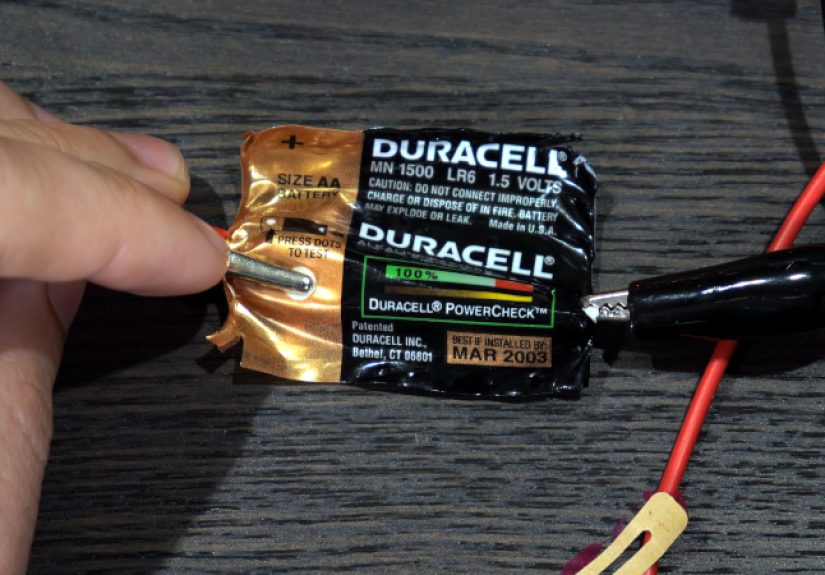
Under the label, PowerCheck used a thin conductive strip and a heat-sensitive indicator. When you pressed the marked points on the battery, you completed a small circuit. Current flowed through the strip, it warmed up, and the indicator changed color to show an approximate power level.
In other words, the battery briefly spent a little energy to tell you how much energy it had left. That sounds absurd only until you remember that your car burns fuel to tell you whether you are low on fuel. Human civilization loves a dashboard.
Why the Color Bar Moved
The moving bar was not reading your battery’s soul. It was reacting to heat generated by the current flowing through the tester strip. A stronger battery could drive more current through the tester, which warmed more of the strip and made more of the indicator appear. A weaker battery heated less of the strip, so the visible bar stayed lower.
That is why PowerCheck was so memorable. It looked alive. Instead of a plain number on a screen, it gave you a physical, visible response right on the side of the battery. For regular consumers, that felt intuitive. Press. Look. Decide. Done.
Why It Was Never Perfect
Here is the important catch: battery strength is complicated. A battery’s voltage can be influenced by temperature, rest time, internal resistance, and the kind of load a device puts on it. A battery may look decent in a quick test but still struggle in a power-hungry gadget. That is why PowerCheck was useful as a fast estimate, not as the final word in battery science.
This limitation was not unique to Duracell. Battery testing in general is tricky. A remote control, a flashlight, a digital camera, and a toy all ask different things from the same cell. A battery that seems “fine” for a wall clock might behave like a Victorian fainting lady inside a camera flash.
Why People Loved PowerCheck
PowerCheck solved a real human problem: uncertainty. Most people do not want to think about battery chemistry. They want to know whether the batteries in the TV remote can survive movie night. That is it. That is the dream.
PowerCheck reduced friction. Instead of swapping cells back and forth between devices like some sad domestic ritual, you could test them on the spot. It was especially handy for parents with toys, gamers with controllers, and anyone who had ever yelled, “Why does this flashlight only work when the power is already out?”
There was also a psychological benefit. The feature made premium batteries feel premium. Duracell was not just selling power; it was selling confidence. That is strong marketing. The battery was saying, “Relax. I brought receipts.”
So What Happened To Duracell PowerCheck?
Duracell rolled out PowerCheck in the mid-1990s, and the feature became one of the brand’s more memorable innovations. Later, it was strongly associated with the company’s premium Quantum batteries. If you bought Quantum cells, especially in the 2010s, there was a good chance PowerCheck was part of the pitch.
Then the trail starts to cool. Over time, Duracell’s public-facing lineup changed. The current U.S. product emphasis is on Coppertop and Optimum. Duracell’s own innovation timeline highlights Optimum as a major modern launch, while Quantum is treated as part of an earlier era. PowerCheck no longer appears to be a headline feature in Duracell’s mainstream U.S. consumer presentation.
That is why the best answer is not “PowerCheck failed overnight.” It is more accurate to say that Duracell seems to have phased it out as its premium product strategy evolved. No giant scandal. No shocking betrayal. Just the classic corporate move of replacing yesterday’s wow feature with today’s shiny new selling point.
Why Duracell Likely Moved On
1. The Feature Added Cost to a Disposable Product
PowerCheck was smart, but it was not free. Adding a tester layer to the wrapper meant additional materials, additional manufacturing steps, and additional complexity on a product that is fundamentally disposable and fiercely price-sensitive.
Batteries are a brutal category. Consumers compare pack size, shelf life, and price in about six seconds while standing under fluorescent lighting near the checkout aisle. Even a clever feature can lose its sparkle if it makes the product harder to produce or pricier to sell.
2. It Was Convenient, Not Perfectly Accurate
PowerCheck estimated remaining power using a quick on-battery test, but real battery performance depends heavily on load and temperature. That matters because consumers do not test batteries in controlled lab conditions. They test them in garages, kitchens, cold basements, hot cars, and living rooms where someone is already annoyed the toy is not working.
In fact, older PowerCheck packaging itself signaled a temperature caveat. That alone tells you something important: the feature was useful, but it had operating assumptions. A gadget that works best under the right conditions is still clever; it is just not foolproof.
3. Consumer Electronics Changed
PowerCheck made the most sense in a world where lots of everyday devices ran on loose alkaline batteries and did not report battery status clearly. That world still exists, but it is smaller. Many modern devices are rechargeable. Many show battery level on-screen. And plenty of consumers now use cheap battery testers or multimeters when they really care.
Back in the day, PowerCheck felt futuristic because the battery itself was doing the talking. Today, your controller, mouse, camera, smart lock, or app often does that job for it.
4. Duracell Found New Ways to Market Premium Batteries
PowerCheck once helped Duracell answer the question, “Why should I pay more for this pack?” But premium branding evolves. More recently, Duracell has leaned into claims around Optimum, POWER BOOST ingredients, performance, and storage-friendly packaging.
That is a different kind of premium message. Instead of saying, “This battery can tell you its status,” the modern pitch says, “This battery performs better.” From a branding perspective, that is simpler and easier to explain in one glance on a shelf.
5. Patent History Probably Did Not Help
PowerCheck also had some legal history hanging around it. Reporting on the technology points to patent overlap and disputes involving similar on-battery tester concepts. That does not prove patents alone killed the feature, and it would be sloppy to claim they did. But patent baggage rarely makes a niche feature more attractive over the long term.
When a feature is already expensive, technically imperfect, and not essential to everyday battery use, legal complications are the sort of thing that can make a product manager stare into the middle distance and choose a simpler future.
Was PowerCheck Actually Good?
Yes, with an asterisk the size of a AA battery.
PowerCheck was genuinely helpful for quick sorting. If you had a pile of loose batteries and wanted to separate the obviously weak ones from the clearly stronger ones, it was handy. It gave consumers a practical, immediate readout without needing a separate tool. That alone made it more useful than a lot of “innovations” that were mostly just packaging gymnastics wearing a tuxedo.
But it was not a full performance guarantee. A battery that looked decent on PowerCheck might still disappoint in a high-drain device. That is not because the system was fake. It is because batteries behave differently depending on the demands placed on them.
Think of it this way: PowerCheck could tell you whether the battery looked healthy at a glance. It could not promise that your child’s screaming toy dinosaur, which apparently requires the energy output of a small hydroelectric plant, would be satisfied.
Could PowerCheck Come Back?
Never say never. Consumer tech loves a comeback. Vinyl records came back. Flip phones came back. Cargo pants somehow came back. So yes, a modernized version of on-battery status indication could return someday.
But a broad mainstream revival seems unlikely unless it solves today’s problems better than yesterday’s version did. Any comeback would have to be cheap, more accurate under real load, durable, easy to understand, and environmentally sensible. That is a tall order for a feature attached to disposable cells in a market where rechargeables and smart device indicators are much more common than they were in the 1990s.
In other words, PowerCheck was ahead of its time in one sense and stuck in its time in another. It solved a problem people absolutely had. It just did so with a design that became less compelling as the market evolved.
What Should You Use Instead Today?
Battery Testers and Multimeters
If you regularly sort loose batteries, a dedicated battery tester is still the most straightforward modern replacement. A multimeter can also help, especially if you know how to test under load or at least understand that open-circuit voltage is only part of the story.
Device Indicators
For many gadgets, the simplest answer is to trust the device’s built-in battery indicator. It is not always perfect, but it is often more relevant because it reflects the battery’s performance in the actual device that matters.
A Simple Household Rule
Also, label your loose batteries. The humble marker is undefeated. “Fresh,” “used,” and “questionable little goblin” can save a lot of household drama.
Why People Still Remember Duracell PowerCheck
People remember PowerCheck because it made an invisible process visible. Battery life is abstract. You cannot see electrons. You cannot watch chemistry happen in real time. But PowerCheck let you squeeze a battery and get a visual answer immediately. That was satisfying in a deeply human way.
It also felt honest. Instead of just promising long life on the package, the battery gave you a little demonstration. It was theater, yes, but useful theater. The kind of theater that earns a standing ovation in the kitchen drawer.
And maybe that is why PowerCheck still has such a grip on people’s memory. It did not just power devices. It reduced uncertainty. It turned a boring object into an interactive one. It made batteries slightly less mysterious and slightly more fun, which is honestly more than most household products ever achieve.
Real-World Experiences With Duracell PowerCheck
If you want to understand why people still miss PowerCheck, do not start in a laboratory. Start in a normal house. Start with a remote control that only works if you press the buttons like you are trying to send a message to outer space. Start with a flashlight that matters only when the power goes out. Start with a child’s toy that suddenly stops singing at full volume and begins producing the audio equivalent of a haunted basement. That was the native habitat of PowerCheck.
For many families, the feature turned the battery drawer into a small sorting station. You would find a handful of loose cells rolling around near rubber bands, expired coupons, mystery keys, and at least one pen that had not worked since the Bush administration. Normally, testing those batteries meant guessing, swapping, and muttering. PowerCheck changed that routine. You pressed, waited a second, and watched the strip climb. It felt like the battery was confessing.
There was a particular satisfaction in using it before a road trip, before a holiday morning, or before storm season. People liked knowing which batteries were still strong enough for the flashlight, the weather radio, the toy race car, or the wireless game controller. It was not just about convenience. It reduced that annoying little layer of household uncertainty that seems trivial until you are standing in the dark.
Of course, PowerCheck also produced some very human moments of confusion. Plenty of people remember pressing the contacts too hard, at the wrong angle, or with the patience level of a raccoon in a vending machine. Others remember that the strip sometimes seemed less convincing when the battery was cold, or when the battery looked “okay” on the indicator but still flopped in a hungrier device. That gap between “looks fine” and “works fine” was where the feature lost some of its shine.
Then there was the physical experience. Ask enough people, and somebody will mention that PowerCheck could be oddly uncomfortable to use. The feature was clever, but not exactly spa-grade. The act of pressing the dots on certain batteries sometimes felt like the wrapper was daring your fingertip to a duel. So yes, PowerCheck was useful. It was also one of the few household technologies people remember with a sentence that begins, “I loved it, but…”
Even so, the affection remains. Why? Because it made people feel in control. It was one of those rare product features that was both practical and memorable. You did not need instructions longer than a fortune cookie. You did not need an app. You did not need Wi-Fi. You just needed a battery and a thumb. In a modern world full of products that require firmware updates to boil water, there is something almost heroic about that simplicity.
That is the emotional afterlife of Duracell PowerCheck. People do not remember it because it was flawless. They remember it because it was tangible, immediate, and oddly charming. It turned battery testing into a tiny ritual. And when a product creates a ritual, even a small one, it tends to live much longer in memory than it does on store shelves.
Conclusion
So, what happened to Duracell PowerCheck? It was not exposed as a fraud, and it did not vanish because consumers imagined it. It was a real innovation that answered a real need. But it also lived at the intersection of added cost, imperfect accuracy, patent baggage, and changing consumer electronics. As Duracell updated its premium battery strategy and moved attention toward lines like Optimum, PowerCheck appears to have slipped from mainstream consumer view.
That makes PowerCheck one of those rare product ideas that can be both admirable and temporary. It was smart. It was useful. It was memorable. It just was not permanent. In the museum of household technology, that still earns it a pretty respectable shelf.