Table of Contents >> Show >> Hide
- Meet Natalie Sideserf, the Cake Artist Turning Dessert Into Optical Illusion
- Why Realistic Cakes Break the Internet
- Realistic and Cartoony Cakes: Two Styles, One Big Personality
- What Makes Natalie Sideserf’s Cake Art So Memorable?
- The Internet Loves Cakes That Make It Feel Fooled
- Realistic Cake Design Is Harder Than It Looks
- Why These Cakes Matter Beyond Social Media
- What Bakers Can Learn From Natalie Sideserf’s Success
- Experiences and Reflections Inspired by Realistic and Cartoony Cakes
- Conclusion
Some cakes politely sit on a dessert table and wait to be admired. Natalie Sideserf’s cakes do something far more dramatic: they make people question reality, squint at their screens, and wonder whether their houseplant, hamburger, or favorite cartoon character might secretly be vanilla sponge in disguise. That is not a normal Tuesday in the kitchen. That is edible sorcery with buttercream receipts.
The Austin, Texas cake artist behind Sideserf Cake Studio has become one of the most recognizable names in hyperrealistic cake art. Her specialty is creating cakes that do not look like cakes at alluntil the knife comes out and the internet collectively yells, “Wait, that was dessert?” From lifelike food replicas to playful cartoon-inspired designs, her creations live in the strange and delightful space between fine art, baking, sculpture, and social media theater.
The appeal is easy to understand. Realistic cakes tap into a tiny, harmless prank inside the human brain. We see an object. We trust the object. Then someone cuts into it and reveals layers of cake. Suddenly, our confidence in the universe is frosting-thin. That surprise is why realistic cakes, cartoony cakes, illusion cakes, and “cake or fake” videos keep pulling millions of viewers into the same sweet rabbit hole.
Meet Natalie Sideserf, the Cake Artist Turning Dessert Into Optical Illusion
Natalie Sideserf is not just a baker with a piping bag and a dream. She is an artist with a fine-art background, a sculptor’s eye, and the patience of someone who can stare at fondant until it behaves. Based in Austin, she built Sideserf Cake Studio around a clear creative identity: cakes that do not look like cakes.
Her rise is closely tied to one of her most famous early creations: a lifelike Willie Nelson bust cake. That piece helped introduce her work to a much wider audience and led to national attention, including Food Network’s Texas Cake House, where Natalie and her husband, Dave Sideserf, showed viewers what it takes to build elaborate sculpted cakes for real clients. Unlike a typical bakery show where the big question is “Will the cake arrive on time?” her work adds another question: “Will anyone believe this thing is edible?”
That combination of technical skill and surprise is the secret ingredient. Natalie’s cakes are impressive as desserts, but they are unforgettable as moments. A realistic cake is not only something to eat. It is a tiny performance. First comes recognition, then confusion, then the cut, then the reveal. It is a magic trick with crumbs.
Why Realistic Cakes Break the Internet
Hyperrealistic cakes exploded online because they are built perfectly for the scroll. In a crowded feed full of recipes, dance trends, pet videos, and people reorganizing refrigerators like they are preparing for a museum exhibit, a cake that looks like a real object has instant stopping power.
The “Is It Cake?” Effect
The viral “cake or fake” format became even more popular as audiences watched bakers recreate everyday objectshandbags, shoes, snacks, tools, fruit, and morethen challenge viewers to guess which item was cake. Netflix’s Is It Cake? brought that concept to a game-show format, proving that people are surprisingly happy to watch judges inspect ordinary objects with the suspicion usually reserved for mystery novels.
But Natalie Sideserf’s work stands out because she was already deep in the world of edible illusion before the trend became mainstream. Her videos often show not only the final reveal but also the process: carving, shaping, covering, coloring, airbrushing, refining, and occasionally wrestling cake physics like a very polite dessert engineer.
Surprise Is the Main Flavor
Of course, flavor matters. Nobody wants a cake that looks like a masterpiece and tastes like a sponge that has given up on life. Still, the first bite of a realistic cake is visual. The viewer “eats” the joke before anyone gets a fork. That is why these cakes spread so quickly online. They are snackable content in the most literal sense.
A regular cake can be beautiful. A realistic cake can be beautiful and suspicious. That extra layer of suspicion makes people comment, share, and tag friends with messages like, “I don’t trust anything anymore.” For a creator, that is gold. For a viewer, it is delicious chaos.
Realistic and Cartoony Cakes: Two Styles, One Big Personality
The title may mention realistic and cartoony cakes, and that contrast is important. Hyperrealistic cake art aims to fool the eye, while cartoony cake design exaggerates shapes, colors, and expressions for charm. Natalie’s work often plays with both worlds.
Realistic Cakes: The Art of Making Cake Disappear
A realistic cake succeeds when the viewer forgets it is cake. That requires attention to texture, proportion, color, shadow, and surface detail. A fruit cake needs tiny bruises, uneven skin tones, and the slight dullness of real produce. A food replica needs edges that look crisp, soft, oily, toasted, or fresh depending on the subject. A sculpted animal cake needs personality without crossing into awkward territory. Cake has range, but it also has limits. It is soft, heavy, and not always interested in standing upright.
That is where artistry matters. A hyperrealistic cake artist must understand structure. Beneath the fondant or modeling chocolate, there may be supports, carved layers, filling, ganache, and careful shaping. The final cake may look effortless, but the process is more like building a tiny edible movie prop.
Cartoony Cakes: When Dessert Learns to Smile
Cartoony cakes work differently. They do not need to fool you; they need to charm you. A cartoony cake might use exaggerated eyes, rounded shapes, bright colors, thick outlines, or playful proportions. It can look like a character, a doodle, a sticker, or a 3D version of something that escaped from Saturday morning television.
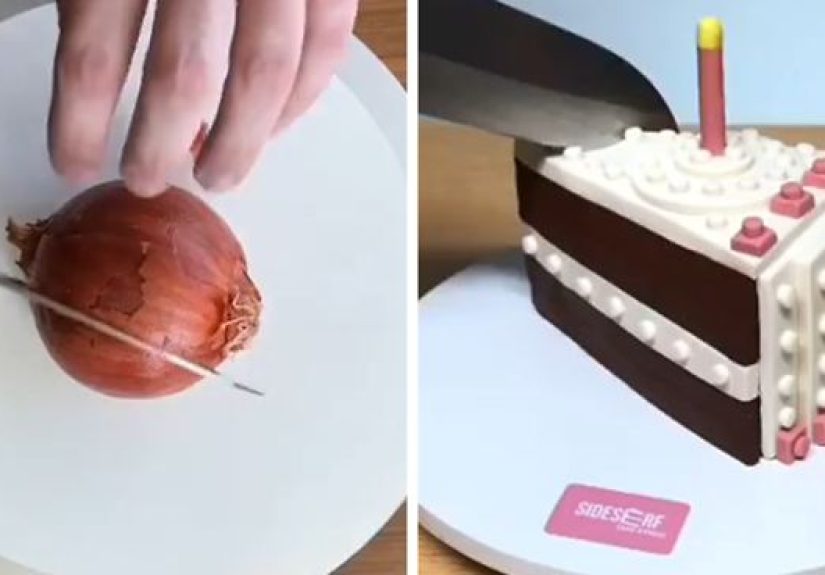
These designs are often more emotionally direct. A realistic onion cake makes people gasp. A cartoony cake makes people grin. Both are powerful, but they hit different buttons. One says, “How did she do that?” The other says, “I would like this cake to be my friend, and then I would like to eat it, which is complicated.”
What Makes Natalie Sideserf’s Cake Art So Memorable?
Many bakers can make beautiful cakes. Natalie Sideserf makes cakes with a punchline. Her work is not only about decoration; it is about timing, storytelling, and the reveal. That is why her videos are so satisfying. Viewers get to see the illusion take shape, then watch it collapse in the best possible way when the knife slices through.
1. She Treats Cake Like Sculpture
At the highest level, realistic cake decorating is closer to sculpting than simple baking. The artist must think in volume, silhouette, balance, and surface anatomy. A cake that looks like a common object has to be recognizable from multiple angles. If it only looks convincing from the front, the internet will notice. The internet always notices. It has zoom buttons and no mercy.
2. She Understands Texture
Texture is the difference between “That is clearly cake” and “Why is someone cutting a shoe?” Realistic cake artists often use fondant, modeling chocolate, edible paint, airbrushing, and hand-sculpted details to mimic surfaces. Smooth plastic, wrinkled fruit skin, cartoon outlines, fur-like impressions, glossy sauce, matte paper, or toasted bread all require different treatments.
3. She Lets Humor Lead
There is a wink in Natalie’s work. Even when a cake is technically brilliant, it does not feel cold or overly precious. The viewer is invited into the joke. That matters because hyperrealistic cakes can easily become intimidating. Her style keeps the experience fun, approachable, and slightly mischievous.
The Internet Loves Cakes That Make It Feel Fooled
People enjoy being fooled when the trick is harmless, clever, and ends with dessert. That is the perfect formula for viral content. A realistic cake creates a tiny emotional roller coaster: recognition, doubt, disbelief, laughter, and finally appetite. It is a five-act play, but with more ganache.
The trend also fits perfectly into short-form video. A realistic cake reveal can happen in seconds. The setup is visual, the twist is clear, and the result does not need much explanation. Even viewers who do not bake can appreciate the craft. You do not need to understand structural supports or buttercream ratios to know that a cake shaped like an ordinary object is impressive.
That broad appeal is why cake art crosses audiences. Food lovers admire the baking. Artists admire the sculpting. Parents show the videos to kids. Kids immediately ask whether the remote control is cake. Everyone becomes a little more suspicious, and honestly, that is part of the fun.
Realistic Cake Design Is Harder Than It Looks
One reason Natalie Sideserf’s realistic and cartoony cakes are so impressive is that cake is not an easy medium. Clay stays where you put it. Wood does not melt. Stone does not sag because the room is warm. Cake, meanwhile, has opinions. It can crumble, bulge, lean, dry out, sweat, crack, or slowly decide gravity has made some good points.
A realistic cake must also taste good, which makes the challenge even more complicated. The artist cannot simply create a sculpture and call it a day. The inside still needs flavor, moisture, stability, and clean slicing. That balance between edible and believable is what separates professional illusion cakes from “I tried this at home and now my banana cake looks like a yellow potato with anxiety.”
Common Tools Behind the Illusion
While every artist has their own methods, realistic cake work often involves carved cake layers, buttercream or ganache coating, fondant, modeling chocolate, edible dusts, food coloring, airbrushing, sculpting tools, and reference images. The cake artist studies the subject like a portrait painter. A small color shift or shape change can make the difference between realistic and “nice try, but that hamburger has seen things.”
Why These Cakes Matter Beyond Social Media
It would be easy to dismiss realistic cakes as internet novelty, but that would miss the larger point. This kind of edible art shows how creative modern baking has become. A cake is no longer limited to round tiers, flowers, and birthday candles. It can be a portrait, a joke, a replica, a character, a brand moment, or a full visual story.
For small creative businesses, Natalie’s career also shows how online content can change everything. A cake made for one client can become a video watched by millions. A local studio can become an international name. A baker can become an artist, teacher, entertainer, and media personality. That is the modern creative economy in one slice.
What Bakers Can Learn From Natalie Sideserf’s Success
Whether someone is a professional baker, a home decorator, or a person who once wrote “Happy Brithday” on a cake and hoped nobody noticed, there are useful lessons in Natalie’s work.
Start With Strong Observation
Realism begins before the oven turns on. Study the object. Notice where it shines, where it dulls, where the edges soften, and where the colors change. A realistic cake is not built from memory; it is built from observation.
Think About the Reveal
A realistic cake is more powerful when the reveal is planned. The cut should happen where the contrast is strongest. If the outside looks like a real object and the inside shows soft cake layers, the viewer gets the full payoff.
Practice With Small Subjects
Not every beginner needs to start with a life-size sculpted masterpiece. Small food replicas, cartoon slices, fruit shapes, or simple objects can teach the fundamentals of carving, coating, coloring, and texture. The first attempt may not fool anyone, but it will teach plenty. Besides, even a failed cake is still cake. That is a pretty forgiving classroom.
Experiences and Reflections Inspired by Realistic and Cartoony Cakes
There is something wonderfully strange about watching a realistic cake video for the first time. At first, you feel confident. That is clearly a tomato. That is obviously a mug. That is definitely a sandwich. Then the knife enters the frame, and your confidence leaves the room wearing a tiny frosting hat. The object splits open, cake appears, and suddenly you are staring suspiciously at your desk lamp.
That experience is why Natalie Sideserf’s work connects with so many people. It is not only about baking skill. It is about restoring a sense of wonder in a very everyday way. Most of us see hundreds of images a day. We scroll quickly. We judge quickly. We assume we understand what we are seeing. Realistic cakes interrupt that habit. They remind us that the ordinary can still surprise us.
For anyone who has tried cake decorating, the respect becomes even deeper. Frosting a simple round cake smoothly can feel like negotiating a peace treaty with crumbs. Making a cake look like a realistic object requires another level of patience. You have to carve confidently, cover cleanly, color carefully, and keep adjusting until the cake stops looking like dessert and starts looking like the thing it is pretending to be. That process can be frustrating, messy, and occasionally ridiculous. It can also be deeply satisfying.
Cartoony cakes offer a different kind of joy. They do not ask us to believe an illusion; they ask us to play along. A cartoon-style cake can be bold, silly, expressive, and full of personality. It may not trick the eye, but it can win the heart. In a world where many desserts are designed to look polished and perfect, cartoony cakes give permission to be fun. They say, “Yes, this cake has a face. Yes, it may be judging your snack choices. Please enjoy.”
These cakes also create shared moments. Imagine bringing a realistic burger cake to a party and watching guests reach for ketchup before realizing the entire thing is chocolate. Or serving a cartoon character cake to a child who studies it like a new best friend before asking for the biggest slice. Those reactions are part of the dessert. The cake becomes a conversation, a memory, and a performance all at once.
The biggest lesson from this topic is that creativity does not have to stay in one lane. Natalie Sideserf combines painting, sculpture, baking, comedy, video, and storytelling. That mix is exactly what makes the work feel fresh. For creators, it is a reminder that the most interesting ideas often happen when skills overlap. For viewers, it is a reminder that art can be serious and silly at the same time. And for anyone currently wondering whether their stapler might be cake, well, proceed carefully.
Conclusion
Natalie Sideserf’s realistic and cartoony cakes have earned internet attention because they deliver more than decoration. They deliver surprise, humor, craftsmanship, and a little bit of delicious confusion. Her cakes prove that dessert can be sculpture, entertainment, and storytelling all at once.
The popularity of hyperrealistic cakes is not just a passing online joke. It reflects a larger love for creative food, visual trickery, and handmade skill. People want to be amazed. They want to laugh. They want to see the impossible become edible. And when a cake can make someone question reality before asking for a fork, that cake has done its job beautifully.