Table of Contents >> Show >> Hide
- What Archaeologists Actually Found in Croatia
- How Experts Figured Out Who Was Inside the Mass Grave
- Why Scholars Link the Grave to the Battle of Mursa
- What Ancient DNA and Isotopes Reveal About Roman Soldiers
- Why This Archaeological Discovery Matters
- The Bigger Story Behind the Bones
- Conclusion
- A Longer Reflection on the Human Experience Behind Finds Like This
- SEO Tags
Some discoveries arrive with trumpets. Others show up as a muddy hole in the ground, a few startled archaeologists, and the kind of silence that makes everybody stop talking. That was the case in 2011, when excavations in Osijek, Croatiaonce the Roman city of Mursarevealed a grim surprise inside an old well: seven perfectly preserved skeletons, dumped together in what was clearly no ordinary burial.
For years, the grave raised more questions than answers. Who were these men? Why were they thrown into a well instead of buried properly? What kind of disaster, battle, or political mess had ended their lives so abruptly?
Now, thanks to a multidisciplinary study using radiocarbon dating, bioarchaeology, isotope testing, and ancient DNA, researchers have a strong answer. The men were almost certainly Roman soldiers, and they likely died during one of the Roman Empire’s most chaotic chapters: the Crisis of the Third Century. More specifically, the evidence points to the Battle of Mursa in 260 C.E., when Emperor Gallienus crushed the rebellion of Ingenuus near the city’s walls.
It is the kind of story that reminds us history is not just emperors, maps, and marble busts staring dramatically into the middle distance. Sometimes history is seven bodies in a dark well, waiting 1,700 years for science to introduce them properly.
What Archaeologists Actually Found in Croatia
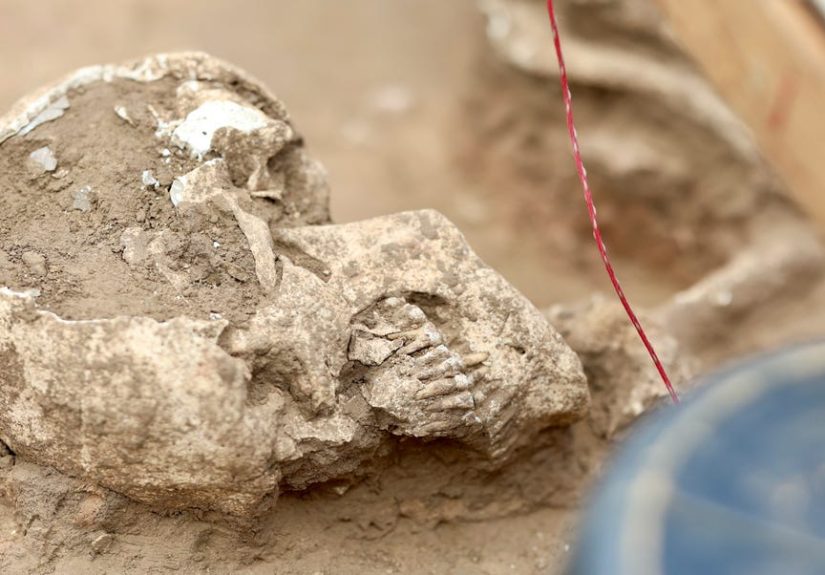
The discovery happened during rescue excavations before construction work near the future university library in Osijek. Archaeologists were investigating a Roman-era area outside the ancient city walls when they examined a used water well. What they found inside was unsettling and unusually intact: seven articulated skeletons, meaning the bones were still in anatomical position and had not been scattered or moved around over time.
That detail matters. It suggests the men were thrown into the well while their bodies were still fleshed, not buried after a long delay and not placed there as part of some slow, repeated process. This was a single event. Quick. Careless. Brutal.
The grave contained almost no personal items. No armor. No weapons. No jewelry. No proud military gear meant to follow the dead into the afterlife. The only meaningful artifact recovered was a Roman coin minted in 251 C.E. That coin, together with radiocarbon dating, helped place the burial in the second half of the third century.
In archaeology, that is the moment when the fog starts to lift. You do not yet have names, but you do have a date range, a location, and the first clue that these men were not buried with honor. They were disposed of.
How Experts Figured Out Who Was Inside the Mass Grave
Radiocarbon dating narrowed the timeline
Researchers directly dated several of the skeletons, and the results clustered in the same period. That ruled out the idea that the well had been reused over generations. These deaths belonged to one historical moment, not a random pileup of unrelated tragedies.
The dating also helped distinguish between two famous battles associated with Mursa. One took place in 260 C.E., during the rebellion of Ingenuus against Gallienus. Another, much later and even bloodier, happened in 351 C.E. The dates from the well fit the earlier battle much better.
The bones pointed to soldiers, not civilians
All seven individuals were adult males. Four were younger adults, and three were middle-aged. Their bodies showed signs of intense physical labor and long-term muscular strain. Most were tall for the period, with average stature above what was typical for men in Roman Pannonia. Several had healed injuries from earlier violent encounters, which strongly suggests they had already survived rough episodes before their final one.
In other words, these were not a random cross-section of city life. This was not a family grave, not an epidemic cemetery, and not a famine pit filled with men, women, and children. The demographic profile looked far more like a military group.
Trauma told a violent story
The skeletons preserved evidence of both old wounds and injuries that likely occurred at or near the time of death. Researchers identified blunt-force trauma, rib fractures, puncture wounds, damaged teeth, and cuts consistent with weapons. One wound appears to have come from a spear or arrow. Another suggests an attack from behind. None of this looks like peaceful death followed by respectful burial. It looks like combat, defeat, and disposal.
That is one reason the study is so compelling. The bodies do not merely sit in the right century. They physically carry the signature of violence.
Why Scholars Link the Grave to the Battle of Mursa
The Roman Empire in the third century was, to put it gently, having a terrible time. From 235 to 284 C.E., the empire lurched through civil wars, invasions, political assassinations, and economic instability in what historians call the Crisis of the Third Century. Emperors rose and fell with alarming speed. Armies backed rival claimants. Borders weakened. Everybody had a sword, a grievance, or both.
Mursa sat in a strategically important zone near the Danube frontier, so it was exactly the kind of place where imperial instability could turn deadly. Historical sources record that Gallienus fought Ingenuus near Mursa in 260 C.E. and won. Ancient accounts also indicate that Gallienus showed little mercy to the defeated side.
That makes the well grave chillingly plausible. If these men were part of the losing forceor victims of the retaliation that followedthe lack of ceremony suddenly makes sense. Bodies stripped of valuables and dumped into a well do not suggest a heroic military funeral. They suggest the losers were treated as disposable.
Researchers also note an alternative possibility: the same period saw pressure from groups beyond Rome’s frontier, and weakened garrisons in the region could have made Mursa vulnerable to outside attack. But even with that caution, the strongest fit remains the Battle of Mursa in 260 C.E.
What Ancient DNA and Isotopes Reveal About Roman Soldiers
The Roman army was more diverse than the movies usually admit
Ancient DNA showed that the men did not share simple continuity with the local earlier population. Their ancestry was heterogeneous, which fits broader evidence for the Roman military as a remarkably mixed institution. By the later empire, Rome was recruiting, absorbing, and reshaping manpower from across a wide geographic world.
That diversity is one of the most fascinating parts of the discovery. These men were buried together, died together, and were probably fighting for the same political cause, yet their backgrounds were not identical. The Roman army was not a neat row of copy-paste Italians in shiny helmets. It was an imperial machine built from many peoples, many regions, and many identities folded into one military system.
Their diet was practical, not glamorous
Stable isotope analysis suggests a largely plant-based diet built around C3 and C4 crops, with limited animal protein and very little marine food. That matches what historians and archaeologists know about many Roman military diets: grain-heavy, functional, and designed to fuel movement more than impress food critics.
So no, these men were probably not feasting on cinematic platters of roasted meat every evening. They were eating the ancient equivalent of dependable field caloriesless luxury banquet, more durable empire food.
They may have been sick before they died
All seven skeletons showed signs on the ribs that may reflect lower respiratory infection or related inflammation near the end of life. That detail adds another human layer to the story. These men may have gone into battle already physically worn down, ill, or recovering from hard conditions. Ancient warfare was not just swords and shields. It was stress, infection, exhaustion, and the sort of medical luck you would not want to test.
Why This Archaeological Discovery Matters
Mass graves from the Roman world are rare, and battle-related mass graves are rarer still. That is one reason this find matters so much. It offers direct evidence of what political collapse looked like on the ground, in the body, and in the handling of the dead.
It also helps bridge the gap between written history and physical evidence. Ancient texts tell us that the third century was violent. This grave shows us that violence in a more intimate way. The men in the well were not abstract casualties in a historian’s paragraph. They were real people with healed wounds, worked muscles, grain-based diets, and one terrible final day.
The discovery also fits into a growing body of evidence that battlefield burials from Roman times can still be found in unexpected places. Another Roman-era mass grave in Vienna has recently highlighted how unusual such finds are. Together, discoveries like these are pushing archaeologists to rethink how war dead were handled in different parts of the empire and at different moments in Roman history.
The Bigger Story Behind the Bones
What makes this story so powerful is not only that science solved a mystery. It is that the solution changes the emotional temperature of the site. A grave that was once anonymous now has historical context. The dead are no longer “seven skeletons from a well.” They are likely Roman soldiers caught up in a civil war, trapped in an empire-wide power struggle, and denied dignified burial after defeat.
That shift matters. Identification restores humanity. Even when archaeologists cannot recover personal names, they can recover social identity, lived experience, and probable cause of death. That is a form of historical justice, even if delayed by seventeen centuries and a truly unreasonable amount of dirt.
It also reminds us that empires do not fall in one dramatic afternoon. They wobble, fracture, and wound people long before they finally collapse. The Mursa grave is one snapshot of that process. Seven men. One well. A superpower under pressure.
Conclusion
The 2011 discovery at Mursa began as a mystery buried in a well. Today, it stands as one of the most revealing Roman mass graves studied in recent years. The evidence strongly suggests that the men were soldiers, that they died in a violent event during the Crisis of the Third Century, and that the Battle of Mursa in 260 C.E. is the best explanation for why they ended up discarded together.
That makes this archaeological find more than a dramatic headline. It is a case study in how modern science can recover voices from deep history without a single written name attached. Radiocarbon dating provided the timeline. Bioarchaeology revealed health, labor, and trauma. Isotopes reconstructed diet. Ancient DNA exposed diversity. Piece by piece, the dead came back into focus.
And maybe that is the real story here. Not just that we now know who was inside the mass grave, but that historywhen treated carefullycan still return identity to the forgotten. Even from a well. Even after all this time.
A Longer Reflection on the Human Experience Behind Finds Like This
There is something strangely humbling about standing in front of a discovery like the Mursa mass grave, even if you are only encountering it through photographs, excavation reports, or museum displays. At first, your brain wants to treat it like a puzzle. You look for clues. You admire the science. You notice the technical terms: radiocarbon dating, isotope analysis, ancient DNA, perimortem trauma. It all feels wonderfully smart and orderly, like history has agreed to sit still and be explained.
Then the second feeling arrives, and it is usually quieter. These were people.
Not symbols. Not textbook extras. Not “the losing side” in some neat imperial timeline. People. Men who ate, marched, got sick, healed from earlier injuries, and probably assumed they would live long enough to complain about their commanders another day. Instead, whatever happened near Mursa ended so badly that nobody bothered to give them a proper burial. That is the part that lingers.
Archaeology often has this double effect. It satisfies curiosity while also unsettling it. You begin with the excitement of discovery and end with the weight of contact. A skeleton is never just bone. It is the outline of a life interrupted. In mass graves especially, that interruption feels amplified. The dead are together, but not peacefully. They were gathered by catastrophe, not community.
For researchers, I imagine the experience must be even more intense. Every careful brushstroke and every lab result carries a kind of responsibility. The job is not only to analyze the remains but to resist flattening them into data points. Good archaeology does both things at once: it measures and it remembers. It recognizes that a puncture wound can be statistically useful and emotionally devastating in the same breath.
For readers, discoveries like this also create a bridge between ancient and modern experiences of war. The weapons have changed. The uniforms have changed. The political slogans have definitely changed. But the human pattern is tragically familiar. Young and middle-aged men are swept into conflicts larger than themselves. Some die in battle. Some die in chaos after battle. Some are honored. Some are discarded. And later generations try to reconstruct meaning from what remains.
That is why stories like this resonate so strongly. They do not stay trapped in antiquity. They speak to something enduring about memory, violence, and dignity. A mass grave is a historical source, yes, but it is also a moral prompt. It asks what societies owe the dead. It asks how easily power can erase individuals. And it asks whether science, centuries later, can restore at least part of what violence took away.
The Mursa grave cannot give us the men’s names or the last thoughts they carried into battle. But it gives us enough to recognize them as more than remains. It gives us labor in their bones, hardship in their ribs, diversity in their DNA, and violence in their wounds. That is not everything. But it is not nothing. In archaeology, recovering that much from silence is almost miraculousand, in the most human sense, deeply moving.