Table of Contents >> Show >> Hide
- Who Is Gabriel Soares?
- Why 3D Caricature Feels So Fresh
- How Soares Builds His Signature Look
- Memorable Pop-Culture Examples
- Why These 3D Caricatures Are So Shareable
- The Art Behind The Humor
- What Artists Can Learn From Gabriel Soares
- Experience Notes: What It Feels Like To Explore These 3D Caricatures
- Conclusion
Some artists draw celebrities. Some sculpt them. And then there are artists like Gabriel Soares, who seems to look at a famous face, press the “make it wonderfully exaggerated” button in his imagination, and turn it into a polished 3D caricature that feels ready for a movie poster, a collectible shelf, or a very stylish fan-art museum.
The Brazilian concept artist and 3D modeler has built a recognizable visual language around pop-culture characters, musicians, actors, superheroes, and screen legends. His portraits are not simple copies. They are playful translations. A jaw becomes a landmark. A grin becomes an event. Hair, posture, costume, and facial expression all get pushed just far enough to feel funny without losing the person underneath.
That balance is the magic trick. A good caricature exaggerates. A great caricature recognizes. Soares’ 3D caricatures do both, giving viewers that instant “I know exactly who that is” feeling, followed by the second reaction: “Wait, why does this look like it could become a premium statue?”
Who Is Gabriel Soares?
Gabriel Soares is a Brazilian 2D/3D concept artist and digital painter known for combining digital painting, sculpting, stylization, and character design. His professional résumé includes work connected with major entertainment and collectible brands, including Netflix, Warner Bros Games, The SPA Studios, Ubisoft, Sideshow Collectibles, Nickelodeon, XM Studios, Unruly Industries, and others.
That professional background matters because his pop-culture caricatures do not look like casual weekend sketches. They have the polish of production art. The proportions may be comic, but the craft is serious: clean forms, carefully controlled lighting, readable silhouettes, expressive posing, and a sculptural finish that makes each character feel tangible.
In other words, this is not the kind of fan art that says, “I had thirty minutes and a tablet.” This is the kind that says, “I have studied faces, anatomy, lighting, materials, entertainment design, and possibly the emotional weight of cheekbones.”
Why 3D Caricature Feels So Fresh
Traditional caricature has been around for centuries, usually in pencil, ink, paint, or editorial illustration. A 3D caricature keeps the humor and exaggeration of classic caricature but adds volume, surface, and lighting. Instead of a flat drawing of a famous person, the viewer gets a character that feels as if it could rotate, cast a shadow, and walk into an animated film.
This is why Soares’ work lands so well online. Pop culture is already visual shorthand. We know Loki’s mischief, Elton John’s flamboyance, Snoop Dogg’s cool, Neo’s stillness, and Superman’s symbolic power before anyone explains them. A 3D caricature uses that shared memory and gives it a new shape.
For viewers, the fun comes from recognition. For artists, the challenge is interpretation. Soares has to decide which details are essential and which can be exaggerated. A costume might be simplified. A face might be stretched. A gesture might become more theatrical. But the soul of the subject has to stay intact. Without that, the caricature becomes a random cartoon wearing a famous person’s outfit, and nobody wants that awkward little identity crisis.
How Soares Builds His Signature Look
Soares’ workflow often blends 2D design thinking with 3D sculpting and rendering. In his shared process notes, he describes creating 2D character designs, sculpting 3D models in ZBrush, moving the work into Maya for materials and lighting, rendering with V-Ray, and finishing with stylized painting and post-production in Photoshop.
That hybrid approach explains why the final pieces feel both sculpted and illustrated. They are not trying to be coldly photorealistic. They have painterly warmth, clean edges, expressive shapes, and a soft cartoon finish. The result sits somewhere between collectible art, animated character design, editorial caricature, and premium fan tribute.
Exaggeration With Discipline
The best thing about Soares’ caricatures is that they do not exaggerate randomly. The exaggeration has a purpose. Elton John’s expressive smile becomes a personality engine. Timothée Chalamet’s cheekbones get the kind of attention usually reserved for national monuments. Snoop Dogg’s relaxed posture and attitude become just as important as his face. In each case, the artist chooses details that already define the subject and turns up the volume.
Lighting That Adds Personality
Lighting is a quiet hero in 3D character art. It can make a face feel heroic, mysterious, soft, dramatic, comic, or cinematic. Soares uses lighting to support the mood of each piece. A superhero gets a stronger, cleaner silhouette. A musician might receive more theatrical warmth. A darker character gets atmosphere without becoming visually muddy.
Texture Without Visual Noise
Many beginner 3D artists make the mistake of adding too much texture too quickly. Every pore, wrinkle, stitch, and reflection starts shouting at once. Soares’ work is more controlled. The surfaces are smooth, stylized, and readable. He keeps enough material detail to make the character feel alive, but not so much that the humor disappears under a pile of digital confetti.
Memorable Pop-Culture Examples
The collection includes a wide range of celebrities and characters from film, television, music, games, comics, and internet culture. That variety is part of the appeal. It is not just a gallery of superheroes or just a lineup of musicians. It feels more like a pop-culture party where Loki is standing near Michael Jackson, Neo is trying to look serious, and someone has definitely invited Snoop Dogg.
Elton John
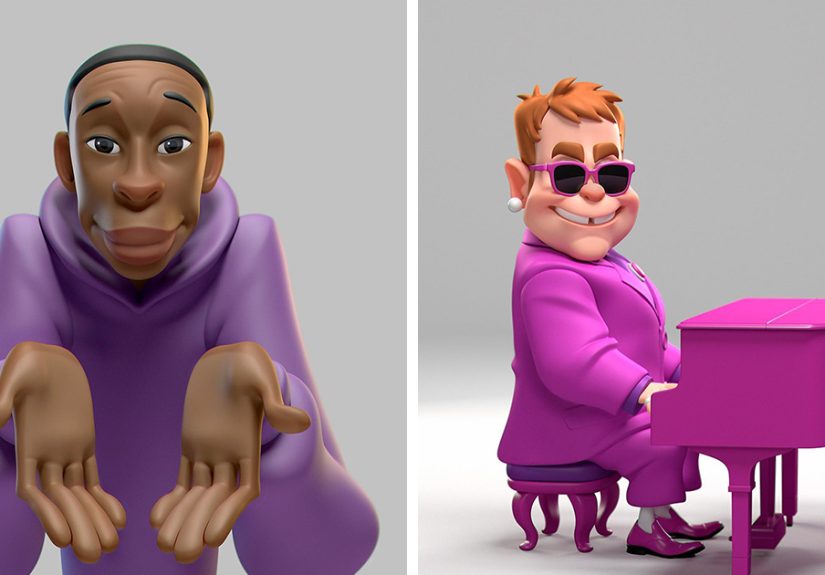
Elton John is a perfect subject for caricature because his public image is already filled with strong visual cues: glasses, bold fashion, stage confidence, and a smile that can carry a stadium. Soares’ interpretation highlights that larger-than-life energy. The charm is not only in the likeness, but in the way the portrait captures performance as personality.
Loki
Loki works beautifully in 3D caricature because he has a face built for scheming. Soares leans into the character’s sharpness, elegance, and mischievous posture. The result feels theatrical, which is exactly right for a character who treats betrayal like performance art and probably rehearses dramatic entrances in mirrors.
Neo From The Matrix
Neo is more minimal than many pop-culture icons: black clothing, calm expression, controlled movement. That makes him harder to caricature than he first appears. The artist has to exaggerate restraint, which sounds like a contradiction but is actually a serious design puzzle. Soares’ Neo-inspired work captures the cool geometry of the character without turning him into a stiff mannequin.
Snoop Dogg
Snoop Dogg’s caricature succeeds because it understands that likeness is more than facial structure. It is rhythm, attitude, relaxation, and silhouette. The portrait feels unmistakably Snoop because it captures the laid-back confidence that has become part of his public persona. It is less “here is a face” and more “here is a whole mood wearing sunglasses.”
John Lennon, Freddie Mercury, And Rock Icons
Musicians are especially rewarding in caricature because audiences already connect them with sound, performance, and style. John Lennon, Freddie Mercury, Robert Plant, Michael Jackson, and other music references allow Soares to work with expressive hair, iconic poses, recognizable clothing, and familiar stage presence. The challenge is to avoid making them look like costumes. The strength of the work is that the figures still feel character-driven.
Superheroes And Comic-Book Legends
Characters like Superman, Thor, Namor, Wolverine, and other comic-inspired figures give Soares room to play with heroic anatomy. Superhero caricature is tricky because comic-book bodies are already exaggerated. The artist must exaggerate the exaggeration without making the result collapse into parody. Soares often solves this by keeping the emotional core clear: Superman remains noble, Thor remains powerful, and the visual humor comes from form rather than disrespect.
Film And TV Characters
From The Witcher and The Last of Us to The Fresh Prince of Bel-Air, Terminator, Alita, Rambo, House of the Dragon, and Peaky Blinders, the gallery shows how adaptable Soares’ style can be. Each subject arrives with a different genre language. Fantasy needs weight and costume detail. Science fiction needs sleek surfaces. Drama needs mood. Comedy needs timing. A good 3D caricature must translate all of that in a single image.
Why These 3D Caricatures Are So Shareable
Internet art spreads quickly when it gives people a reason to react. Soares’ work checks several boxes at once: the characters are recognizable, the style is polished, the exaggeration is funny, and the finish looks professional. People share it because it makes them feel clever for recognizing the reference and delighted by the twist.
There is also a collectible quality to the images. Many of them look like they could become vinyl figures, resin statues, or limited-edition designer toys. That is not an accident. Soares has experience with collectibles and toy art, and that background shows in the sculptural clarity of the pieces. They are designed like objects, not just images.
This is one reason his style appeals beyond fan-art circles. A movie fan sees the character. A 3D artist sees the sculpting. A designer sees the shape language. A collector sees shelf potential. A casual viewer sees something funny and impressive. That is a rare combo platter, and yes, it comes with extra sauce.
The Art Behind The Humor
Caricature can look effortless when it is done well, but it demands strong observation. The artist must study anatomy, facial planes, expression, silhouette, costume, gesture, and cultural context. The more famous the subject, the harder the job becomes, because viewers already know the face. One wrong proportion can break the illusion.
Soares’ work shows that caricature is not about making people look silly. It is about finding the most memorable truth in a face or character and presenting it with confidence. A long face becomes more elegant. A strong brow becomes more intense. A smile becomes more musical. A serious pose becomes funnier because it is pushed into stylized clarity.
That is why the pieces feel affectionate rather than mean-spirited. They celebrate the subject. Even when the proportions are playful, the craftsmanship says, “I studied this carefully.” That respect keeps the humor warm.
What Artists Can Learn From Gabriel Soares
For aspiring digital artists, Soares’ portfolio is a useful reminder that style is built from many skills, not one magic brush. His work blends drawing, design, sculpting, lighting, rendering, color, storytelling, and taste. Learning software is important, but software alone does not create charm. A sculpting tool can help shape a face; it cannot decide what makes that face unforgettable.
The strongest lesson is simplification. Soares does not copy every detail. He selects. He edits. He pushes what matters. That is a valuable habit for any creative field, whether you are designing characters, writing stories, making thumbnails, or trying to explain a movie plot to someone who keeps checking their phone.
Experience Notes: What It Feels Like To Explore These 3D Caricatures
Looking through a collection like this feels a little like walking into a tiny digital wax museum where every statue has secretly joined an animated comedy. The first pleasure is recognition. You see a character or celebrity and your brain clicks immediately. Then the second pleasure arrives: noticing what the artist changed. Maybe the head is larger, the jaw is bolder, the eyebrows are more theatrical, or the body language has been distilled into one clean visual joke.
That two-step experience is why 3D caricature is so satisfying. It rewards both casual viewers and detail hunters. A casual fan can enjoy the obvious likeness. A more art-focused viewer can study the sculpt, lighting, facial planes, and stylized anatomy. The work functions on multiple levels, which is one reason it holds attention longer than a typical fan image.
There is also a nostalgic effect. Pop-culture characters are not just entertainment products; they are memory containers. A portrait of Neo might remind someone of watching The Matrix for the first time and briefly believing sunglasses were a personality. A Fresh Prince-inspired caricature can bring back sitcom memories, bright colors, and theme-song energy. A rock-star portrait may recall an album, a concert clip, or a parent playing music too loudly in the kitchen while claiming it was “educational.”
The best experience, though, is the sense of play. Soares’ caricatures do not ask viewers to admire them from a cold distance. They invite reaction. You can laugh at the exaggeration, admire the craft, and still feel that the artist respects the original subject. That friendliness makes the work accessible. It is polished enough for professionals, but fun enough for anyone scrolling during a lunch break.
For young artists, the gallery can be motivating rather than intimidating if approached the right way. Instead of thinking, “I could never do that,” it is more useful to ask, “What did he choose to exaggerate, and why?” That question turns viewing into learning. You start noticing how a character’s identity depends on shapes, expressions, color, posture, and props. Eventually, you realize that caricature is less about distortion and more about decision-making.
There is a practical lesson for content creators, too. A strong visual concept travels. “Brazilian artist recreates famous characters as 3D caricatures” is easy to understand in one sentence. The idea is clear, the execution is impressive, and the results are instantly clickable without needing cheap shock value. That is exactly the kind of creative clarity that performs well on social platforms, art blogs, and search engines.
Most of all, these works remind us that pop culture stays alive when artists reinterpret it. A beloved character does not have to remain frozen in its original form forever. It can become a sculpture, a painting, a toy, a parody, a tribute, or a lovingly exaggerated 3D face with eyebrows powerful enough to file taxes independently.
Conclusion
Gabriel Soares’ 3D caricatures show what happens when technical skill meets pop-culture affection. His portraits are funny without being lazy, polished without being stiff, and exaggerated without losing likeness. Whether he is reimagining superheroes, actors, musicians, movie icons, or internet-famous personalities, his work proves that caricature is not simply about making features bigger. It is about making character clearer.
In a digital world overflowing with fan art, Soares stands out because his pieces feel sculptural, expressive, and professionally finished. They are not just images of famous people and characters; they are interpretations with personality. That is why these 3D caricatures are so easy to enjoy, so easy to share, and so hard to scroll past without saying, “Okay, that one is ridiculously good.”
Note: This original article was written for web publication in clean body-only HTML, with factual details synthesized from publicly available information about Gabriel Soares, his portfolio, and the 3D character-art workflow.