Table of Contents >> Show >> Hide
- Why Casting Non-Actors Can Work So Well
- 37 Amazing Movie Performances By Non-Actors
- 1. Harold Russell in The Best Years of Our Lives
- 2. Haing S. Ngor in The Killing Fields
- 3. Anna Paquin in The Piano
- 4. Barkhad Abdi in Captain Phillips
- 5. Yalitza Aparicio in Roma
- 6. Quvenzhané Wallis in Beasts of the Southern Wild
- 7. Dwight Henry in Beasts of the Southern Wild
- 8. Gabourey Sidibe in Precious
- 9. Bria Vinaite in The Florida Project
- 10. Sasha Lane in American Honey
- 11. Katie Jarvis in Fish Tank
- 12. Darlene Cates in What’s Eating Gilbert Grape
- 13. R. Lee Ermey in Full Metal Jacket
- 14. Vinnie Jones in Lock, Stock and Two Smoking Barrels
- 15. Björk in Dancer in the Dark
- 16. Eminem in 8 Mile
- 17. Tupac Shakur in Juice
- 18. Ice Cube in Boyz n the Hood
- 19. Jennifer Hudson in Dreamgirls
- 20. Lady Gaga in A Star Is Born
- 21. Cher in Silkwood and Moonstruck
- 22. Dolly Parton in 9 to 5
- 23. Alana Haim in Licorice Pizza
- 24. Cooper Hoffman in Licorice Pizza
- 25. Ray Allen in He Got Game
- 26. LeBron James in Trainwreck
- 27. Kareem Abdul-Jabbar in Airplane!
- 28. Brady Jandreau in The Rider
- 29. Linda May in Nomadland
- 30. Swankie in Nomadland
- 31. Bob Wells in Nomadland
- 32. Lamberto Maggiorani in Bicycle Thieves
- 33. Enzo Staiola in Bicycle Thieves
- 34. David Bowie in The Man Who Fell to Earth
- 35. Courtney Love in The People vs. Larry Flynt
- 36. Harry Styles in Dunkirk
- 37. Peter Ostrum in Willy Wonka & the Chocolate Factory
- What These Performances Teach Us About Great Casting
- Experience-Based Reflections: Why Non-Actors Feel So Real Onscreen
- Conclusion
Hollywood loves training, résumés, agents, callbacks, and people who can say “I studied Stanislavski” without sounding like they sneezed. But every so often, a filmmaker looks outside the usual acting pool and finds someone who simply feels right. A teacher. A baker. A limo driver. A rodeo rider. A rapper. A basketball legend. Someone who has never hit a mark in their life but somehow understands the emotional target better than anyone in the room.
That is the magic of non-actors in movies. They often bring a texture that polished performers spend years trying to imitate: lived-in truth. They may not know every technical trick, but they know how to be present. And when the camera loves that presence, the result can be unforgettable.
Below are 37 times non-professional actors, first-time performers, musicians, athletes, real-life experts, or everyday people were cast in movies and delivered performances so good that audiences forgot they were “not actors.” In some cases, they became stars. In others, they walked back into ordinary life with one extraordinary screen credit tucked under their arm like a secret superpower.
Why Casting Non-Actors Can Work So Well
Non-actors are not automatically better than trained actors. Let’s not cancel drama school just yet. But when the role needs rawness, realism, awkward honesty, or a specific life experience, nontraditional casting can be a brilliant choice. Directors such as Vittorio De Sica, Chloé Zhao, Sean Baker, Andrea Arnold, and Benh Zeitlin have used non-professional performers to make fictional stories feel almost documentary-level real.
The best non-actor performances work because they do not feel performed. They feel overheard, witnessed, or accidentally captured. That can make a movie breathe differently. The viewer leans in because the person onscreen seems less like a character and more like someone who wandered in from real life carrying a whole world behind their eyes.
37 Amazing Movie Performances By Non-Actors
1. Harold Russell in The Best Years of Our Lives
Harold Russell was a World War II veteran, not a polished Hollywood performer, when he played Homer Parrish, a sailor returning home after losing both hands. His performance had a quiet dignity that no costume department could fake. Russell won Best Supporting Actor and an honorary Oscar, proving that authenticity can sometimes walk right past technique and sit in the winner’s circle.
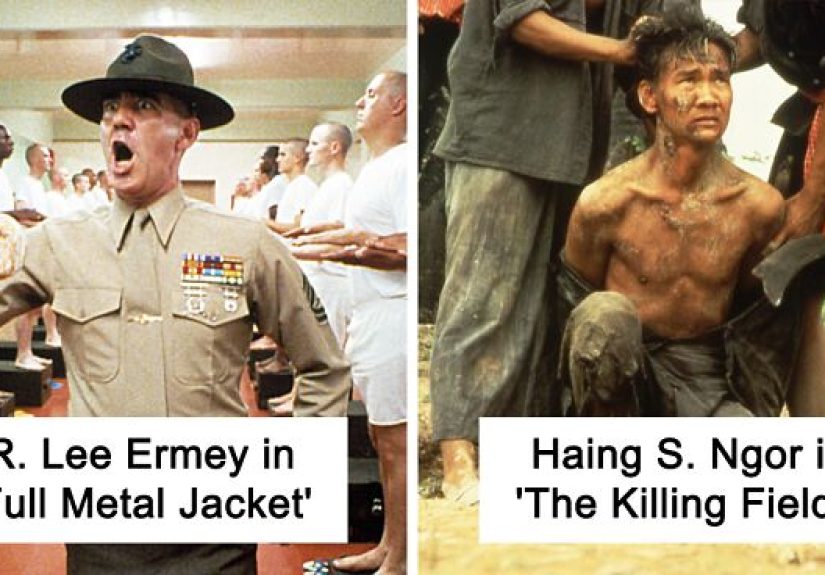
2. Haing S. Ngor in The Killing Fields
Before acting, Haing S. Ngor was a physician and a survivor of the Cambodian genocide. In The Killing Fields, he played journalist Dith Pran with devastating emotional force. His real-life history gave the role an unbearable gravity, and he won the Academy Award for Best Supporting Actor.
3. Anna Paquin in The Piano
Anna Paquin was a child with no professional acting background when she auditioned for Jane Campion’s The Piano. As Flora, she was mischievous, watchful, funny, and heartbreaking. She won an Oscar at age 11, while many adults were still trying to win a decent school talent show.
4. Barkhad Abdi in Captain Phillips
Barkhad Abdi had worked as a limo driver and cell phone salesman before playing Somali pirate leader Abduwali Muse opposite Tom Hanks. His line “I’m the captain now” became instantly famous, but the performance was more than one meme-worthy moment. Abdi gave Muse danger, desperation, intelligence, and fear.
5. Yalitza Aparicio in Roma
Yalitza Aparicio was training to become a teacher when she was cast as Cleo in Alfonso Cuarón’s Roma. With no prior acting experience, she delivered a performance of remarkable restraint and emotional clarity. Her Oscar nomination felt like a victory for naturalism, representation, and quiet screen power.
6. Quvenzhané Wallis in Beasts of the Southern Wild
Quvenzhané Wallis was only a child when she became Hushpuppy, the fearless heart of Beasts of the Southern Wild. Her performance was fierce, funny, and mythic without ever feeling rehearsed. She earned a Best Actress Oscar nomination and carried the film like a tiny storm in rain boots.
7. Dwight Henry in Beasts of the Southern Wild
Dwight Henry was a New Orleans baker before playing Wink, Hushpuppy’s rough but loving father. His performance had the heaviness of real weather: unpredictable, human, and intense. He did not act like a man shaped by hardship; he seemed to have brought that knowledge with him.
8. Gabourey Sidibe in Precious
Precious was Gabourey Sidibe’s screen debut, and she stepped into one of the most emotionally demanding roles of the 2000s with astonishing control. She made Precious guarded, wounded, imaginative, angry, and hopeful. The performance earned her an Academy Award nomination and launched a lasting career.
9. Bria Vinaite in The Florida Project
Director Sean Baker discovered Bria Vinaite through Instagram before casting her as Halley, a young mother living on the edge of survival near Disney World. Vinaite’s performance was messy in the best possible way: funny, reckless, loving, self-sabotaging, and painfully believable.
10. Sasha Lane in American Honey
Sasha Lane was discovered by director Andrea Arnold during spring break before starring in American Honey. As Star, she carried the movie with restless curiosity and emotional openness. She made the road-trip drama feel less like a story and more like a memory you were not supposed to see.
11. Katie Jarvis in Fish Tank
Katie Jarvis was reportedly spotted at a train station before Andrea Arnold cast her in Fish Tank. As Mia, she delivered a raw portrait of teenage frustration, ambition, and loneliness. The performance feels so immediate that it almost dares you to call it acting.
12. Darlene Cates in What’s Eating Gilbert Grape
Darlene Cates had appeared on television as herself before being cast as Bonnie Grape. Her movie performance was tender, painful, and deeply human. She turned a role that could have become cruel caricature into a portrait of shame, love, and dignity.
13. R. Lee Ermey in Full Metal Jacket
R. Lee Ermey was a former Marine drill instructor before becoming the terrifying Gunnery Sergeant Hartman. Stanley Kubrick originally brought him on as a technical adviser, but Ermey’s command of the role was impossible to ignore. His performance is so iconic that it now defines the cinematic drill sergeant archetype.
14. Vinnie Jones in Lock, Stock and Two Smoking Barrels
Before acting, Vinnie Jones was known as a hard-edged professional footballer. Guy Ritchie turned that intimidating presence into movie gold. As Big Chris, Jones was funny, scary, and oddly charming, like a brick wall that had learned comic timing.
15. Björk in Dancer in the Dark
Björk was already a major musician when she starred in Lars von Trier’s Dancer in the Dark. Her performance as Selma was fragile, musical, and emotionally punishing. She won Best Actress at Cannes, then wisely made many viewers cry into their sleeves.
16. Eminem in 8 Mile
Eminem’s feature-film debut worked because 8 Mile used his real background without simply turning him into a music-video version of himself. As Jimmy “B-Rabbit” Smith Jr., he was guarded, tense, funny, and believable. The final rap battle still lands like a cinematic uppercut.
17. Tupac Shakur in Juice
Tupac Shakur was already a rapper when he played Bishop in Juice, but his screen presence shocked people. He made Bishop magnetic, dangerous, wounded, and unpredictable. It was not just a good musician-turned-actor performance; it was a reminder that charisma can be terrifying.
18. Ice Cube in Boyz n the Hood
Ice Cube entered Boyz n the Hood as a rapper and left as a convincing screen actor. His performance as Doughboy balanced toughness with sadness, giving the film one of its most memorable emotional centers. He looked completely at home in front of the camera.
19. Jennifer Hudson in Dreamgirls
Jennifer Hudson was known as a singer before her film debut as Effie White. Then she sang “And I Am Telling You I’m Not Going,” and suddenly everyone understood that the building had a new owner. Her performance won an Oscar and made the transition from singer to actor look almost unfairly easy.
20. Lady Gaga in A Star Is Born
Lady Gaga had performed on screen before, but A Star Is Born was the movie that proved her dramatic power to a wide film audience. As Ally, she stripped away the spectacle and showed vulnerability, humor, and fear. The result felt intimate, not manufactured.
21. Cher in Silkwood and Moonstruck
Cher was famous as a singer and television personality before earning serious respect as an actor. Her supporting work in Silkwood showed dramatic discipline, and Moonstruck won her the Oscar. She did not just cross over; she built a bridge, lit it beautifully, and walked across in heels.
22. Dolly Parton in 9 to 5
Dolly Parton made her film debut in 9 to 5 and immediately radiated comic confidence. Playing Doralee, she turned charm into armor and timing into a weapon. The movie needed her warmth, wit, and musical sparkle, and she supplied all three like she had a warehouse full of them.
23. Alana Haim in Licorice Pizza
Alana Haim was known for music before Paul Thomas Anderson cast her in Licorice Pizza. Her performance felt loose, specific, and alive. She captured the impatience of a young adult who wants life to start already, preferably five minutes ago.
24. Cooper Hoffman in Licorice Pizza
Cooper Hoffman, son of Philip Seymour Hoffman, made his feature debut opposite Alana Haim. Despite the family connection, his performance did not feel like imitation. He brought confidence, insecurity, hustle, and boyish bravado to Gary Valentine.
25. Ray Allen in He Got Game
Spike Lee cast NBA star Ray Allen as basketball phenom Jesus Shuttlesworth. Allen had no deep acting résumé, but he understood the pressure of being young, talented, watched, and recruited. That real-world understanding gave the performance its backbone.
26. LeBron James in Trainwreck
LeBron James surprised audiences by being genuinely funny in Trainwreck. Playing an exaggerated version of himself, he showed relaxed comic timing and a willingness to look silly. For a global sports icon, that is not always easy. Ego can be heavy luggage.
27. Kareem Abdul-Jabbar in Airplane!
Kareem Abdul-Jabbar’s cameo as Roger Murdock remains one of the funniest athlete performances in movie history. The joke works because he tries to deny being Kareem until a child criticizes his defense. Then the legend snaps, and comedy history gets a clean dunk.
28. Brady Jandreau in The Rider
Brady Jandreau was a real rodeo rider recovering from a serious injury when Chloé Zhao shaped The Rider around his experience. His performance has the ache of someone facing the possible loss of his identity. It is quiet, physical, and deeply moving.
29. Linda May in Nomadland
Linda May, one of the real-life nomads featured in Nomadland, brought warmth and lived experience to the film. Her scenes helped blur the line between fiction and documentary, making the road community feel textured rather than decorative.
30. Swankie in Nomadland
Charlene Swankie, another real nomad in Nomadland, gave the film some of its most memorable reflections on mortality and freedom. She did not need big dramatic gestures. Her presence alone carried years of travel, solitude, and hard-won wisdom.
31. Bob Wells in Nomadland
Bob Wells appeared as himself in Nomadland, offering practical guidance and emotional philosophy to Fern and the audience. His sincerity gave the movie a spiritual anchor. He made the nomadic lifestyle feel not trendy, but chosen, endured, and understood.
32. Lamberto Maggiorani in Bicycle Thieves
Italian factory worker Lamberto Maggiorani became the face of postwar desperation in Vittorio De Sica’s Bicycle Thieves. His untrained performance helped define Italian neorealism. He looked like a man who had not memorized poverty; he had met it.
33. Enzo Staiola in Bicycle Thieves
Enzo Staiola, the child actor discovered for Bicycle Thieves, gave the movie its tender heartbeat. As Bruno, he watches his father’s dignity collapse with innocent confusion. His small reactions are devastating because they feel completely unforced.
34. David Bowie in The Man Who Fell to Earth
David Bowie was not an ordinary musician, which helped because The Man Who Fell to Earth did not need an ordinary man. As Thomas Jerome Newton, Bowie used his alien-like public image to haunting effect. He seemed less cast than summoned from another frequency.
35. Courtney Love in The People vs. Larry Flynt
Courtney Love was known for music and tabloid chaos before earning serious acclaim as Althea Flynt. Her performance was sharp, vulnerable, funny, and tragic. She showed that raw public energy could be transformed into disciplined screen electricity.
36. Harry Styles in Dunkirk
Harry Styles entered Christopher Nolan’s Dunkirk as a pop star, which made some viewers skeptical. Then the movie came out, and he fit cleanly into the ensemble. He did not try to dominate the film; he served the tension, which was exactly the job.
37. Peter Ostrum in Willy Wonka & the Chocolate Factory
Peter Ostrum made his only major film appearance as Charlie Bucket, then eventually became a veterinarian. His performance remains beloved because it is gentle, sincere, and never showy. In a movie full of chaos, candy, and questionable factory safety standards, he gave the story its pure heart.
What These Performances Teach Us About Great Casting
The best casting is not always about who has the longest résumé. It is about who carries the right energy for the story. A trained actor may understand camera angles, emotional beats, and continuity. A non-actor may understand the actual life being represented. When those instincts meet the right director, the screen can spark.
These examples also show that “non-actor” does not mean “unskilled.” Athletes know pressure. Musicians know rhythm. Teachers know observation. Veterans know trauma. Bakers know exhaustion. Real nomads know the daily mathematics of survival. Those skills may not appear on an acting résumé, but they can feed a performance in powerful ways.
Of course, there are risks. Non-professional performers may need support on set. They may not know how to repeat emotional moments for multiple takes. They may feel overwhelmed by publicity after release. Responsible filmmakers must protect them, not simply extract authenticity and move on. A great non-actor performance should never be treated like a lucky accident; it is usually the result of trust, patience, smart direction, and careful editing.
Experience-Based Reflections: Why Non-Actors Feel So Real Onscreen
Watching non-actors in movies can feel different from watching polished stars, and the difference often shows up in tiny details. A professional actor might enter a room with perfect timing. A non-actor might enter slightly awkwardly, glance at the floor, adjust their sleeve, and suddenly the scene feels more like life. That little imperfection can be gold. Real people rarely move like choreography unless they are in a wedding dance line, and even then, Uncle Dave is usually two beats behind.
The experience of seeing someone unfamiliar on screen also removes baggage. When a movie star appears, the audience brings memories of earlier roles, interviews, scandals, superhero suits, perfume ads, and possibly one unfortunate talk-show appearance. With a non-actor, there is less noise. We meet the person as the character first. That freshness can make a story feel newly discovered.
There is also an emotional honesty that comes from not overexplaining. Many non-professional performers do not “decorate” a scene. They do not underline every feeling with a grand expression. Instead, they sit inside the moment. Yalitza Aparicio’s stillness in Roma, Brady Jandreau’s physical hesitation in The Rider, and Barkhad Abdi’s tense watchfulness in Captain Phillips all show how restraint can be more powerful than volume.
For viewers, these performances are a reminder that talent does not always arrive wearing a name tag. It may be found in a bakery, on a basketball court, at a casting call attended by accident, or on an Instagram feed. That does not mean anyone can act brilliantly without work. It means life experience can be its own kind of training. Some people have been studying human behavior for years without calling it acting.
For filmmakers, the lesson is simple but demanding: look harder. The perfect person for a role may not be waiting in the usual audition room. They may not have headshots. They may not know what a mark is. They may ask where to stand, then accidentally break your heart once the camera rolls. Finding that person requires curiosity, sensitivity, and a willingness to build a set where newcomers can succeed.
For audiences, the pleasure is equally simple. Non-actors can make movies feel dangerous again, in the best sense. We do not always know what they will do next. Their timing may not be slick, but their presence can be electric. They remind us that cinema is not only about performance as craft. It is also about faces, histories, instincts, and the strange miracle of the right person being in the right frame at the right time.
That is why these 37 examples endure. They are not just trivia. They are proof that movie magic sometimes walks in through the side door, wearing regular shoes, with no agent, no plan, and absolutely no idea that it is about to steal the scene.
Conclusion
Non-actors in movies can bring a rare kind of truth to the screen. From Harold Russell’s history-making Oscar win to Yalitza Aparicio’s luminous debut in Roma, from Bria Vinaite’s Instagram-to-indie-film leap to LeBron James casually stealing laughs in Trainwreck, these performances prove that acting talent does not always follow a traditional route.
The magic happens when real experience, smart direction, and the right role meet. Sometimes the result is a one-time wonder. Sometimes it launches a full career. Either way, these casting choices remind us that great cinema is not just about pretending well. Sometimes it is about being brave enough to bring your real self into the frame.