Table of Contents >> Show >> Hide
- What Actually Happened at the Pentagon on 9/11?
- Why Pentagon Crash Myths Spread So Easily
- Myth #1: “No Boeing 757 Hit the Pentagon”
- Myth #2: “The Hole Was Too Small for a 757”
- Myth #3: “There Was No Plane Debris”
- Myth #4: “There Were No Black Boxes, No Flight Data, and No Real Trail of Evidence”
- Myth #5: “The Pentagon Videos Don’t Show a Boeing 757”
- Myth #6: “The Light Poles, Windows, and Damage Pattern Look Suspicious”
- Why the Evidence Still Points to Flight 77
- The Human Cost of Treating Evidence Like a Costume
- Experiences Related to the Topic: Why These Myths Still Feel Personal
- Conclusion
Some conspiracy theories survive on a weird mix of shock, grainy footage, and the human tendency to say, “That looks strange, therefore it must be fake.” Few examples prove that better than the myths surrounding the Pentagon attack on September 11, 2001. More than two decades later, claims still bounce around the internet insisting that no commercial jet hit the building, that the hole was “too small,” that the debris was “missing,” or that the whole event was somehow staged.
These claims can sound dramatic, but drama is not evidence. When you line up the documented flight path, air traffic data, eyewitness reports, physical wreckage, structural damage, and victim records, the story becomes clear: American Airlines Flight 77, a hijacked Boeing 757, struck the Pentagon. The myths do not hold up under scrutiny. They mostly thrive by zooming in on one image, ignoring how aircraft break apart at high speed, and pretending that confusion in a disaster is the same thing as proof of a cover-up.
This article breaks down the most common Pentagon crash myths and compares them with the documented record. No tinfoil hats required. Just patience, basic physics, and a willingness to let facts be less flashy than fiction.
What Actually Happened at the Pentagon on 9/11?
On the morning of September 11, American Airlines Flight 77 departed from Dulles International Airport on a scheduled flight to Los Angeles. It was hijacked and later turned back toward the Washington, D.C., area. Official timelines and flight-path reconstructions place the impact at 9:37 a.m., with detailed records putting the strike at 9:37:46. Flight data analysis estimated the jet’s speed at roughly 530 miles per hour at impact.
The aircraft hit the Pentagon’s western side after descending rapidly and flying at extremely low altitude. Multiple investigations, including the 9/11 Commission and aviation analyses tied to the event, document the aircraft’s approach, timing, and impact. The attack killed people aboard the plane and inside the building, and the Pentagon Memorial today honors 184 victims, excluding the five hijackers.
That is the baseline reality. Everything else should be measured against it.
Why Pentagon Crash Myths Spread So Easily
The Pentagon myths did not spread because the evidence was weak. They spread because the visuals were incomplete. People expected a Hollywood crash scene: a giant cartoon-shaped airplane outline in the wall, a pristine tail in the parking lot, and a crystal-clear blockbuster video from twelve angles. Real disasters are rude that way. They do not care what internet speculation expects them to look like.
A fast-moving jetliner hitting a reinforced concrete building does not leave behind a tidy museum display. It creates fragmentation, fire, collapse, confusion, and photographs that look incomplete when stripped of context. Conspiracy content loves that gap. It thrives in the space between “that seems odd” and “I bothered to learn how impact damage works.”
Myth #1: “No Boeing 757 Hit the Pentagon”
The claim
The biggest myth says the Pentagon was not hit by American Airlines Flight 77 at all. Depending on the version, believers swap in a missile, a military aircraft, or a mystery object. In other words: anything except the documented plane.
The reality
This claim falls apart almost immediately. The documented record includes radar tracking, flight-path analysis, air traffic control records, eyewitness accounts, wreckage recovery, and an extensive federal investigation. The attack was not established by a single blurry frame or one government press release. It was established through overlapping lines of evidence.
Investigators did not simply shrug and decide a plane was “close enough.” They traced the hijacked flight, collected evidence at the crash site, examined the physical damage, and linked the event to the aircraft and the people on board. That is what serious investigations do. They stack evidence until the conclusion becomes boringly obvious.
And boringly obvious is exactly the problem for conspiracy culture. “A hijacked commercial airliner hit the Pentagon” is true, but it lacks the cinematic spice of secret missiles and invisible jets. Truth is often less glamorous than rumor. It is also far more durable.
Myth #2: “The Hole Was Too Small for a 757”
The claim
This argument says the visible opening in the Pentagon’s façade did not look wide enough for a Boeing 757, so the aircraft could not have hit the building.
The reality
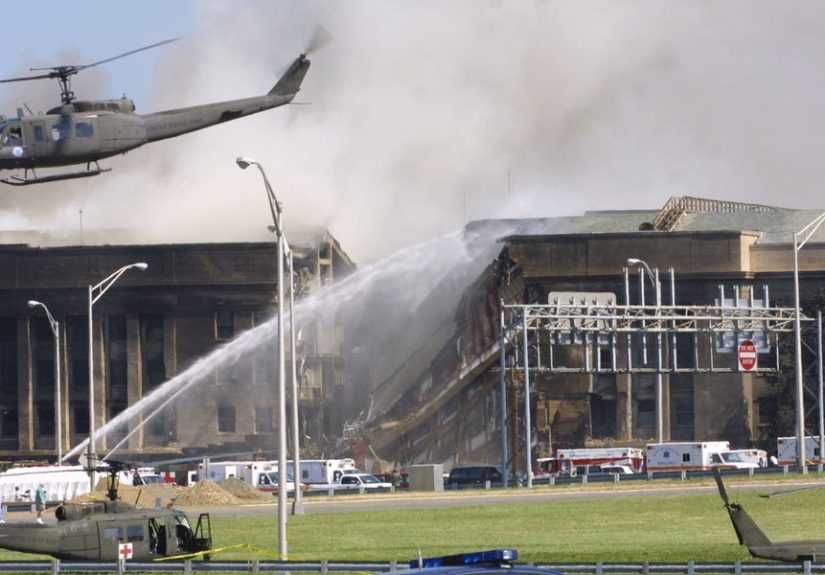
This myth depends on a very common mistake: confusing an early exterior photograph with the full damage pattern. A large jet traveling at high speed into a reinforced structure does not stamp its silhouette into the wall like a cookie cutter. It breaks apart. Different components strike at different angles and with different effects. Some parts fragment outside, some penetrate, some shear away, and some contribute mainly through force and fuel-fed fire.
The plane’s wings were not magic steel spears that would remain perfectly intact long enough to draw a neat outline. They were designed to fly, not to carve a textbook-sized airplane shape into concrete. At impact speed, lighter structures would fragment violently. The Pentagon’s exterior, interior columns, and later collapse patterns all matter when evaluating the final appearance of the opening.
In short, “the hole should have looked more airplane-ish” is not engineering. It is vibe-based architecture criticism.
Myth #3: “There Was No Plane Debris”
The claim
Another favorite says there was no meaningful wreckage, and therefore no commercial aircraft.
The reality
There was debris. This myth survives by pretending that if a full airplane was not lying politely on the lawn, then no airplane existed. But crash evidence does not have to resemble a toy set after a mild tantrum. A jetliner hitting a building at around 530 miles per hour is going to fragment heavily.
Photos and witness accounts documented aircraft wreckage at the site. Structural engineers and emergency responders reported pieces consistent with the plane, including components with airline markings. Investigative reporting has also highlighted firsthand accounts from experts who arrived early and described both aircraft debris and recorder recovery. The problem for the myth is not lack of evidence; it is selective eyesight.
Conspiracy posts often crop photographs tightly, ignore interior debris, dismiss recovered fragments as “planted,” and then congratulate themselves for being skeptical. That is not skepticism. That is reverse-engineering a conclusion and calling it curiosity.
Myth #4: “There Were No Black Boxes, No Flight Data, and No Real Trail of Evidence”
The claim
Some versions of the story insist the event lacked the normal documentation associated with an air disaster, which supposedly proves a cover-up.
The reality
The official record says otherwise. The event generated air traffic control recordings, flight-path studies, investigative files, and recorder-related documentation. National Archives materials also reflect the existence of extensive FAA records concerning Flight 77 and the government’s response. That is exactly what you would expect from a real hijacking and crash investigation.
People sometimes treat the existence of unanswered questions in the first hours after the attack as proof that no evidence existed later. That is backward. Initial confusion is normal in fast-moving disasters. The question is what the record looks like after investigators gather radar, communications, physical evidence, witness testimony, and identification data. In this case, the record points in one direction.
That direction is not “mystery missile.” It is “Flight 77.”
Myth #5: “The Pentagon Videos Don’t Show a Boeing 757”
The claim
Because publicly circulated footage is brief and visually limited, conspiracy theorists argue that the lack of a dramatic full-plane image proves the crash never happened.
The reality
This argument confuses low-quality footage with contrary evidence. Security footage from 2001 was not designed to satisfy internet frame-by-frame hobbyists twenty years later. It was not shot for cinematic clarity, and it certainly was not arranged to give future social media sleuths a perfect side profile of a fast-moving jet traveling just above the ground.
More importantly, video is only one piece of evidence. Even if the footage were worse than it is, the conclusion would still rest on the broader record: radar, timing, witnesses, debris, crash-site investigation, and victim documentation. A poor camera angle cannot erase a real event. It only frustrates people who want one screenshot to do the work of an entire investigation.
Myth #6: “The Light Poles, Windows, and Damage Pattern Look Suspicious”
The claim
This myth points to clipped light poles, damaged windows, and the building’s exterior as signs that the official account is staged or inconsistent.
The reality
The “suspicious” details actually fit the crash sequence better than the conspiracy theory does. Reporting on the Pentagon damage notes that the aircraft approached so low that it struck light poles before hitting the building. Structural details also matter. Portions of the Pentagon had undergone renovation and included blast-resistant upgrades. Some windows performed better than people expected, which conspiracy theorists then misread as evidence that a plane could not have hit there.
But buildings are not all-or-nothing objects. One part can fail catastrophically while another resists blast and debris for a time. The fact that certain windows or sections behaved differently does not undermine the crash narrative. It supports the boring, technical explanation: impact forces, materials, reinforcement, and subsequent collapse patterns vary across a structure.
Conspiracies often depend on the audience treating every surprising detail as impossible. Real engineering says otherwise.
Why the Evidence Still Points to Flight 77
When people push Pentagon crash myths, they usually isolate one image or one question. Serious analysis does the opposite. It asks whether independent evidence points to the same conclusion.
Here, it does. The timeline aligns. The flight-path analysis aligns. The air traffic record aligns. Eyewitness reports align. The damage pattern aligns with a high-speed impact. The physical evidence aligns. The victim record aligns. The memorial aligns. The broader 9/11 record aligns.
To reject all of that, you do not need a healthy sense of doubt. You need a willingness to assume that every system, witness, investigator, piece of wreckage, and data source was either mistaken or secretly coordinated. That is not a stronger theory. It is a much weaker one wearing dramatic makeup.
The Human Cost of Treating Evidence Like a Costume
Pentagon crash myths are not just wrong. They are corrosive. They flatten a real act of terror into internet content and turn real deaths into props for speculative theater. Families, survivors, military personnel, investigators, and first responders do not experience these myths as harmless questions. Many experience them as a refusal to acknowledge what happened to actual people.
That matters. Historical literacy is not just about memorizing dates. It is about respecting evidence enough to tell the truth about the dead, the injured, and the people who had to rebuild after catastrophe. When myths insist that documented victims were somehow part of a staged event, the insult is not abstract. It lands on names, lives, and memories.
Debunking false claims is not about protecting official narratives from scrutiny. It is about protecting reality from becoming optional.
Experiences Related to the Topic: Why These Myths Still Feel Personal
One reason Pentagon plane crash myths keep resurfacing is that 9/11 lives in memory differently depending on where people stood in history. For some Americans, it is a vivid lived event: the day the office television stayed on, the day phone lines jammed, the day smoke over Washington stopped feeling like something that only happened “somewhere else.” For younger readers, it often arrives secondhand through documentaries, screenshots, clips, and internet arguments. That difference matters, because distance creates room for speculation.
People who remember that morning often describe an experience that was chaotic but unmistakably real. They remember the confusion, yes, but also the weight of the day settling in minute by minute. The Pentagon was not a rumor on a message board. It was a place with workers, families, routines, deadlines, and ordinary lives interrupted in an instant. That human scale tends to disappear online, where myths are packaged like clever puzzles and history gets treated like a Reddit scavenger hunt.
There is also the experience of encountering these theories years later and feeling a strange mix of disbelief and exhaustion. Many readers go in expecting a genuine question and come out realizing the claim has been built on cropped photos, repeated talking points, and a refusal to accept any evidence that disrupts the desired conclusion. It can feel less like a search for truth and more like watching someone audition for the role of “the only person who sees through everything.”
Teachers, historians, journalists, and family members often run into the same pattern: a myth sounds persuasive for about thirty seconds, right up until you put it next to the actual record. Then the emotional engine behind it becomes clearer. These theories often offer believers a sense of control. If the official story must be false, then the world is not tragic and chaotic; it is secretly scripted. In a dark way, that can feel more comforting. Planned evil can seem easier to understand than catastrophic reality.
But the experience of working through the evidence usually points the other way. The more closely people examine the Pentagon attack, the less mysterious it becomes. Not less tragic, of course. Just less available for fantasy. The timelines lock into place. The crash path makes sense. The damage makes sense. The memorial makes sense. The myths start to look less like hidden truth and more like internet folklore with a confidence problem.
There is also something deeply human in wanting the facts to stay anchored. Memory fades. Visuals circulate without captions. A new generation inherits fragments instead of context. That is exactly why careful debunking matters. It is not an exercise in smugness. It is an act of maintenance. Historical truth needs upkeep, especially when algorithms reward sensational doubt more than patient explanation.
And maybe that is the most important experience tied to this topic: learning that responsible skepticism is not the same thing as endless suspicion. Real skepticism follows evidence wherever it goes. It does not stomp its foot and demand that reality be more cinematic. With the Pentagon attack, the evidence leads back to the same conclusion again and again. Flight 77 hit the building. The myths do not deepen the story. They distract from it.
Conclusion
The Pentagon plane crash myths survive because they are simple, dramatic, and endlessly recyclable. The evidence against them is the opposite: layered, technical, human, and sometimes less flashy than the rumors. But that is how reality usually works. It does not perform for the camera. It leaves records, wreckage, timelines, testimony, and consequences.
Once you examine the documented facts, the central claim collapses. American Airlines Flight 77 hit the Pentagon. The visible damage, flight-path data, investigative records, witness accounts, and victim documentation all support that conclusion. The myths persist not because the case is weak, but because repetition can make even flimsy claims look sturdy from a distance.
So the next time someone says, “The hole was too small,” or “There was no plane,” the best response is not outrage. It is evidence. Calm, stubborn, well-sourced evidence. Conspiracy theories love fog. Facts turn on the lights.