Table of Contents >> Show >> Hide
- First, You Need a Star Big Enough to Die Dramatically
- Neutron Stars: The Last “Normal” Stop Before Things Get Truly Exotic
- So What Exactly Is a Quark Star?
- How the Transition Might Happen
- Why Quark Matter Is So Hard to Predict
- What Would Make a Quark Star Look Different?
- Why Modern Observations Matter So Much
- Are Quark Stars Real?
- Why This Topic Is Such a Big Deal in Cosmology
- Conclusion
- A Researcher’s Experience of Thinking About Quark Stars
Some stars go out quietly. Others throw one last cosmic tantrum, collapse under their own weight, and leave behind an object so dense it makes ordinary matter look downright fluffy. That is where the story of quark stars begins. Or, to be more precise, that is where the argument begins, because quark stars sit in one of astrophysics’ favorite categories: spectacularly plausible, mathematically interesting, and still not definitively confirmed.
If you have ever heard of a neutron star, you are already standing at the front door of this idea. A quark star is what may happen when gravity keeps squeezing matter past the point where even neutrons can maintain their identity. It is the universe’s way of asking a rude but important question: what if a dead star gets even weirder?
In this guide, we will walk through how quark stars may form, what makes them different from neutron stars, why astronomers care so much about them, and how modern observations from X-ray telescopes and gravitational-wave detectors are slowly turning science fiction-sounding theory into a real testable problem.
First, You Need a Star Big Enough to Die Dramatically
Quark stars do not start life as quark stars. They begin as massive stars, the kind that spend millions of years fusing lighter elements into heavier ones in their cores. For most of a star’s life, there is a balance: gravity pulls inward while pressure from fusion pushes outward. It is an elegant arrangement, but like many elegant arrangements, it ends badly.
Once a massive star builds an iron-rich core, fusion stops being useful as a support system. Iron does not release energy the way lighter elements do, so the pressure holding the star up begins to fail. Gravity, which has been waiting patiently this whole time, takes over. The core collapses in a fraction of a second. Electrons and protons are crushed together, producing neutrons and neutrinos in huge numbers. The outer layers rebound and blast into space as a supernova.
What remains at the center depends on mass. If the collapsed core is in the right range, it becomes a neutron star. If it is too massive, the collapse can continue toward a black hole. That in-between zone is where things get especially interesting, because a neutron star may not be the final stop.
Neutron Stars: The Last “Normal” Stop Before Things Get Truly Exotic
A neutron star is already extreme enough to sound made up. It packs roughly the mass of the Sun into a sphere about the size of a city. Its matter is squeezed so tightly that atomic structure is gone. Electrons are no longer orbiting nuclei like tidy little textbook diagrams. Instead, matter becomes a dense, neutron-rich fluid supported largely by quantum pressure and the nuclear force.
At this point, physics is no longer operating in the comfortable regime of chemistry class. It is deep in the territory of nuclear physics, general relativity, and quantum chromodynamics, the theory that describes quarks and the strong force. In other words, it is where simple answers go to retire.
For decades, astronomers treated neutron stars as the densest stable matter we were likely to observe directly. But theory kept nudging the door open to another possibility: if density in the core becomes high enough, neutrons themselves may stop acting like intact particles. Their constituent quarks could become deconfined, meaning they are no longer locked inside individual neutrons and protons.
So What Exactly Is a Quark Star?
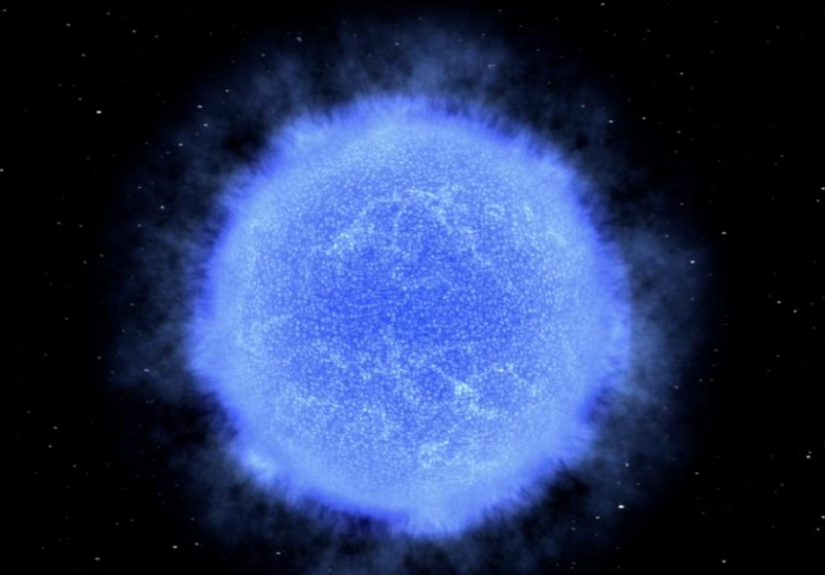
A quark star is a hypothetical compact star made largely of deconfined quark matter. In plain English, the matter inside it is so compressed that the neutrons have effectively melted into a sea of quarks. That does not mean the star turns into a sci-fi smoothie. The matter would still be under enormous pressure and remain an ultra-dense quantum state. It is just no longer ordinary neutron matter.
The most commonly discussed version is the strange quark star. That idea comes from the possibility that matter made of up, down, and strange quarks could be unusually stable at extremely high densities. A regular neutron is built from up and down quarks. But under crushing pressure, some quarks might convert into strange quarks, lowering the total energy of the system. If that happens on a large scale, the star could develop a core of strange quark matter, or in more radical scenarios, the entire object could become a strange star.
That is why quark stars are often discussed in two flavors. One is the hybrid star, which is mostly a neutron star with a quark-matter core. The other is a more complete quark star, possibly made almost entirely of strange quark matter with only a thin outer crust, if any. Think of hybrid stars as neutron stars with an exotic center and pure quark stars as the full commitment version.
How the Transition Might Happen
The basic idea is simple even if the math is not: gravity keeps compressing the core until neutron matter undergoes a phase transition. That phrase, phase transition, sounds polite, but it is doing a lot of work here. Water freezing into ice is a phase transition. Carbon turning into diamond under extreme pressure is another. In compact stars, the proposed transition is far more dramatic: hadronic matter, where quarks are confined inside particles, may transform into quark matter, where they move in a collective dense state.
There are several pathways theorists consider.
1. Birth as a quark-containing remnant
Right after a core-collapse supernova, temperatures and densities in the newborn compact remnant are extraordinarily high. Some models suggest quark matter could appear almost immediately in the center if conditions cross the required threshold. In that case, the star may be born as a hybrid object and then settle as it cools.
2. Delayed conversion inside an aging neutron star
A neutron star may begin as ordinary neutron-rich matter and only later form quark matter in its core as spin-down, cooling, or accretion gradually increases central density. This is the slow-burn version of the story. The star looks like a neutron star for a while, then nature quietly upgrades the interior to something far stranger.
3. Compression during a merger
When two neutron stars spiral together and collide, the densities and temperatures can spike dramatically. That environment may be especially favorable for a hadron-to-quark transition. In other words, if quark matter is shy in isolated neutron stars, mergers may force it onto the stage. This is one reason gravitational-wave astronomy is such a big deal for the field.
Why Quark Matter Is So Hard to Predict
If this all sounds tantalizingly plausible but frustratingly unsettled, welcome to modern compact-object astrophysics. The main difficulty is the equation of state, which is the relationship between pressure, density, and temperature inside ultra-dense matter. Different equations of state predict different star sizes, maximum masses, and responses to tidal forces during mergers.
And here is the catch: we do not yet know the correct equation of state for matter at the densities reached in neutron-star cores. Laboratory experiments can create quark-gluon plasma, but that is hot, short-lived matter produced in particle collisions. The matter inside a neutron star is different. It is colder by particle-physics standards, much denser, and stable on astronomical timescales. So the universe is running an experiment we cannot reproduce exactly on Earth.
That is why quark stars live at the intersection of astrophysics and particle physics. Heavy-ion colliders teach us how quarks behave when they are freed from hadrons. X-ray telescopes tell us how compact stars bend light and pulse. Gravitational-wave detectors tell us how squishy or stiff these stars are when they collide. Piece by piece, researchers are building a profile of matter under conditions so extreme that atoms do not just break; they become irrelevant.
What Would Make a Quark Star Look Different?
If astronomers cannot cut one open, they have to infer its interior from measurable properties. That means looking for signatures quark matter might leave behind.
Mass and radius
A quark-containing star may have a different mass-radius relationship than an ordinary neutron star. In some models, quark matter makes the star more compact for the same mass. That means a smaller radius can become a clue, although not a clean smoking gun. Multiple equations of state can produce overlapping predictions, which is astrophysics’ favorite way to stay annoying.
Cooling behavior
Quark matter may affect how efficiently the star loses energy, especially through neutrino emission. A star with an exotic core might cool differently from a conventional neutron star. Again, this is useful, but not uniquely decisive. Nature rarely labels her leftovers.
Rotation and glitches
The star’s internal structure affects how it spins, wobbles, and occasionally changes rotation rate. Some models suggest quark matter could influence starquakes or glitch behavior, though interpreting these signals is challenging.
Merger signals
When neutron stars merge, the gravitational-wave signal depends on how deformable the stars are before impact and what kind of remnant forms afterward. A strong phase transition to quark matter could alter the waveform or the post-merger oscillation pattern. This is one of the most promising routes to evidence.
Why Modern Observations Matter So Much
This is where the subject stops being purely theoretical and starts feeling deliciously empirical. NASA’s NICER mission has been measuring neutron-star masses and radii with improving precision. LIGO and Virgo have already shown that neutron-star mergers can reveal information about dense matter through gravitational waves. Those observations do not yet prove quark stars exist, but they are narrowing the range of what is physically allowed.
Meanwhile, recent theoretical work that combines astrophysical observations with quantum chromodynamics has started placing limits on how quark matter could behave in compact stars, including the possibility of color-superconducting phases. If that sounds like something invented by a physicist after too much coffee, I regret to inform you that it is real. In some conditions, quarks may pair up in ways loosely analogous to electrons in a superconductor, changing the properties of the matter inside the star.
Researchers are also exploring the possibility of “twin stars,” where two compact stars of nearly the same mass could have noticeably different radii because one contains quark matter and the other does not. If astronomers can firmly identify that kind of pairing, it would be a major clue that a phase transition really happens inside compact stars.
Are Quark Stars Real?
Maybe. That is the honest answer, and cosmologists have learned to say “maybe” with great passion.
At the moment, quark stars remain hypothetical. There are intriguing candidates, and there are models that fit some observations very well. But no object has been universally accepted as a confirmed quark star. What we do have is a growing body of evidence that the innermost regions of some neutron stars may contain matter far more exotic than a simple neutron soup.
That matters because quark stars are not just another strange object to add to the cosmic zoo. They would tell us something profound about the strong force, about the phases of matter allowed by quantum chromodynamics, and about how nature behaves when density climbs past anything we can engineer in a laboratory. A confirmed quark star would be a physics result disguised as an astronomy result, which is arguably the best kind.
Why This Topic Is Such a Big Deal in Cosmology
Quark stars connect the death of stars with the birth of the universe. The early cosmos briefly contained deconfined quark-gluon plasma before cooling into ordinary matter. Deep inside compact stars, nature may be recreating a related state under a very different set of conditions. That means quark stars, if they exist, are not just odd stellar remnants. They are laboratories for the behavior of matter at the edge of known physics.
That is what makes them so irresistible. Black holes tell us what gravity does when it wins completely. Neutron stars tell us what happens when matter barely resists. Quark stars may reveal what happens in the tense middle ground, where gravity wins enough to break hadrons but not enough to form an event horizon. It is like watching the universe negotiate with itself.
Conclusion
So, how do quark stars form? The leading idea is that they begin as the remnants of massive stars that already collapsed into neutron stars, or nearly did. If pressure and density in the core rise high enough, neutrons may dissolve into their constituent quarks, producing a core of deconfined quark matter. In some models that core stays surrounded by neutron matter, creating a hybrid star. In others, the conversion spreads farther, potentially creating a strange quark star.
The concept is bold, but it is grounded in real physics: core-collapse supernovae, quantum chromodynamics, dense matter equations of state, X-ray timing, and gravitational-wave data. We are not guessing wildly here. We are testing a serious idea at the edge of observability.
And that is what makes quark stars such a wonderful cosmology topic. They remind us that the universe is under no obligation to stop at neutron stars just because humans already find them ridiculous. There may always be one more layer of strange waiting underneath.
A Researcher’s Experience of Thinking About Quark Stars
There is a particular kind of intellectual thrill that comes with studying quark stars, and it is not the tidy thrill of solving a problem where all the data are lined up in obedient rows. It is the thrill of standing in front of a cosmic crime scene with partial fingerprints, one blurry security camera image, and a witness who only speaks in gravitational waves.
That experience is part of why the subject captures so many cosmologists and astrophysicists. You are dealing with an object that may exist in the universe right now, possibly in our own galaxy, and yet you cannot touch it, sample it, or reproduce it under the exact same conditions in a laboratory. Instead, you assemble a case from clues scattered across multiple fields. A pulse profile from an X-ray telescope. A radius estimate from timing data. A tidal deformability constraint from a merger. A theoretical calculation in quantum chromodynamics. None of these clues solves the mystery alone. Together, they start to feel like a conversation with nature.
There is also a strange emotional rhythm to the work. One week, a new model suggests quark matter could explain an unusually compact star. The next week, another paper shows that a more conventional neutron-star equation of state can fit the same observation. Progress in this field is rarely a straight line. It feels more like inching through a dark room with an excellent flashlight and a deep suspicion that the furniture is rearranging itself.
But that uncertainty is not a bug. It is the point. Quark stars force researchers to think across scales that normally do not share a table. You have to move from the death of massive stars to the behavior of quarks, from supernova dynamics to the strong force, from the early universe to the interiors of compact remnants. It is difficult, yes, but it is also deeply satisfying because the universe is revealing how connected its rules really are.
There is a teaching pleasure in it, too. When you explain quark stars to students or general readers, you can see the moment the idea lands. First comes the ordinary picture of a star. Then the dramatic collapse into a neutron star. Then the next question arrives almost automatically: wait, are you saying even neutrons might not survive the pressure? Exactly. That moment of surprise is the subject’s secret engine. It reminds people that science is not just a catalog of known things. It is a disciplined way of chasing realities that are almost, but not quite, visible.
And perhaps that is the best experience quark stars offer. They keep cosmology honest. They prevent us from pretending that the universe has already been neatly explained. Every time a new observation sharpens a mass measurement or a merger analysis trims the allowed equations of state, the possible existence of quark stars becomes a little less like speculation and a little more like a test. That is a beautiful place for a scientific idea to be: uncertain, consequential, and close enough to reality that better data could change everything.