Table of Contents >> Show >> Hide
- What Is Hand Expression, Exactly?
- Why Learn How To Hand-Express Breast Milk?
- Before You Start: Set Yourself Up for Success
- How To Hand-Express Breast Milk: Step-by-Step
- What Should Happen When You Are Doing It Right?
- Common Mistakes That Make Hand Expression Harder
- When Hand Expression Is Especially Helpful
- How Often Should You Hand-Express?
- How To Store Hand-Expressed Breast Milk Safely
- When To Ask for Help
- Practical Tips To Make Hand Expression Easier
- Real-World Experiences With Hand Expression
- Conclusion
There are a few parenting skills that look suspiciously simple until you actually try them. Swaddling is one. Folding a stroller is another. And learning how to hand-express breast milk? Oh yes. At first, it can feel like your body forgot to send the instruction manual. But once you know the technique, hand expression can become one of the most useful tools in your feeding toolkit.
Hand expression means using your hands to remove milk from your breast without a pump. It is practical, free, quiet, portable, and blessedly immune to dead batteries. It can help you collect colostrum in the early days, soften a very full breast so your baby can latch better, relieve pressure when you are engorged, and get milk out when a pump is nowhere to be found. In other words, it is a low-tech skill with high-value payoff.
This guide walks you through exactly how to hand-express breast milk, when to use it, what it should feel like, how to avoid common mistakes, and how to store the milk safely after you collect it. We will also cover real-world experiences at the end, because sometimes the most comforting thing to hear is: “No, it is not just you. Yes, the first few tries can feel weird.”
What Is Hand Expression, Exactly?
Hand expression is the process of removing milk by using your fingers and thumb to gently compress the milk-making tissue behind the nipple and areola. It is not about pinching the nipple like a ketchup packet. That approach mostly leads to frustration and a face that says, “Really?”
The goal is to place your fingers far enough back from the nipple so you are pressing on the milk ducts behind the areola. Then you use a gentle rhythm: press back, compress, release, repeat. Once you find the right spot and rhythm, milk may appear as drops, a drip, or a small spray. In the early days, especially with colostrum, a few golden drops are not a failure. They are the plan.
Why Learn How To Hand-Express Breast Milk?
You may not use hand expression every day, but it is one of those skills that can save the day when breastfeeding does not go according to schedule. And let’s be honest, newborn life is not exactly famous for following a schedule.
Hand expression can help when:
- Your breasts feel very full, tight, or uncomfortable.
- Your baby is having trouble latching because the areola is too firm.
- You want to collect colostrum after birth.
- You are away from your baby and need to remove milk.
- You do not have a pump with you.
- You want to encourage let-down before a feeding.
- You need a little milk for spoon, cup, or syringe feeding.
Many parents also find that hand expression works especially well for thick, sticky colostrum, which sometimes does not collect easily in a pump during the first days after delivery.
Before You Start: Set Yourself Up for Success
Hand expression is easier when your body gets the message that it is time to let the milk flow. That message is easier to receive when you are warm, reasonably comfortable, and not trying to multitask while balancing a burp cloth, a water bottle, and your phone at a dramatic angle.
Do this first:
- Wash your hands thoroughly.
- Use a clean spoon, cup, jar, or milk storage container.
- Sit somewhere comfortable and support your back.
- Lean slightly forward so gravity can help.
- Take a few slow breaths.
- Look at your baby, think about your baby, or smell a baby blanket if you are apart.
- Use warmth for a few minutes if that feels good, such as a warm shower or warm compress.
- Gently massage your breast before you begin.
Some parents like to roll the breast gently between their hands or stroke from the chest wall toward the nipple to encourage let-down. You are not trying to tenderize anything. Think “wake up the milk,” not “prepare for battle.”
How To Hand-Express Breast Milk: Step-by-Step
Step 1: Find the right hand position
Make a “C” shape with your hand. Place your thumb above the areola and your first finger or first two fingers below it. Your fingers should usually sit about 1 to 1.5 inches behind the nipple, not right on top of it. This matters. The action happens behind the areola, not at the tip of the nipple.
Step 2: Press back toward your chest
Gently press your thumb and fingers straight back toward your chest wall. Do not spread your fingers wide and do not yank the skin forward. The motion is subtle, not dramatic. If it looks like your hand is acting in a soap opera, you are probably overdoing it.
Step 3: Compress your fingers together
After pressing back, gently compress your thumb and fingers toward each other. This helps move milk from the ducts toward the nipple. Then release.
Step 4: Repeat in a rhythm
Keep going with a steady pattern: press back, compress, release. Press back, compress, release. Try to avoid sliding your fingers over the skin. The movement should be rhythmic and controlled, not a rubbing motion.
Step 5: Rotate around the breast
When the flow slows, move your fingers to a different position around the areola. Imagine a clock face and change from 12 and 6 o’clock to 2 and 8, then 4 and 10. Different ducts may respond better from different angles.
Step 6: Switch breasts and repeat
Move from one breast to the other, then back again if needed. Many people find they get a bit more each time they return to the first side.
Step 7: Stop when the milk flow slows and you feel comfortable
If you are expressing to relieve fullness, you may not need to fully empty the breast. If you are collecting milk for a feeding, keep going until the flow slows and you feel you have removed what you need.
What Should Happen When You Are Doing It Right?
At first, maybe not much. That is normal.
You may see:
- A few drops at the start
- A slow drip after a minute or two
- A light spray once let-down happens
- More milk after massage and repositioning your fingers
If you are expressing colostrum in the first days after birth, the amount may be tiny but still completely valuable. Colostrum is concentrated, rich, and made in small amounts on purpose. This is not a gallon challenge. It is a teaspoon mission.
Hand expression should not feel sharply painful. It may feel unusual, especially at first, but pain is a sign to stop and adjust your hand position, your pressure, or your expectations. Gentle is the winning strategy here.
Common Mistakes That Make Hand Expression Harder
1. Squeezing the nipple
This is the most common mistake. Milk is not stored in the nipple. Focus on the tissue behind the areola instead.
2. Sliding fingers over the skin
Rubbing can irritate the skin and does not do much for milk flow. Use a press-and-compress motion rather than a drag.
3. Pressing too hard
More force does not equal more milk. In fact, too much pressure can make you sore and tense, which is not exactly helpful for let-down.
4. Giving up after 20 seconds
It may take a minute or two for let-down to happen, especially if you are tired, stressed, or learning. Your body is not being difficult. It is being hormonal.
5. Staying in one spot
Rotate your fingers around the areola to reach different milk ducts. One angle may give you “nothing to see here,” while another suddenly works beautifully.
When Hand Expression Is Especially Helpful
During engorgement
When your breasts feel very full and firm, your baby may struggle to latch because the areola is too tight. Hand expression can soften the area around the nipple so your baby can latch more deeply and comfortably.
In the early postpartum days
Many parents find hand expression especially useful in the first couple of days after birth, when they are making colostrum and not a large milk volume yet.
If your baby is sleepy or not feeding well
Hand expression can help you collect small amounts of milk to offer by spoon, cup, or syringe if your baby is not transferring milk effectively at the breast.
When you are away from your baby
No pump? No problem. Hand expression can remove enough milk to ease discomfort, protect supply, and collect milk until you can feed or pump again.
To stimulate let-down
If your milk takes a little time to let down, hand expression before nursing may help get things moving and make the feed less frustrating for a hungry baby who would prefer service to be immediate.
How Often Should You Hand-Express?
That depends on your goal.
- To soften the breast before a latch: express just enough to make the areola softer.
- To relieve fullness: express until you feel more comfortable, but avoid overdoing it if you are trying to reduce engorgement.
- To maintain supply when your baby is not nursing: remove milk frequently across the day, roughly in line with normal feeding patterns.
- To collect milk for feeding: express as long as the milk is flowing and you are comfortable.
If your baby is not feeding well, or if you are needing to express often because of pain, poor latch, or low milk transfer, check in with a lactation consultant or your baby’s pediatrician. A technique problem is fixable. Suffering in silence is not a feeding plan.
How To Store Hand-Expressed Breast Milk Safely
Once you collect breast milk, store it correctly so all that effort does not go to waste.
Basic storage tips
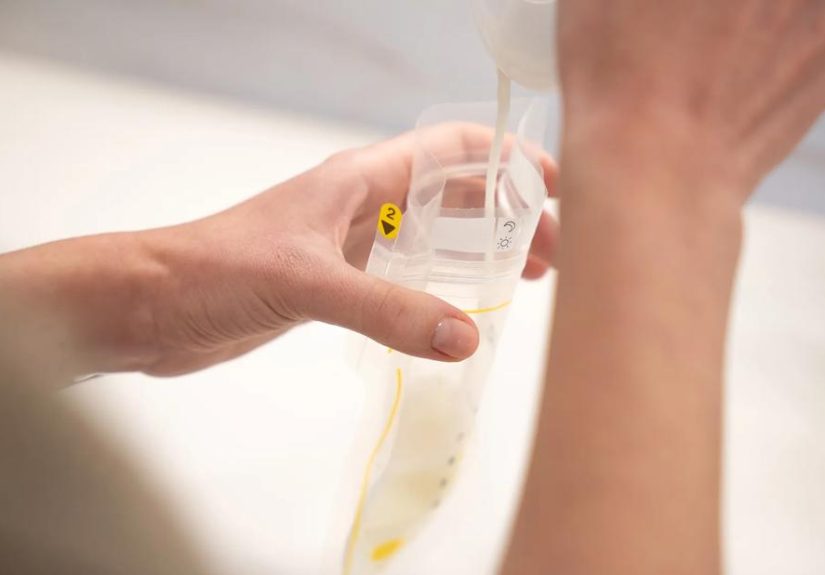
- Use breast milk storage bags or clean, food-grade containers with tight-fitting lids.
- Label the milk with the date it was expressed.
- Store small amounts to reduce waste.
- Do not store breast milk in thin plastic bags not meant for milk storage.
General storage guidelines
- At room temperature: up to 4 hours
- In the refrigerator: up to 4 days
- In the freezer: about 6 months is best, up to 12 months is acceptable
Thawing and warming tips
- Thaw the oldest milk first.
- Thaw in the refrigerator overnight or under lukewarm water.
- Do not microwave breast milk.
- Use thawed milk within 24 hours if thawed in the refrigerator.
- Use warmed or room-temperature milk within 2 hours.
- Do not refreeze thawed milk.
When To Ask for Help
Hand expression is a useful skill, but it is not a substitute for medical care or lactation support when something bigger is going on.
Contact a healthcare professional if:
- You have fever, chills, or flu-like symptoms.
- Your breast becomes red, hot, or increasingly painful.
- You have cracked nipples with severe pain or bleeding.
- Your baby is too sleepy to feed or is not having enough wet diapers.
- You think your baby is not getting enough milk.
- You keep having trouble with latch, engorgement, or blocked flow.
Sometimes the answer is a small technique tweak. Sometimes it is a bigger feeding issue. Either way, you do not need to guess your way through it while exhausted and holding a cold cup of coffee you forgot to drink three hours ago.
Practical Tips To Make Hand Expression Easier
- Practice when you are not in a panic.
- Try after a warm shower or while feeding on the other side.
- Massage first, then express.
- Use a wide spoon or small cup for early colostrum collection.
- Lean forward a little so the milk drips into the container more easily.
- Switch finger positions when the flow slows.
- Be patient with yourself. Skill beats force.
Real-World Experiences With Hand Expression
Hand expression sounds wonderfully simple on paper. In real life, many parents describe the first attempt as somewhere between “awkward science project” and “why is nothing happening?” That reaction is incredibly common.
One of the most common experiences is surprise at how little milk appears at first. A new parent may expect a dramatic flow and instead get three shiny drops of colostrum and a deep existential sigh. But that tiny amount can still be meaningful. Early milk is concentrated, and the process often improves quickly with practice. What feels impossible on day one can feel routine by day three or four.
Another common experience is that the technique suddenly clicks after a few tries. At first, many people squeeze too close to the nipple, use too much pressure, or forget to rotate their fingers around the breast. Then one small adjustment changes everything. The milk starts to drip, the breast softens, and confidence goes up by about a thousand percent. It is less “natural instinct” and more “learned body skill,” which can be reassuring if it does not come easily at first.
Parents also often say hand expression feels most useful in very specific moments rather than all day long. For example, it can be a lifesaver when the breast is so full that the baby cannot latch. Expressing a little first can soften the areola and turn a tear-filled feeding attempt into a much calmer one. Others say it helps when they need just a small amount of milk for a spoon or syringe feed, especially in the first days postpartum when using a full pump setup feels excessive, noisy, and frankly a bit rude at 2 a.m.
Some describe hand expression as strangely empowering. There is something reassuring about knowing that even without a pump, a wall outlet, or perfect conditions, you can still remove milk and care for your baby. It can make parents feel less dependent on gear and more confident in their own ability to respond when plans change.
Of course, not every experience is magical. Some parents find hand expression tiring on the hands. Some feel awkward collecting milk without spilling it. Some never love it and prefer a pump for larger volumes. That is fine. Hand expression does not have to become your favorite hobby. It just needs to become a skill you can use when it helps.
The biggest theme across real-world experiences is this: hand expression tends to get easier, faster, and less weird with practice. What feels clumsy in the beginning often becomes one more practical newborn skill tucked into your back pocket. And in early parenthood, having even one more thing that works can feel like a minor miracle.
Conclusion
Learning how to hand-express breast milk is one of those small skills that can make a big difference. It can help with engorgement, collect precious early milk, support latch, protect supply, and give you a reliable backup when a pump is not available. Best of all, it is free, portable, and always within arm’s reach. Literally.
If it feels clumsy at first, that is normal. If you only get drops in the beginning, that is normal too. Start gently, use the press-back-compress rhythm, rotate your fingers around the areola, and give yourself a little grace. Breastfeeding is not a talent show. It is a skill-building phase, and hand expression is one more tool that can make it easier.