Table of Contents >> Show >> Hide
- What Is Sorensen's Phosphate Buffer?
- Before You Begin: Choose the Buffer You Need
- Materials and Equipment
- Quick Ratio Table for Sorensen's Phosphate Buffer
- How to Prepare a Sorensen's Phosphate Buffer: 13 Steps
- Step 1: Read Your Protocol First
- Step 2: Select the Correct Hydrate Forms
- Step 3: Prepare 0.2 M Sodium Phosphate Monobasic Stock A
- Step 4: Prepare 0.2 M Sodium Phosphate Dibasic Stock B
- Step 5: Mix the Stocks According to Your Target pH
- Step 6: Stir Gently but Thoroughly
- Step 7: Check the Temperature
- Step 8: Calibrate the pH Meter
- Step 9: Measure the Buffer pH
- Step 10: Adjust pH Only If Necessary
- Step 11: Bring to Final Volume
- Step 12: Filter or Sterilize When Needed
- Step 13: Label and Store the Buffer
- Example Recipe: 100 mL of 0.1 M Sorensen's Phosphate Buffer, pH 7.4
- Common Mistakes to Avoid
- When Should You Use Sorensen's Phosphate Buffer?
- How to Scale the Recipe
- Practical Experience: What Really Happens at the Bench
- Conclusion
Preparing a Sorensen’s phosphate buffer sounds like the kind of task that should come with a lab coat, a serious face, and maybe a dramatic thunderclap. In reality, it is a straightforward laboratory skill built on one elegant idea: mix the acidic and basic forms of phosphate in the right ratio, confirm the pH, and bring the solution to the correct final volume. Simple? Yes. Worth doing carefully? Absolutely.
Sorensen’s phosphate buffer is widely used in biology, histology, microscopy, protein work, staining protocols, and sample preparation because it holds pH steady in the useful range of about 5.8 to 8.0. Its classic pair is sodium phosphate monobasic, NaH2PO4, and sodium phosphate dibasic, Na2HPO4. One behaves as the acid partner, the other as the base partner. Together, they are the lab equivalent of a calm friend who says, “Let’s not overreact,” whenever acid or base tries to crash the party.
This guide explains how to prepare a Sorensen’s phosphate buffer in 13 practical steps, with a common example for 0.1 M buffer at pH 7.4. You will also learn how to scale volumes, avoid common mistakes, choose the correct hydrate form of each salt, and store the finished buffer properly.
What Is Sorensen’s Phosphate Buffer?
Sorensen’s phosphate buffer is a mixture of monobasic and dibasic phosphate salts. The buffer system is based on the phosphate equilibrium between H2PO4– and HPO42-. Because the second pKa of phosphoric acid is close to neutral pH, phosphate buffer works especially well around pH 7.2, which makes it valuable for biological applications.
The standard laboratory approach is to prepare two stock solutions, usually 0.2 M NaH2PO4 and 0.2 M Na2HPO4, then mix them in a defined ratio. The more monobasic phosphate you use, the lower the pH. The more dibasic phosphate you use, the higher the pH. That is the heart of the method.
Before You Begin: Choose the Buffer You Need
Before weighing anything, decide three things: target pH, final concentration, and final volume. A common working choice is 0.1 M Sorensen’s phosphate buffer at pH 7.4. For microscopy and many biological protocols, pH 7.2 or 7.4 is often used. If your protocol specifies pH 6.8, 7.0, 7.2, or 8.0, follow that exact requirement rather than guessing. Buffers are friendly, but they are not psychic.
Materials and Equipment
- Sodium phosphate monobasic, NaH2PO4, anhydrous or hydrated form
- Sodium phosphate dibasic, Na2HPO4, anhydrous or hydrated form
- Deionized or distilled water
- Analytical balance
- Weigh boats or weighing paper
- Beakers, graduated cylinders, and volumetric flasks
- Magnetic stir plate and stir bar
- Calibrated pH meter
- 1 M HCl and/or 1 M NaOH for small pH corrections
- 0.22 micron filter, if sterile or particle-free buffer is needed
- Clean storage bottle with label
- Gloves, goggles, and lab coat
Quick Ratio Table for Sorensen’s Phosphate Buffer
The table below uses two 0.2 M stock solutions: Stock A is NaH2PO4, and Stock B is Na2HPO4. The listed volumes make a 0.2 M phosphate mixture before dilution. To prepare 100 mL of 0.1 M working buffer, use half of the listed A and B volumes, then add water to 100 mL.
| Target pH | Stock A: 0.2 M NaH2PO4 | Stock B: 0.2 M Na2HPO4 | For 100 mL of 0.1 M Buffer |
|---|---|---|---|
| 6.8 | 51.0 mL | 49.0 mL | 25.5 mL A + 24.5 mL B + water to 100 mL |
| 7.0 | 39.0 mL | 61.0 mL | 19.5 mL A + 30.5 mL B + water to 100 mL |
| 7.2 | 28.0 mL | 72.0 mL | 14.0 mL A + 36.0 mL B + water to 100 mL |
| 7.4 | 19.0 mL | 81.0 mL | 9.5 mL A + 40.5 mL B + water to 100 mL |
| 7.8 | 8.5 mL | 91.5 mL | 4.25 mL A + 45.75 mL B + water to 100 mL |
| 8.0 | 5.3 mL | 94.7 mL | 2.65 mL A + 47.35 mL B + water to 100 mL |
How to Prepare a Sorensen’s Phosphate Buffer: 13 Steps
Step 1: Read Your Protocol First
Start by checking the required pH, molarity, volume, and sterility level. A staining protocol may ask for 0.1 M phosphate buffer at pH 7.2, while a protein assay may need pH 7.4. Do not assume one phosphate buffer can replace another. In buffer preparation, “close enough” is sometimes the beginning of a troubleshooting saga nobody wants.
Step 2: Select the Correct Hydrate Forms
Phosphate salts often come in different hydrate forms. Sodium phosphate monobasic may be anhydrous, monohydrate, or dihydrate. Sodium phosphate dibasic may be anhydrous, dihydrate, heptahydrate, or dodecahydrate. The formula weight changes with hydration, so the mass you weigh must match the chemical bottle. This is one of the most common sources of buffer errors.
Step 3: Prepare 0.2 M Sodium Phosphate Monobasic Stock A
To make 100 mL of 0.2 M Stock A, weigh the appropriate amount of NaH2PO4. Use about 2.40 g if using anhydrous NaH2PO4, 2.76 g if using monohydrate, or 3.12 g if using dihydrate. Add the salt to about 80 mL of deionized water, stir until dissolved, then bring the final volume to 100 mL in a volumetric flask.
Step 4: Prepare 0.2 M Sodium Phosphate Dibasic Stock B
To make 100 mL of 0.2 M Stock B, weigh the correct mass of Na2HPO4. Use about 2.84 g for anhydrous Na2HPO4, 3.56 g for dihydrate, 5.36 g for heptahydrate, or 7.16 g for dodecahydrate. Dissolve it in about 80 mL of deionized water and bring the final volume to 100 mL.
Step 5: Mix the Stocks According to Your Target pH
For a common 100 mL batch of 0.1 M Sorensen’s phosphate buffer at pH 7.4, combine 9.5 mL of Stock A with 40.5 mL of Stock B. Then add deionized water to a final volume of 100 mL. For pH 7.2, use 14.0 mL of Stock A and 36.0 mL of Stock B, then dilute to 100 mL.
Step 6: Stir Gently but Thoroughly
Place the solution on a magnetic stir plate and mix until it looks completely uniform. You do not need aggressive stirring. A gentle vortex is enough. The goal is a consistent buffer, not a tiny phosphate tornado.
Step 7: Check the Temperature
Measure pH at room temperature, ideally around 25°C, unless your protocol requires another temperature. pH changes with temperature, and phosphate buffers are not immune to this effect. If your experiment runs cold, warm, or in a temperature-controlled chamber, document the temperature used for pH measurement.
Step 8: Calibrate the pH Meter
Calibrate the pH meter with fresh standards that bracket your target pH, such as pH 7.00 and pH 10.00 for pH 7.4 work, or pH 4.00 and pH 7.00 for lower-pH work. Rinse the electrode with deionized water and blot gently. Do not wipe aggressively, because that can create static and unstable readings.
Step 9: Measure the Buffer pH
Place the electrode in the mixed buffer and wait for the reading to stabilize. If the pH is within your acceptable range, move on. If your lab protocol allows a tolerance of ±0.05 or ±0.1 pH units, record the actual reading. Good documentation saves future you from asking, “What mysterious liquid did past me make?”
Step 10: Adjust pH Only If Necessary
If the pH is too low, add very small amounts of NaOH. If the pH is too high, add very small amounts of HCl. Add dropwise, stir, and recheck. Avoid large corrections because excessive acid or base can alter ionic strength and change how the buffer behaves. If you overshoot badly, it is often better to remake the buffer than to play chemical ping-pong.
Step 11: Bring to Final Volume
Once the pH is correct, transfer the solution to a volumetric flask and bring it exactly to the final volume with deionized water. Always adjust pH before final volume correction. If you fill to the mark first and then add acid or base later, your concentration will no longer be exact.
Step 12: Filter or Sterilize When Needed
If the buffer will be used for cell-related work, microscopy, immunostaining, or sensitive assays, filter it through a 0.22 micron membrane. Some labs autoclave phosphate buffers, but filtration is often preferred when you want to avoid precipitation, concentration changes, or compatibility issues with added components. Follow your institutional protocol.
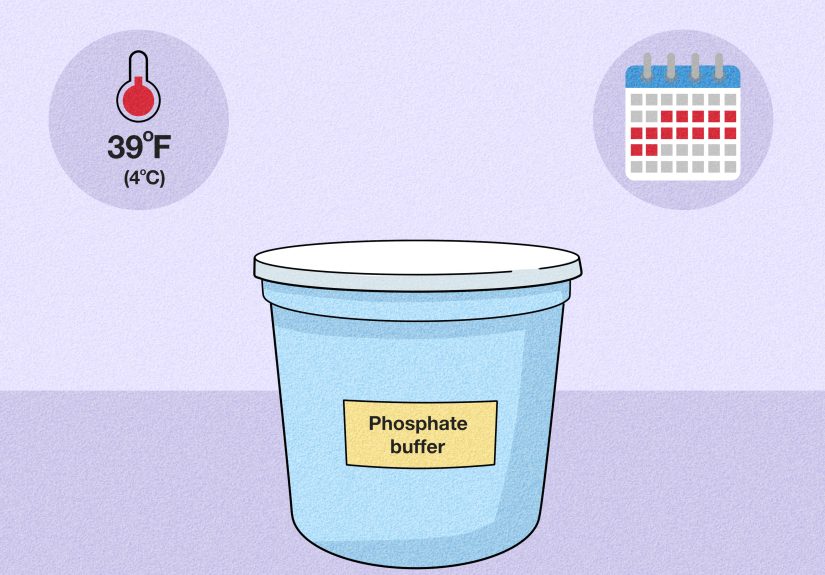
Step 13: Label and Store the Buffer
Label the bottle with the buffer name, concentration, pH, date, preparer’s initials, and storage conditions. A proper label might read: “Sorensen’s phosphate buffer, 0.1 M, pH 7.4, prepared May 12, filtered, store at room temperature.” Store according to your lab’s SOP. If contamination, cloudiness, crystals, or mystery floaters appear, discard it. Mystery floaters are not part of the recipe.
Example Recipe: 100 mL of 0.1 M Sorensen’s Phosphate Buffer, pH 7.4
- Prepare 0.2 M NaH2PO4 Stock A.
- Prepare 0.2 M Na2HPO4 Stock B.
- Add 9.5 mL of Stock A to a clean beaker.
- Add 40.5 mL of Stock B.
- Add about 40 mL of deionized water and mix.
- Measure pH with a calibrated pH meter.
- Adjust gently if needed.
- Bring the final volume to 100 mL with deionized water.
- Filter if required, then label and store.
Common Mistakes to Avoid
Using the Wrong Molecular Weight
The most common error is using the mass for anhydrous sodium phosphate while the bottle contains a hydrate. The solution will still look clear, which is rude, because it hides the mistake beautifully. Always check the formula on the label before calculating.
Adjusting pH Too Aggressively
Adding too much HCl or NaOH can change the buffer’s composition. Use small drops, stir well, and let the reading stabilize. Buffers reward patience.
Skipping Calibration
A pH meter that has not been calibrated is basically a very expensive guessing stick. Calibrate before measuring, especially when preparing buffer for published work or critical experiments.
Forgetting Final Volume
Do not simply add salts to 100 mL of water. Dissolving solids changes volume. Dissolve first in less than the final volume, then bring the solution to the mark.
When Should You Use Sorensen’s Phosphate Buffer?
Sorensen’s phosphate buffer is useful when you need a stable pH near neutral conditions. It is common in histology, enzyme studies, immunostaining, microscopy, fixation workflows, and general biological sample handling. It is especially convenient because the two-stock method makes pH adjustment predictable and scalable.
However, phosphate buffer is not perfect for every experiment. Phosphate can interact with some metal ions, may precipitate with calcium or magnesium under certain conditions, and may not be ideal for every cell type or biochemical system. If your protocol warns against phosphate, believe it. The protocol is not being dramatic; it has probably seen things.
How to Scale the Recipe
Scaling is simple if you keep the ratio constant. For pH 7.4 at 0.1 M, the ratio is 9.5 parts Stock A to 40.5 parts Stock B, then water to final volume. For 1 L, multiply by 10: use 95 mL Stock A and 405 mL Stock B, then add water to 1 L. For 500 mL, use 47.5 mL Stock A and 202.5 mL Stock B, then add water to 500 mL.
If you need 0.2 M final buffer instead of 0.1 M, do not dilute the combined 0.2 M stocks by half. For 100 mL of 0.2 M buffer at pH 7.4, mix 19 mL Stock A and 81 mL Stock B. Confirm pH and adjust only if necessary.
Practical Experience: What Really Happens at the Bench
In real laboratory settings, preparing Sorensen’s phosphate buffer is rarely difficult, but it does teach several bench habits that separate clean, repeatable work from “why is this experiment haunted?” work. The first experience many people have is discovering that sodium phosphate salts love hydration states. A recipe may say “sodium phosphate monobasic,” but the bottle might say anhydrous, monohydrate, or dihydrate. That one word changes the mass. This is why experienced lab workers pause before weighing and read the label twice. It is not paranoia; it is survival.
Another practical lesson is that pH meters need time. Beginners often dip the probe, see a number, and immediately start adding acid or base. Then the reading drifts, panic begins, and suddenly the buffer has been adjusted three times before breakfast. A better habit is to stir gently, wait for stabilization, and make tiny corrections. Phosphate buffer usually lands close to the target if the stock ratios are correct, so major pH surgery is a warning sign that something upstream may be wrong.
Clean glassware matters too. A beaker with detergent residue, leftover salts, or a mystery film can shift results, contaminate samples, or create particles. For routine teaching labs, this may only cause mild annoyance. For immunostaining, microscopy, or protein work, it can become a real problem. The best practice is boring but powerful: rinse well, use clean vessels, and store the finished buffer in a properly labeled bottle.
Filtration is another experience-based decision. If the buffer will touch cells, tissue sections, antibodies, or fine microscopy samples, filtering through a 0.22 micron membrane is a smart move. It removes particles and lowers the chance of contamination. If the buffer is only for a quick chemistry demonstration, filtration may not be necessary. The key is matching preparation quality to the purpose.
Finally, documentation is underrated. A label with “PB” is not enough. Which PB? What pH? What molarity? Who made it? When? Was it filtered? Future users should not need detective skills to identify a bottle. A complete label prevents mistakes, saves time, and makes your lab notebook look like it was written by a responsible scientist rather than a raccoon with a marker.
Conclusion
Learning how to prepare a Sorensen’s phosphate buffer is a small laboratory skill with big practical value. Once you understand the relationship between sodium phosphate monobasic and sodium phosphate dibasic, the method becomes logical: prepare accurate stocks, mix the correct ratio, check the pH, adjust gently if needed, bring to final volume, and label the finished solution clearly.
The main secret is not speed. It is accuracy. Choose the correct hydrate form, use clean equipment, calibrate the pH meter, and avoid dramatic pH corrections. Do those things, and your Sorensen’s phosphate buffer will behave exactly as a good buffer should: quietly, reliably, and without demanding applause.