Table of Contents >> Show >> Hide
- What a mouth swab drug test actually measures
- Common reasons you might be asked to take one
- Step-by-step: what happens during collection
- How the testing works: screening vs confirmation
- What drugs are commonly included in a mouth swab panel?
- How long do drugs stay detectable in saliva?
- What can affect your result (without getting weird about it)
- Accuracy, false positives, and why confirmation matters
- How long results take (and why it varies)
- What to bring, what to say, and what not to panic about
- Quick example scenarios (because real life is where confusion happens)
- Bottom line: what to expect (the calm, non-scary version)
- Experiences: what it feels like in the real world (the extra )
A mouth swab drug test (also called an oral fluid or saliva drug test) is exactly what it sounds like: someone collects a small sample from inside your mouth and tests it for certain drugs (and sometimes alcohol). It’s popular because it’s quick, observed, and doesn’t require a restroom or awkward waiting-room hydration Olympics. It’s also best at detecting recent usethink “hours to a couple of days,” not “a month ago at that one music festival you swear you don’t remember.”
In this guide, you’ll learn what happens during collection, what drugs are typically included, how results are produced, how long substances may show up, and what to do if you’re surprised by a result. Expect clear explanations, real-world examples, and only the good kind of science.
What a mouth swab drug test actually measures
Oral fluid testing looks at the liquid in your mouthmostly saliva, plus tiny amounts of other oral fluids and cells. Drugs and their metabolites can move from the bloodstream into oral fluid, which is one reason oral fluid testing tends to detect use sooner than urine in many casesand also why it usually has a shorter detection window overall.
Why “oral fluid” tests are often used for recent use
Because salivary glands are highly supplied with blood, drugs can appear in oral fluid relatively quickly after use and then drop off faster than urine testing for many substances. That makes mouth swabs a go-to option when the goal is to identify recent exposure or use (for example: post-accident testing, reasonable suspicion testing, or some random workplace testing programs).
Common reasons you might be asked to take one
- Pre-employment screening (especially when a fast, observed collection is preferred)
- Random workplace drug testing
- Post-accident or return-to-duty testing
- Reasonable suspicion testing (when an employer needs a timely sample)
- Some law-enforcement or roadside contexts (rules vary by jurisdiction and program)
Employers like oral fluid testing because collection can happen almost anywhere and is directly observed, which helps reduce tampering concerns. Federal workplace programs have also developed detailed collection and chain-of-custody requirements for oral fluid specimens in regulated settings.
Step-by-step: what happens during collection
The exact routine varies by program (workplace, healthcare, legal), but most mouth swab tests follow a predictable script. Here’s what you can typically expect:
1) Check-in and identity verification
You’ll usually be asked for a government ID and may be asked to confirm basic information. If the testing is regulated or has legal stakes, paperwork and chain-of-custody steps are taken seriously.
2) A quick “mouth check” (yes, really)
The collector may ask you to show that your mouth is clearno gum, candy, tobacco, or anything that could interfere with collection. If something is present, you may be asked to remove it. In some regulated procedures, if the collector notices anything that could interfere (including very unusually colored saliva) or you report dry mouth, the collector may provide water to rinse and then wait briefly before collecting.
3) The swab/device goes in your mouth
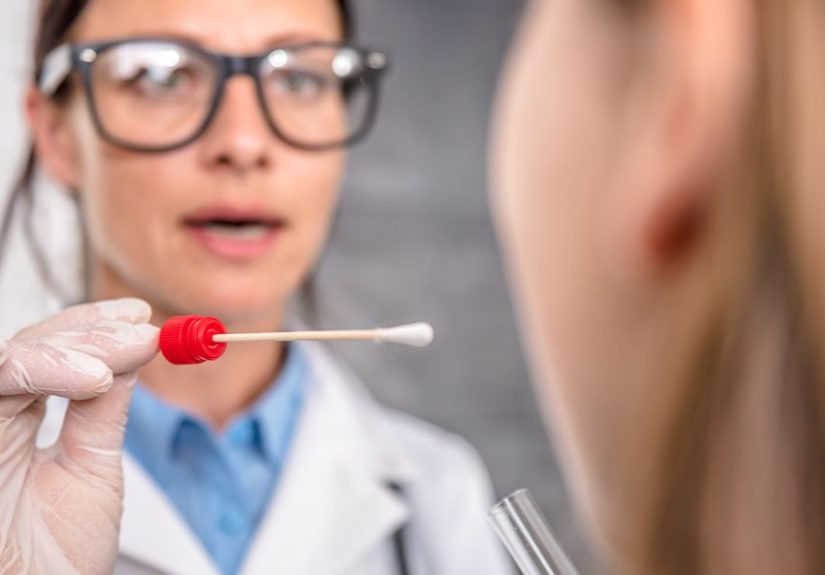
Many modern collection kits use a small absorbent pad or swab that you place under your tongue or between cheek and gum. You keep it there until the device indicates enough oral fluid has been collected. This can take a minute or two, sometimes longer if your mouth is dry (hello, anxiety).
4) Sealing, labeling, and chain of custody
The collector seals the specimen in its transport container, labels it, and completes documentation. In formal programs, you may initial seals or sign forms confirming the sample is yours and was handled properly. The sample is then shipped to a laboratory for testing (unless it’s a rapid point-of-collection screen).
5) How long you’ll be there
A smooth collection can take only a few minutes. If you have dry mouth or need to wait briefly after a rinse, it may take longerbut it’s still generally faster than urine testing logistics.
How the testing works: screening vs confirmation
Most lab-based drug testing follows a two-step logic: a fast initial screen, then a highly specific confirmation if needed.
Initial screening (the fast “first pass”)
Many labs use an immunoassay for the initial screen. Immunoassays use antibodies to detect whether a drug class (or a specific drug) is present above a cutoff. They’re efficient and cost-effective, but they can be less specific than confirmatory testing.
Confirmatory testing (the “proof” step)
If the screen is positive (often called “presumptive positive”), labs typically run a confirmation using mass spectrometry (commonly LC-MS/MS or sometimes GC-MS). This is considered the gold standard because it identifies specific compounds with high accuracy and reduces the chance that a look-alike substance triggered the result.
Medical Review Officer (MRO) review (common in workplace testing)
In many workplace programs, a licensed physician called a Medical Review Officer reviews certain non-negative results and contacts the donor to check for legitimate medical explanations (for example, a prescription medication). You may be asked to provide documentation such as prescription details or pharmacy records. Some programs also allow a split specimen to be tested at another certified lab within a set timeframe.
What drugs are commonly included in a mouth swab panel?
Panels vary by employer, testing program, and state requirements, but many oral fluid workplace tests cover the classic “workplace” categories:
- Cannabinoids (often targeting Δ9-THC)
- Cocaine (often via a metabolite)
- Amphetamines (may include methamphetamine and sometimes MDMA-related analytes, depending on the panel)
- Opiates/opioids (may include morphine/codeine and/or expanded opioids like hydrocodone, oxycodone, etc.)
- PCP (less common in everyday life, more common in test panels than in your neighborhood barbecue)
Some organizations use expanded panels to include additional prescription or synthetic opioids, depending on policy and risk profile.
How long do drugs stay detectable in saliva?
Here’s the headline: oral fluid testing is generally best at detecting recent use. Many sources describe a typical window from about 5 hours up to 48 hours after last use for many substances, with important exceptions depending on the drug, dose, and person. Some drugs may be detectable for only a few hours; others can persist longer in certain circumstances.
Typical detection windows (estimates, not promises)
Detection time depends on the substance, dose, route of use, frequency of use, metabolism, and even the amount of saliva available. The table below summarizes common estimates used in patient-facing guidance.
| Substance (examples) | Estimated time detectable in saliva | Notes |
|---|---|---|
| Alcohol | Up to ~24 hours | Short window; oral fluid reflects recent exposure. |
| Marijuana (cannabis / Δ9-THC) | Up to ~24 hours | Often shorter than urine testing; varies by use pattern. |
| Cocaine | Up to ~36 hours | Some guidance notes it can be only hours in oral fluid for certain drugs. |
| Amphetamines | Up to ~48 hours | May vary by formulation and route. |
| Methamphetamine | Up to ~48 hours | Recent use detection; confirmation clarifies specifics. |
| Opiates (morphine, heroin) | Up to ~36 hours | Panels may include heroin metabolite (6-AM) in some programs. |
| Opioids (oxycodone, fentanyl) | Up to ~48 hours | Fentanyl detection depends on panel design and cutoffs. |
| Benzodiazepines | Up to ~48 hours (often variable) | Some benzos can be harder to detect in oral fluid at low levels. |
Important reality check: detection is not the same as impairment. Oral fluid results are better described as evidence of exposure/ingestion within a recent windownot a simple “you are impaired right now” meter.
What can affect your result (without getting weird about it)
Oral fluid testing is sensitive to real-world variablesbecause humans are not standardized laboratory robots (yet). Factors that can influence detection include:
- Time since last use (oral fluid is a short-window test for many drugs)
- Dose and frequency (higher or repeated exposure can extend detectability)
- Route of administration (smoked, oral, nasal, etc.)
- Individual metabolism and body chemistry
- Saliva production and hydration (dry mouth can make collection take longer)
- Oral conditions and the pH of oral fluid
- Collection and handling quality (proper sealing and documented custody matter)
Practical tip for a smooth experience: follow collector instructions. If they ask you not to eat, drink, or chew gum right before collection, it’s generally to avoid interference and keep the sample validnot because they enjoy rules.
Accuracy, false positives, and why confirmation matters
Mouth swab testing can be highly useful, but no drug test is perfectespecially at the screening step. Here’s the safest way to understand results:
A negative result usually means “no detection above cutoff”
That’s not the same as “no exposure ever,” and it’s not a time machine. It means the test didn’t detect the targeted drug/analyte above the cutoff at the time of collection.
A positive screen is often “presumptive” until confirmed
Immunoassay screens are designed to be fast and sensitive. They can occasionally react to compounds that resemble the target (cross-reactivity). That’s why confirmatory testing using mass spectrometry is so important when decisions are on the line.
If an MRO calls, it’s not automatically “game over”
In workplace programs with MRO review, the MRO may contact you to discuss the result and ask whether there’s a legitimate medical explanation. You may be asked to provide documentation (for example, prescription details, pharmacy records, or verification from a prescribing clinician). In certain regulated processes, donors may also be informed of split specimen testing options within a defined timeframe.
How long results take (and why it varies)
Timing depends on whether it’s a rapid on-site screen or lab testing:
- Point-of-collection (rapid) screening: sometimes available in minutes.
- Laboratory testing: often reported within about 24–48 hours, though confirmation and MRO review can add time.
If a confirmatory test is needed, that extra step can extend turnaroundbecause the lab is doing the more detailed, more definitive work.
What to bring, what to say, and what not to panic about
Bring
- Government-issued ID (common requirement)
- A list of current prescriptions (name, dose, prescribing clinician, pharmacy)
- Any documentation you’ve been instructed to bring by the testing program
Say (if asked)
- Answer identity questions accurately
- If there’s an MRO process, be prepared to explain legitimate prescriptions if contacted later
Don’t panic about
- Needing an extra minute to produce enough saliva (dry mouth is common)
- Being asked to rinse and wait briefly if something in your mouth could interfere
- Paperworkchain-of-custody is normal in structured programs
Quick example scenarios (because real life is where confusion happens)
Example 1: Pre-employment mouth swab at a clinic
You arrive, show ID, sign forms, and place a collection pad in your mouth. The collector seals the device, logs the chain of custody, and ships it to a lab. You get a result notification later. If the initial screen is non-negative, confirmation and MRO review may occur before a final report.
Example 2: Post-accident workplace test at the job site
A supervisor or trained collector administers an observed oral fluid collection on-site. This reduces delays and avoids the logistics of traveling to a collection facility immediately after an incident. Because oral fluid is good at detecting recent use, it’s often used when timing matters.
Example 3: “I took a prescriptionwill that matter?”
Many workplace programs aren’t looking to punish legitimate medical treatmentbut they do need to document it properly. If an MRO contacts you, they may ask for prescription proof (pharmacy details, prescribing clinician verification, etc.) to determine whether there’s a legitimate explanation for the lab finding.
Bottom line: what to expect (the calm, non-scary version)
A mouth swab drug test is usually fast, observed, and focused on recent exposure. Collection involves a swab or pad in your mouth until enough sample is collected, followed by sealing and documentation. Results may come quickly for rapid screens, but lab-based testing often takes a day or twoand longer if confirmation or MRO review is needed.
The most helpful mindset is: cooperate with the process, follow instructions, and keep your medication information handy. And rememberscreening is not the final word. When the stakes are high, confirmation exists for a reason.
Experiences: what it feels like in the real world (the extra )
If you’ve never taken a mouth swab test, the weirdest part is how unweird it isright up until the moment you realize you’re suddenly very aware of your own saliva. People often describe the first 30 seconds as “easy,” followed by a surprisingly intense internal monologue: “Am I producing enough saliva? Is my mouth too dry? Should I think juicy thoughts? Why am I like this?”
In workplace settings, a common experience is the speed. You might be bracing for a long clinic visit, but the collector is often ready with a sealed kit, instructions, and a clipboard that has clearly seen some things. Many donors report the process feels more straightforward (and less invasive) than urine testingno restroom logistics, no awkward “please don’t flush” reminders. The tradeoff is that collection is typically observed, which can make some people feel self-conscious. (If it helps: the collector has a job to do and is rarely emotionally invested in your ability to hold a sponge under your tongue.)
Dry mouth is a frequent plot twist. Stress, caffeine, certain medications, or simply being human can slow collection. In structured programs, donors may be asked to rinse and wait briefly if something could interfere, or they may just need a bit more time for the device to show it’s collected enough fluid. People often say the best way to get through it is to relax your jaw, breathe through your nose, and stop trying to “help” the swab. The swab does not need encouragement. It does not respond to pep talks.
Waiting for results is where nerves spike. Even if you’re confident, the phrase “drug test” has a way of making everyone feel like they should suddenly confess to stealing a cookie in 1997. In many workplace programs, donors don’t hear anything if the result is negative (no news can be good news). When a screen is non-negative, the experience often shifts into a more formal lane: confirmation testing, potential MRO contact, and a request for documentation if there’s a legitimate medical explanation. People who have been through MRO reviews often describe it as structured and clinicalless “gotcha” and more “show me the paperwork so we can classify this correctly.”
Another common theme: confusion about what the test “means.” Many people assume a positive result equals impairment, but oral fluid testing is better framed as evidence of recent exposure within a window. That nuance matters most in conversations with employers or program administrators. The donors who feel least blindsided are usually the ones who came prepared with a basic list of medications, asked the collector a couple of polite questions, and treated the process like what it is: a standardized procedure, not a personality test.
The takeaway from real-world experiences is pretty consistent: the test itself is quick; the paperwork is routine; the waiting is the hardest part. If you show up with ID, follow instructions, and keep your medical documentation organized, the whole experience tends to be more boring than scary. And honestly, boring is the goal.