Table of Contents >> Show >> Hide
- Table of Contents
- Who Is Brett Queener (and why listen)?
- What a “WTF Product” Actually Means
- Why “WTF or Die” Is the Rule Today
- The Anatomy of a WTF Moment
- How to Build a WTF Product (without getting weird)
- Go-to-Market in the WTF Era
- Yes, Sometimes You Should Fire Customers
- Real-World Examples of WTF Value
- A Quick WTF Scorecard You Can Use This Week
- Bonus: of “WTF Product” Experiences
- Experience #1: The demo that uses your data (and removes disbelief)
- Experience #2: The first-time user who finishes a real task without training
- Experience #3: The agent that does the annoying parts while you stay in control
- Experience #4: The “why didn’t we have this years ago?” team reaction
- Experience #5: The moment pricing feels fair because value is visible
- Experience #6: The product teaches itself as it evolves
- Conclusion
There was a time when “pretty good” software could coast. You could build a dashboard, add five integrations, publish a webinar called “Unlocking Synergy Through Visibility,” andboomsomeone’s VP would sign a 12-month contract just to feel productive while ignoring 600 emails.
That time is gone. The modern buyer (and honestly, the modern human) is drowning in tools, tabs, and AI “copilots” that promise the moon and deliver… a slightly faster way to paste into a spreadsheet.
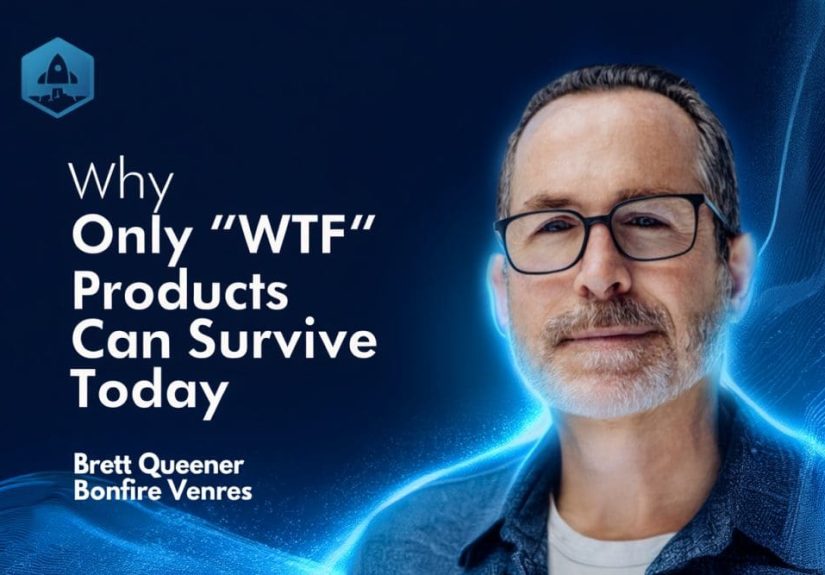
Brett QueenerPartner at Bonfire Ventures and longtime operator across enterprise softwarehas a blunt framing for what survives now: only “WTF” products. As in, a product that creates an immediate “Wait… WHAT?!” reaction because it does a job you couldn’t do before, or does it so much better it feels like cheating.
Who Is Brett Queener (and why listen)?
Brett Queener is a Partner at Bonfire Ventures (a seed-focused firm) and has spent his career living at the intersection of product and go-to-marketexactly where startups either become rockets or expensive cautionary tales. Before investing, he operated inside major enterprise software environments and helped scale businesses through the messy realities of adoption, messaging, pricing, and “Wait, why is the customer doing that?” moments.
His core credibility here isn’t that he can recite frameworks (though he can). It’s that he’s arguing from the front lines of how software buying, building, and shipping is changingfast. And his “WTF” framing is basically a survival filter: if your product doesn’t create immediate, undeniable value, it gets ignored. Not hated. Not debated. Just… ghosted.
What a “WTF Product” Actually Means
A “WTF product” isn’t about shock value or gimmicks. It’s not “Look, our app has a neon purple button that screams.” It’s about instant, visceral value.
The simplest definition
A WTF product delivers a moment where a user thinks: “I didn’t know software could do that… and now I don’t want to work without it.”
What it’s not
- Not “nice UI” by itself (pretty is good; productive is better).
- Not “more features” (feature soup is not a moat, it’s a menu nobody reads).
- Not “AI everywhere” (slapping AI on a workflow is not the same as finishing the job).
What it usually is
- Time compression: something that took 3 hours now takes 3 minutes.
- Skill compression: something only experts could do is now accessible to normal humans.
- Workflow completion: the product doesn’t just inform you; it does the thing.
- Immediate proof: the value shows up right away, not after “a full implementation.”
Why “WTF or Die” Is the Rule Today
The “WTF” bar isn’t rising because customers got meaner (though… have you read software review sites lately?). It’s rising because the market changed. Here are the big forces behind it.
1) AI turned “good enough” into a commodity
Many teams can now prototype quickly, ship faster, and replicate baseline functionality. If three competitors can get you to “mostly works,” the winner is the one who gets you to holy-crap-it-works.
In other words: differentiation moved from “we have the feature” to “we deliver the outcome.” When the tooling improves, the tolerable mediocrity shrinks. Your product can’t be “fine.” It has to be felt.
2) Buyers don’t want softwarethey want the job done
A lot of SaaS economics were built around a gap: software shipped X, customers got Y, and a small army of onboarding calls tried to bridge the difference. But the modern expectation is “the product should teach itself” and “I should see value now,” not after three QBRs and a 47-slide implementation plan.
3) Shipping speed is now a competitive weapon
When products evolve quickly, the cost of waiting is massive. Users expect improvements to arrive continuously, not quarterly. A slower ship cadence means you’re constantly behindeven if your team is working hard. (Hard work is great. Working hard on the wrong timeline is just cardio.)
4) Attention is the scarcest resource in the economy
The average buyer is juggling tool sprawl, budget scrutiny, security reviews, and internal skepticism. The only product that cuts through is the one that triggers: “We need this. Like, yesterday.”
The Anatomy of a WTF Moment
You can’t manufacture delight with motivational quotes. But you can design for “WTF value” by building toward a few measurable properties.
Time-to-Value: Under 5 Minutes (ideally under 60 seconds)
The best WTF products don’t say, “Trust me.” They say, “Herewatch this.” The user experiences the core value proposition immediately. This is the product equivalent of a mic drop, except the mic is your customer’s actual data.
Outcome Delivery: The product completes the task
A dashboard that shows “you have a problem” is informative. A system that fixes the problem (or executes the next best action) is transformative. This is where “agentic” experiences shine: the software isn’t just a record of work; it’s an active participant in doing the work.
Self-Teaching UX: the product trains the user
If you ship frequently, you can’t rely on webinars to keep users up to date. The product must guide behavior in context: “Want to try this next?” “Here’s a shortcut.” “I noticed you do Xdo you want me to automate it?”
Identity Clarity: a single, sharp reason to exist
A WTF product isn’t a Swiss Army knife on day one. It’s a scalpel. It does one core job so well that the user tells peers without being asked. That word-of-mouth impulse is the most honest metric you’ll ever get.
How to Build a WTF Product (without getting weird)
“WTF” sounds like chaos. In practice, it’s disciplined product strategy. Here’s a builder-friendly approach.
Step 1: Choose the “kernel” (the job that must feel magical)
Your kernel is the smallest repeatable unit of value: the job your ICP hires your product to do. If you don’t have a kernel, you have a feature collection. That’s not a product; it’s a group project.
A strong kernel is specific and testable: “Draft a client-ready update from meeting notes.” “Turn inbound requests into routed, prioritized workautomatically.” “Generate and run the right analysis without a data team.”
Step 2: Define your 3 verbs and 3 adjectives
One practical way to sharpen the kernel is to define: the 3 verbs your users can do better with you, and the 3 adjectives that describe what makes it special.
Example:
Verbs: route, resolve, report
Adjectives: instant, trustworthy, hands-free
Notice what this does: it makes product strategy communicable. If your team can’t explain the product in verbs and adjectives, your roadmap will drift into whatever the loudest customer asked for last Tuesday.
Step 3: Make the first experience unreasonably good
You’re not optimizing for “user understands the product.” You’re optimizing for “user experiences value.” That often means:
- Start with a guided workflow that finishes a job.
- Use real data as fast as possible (demo with the customer’s data when feasible).
- Ship default settings that work for the ICP (config is not value).
- Automate the boring parts aggressively.
Step 4: Ship in tight loops
Fast shipping is not about “more features.” It’s about shortening the distance between user reality and product reality. The best WTF teams build a rhythm where learning turns into shipping quickly enough that customers can feel the product improving.
Go-to-Market in the WTF Era
Here’s the slightly unfair truth: even a great product can die if nobody understands it. And even a “pretty good” product can win if it nails the narrative. So yes, in the WTF era, product and marketing are fused at the hip.
Message like a mind reader (not a brochure)
Buyers don’t want abstract categories. They want their exact pain reflected back at them in their own words. When your messaging clicks, it feels like you crawled inside their calendar and took notes. That “You get me” effect is a huge accelerantespecially when multiple tools look similar on paper.
Start narrow, expand fast
If your product can create a holy-cow moment for a small slice of a workflow, you can land quickly and expand after you’ve earned trust. The key is avoiding the temptation to “sell the whole platform” too early.
Pricing should match how value is experienced
When products behave less like “software you own” and more like “a capable assistant,” the pricing conversation changes. The buyer starts thinking monthly value, measurable output, and replaceability: “Is this still the best tool for the job?”
That’s one reason usage-based or value-based pricing keeps showing up in modern SaaS discussions: it maps more naturally to products that actually do work.
Founder involvement still matters at seed
In the early days, founders are the best translators between product reality and customer reality. You don’t need to be a “salesperson” in the cheesy sense. You need to be the person closest to the truth: what’s working, what’s not, and what must be built next.
Yes, Sometimes You Should Fire Customers
This is the part where polite startup advice usually whispers, “Every customer is precious.” Brett’s version is more like: “Every customer is precious… until they try to turn your modern product into a 12-month consulting engagement.”
In the WTF era, the wrong customer can slow you down enough to kill you. Here are signs you should consider walking away:
- They demand heavy customization before experiencing core value.
- They want a year-long rollout for a workflow that should be usable next week.
- They treat your product like legacy software instead of an evolving system.
- They drain roadmap time while contributing little learning about the ICP.
“Firing customers” doesn’t mean being reckless. It means defending product velocity and identity. If your best future is speed, clarity, and self-serve value, you can’t chain yourself to slow-moving expectations from a different era.
Real-World Examples of WTF Value
“WTF value” shows up across categories. Here are a few patterns (and examples) that illustrate the idea.
1) Collaboration that feels like magic
Products that let multiple people work in the same place, in real time, often generate instant disbeliefespecially for teams used to version control chaos. The “WTF” isn’t the feature; it’s the relief: fewer handoffs, fewer merges, fewer “who has the latest?” arguments.
2) Setup that collapses complexity
Some products win because onboarding is absurdly fast. When a tool goes from “we should evaluate this” to “we’re live” in a single sitting, it creates momentum. That momentum becomes a moat because nobody wants to go back to the old pain.
3) Agentic assistants that finish the workflow
The newest wave of WTF products increasingly behaves like an assistant: drafting, scheduling, updating systems, generating deliverables, and nudging the user toward better next actions. The “WTF” moment is when the user realizes the tool doesn’t just help them do workit removes work.
4) Messaging that nails the “exactly” feeling
Sometimes the WTF moment starts before product usage. When a landing page describes the pain so precisely that a buyer thinks, “That’s my problem,” it accelerates evaluation and adoption. Great products still need this clarity because it determines who even tries the tool in the first place.
A Quick WTF Scorecard You Can Use This Week
If you’re building, investing, or just trying to avoid shipping “meh,” here’s a simple scorecard. Give yourself 0–2 points on each line and be honest (your mom already thinks you’re amazing).
- Time-to-Value: Do users experience core value in the first session?
- Job Completion: Does the product complete meaningful work end-to-end?
- Self-Teaching: Can users discover advanced value without training calls?
- Identity: Can you explain the kernel in one sentence without “and also”?
- Ship Velocity: Do customers regularly feel improvement?
- Word-of-Mouth Trigger: Would a user tell a peer unprompted?
- Pricing Alignment: Does pricing match how value is delivered and measured?
If you score low, the answer usually isn’t “add features.” It’s: tighten the kernel, sharpen the message, and deliver a faster aha moment.
Bonus: of “WTF Product” Experiences
You asked for experiencesso here are the kinds of “WTF” moments teams commonly describe when they finally cross the line from “tool” to “can’t-live-without-it.” None of these require a gimmick. They require outcome delivery.
Experience #1: The demo that uses your data (and removes disbelief)
A buyer sits down expecting the usual demo theater: polished slides, fake sample accounts, and a promise that everything will “work once implemented.” Instead, the product connects to their real environment and produces a useful result immediately. The emotional shift is obvious: skepticism turns into curiosity, then urgency. The “WTF” isn’t amazement at techit’s the sudden collapse of risk. If it worked on my data today, it can work on my job tomorrow.
Experience #2: The first-time user who finishes a real task without training
A new user signs up and expects to be lost. But the product guides them through one narrow workflow and produces a finished output: a report they can share, an analysis they can act on, a customer message they can send. They never open a help doc. They don’t schedule onboarding. They just… do the work. That’s a “WTF” moment because most software still assumes the user will supply the expertise and the effort.
Experience #3: The agent that does the annoying parts while you stay in control
In the best agentic experiences, the product doesn’t “go rogue.” It proposes actions, explains why, and lets the user approve or edit. The first time a user watches routine updates happentickets categorized, CRM fields updated, a follow-up drafted, next steps summarizedthey feel a surprising form of joy: mental load leaving the building. The product becomes an assistant, not another inbox.
Experience #4: The “why didn’t we have this years ago?” team reaction
A small team adopts the product and suddenly a recurring weekly meeting becomes unnecessary. Not shorterunnecessary. The output appears continuously inside the workflow. People stop asking for status updates because the truth is already there. When a product removes meetings, it’s not just saving timeit’s changing behavior. That’s a durable kind of WTF, because it reclaims a resource nobody can buy more of.
Experience #5: The moment pricing feels fair because value is visible
Some products earn trust by making value measurable. The buyer can see outputs: time saved, tasks completed, revenue-impacting actions taken. That clarity changes the pricing conversation. Instead of “Can we get a discount?” it becomes “How much more value can we unlock if we roll this out wider?” That shift is rareand it only happens when the product’s impact is obvious without spreadsheets and storytelling gymnastics.
Experience #6: The product teaches itself as it evolves
Frequent shipping can be chaotic unless the product helps users discover new capabilities in context. The best teams describe a moment where the product feels “alive”: it nudges the user toward higher leverage behaviors, points out what’s possible, and adapts to usage patterns. That’s a “WTF” moment because it reverses the normal relationshipusers don’t chase updates; updates meet users where they are.
The through-line across every experience is simple: a WTF product isn’t “cool.” It’s undeniably useful, fast enough to be felt, and clear enough to be repeated.
Conclusion
In a market packed with software, the real competition isn’t “other tools.” It’s the status quo, skepticism, and limited attention. Brett Queener’s “WTF product” framing is a forcing function: if your product doesn’t deliver immediate, surprising valueand keep improving fastthen it will struggle to earn adoption, expansion, and pricing power.
The good news? “WTF” isn’t luck. It’s design. Pick a sharp kernel. Engineer an instant aha moment. Teach users inside the product. Ship in tight loops. And protect your velocityeven if that means saying no to customers who want to drag you back into the old world.