Table of Contents >> Show >> Hide
- What “Bricking” Really Means (And Why It Feels Personal)
- The Math Problem Hiding in Plain Sight: The Rim Isn’t That Big
- The Physics of “Makeable”: Arc, Entry Angle, and Touch
- Equipment Matters More Than People Want to Admit
- So… Can a Hoop “Never Let You Brick”?
- How to Build Your Own “Never Brick” Setup (Without Cheating the Rim Size)
- of Real-World “No-Brick” Experiences
- Conclusion: The Real “No-Brick” Hoop Is a System
Every hooper has dreamed it at least once: a magical rim that looks at your shot, sighs dramatically,
and says, “Relax. I got you.” No clanks. No back-iron heartbreak. No “I swear that was online!”
Just pure, satisfying swishlike the hoop is on your payroll.
Here’s the twist: in real basketball, a hoop that “never lets you brick” doesn’t exist in official play.
But the closest real-world version is absolutely a thingthrough smart training tech,
more forgiving equipment choices, and a little engineering that nudges the odds in your favor.
What “Bricking” Really Means (And Why It Feels Personal)
A “brick” is more than a miss. It’s a miss with volume. The kind that ricochets off the rim like the ball
is late for another appointment. Most bricks happen when two things get out of alignment:
- Accuracy (left-right aim and front-back distance)
- Make-friendly ball flight (arc, entry angle, and speed)
The hoop doesn’t judge, but physics absolutely does.
The Math Problem Hiding in Plain Sight: The Rim Isn’t That Big
Regulation basketball is an unforgiving little geometry quiz. An official rim has an inside diameter of
18 inches. An official men’s size ball is 29.5 inches in circumference,
which works out to about 9.39 inches in diameter (29.5 ÷ π).
That means you’ve only got about 8.61 inches of total clearance between ball and rim
(18 − 9.39). And because the ball isn’t a laser pointit’s a big sphere that arrives at an anglethe
“make window” shrinks fast if your shot is too flat or too fast.
Translation: the hoop isn’t tiny… but it’s not exactly a driveway trash can either.
The Physics of “Makeable”: Arc, Entry Angle, and Touch
If you want the hoop to feel more forgiving, you don’t need magicyou need a shot that gives the ball
more usable rim space. The sweet spot most shooting science and tracking systems circle around is:
1) A Medium-High Arc (Not a Laser, Not a Moonshot)
A flatter shot arrives like a fastball. It has less margin for error because it hits more rim, more often,
and rebounds out more violently. A higher arc increases the ball’s downward angle, which generally makes the
rim “play bigger.”
2) A Friendly Entry Angle
Many coaches cue “get it up,” but what you really want is the ball entering the hoop at a
make-friendly angleoften discussed around the mid-40-degree range for many common shots.
Too flat: you catch front rim. Too steep: you lose distance control and start missing short.
3) Speed Control (a.k.a. Touch)
A shot with good touch can kiss rim and still drop. A shot with bad touch turns the rim into a trampoline.
This is why great shooters don’t just “aim better”they’re elite at repeating the same speed and spin.
Equipment Matters More Than People Want to Admit
Two courts can be the same distance, same ball, same shooterand still feel wildly different.
That’s usually because of the hoop setup.
Rim Type: “Soft” vs. “Angry” Hoops
Not all rims rebound the ball the same way. Breakaway rims, for example, are designed to flex under load
and return to positionmostly for safety and durability, but also to keep rebounds consistent. Consistency matters:
the more predictable the rim, the more your brain can calibrate.
Net Behavior: The Forgotten Hero
Nets aren’t just decoration. A proper net slows the ball slightly and “checks” it as it drops, which helps
reduce wild ricochets and gives that satisfying confirmation you made it. A stiff or damaged net can make makes
look like misses and misses look like a circus act.
Backboard Material and Rebound Feel
Glass backboards generally provide a cleaner, more consistent bank response than many low-cost materials.
If you’re practicing layups and bank shots, a consistent backboard is basically a fairness requirement.
Double Rims: Durable… and Less Forgiving
If you grew up shooting on outdoor double rims, you already know they can feel like the hoop is mad at you.
Double rims are common for durability, but the extra thickness and stiffness can punish shots that would fall
on a single rim. That’s not “in your head”that’s engineering.
So… Can a Hoop “Never Let You Brick”?
In regulation basketball, no. The rim must be the regulation size and behave within specific standards.
But in the real worlddriveways, gyms, training facilitiesthe closest version comes in three flavors:
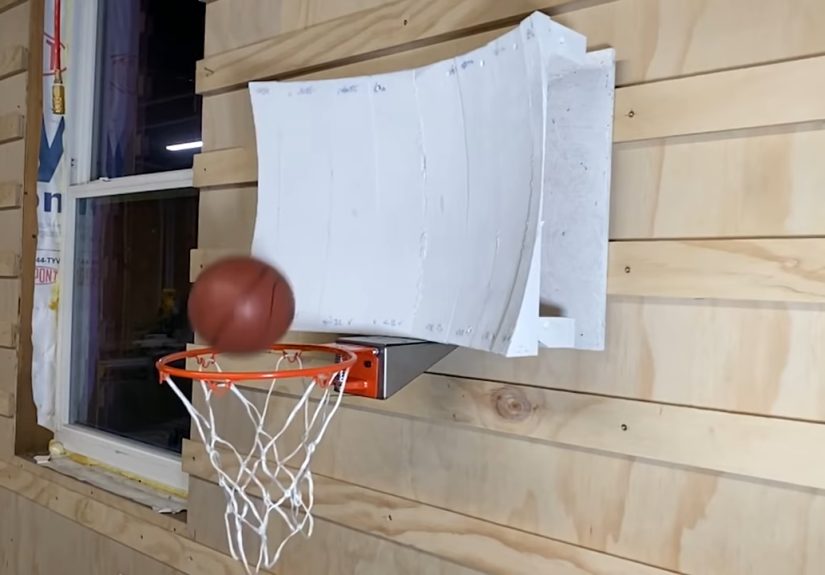
1) Make the Target Bigger (The “Carnival Cheat Code”)
The simplest no-brick hoop is also the least subtle: increase the effective opening. Oversized novelty hoops exist,
and some training setups add a funnel-like guide above the rim so near-misses fall in. It’s not “real” basketball,
but it is excellent for:
- Confidence-building reps for beginners
- Warm-ups that emphasize rhythm
- Rehab / return-to-play shooting where you want volume without frustration
Think of it like bowling with bumpers. No one is confusing it with the NBA Finals, but it gets you rolling.
2) Lower the Hoop (The Youth Development “No-Brick” Strategy)
The most legitimate way to reduce bricksespecially for kidsis to adjust hoop height. Lower rims help younger
players develop proper mechanics without heaving the ball like a medieval catapult. When the rim is too high,
kids compensate with bad habits: chucking, leaning, and launching from the shoulder.
A lowered hoop doesn’t guarantee makes, but it massively increases “good misses,” which accelerates learning.
More makes also mean more joywhich, shockingly, makes kids want to practice more. Wild concept.
3) Add “Smart Feedback” (The Closest Thing to a Real No-Brick Hoop)
Here’s where the modern game gets spicy. Shot-tracking systems can measure arc, depth, left-right accuracy,
and consistencythen give instant feedback. Some systems mount sensors/cameras around the backboard and can track
the ball’s flight path without requiring a special ball.
This doesn’t force the ball to go in. But it does something almost as powerful: it tells you exactly
why you missed and what to change. If you’ve ever argued with your friends about whether you missed left or short,
congratulationstechnology is here to end friendships with data.
How to Build Your Own “Never Brick” Setup (Without Cheating the Rim Size)
If your goal is to miss less (not secretly install a funnel when nobody’s looking), here’s the
highest-ROI approach:
Step 1: Choose a Consistent Rim
- Prefer a quality breakaway rim for predictable rebound behavior.
- Avoid bent rims, loose mounts, and damaged nets (they sabotage feedback).
Step 2: Practice the Shots That Pay Rent
Most game points come from a small menu: layups, free throws, catch-and-shoot jumpers, and a few dribble pull-ups.
Build your training around those. Your step-back 28-footer is funbut it’s not paying the mortgage.
Step 3: Track One Metric at a Time
If you chase ten fixes at once, you’ll improve at none of them. Instead:
- Week 1: arc and a repeatable release
- Week 2: left-right accuracy
- Week 3: distance control (short vs long)
Step 4: Turn “Bricks” into Useful Misses
A miss can be a teacher or a troll. Use this quick read:
- Front rim often means short or flat
- Back rim often means long or too much push
- Left/right often means release alignment
- Side-to-side rattle-out often means speed too high
of Real-World “No-Brick” Experiences
If you’ve played on enough courts, you’ve probably felt it: that weird moment when a hoop seems… friendly.
Not “magical,” but friendlylike it’s giving you the benefit of the doubt. Players talk about it the same way
golfers talk about “fast greens” or bowlers talk about “oily lanes.” It’s not superstition; it’s environment.
One of the most common experiences comes from switching between outdoor park rims and indoor gym rims.
Outdoors, you might face a stiff double rim, wind, uneven pavement, and a ball that’s seen better decades.
Makes don’t just feel earnedthey feel like a small miracle with good cardio. Then you walk into a gym with a
clean breakaway rim, a fresh net, stable lighting, and a consistent backboard… and suddenly your jumper feels
like it upgraded from economy to first class. The shot didn’t change overnight. The feedback did.
Another classic experience is the “net difference.” Some nets are so thick and tight they practically hug the ball
on the way down, turning near-misses into dramatic pauses that still end in a make. Others are old, tangled, or
cut short so the ball snaps through like it’s escaping. A clean net gives your brain a clearer “yes” signal.
That matters more than people admit. When your makes look and sound like makes, confidence growsand confidence
is a sneaky performance enhancer. Not because the hoop is easier, but because your body relaxes and repeats.
Then there’s the experience of lowering the rimespecially for beginners. Coaches who’ve worked with younger kids
often see an instant change in shot quality the moment the hoop matches the player’s strength.
The ball stops being launched with two hands from the chest (a form of basketball shot-put) and starts being guided
with one hand and a real follow-through. More makes happen right away, surebut the bigger win is that the motion
becomes repeatable. Kids get addicted to the feeling of a clean release, and practice stops feeling like punishment.
The “no-brick” effect is really a “no-bad-habits” effect.
Finally, there’s the modern experience: training with immediate feedback. Players using shot tracking often describe
a shift from emotional guessing (“I think I missed long?”) to objective adjustment (“That was 2 inches long and
slightly right; fix the finish and soften the push”). Even without fancy tech, you can mimic this by filming
a few reps and tracking simple patterns. The point is that the hoop isn’t saving youyour process is.
And when your process gets consistent, bricks become rare enough that your friends start accusing you of witchcraft.
That’s when you know you’re close to the dream.
Conclusion: The Real “No-Brick” Hoop Is a System
A basketball hoop that literally never lets you brick would break the rules (and probably the internet).
But the closest real-world version is totally achievable: a consistent rim and net, smart feedback (or simple video),
age-appropriate hoop height, and reps that train arc, entry angle, and touch. When those pieces line up, the hoop
starts to feel biggernot because it changed, but because your shot did.
And if you still want a hoop that never lets you miss… go play skee-ball. No shame. Just honesty.