Table of Contents >> Show >> Hide
- Why Learning to Curve a Soccer Ball Matters
- The Science of a Curved Soccer Ball, Without the Boring Lab Coat
- How to Bend or “Curve” a Soccer Ball: 8 Steps
- Step 1: Pick Your Target and Picture the Flight
- Step 2: Approach the Ball at an Angle
- Step 3: Plant Your Non-Kicking Foot Correctly
- Step 4: Lock Your Ankle and Use the Right Part of the Foot
- Step 5: Strike the Ball Off-Center
- Step 6: Wrap Your Leg and Hips Around the Ball
- Step 7: Control Your Body Lean and Height
- Step 8: Practice the Right Way Until the Motion Becomes Automatic
- Common Mistakes When Trying to Curve a Soccer Ball
- Best Times to Use a Curved Shot or Pass
- Simple Drills to Improve Your Curve Shot
- Final Thoughts
- Extra Experience and Practical Lessons From Learning to Curve a Soccer Ball
- Conclusion
There are few things in soccer more satisfying than watching a ball start in one zip code and finish in another. One second it looks like your shot is headed straight for the keeper’s gloves, and the next second it swerves into the far corner like it remembered a dentist appointment. That, friends, is the magic of learning how to bend or curve a soccer ball.
If you have ever wondered how players make free kicks curl around a wall, whip crosses into dangerous spaces, or slide a shot inside the post with just enough swagger to hurt a goalkeeper’s feelings, the answer is not magic. It is technique, timing, body position, and lots of repetition. The good news is that this is a learnable skill. The slightly annoying news is that you will not master it after six heroic attempts in your backyard while pretending to be a set-piece genius.
In this guide, you will learn the mechanics behind a curved shot, how to strike the ball properly, what common mistakes to avoid, and how to practice until the movement feels natural. Whether you want to improve your free kick technique, curl better crosses, or simply stop blasting every shot into the parking lot, these eight steps will help.
Why Learning to Curve a Soccer Ball Matters
Curving the ball is not just for highlight reels and dramatic slow-motion montages. It is a practical tool in real games. A bent shot can move away from the goalkeeper’s reach. A curling pass can travel around a defender instead of through them. A swerving cross can arrive in a dangerous area without floating forever like it is sightseeing.
That is why players work on this skill for free kicks, corners, long-range shots, crosses, and even certain passes. Once you understand how to put spin on the ball, you gain more control over where it starts, how it travels, and where it finishes. In other words, you stop just kicking the ball and start telling it what to do.
The Science of a Curved Soccer Ball, Without the Boring Lab Coat
Before we get into the eight steps, here is the simple version of what makes the ball bend. When you strike the ball off-center and create spin, the spinning ball interacts with the air around it. That spin changes the airflow and creates a pressure difference, which causes the ball to curve in flight. This is commonly explained through the Magnus effect.
You do not need to become a physics professor to use it. You just need to know this: no spin means little or no curve, useful spin means bend, and bad contact means the ball may do something deeply embarrassing. The curve depends on your contact point, the angle of your approach, your follow-through, and how cleanly you wrap your foot around the ball.
How to Bend or “Curve” a Soccer Ball: 8 Steps
Step 1: Pick Your Target and Picture the Flight
Do not walk up to the ball and hope your foot invents a miracle. The first step is visualization. Decide where you want the ball to finish and how you want it to get there. Are you trying to bend a right-footed shot around a wall and into the left side of the goal? Are you curling a cross toward the back post? Are you wrapping a pass around a defender?
Picture the path before you move. Good ball strikers are not just aiming at the final spot. They are imagining the whole arc. That mental image matters because it helps set your approach angle, body shape, and contact point. Basically, you are creating the blueprint before your foot starts construction.
Step 2: Approach the Ball at an Angle
If you run straight at the ball and try to curve it, you are making life harder than it needs to be. A slight angle in your run-up gives your hips and kicking leg room to move around the outside of the ball. For most players, that means approaching from the side opposite the direction of the intended curve.
For example, if you are right-footed and want the ball to curl from right to left, approach from slightly left of the ball. If you are left-footed and want a left-to-right curve, approach from slightly right of the ball. The angle does not need to be dramatic. Think controlled arc, not interpretive dance.
A useful starting point is a modest diagonal approach that feels natural and balanced. Too straight and you lose the wrapping motion. Too wide and your body may open too much, which can wreck accuracy.
Step 3: Plant Your Non-Kicking Foot Correctly
Your plant foot is the quiet hero of the whole technique. If it lands in the wrong place, everything after it becomes chaos in cleats. Place your non-kicking foot next to the ball, slightly behind it, with a few inches of space between your foot and the ball.
This positioning gives you stability and helps create the right upward-and-across contact. If your plant foot lands too far in front, the ball may stay low or get cut awkwardly. If it is too far away, you lose balance and clean contact. If it is too close, your swing gets jammed and the shot turns into a sad little toe-poke with unrealistic ambitions.
Your planted foot should also support the line of the shot. Think stable, balanced, and under control. Curving the ball is a technical movement, not a falling-down contest.
Step 4: Lock Your Ankle and Use the Right Part of the Foot
To curve a soccer ball with the inside bend technique, you typically strike it with the area just below the big toe, near the inside of the foot where the arch begins. That part of the foot gives you a clean blend of control and spin.
Your ankle should be locked. A floppy ankle is the enemy of accuracy, power, and dignity. Keep the foot firm so the contact is crisp. The toe position will vary slightly depending on the shot, but for a classic curling strike, you want the foot shaped and firm enough to brush across the ball, not slap it randomly.
This is one of the biggest differences between curving a ball and simply passing with the inside of the foot. You are not using the broad middle of the foot to push through the center of the ball. You are using a more specific contact area to strike across it and create spin.
Step 5: Strike the Ball Off-Center
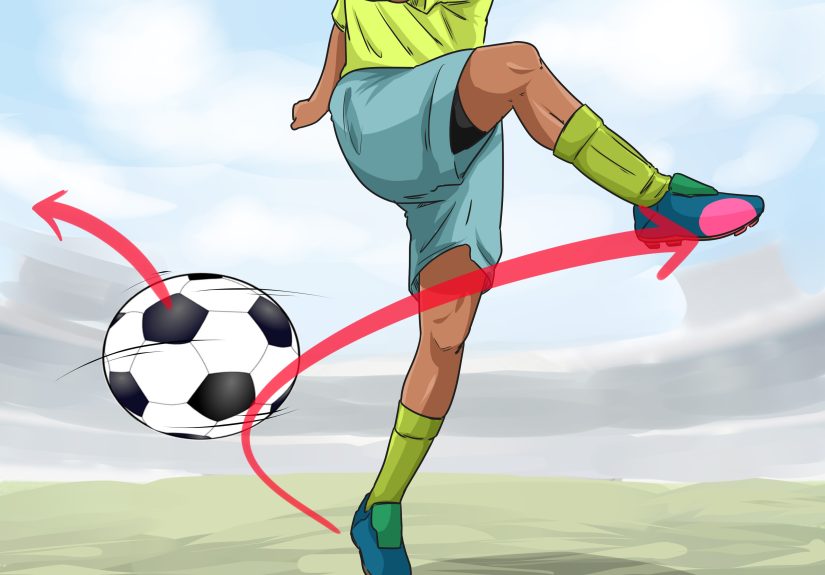
This is where the curve is born. To bend the ball, you do not strike dead center. You contact the side of the ball that helps create the spin you want. For a right-footed player trying to curl the ball from right to left, that usually means contacting the outside-right portion of the ball while brushing up and around it. A left-footed player reverses that pattern.
You will also usually strike slightly below the midline if you want a little lift. Hit too low and the ball balloons upward like it is trying to leave the atmosphere. Hit too high and you may get a flatter shot with less dip. The sweet spot depends on distance, power, and the type of bend you want, but a little below center is a smart place to start.
If you keep hitting beautiful, powerful shots that travel stubbornly straight, your contact point is probably too central. If the ball spins but has no pace, you may be brushing too much and driving too little.
Step 6: Wrap Your Leg and Hips Around the Ball
Here is the move that separates a true curved strike from a regular shot wearing a fake mustache. Your leg should not simply drive forward through the ball. It should sweep around it. Your hips rotate, your kicking leg wraps across your body, and your foot follows the line of spin you are trying to create.
This wrap-around motion is what really helps generate sidespin. Many players understand the contact point but forget the wrapping action, which is like buying cake ingredients and forgetting the cake. The ball may move a little, but not enough to really bend.
Let the motion feel smooth and connected. You are not chopping at the ball. You are guiding spin into it with a controlled sweep. A good follow-through often feels like your kicking foot is finishing across your body and your hips have turned toward the target.
Step 7: Control Your Body Lean and Height
Your upper body has a huge effect on the shot. Leaning slightly over the ball generally helps keep it down. Leaning back tends to lift it. Neither is automatically wrong, but both need control.
If every attempt flies over the goal, you are probably leaning back too much or striking too far under the ball. If every shot stays low and never threatens the top corner, you may be too far over the ball or hitting it too flat. For most curling shots, a slight forward lean or a balanced torso gives you the best chance to combine bend with controllable height.
Your arms matter too. Use them for balance. A stable upper body helps the lower body do precise work. Soccer technique is often just organized balance pretending to be style.
Step 8: Practice the Right Way Until the Motion Becomes Automatic
No one becomes dangerous at curling a soccer ball by reading one article and then whispering “I believe” to the ball. You need repetitions. Smart repetitions.
Start with a stationary ball and a simple target. Place a cone, pole, or small wall between the ball and your target area. Try to bend the ball around the obstacle and into the target. Work from manageable distances before moving farther away. Focus on one technical goal at a time: approach angle, plant foot, contact point, wrap, or body lean.
Practice with both feet, even if one side feels like it belongs to a suspicious stranger. Film yourself if possible. Slow-motion video is brutally honest, which is excellent for improvement and terrible for the ego. Over time, the curve becomes less about thinking through ten details and more about repeating a familiar movement.
Common Mistakes When Trying to Curve a Soccer Ball
Trying to Crush the Ball
Power matters, but technique matters more. Many players swing too hard and lose the clean contact needed for spin. Think smooth and sharp, not wild and dramatic.
Hitting the Center of the Ball
If you strike the middle, the ball will travel mostly straight. Curve requires off-center contact and a brushing action.
Forgetting the Follow-Through
A lot of players tap the right spot on the ball but fail to wrap the leg around it. The result is weak bend or no bend at all. Spin is not just where you hit the ball. It is also how your foot moves through it.
Plant Foot in the Wrong Place
Too close, too far, too far ahead, too square. Any of these can ruin the strike. Your plant foot gives your kick its platform.
Leaning Back Too Much
This is the classic “why is my shot now orbiting the moon” problem. Keep your body controlled and avoid unnecessary backward lean.
Best Times to Use a Curved Shot or Pass
The classic moment is a direct free kick around a wall, but that is only part of the story. Curving the ball is useful when you want to bend a shot inside the far post, whip a corner into a dangerous zone, deliver an inswinging or outswinging cross, or play a pass around a defender instead of through traffic.
It is not always the right choice, though. Sometimes a straight driven shot is better. Sometimes a knuckling strike is more dangerous. Sometimes a simple pass beats a fancy idea. The best players do not curve the ball because it looks cool. They curve it because the situation calls for it. The cool part is just a bonus.
Simple Drills to Improve Your Curve Shot
1. Cone Bend Drill
Place one cone or mannequin between the ball and the target. Start 15 to 20 yards out. Try to bend around the obstacle and finish inside a marked target zone.
2. Far-Post Curl Drill
Set up balls outside the box and aim to start the shot outside the post before curling it back in. This teaches commitment to the bend instead of steering the ball too early.
3. Crossbar Window Drill
Choose a high target area just under the bar or in an upper corner. This helps you learn how much height and dip to use, rather than just producing sideways spin.
4. Around-the-Pole Pass Drill
Use poles or cones as defenders and practice curling passes with pace to a partner. This builds game-realistic bend, not just free kick theater.
Final Thoughts
Learning how to bend or curve a soccer ball is one of the most rewarding soccer skills you can develop. It combines technique, feel, timing, and repetition in a way that makes the game more creative and more dangerous for defenders and goalkeepers. Once you understand your approach angle, plant foot, contact point, and follow-through, the skill starts to make sense. Then it becomes a matter of repetition, adjustment, and patience.
So do not chase perfection on day one. Chase clean contact. Chase consistent mechanics. Chase one better strike than yesterday. With enough practice, you will stop hoping the ball bends and start expecting it to. And when that first perfect curling shot tucks into the corner, try to act like you have done it before. Even if internally you are throwing a parade.
Extra Experience and Practical Lessons From Learning to Curve a Soccer Ball
One of the funniest things about learning how to curve a soccer ball is how humbling it is in the beginning. Most players start with a very cinematic expectation. They place the ball down, take three dramatic steps backward, squint at the goal like they are in a World Cup final, and then absolutely launch the shot into another dimension. The problem is rarely effort. The problem is that curving the ball is a feel-based skill built on precise mechanics, and precise mechanics do not care how confident your walk-up looks.
A common experience is realizing that what felt like a perfect strike was not actually close. Maybe your body leaned back too much. Maybe your plant foot landed too far forward. Maybe you hit the ball with the broad inside of your foot instead of that firmer area near the big toe. This is why video helps so much. It closes the gap between what you think you did and what you actually did. That gap can be large enough to drive a team bus through.
Another lesson players discover quickly is that repetition changes everything. The first ten attempts feel awkward. The next twenty begin to show a pattern. Then suddenly one shot bends properly, and your brain goes, “Oh, so that’s what we were trying to do.” That moment matters. Once you feel one clean curved strike, you have a reference point. You are no longer guessing in the dark. You are refining something real.
Players also learn that different game situations require different versions of the curve. A free kick around a wall is not the same as a curling cross from wide space. A short-range finesse finish is not the same as a long-distance bending strike. The base technique is similar, but the height, speed, and amount of wrap change. That is why experienced players do not just practice one dramatic shot. They practice bending the ball from multiple angles, distances, and speeds.
There is also the experience of discovering that your weaker foot can, in fact, do useful things. At first, it feels uncoordinated and mildly offended by the request. But with enough repetitions, it becomes more capable. Even if your weaker foot never becomes your favorite weapon, improving it makes you less predictable and far more useful on the field.
Probably the biggest practical takeaway is this: players who become good at curving the ball are usually not the ones who search endlessly for secret tricks. They are the ones who return to the basics again and again. Same angle. Same plant foot. Same contact zone. Same wrap. Same target. They experiment, yes, but they build from solid habits. Over time, the strike becomes less mechanical and more instinctive. The ball starts doing what you meant instead of what it felt like doing. That is when the technique becomes part of your game rather than a party trick you try twice a month.
Conclusion
If you want to master how to bend or curve a soccer ball, focus less on trying to look spectacular and more on repeating the right movements. Choose your target, approach at an angle, plant properly, strike off-center, wrap through the ball, and stay balanced. Then practice enough that your body no longer has to hold a committee meeting before every shot.
Curve is not just a flashy soccer skill. It is a practical weapon. It helps you score, create chances, and play passes defenders hate. Put in the reps, be patient with the ugly attempts, and keep chasing clean technique. Eventually, the bend will come. And when it does, the goalkeeper will be the one having a bad day.