Table of Contents >> Show >> Hide
- Menopause as an Evolutionary Puzzle (Not Just a Hormonal One)
- The Whale “Menopause Club”: Who’s In?
- How Scientists Tell a Whale Is Post-Reproductive
- Why Stop Reproducing? The Big Explanations Whale Data Can Test
- Killer Whales: The Menopause MVPs
- Why These Whales (And Not Most Mammals)?
- What Whale Menopause Can Teach Us About Human Menopause
- Open Questions Scientists Are Still Chasing
- Experiences Related to “Whales Help Scientists Investigate The Mystery Of Menopause” (About )
- Conclusion
Menopause is one of biology’s biggest plot twists: fertility shuts down, but life keeps rollingsometimes for decades. In most mammals, reproduction tapers off only near the end of life. Humans are the famous exception… and so are a few toothed whales. That odd overlap has turned whales into an unexpectedly useful “research partner” for a question evolutionary biologists have wrestled with for generations: why would natural selection favor a long life after reproduction ends?
Whales give scientists a rare gift: multiple species with a clear post-reproductive phase, plus the kind of long-term field data that lets researchers connect life history to real outcomessurvival, food, leadership, and family success. When a whale grandmother helps her descendants thrive, menopause stops looking like a mistake and starts looking like a strategy with a job description.
Below, we’ll unpack which whales appear to experience menopause, how researchers detect it, what the leading evolutionary explanations are, and why “grandma whales” are rewriting the menopause story in a very salty font.
Menopause as an Evolutionary Puzzle (Not Just a Hormonal One)
From an evolutionary perspective, “success” means getting your genes into future generations. The obvious way to do that is to reproduce for as long as your body allows. So a long post-reproductive lifespan looks counterintuitivelike buying extra years and refusing to spend them on offspring.
The workaround is kin support. If an older female can increase the survival or future reproduction of her children and grandchildren, her genes can still spread indirectly. That’s the logic behind the major menopause hypothesesand whales are a great testing ground because many toothed whales live in tight family groups where older females can plausibly help relatives in measurable ways.
The Whale “Menopause Club”: Who’s In?
Clear evidence for a long, meaningful post-reproductive phase has been documented in five toothed whale species:
- Killer whales (orcas)
- Short-finned pilot whales
- False killer whales
- Beluga whales
- Narwhals
This isn’t “all whales.” Many other toothed whales (and the baleen whales that filter-feed, like humpbacks and blues) don’t show the same strong pattern. That contrast is exactly what makes these species scientifically valuable: it creates a natural comparison set for testing what conditions make menopause more likely to evolve.
How Scientists Tell a Whale Is Post-Reproductive
Whales don’t line up at a clinic and announce their last ovulation. Researchers infer reproductive status using multiple lines of evidence. The strongest cases combine demography, behavior, and (when available) biology.
1) Long-term photo-ID and family tracking
For some populationsespecially resident killer whalesscientists can identify individuals by distinctive dorsal fin shapes and saddle-patch markings, then track them for decades. Births and deaths build detailed family trees. When the data show females stop producing calves around midlife but live for many years afterward, that’s a classic signature of an extended post-reproductive lifespan.
2) Demography and cross-species comparisons
Comparative studies analyze reproduction and survival patterns across dozens of toothed whale species. A key insight from recent work is that menopausal toothed whales appear to have evolved the trait by extending lifespan without similarly extending the reproductive window. In other words, the “baby-making years” stay roughly comparable, while post-reproductive years expand dramaticallyoften by decades.
3) Biological clues (when available)
In some cases, researchers use hormonal data or ovarian evidence from deceased animals to support the demographic picture. Findings consistent with ovarian inactivity in older females help confirm that “no observed births” reflects true reproductive cessation, not just missing data or unusual conditions in a short observation window.
Why Stop Reproducing? The Big Explanations Whale Data Can Test
There’s no single “menopause switch” theory that fits every species. But whale research has sharpened three major explanations that can work together.
The Grandmother Hypothesis: help beats having one more calf
This hypothesis proposes that older females gain more genetic benefit by helping descendants than by taking on the risks of late-life reproduction. In whales, the “help” is not metaphorical. It can include:
- Food support: older females may share prey with relatives, which can matter most in tough years.
- Leadership: experienced females can guide groups toward better foraging areas or better timing.
- Care and protection: supporting calves, stabilizing groups, and reducing risks during travel and foraging.
For the grandmother hypothesis to hold, the payoff must show up in survival or reproduction data. For killer whales, multiple studies suggest it does.
The Reproductive Conflict Hypothesis: stop competing with your daughters
In several menopausal toothed whales, daughters and sons often remain with their mother’s group for life. That creates intergenerational overlap: mothers and daughters can reproduce in the same social unit at the same time. If resources are limited, late-life calves from older females can increase competition with their daughters’ calves. By ceasing reproduction, older females can reduce that conflict and invest in existing kinboosting overall family success.
The “Live Long” pattern: longevity makes menopause possible
Comparative research across toothed whales suggests menopause can evolve when females become unusually long-lived without extending the reproductive span. Once a long post-reproductive period exists, natural selection can favor behaviors and social roles that make those extra years beneficial. In that framing, menopause isn’t just “reproduction fails early.” It’s “life got longer, and post-reproductive life found a purpose.”
Killer Whales: The Menopause MVPs
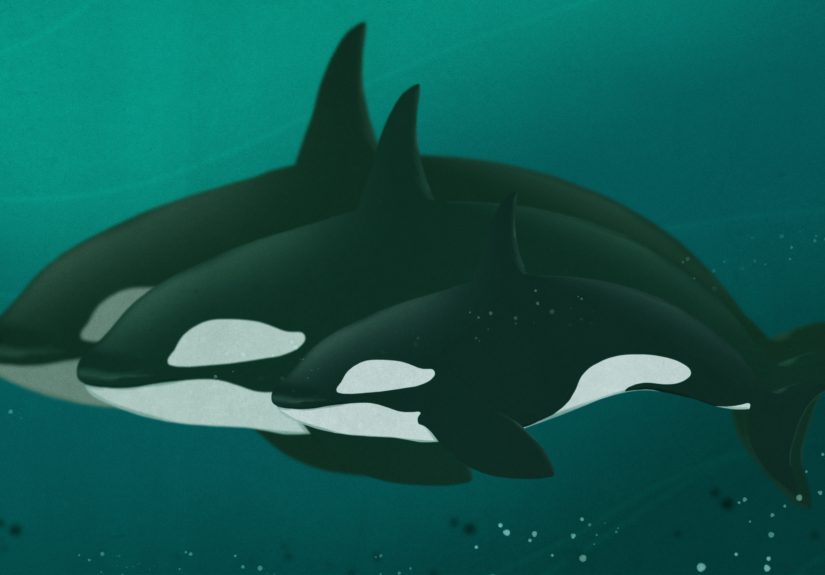
If menopause research had a mascot, it would be an orcasmart, social, long-lived, and always traveling with family. Killer whales are crucial because some populations have been monitored for decades, allowing researchers to connect post-reproductive life to real, measurable outcomes.
Grandmothers and grandcalf survival
Long-term studies of resident killer whales show that grandoffspring survival can be better when a post-reproductive grandmother is alive. The benefit appears strongest when the grandmother is no longer reproducing, consistent with the idea that she can focus effort on helping descendants rather than splitting resources between helping and raising another calf.
Ecological knowledge: the ocean’s living memory
In years when prey is scarce, older females are often observed leading groups. That leadership likely reflects experience: knowing where prey tends to be, when seasonal runs occur, and which areas are reliable. In plain English, menopausal whales may function like a living search engineexcept the queries are “Where is dinner?” and the results determine whether the whole family eats.
Protecting adult sons: a surprising kind of help
Recent work suggests post-reproductive mothers can reduce socially inflicted injuries in adult sons (measured through markings like tooth-rake wounds). That hints that older females may provide social support that reduces conflict or helps sons navigate group dynamics more safely. It’s a reminder that “helping kin” isn’t only about calvesit can matter for grown offspring, too.
Why These Whales (And Not Most Mammals)?
Menopause is rare, and whales help show why. The trait appears most likely to evolve when the math of family life makes older females valuable even after they stop reproducing.
Stable, kin-rich social structure
In many menopausal whale species, older females remain closely associated with relatives. That means any time, food, or knowledge they invest is likely to benefit kin. In species where offspring disperse widely or adults live mostly alone, the “grandmother payoff” is harder to cash in.
High value of learning and culture
Many toothed whales show long learning curves and complex social behavior. When knowledge accumulates over decadesmigration routes, foraging hotspots, hunting strategiesolder individuals can be valuable repositories of information. If elders improve group decisions, selection can favor keeping them alive.
High reproductive costs
Pregnancy, lactation, and calf-rearing are expensive. In variable environments, late-life reproduction may be risky and could reduce the survival chances of existing offspring. Shifting from reproduction to kin support can be a better long-term bet for genes.
What Whale Menopause Can Teach Us About Human Menopause
Whales help separate two questions people often mix together:
- Evolutionary “why”: what conditions could favor a long post-reproductive life?
- Biological “how”: what mechanisms produce reproductive cessation, and what symptoms or health changes follow?
Whales are especially powerful for the “why.” They show a credible pathway for menopause to be adaptive: older females embedded in family groups can improve descendant survival and reduce reproductive conflict. That doesn’t mean whale menopause is identical to human menopause, or that it explains every health outcome. But it does suggest menopause can be more than an accident of agingit can be a life-history strategy that makes sense under specific social conditions.
Open Questions Scientists Are Still Chasing
- How many species truly have menopause? Fertility decline is common; a long, distinct post-reproductive lifespan is not.
- Which helping behaviors matter most? Food sharing, leadership, and social protection may play different roles across species.
- How do climate change, prey shifts, and human impacts change the value of elders? If experienced leaders matter most in hard years, environmental disruption may raise the stakes.
Now, let’s zoom in on the “human side” of this science: what it looks and feels like to study menopausal whales in the real world.
Experiences Related to “Whales Help Scientists Investigate The Mystery Of Menopause” (About )
Experience 1: Meeting a matriarch you’ve only known as a spreadsheet row. In long-term orca research, whales are identified by dorsal fins and markings, and many individuals are recognizable across decades. Researchers often describe a shift that happens the first time they truly see an older female in contextnot as a number, but as a living anchor for a whole family. She surfaces, exhales, and within minutes you notice the pattern: adult offspring nearby, younger relatives pacing her movements, calves traveling in the protective “bubble” of the group. The family tree you memorized on land suddenly becomes a moving, breathing thing in the water.
Experience 2: Leadership that looks like subtle choreography. On days when prey is scarce, field notes can read like a quiet drama: longer travel, fewer feeding events, tighter spacing, and more time scanning. In those conditions, researchers sometimes observe older females initiating direction changes and the group aligning behind them. It doesn’t look like a heroic charge; it looks like quiet confidence. The scientific excitement is immediate: these moments are the behavioral “how” that could explain the evolutionary “why.” If elders are most valuable when resources are hard to find, that makes menopause less strange and more sensible.
Experience 3: Watching kin support show up in ordinary decisions. “Grandmothering” doesn’t always look like babysitting. Much of it can be small and cumulative: a matriarch holding the center of the group, keeping pace with a calf, staying close during tense social interactions, or being the individual others consistently choose to travel beside. Researchers document who is near whom, how associations shift across seasons, and what happens during difficult years. Over time, these ordinary decisions can map onto extraordinary outcomeslike higher survival in the presence of a post-reproductive female.
Experience 4: Menopause changes how conservation stories get told. Public outreach often focuses on breeding females and newborn calves, which makes sensereproduction drives population growth. Menopause research adds a twist: older, non-reproducing females may still be essential because they contribute knowledge and stability. In community talks and policy discussions, scientists sometimes find themselves explaining why protecting an elder matters even if she will never have another calf. It’s a shift from “value equals babies” to “value equals family success,” and it can change how people think about threats like prey depletion, noise, and ship traffic.
Experience 5: The unglamorous grind that makes the big idea believable. For every magazine headline about “grandma whales,” there are hours of routine work: photographing fins in rough light, confirming identities, recording group composition, and cleaning datasets so the conclusions don’t rely on hope. Researchers often say the payoff is uniquely satisfying here because the theory is testable. Menopause stops being an abstract puzzle and becomes something you can measure: who survives, who leads, who benefits, and how families respond during hard years.
Put together, these experiences highlight why whales are such powerful teachers. Menopause stops looking like a biological error and starts looking like a role changeone that can keep a family afloat in a difficult ocean.
Conclusion
Whales help scientists investigate menopause because they make the puzzle measurable. In a handful of toothed whale species, females stop reproducing and then live for decadessurrounded by kin who can benefit from their support. Research on orcas and other toothed whales suggests a consistent theme: menopause can evolve when longevity extends, when older females remain embedded in family groups, and when helping kin (and avoiding reproductive conflict) produces real fitness benefits.
Menopause in whales isn’t a perfect mirror of menopause in humans. But it strengthens the idea that a long post-reproductive life can be adaptive under the right social conditions. Sometimes, the most powerful contribution isn’t producing one more offspringit’s ensuring the offspring already here survive, learn, and thrive.