Table of Contents >> Show >> Hide
- What Hungary’s Biggest Celebration in Budapest Actually Is
- Why Finding the Best Place Took Me Seven Years
- The Main Contenders for the Best Shooting Spot
- The Best Place to Shoot It: Fisherman’s Bastion and the Castle Hill Terraces
- How I Would Shoot It Today
- Field Notes from Seven Years of Searching
- Final Thoughts
Every city has that one night when it stops acting normal and decides to dress like a movie set. In Budapest, that night is August 20, when Hungary celebrates St. Stephen’s Day and the city turns into a grand stage of river reflections, national pride, glowing bridges, and fireworks loud enough to make your camera bag feel underdressed. If you are a photographer, this is not merely a holiday. It is a yearly test of patience, timing, leg strength, and your ability to pretend you are totally calm while thousands of other people are also chasing the exact same skyline.
For seven years, I kept asking the same question: where is the best place to shoot Hungary’s biggest celebration in Budapest? Not the best place to stand. Not the best place to sip a cocktail and say, “Wow, lovely.” I mean the best place to shoot it: to frame the Danube, the Parliament, the bridges, the fireworks, the atmosphere, and that impossible Budapest glow without ending up with thirty elbows, two selfie sticks, and one stranger’s head taking center stage in every photo.
After scouting embankments, hillsides, rooftops, and the kinds of corners that photographers mention in a whisper like they are protecting a family recipe, I finally reached a conclusion. The best all-around place to photograph the biggest celebration of Hungary in Budapest is the Pest-facing side of Castle Hill, especially around Fisherman’s Bastion and the nearby terraces of the Buda Castle District. It is not the easiest spot. It is not the emptiest. It is not the cheapest if you choose a rooftop nearby. But for composition, altitude, atmosphere, and storytelling power, it wins.
What Hungary’s Biggest Celebration in Budapest Actually Is
Before we talk lenses and locations, let’s talk context. August 20 is one of the most important dates on Hungary’s calendar. It commemorates the foundation of the Hungarian state and honors St. Stephen, the country’s first king. In Budapest, the day usually unfolds like a festival marathon: official ceremonies, patriotic events, religious traditions, air displays over the Danube, food programs, concerts, and finally the giant evening fireworks show that turns the city into a live-action postcard.
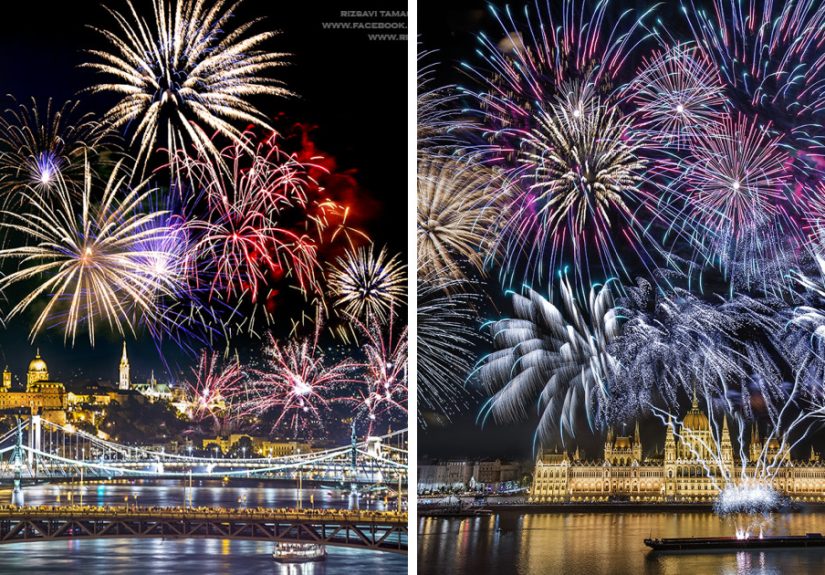
That matters for photography because you are not simply shooting fireworks. You are shooting meaning. The best images do not only show color exploding in the sky. They show why Budapest is the perfect stage for this celebration: the Parliament standing like a gothic chandelier on the riverbank, the Chain Bridge stretching like a visual zipper between Buda and Pest, and the hills of Buda giving you just enough elevation to make the whole city behave for one glorious night.
In other words, this is not a “point camera up and hope for the best” situation. This is urban theater with pyrotechnics.
Why Finding the Best Place Took Me Seven Years
If Budapest were flat, easy, and emotionally cooperative, this article would have been six paragraphs long and mildly boring. But Budapest is a city of layers. Buda rises. Pest stretches. The Danube cuts the whole thing in half with cinematic confidence. One location gives you a better foreground. Another gives you a wider skyline. Another gives you great fireworks but awful crowd management. Another gives you a beautiful angle and the sudden realization that your tripod leg is now blocking three tourists and one small family from seeing history.
That is why the search took years. I was not just looking for a place with a view. I was looking for a place that solved five problems at once:
1. It needed a strong line of sight to the Danube fireworks zone
The August 20 show stretches across central Budapest, so a good photography position must face the action cleanly. If you are tucked behind buildings, too low on the riverbank, or standing where trees decide to become your co-composer, your night gets complicated fast.
2. It needed iconic Budapest landmarks in the frame
Fireworks are pretty almost anywhere. But fireworks over Budapest are special because you can anchor them with world-class architecture. The Parliament building is the star here. The more effectively you include it, the more the image becomes unmistakably Budapest instead of “generic bright sky over some city.”
3. It needed enough elevation
Ground-level shooting near the river creates drama, yes, but it also creates a visual wrestling match with crowds, barriers, and bridge traffic. Elevation gives you cleaner layers, more elegant symmetry, and less accidental portraiture of strangers who did not agree to become part of your masterpiece.
4. It needed room to work
Photographers need space. Tripods need space. Sanity needs space. A magical location becomes much less magical when everyone around you has decided that your carefully chosen composition is also the ideal place to unwrap snacks, answer video calls, and wave at fireworks with both arms.
5. It needed atmosphere
A technically perfect image can still feel dead. The best place had to deliver the emotional side too: anticipation before the first burst, a view that builds suspense, and a sense that the city itself is participating in the celebration rather than merely being illuminated by it.
The Main Contenders for the Best Shooting Spot
Danube Embankments: Great Energy, Tough Logistics
The riverbanks are the classic choice, and for pure immersion they are wonderful. You are close to the action, surrounded by crowd energy, and fully inside the celebration. The downside is that “inside the celebration” often also means “inside a human traffic jam.” For photography, the embankments can be brilliant for atmosphere shots, silhouettes, and lower-angle compositions with bridge details. But if your mission is the best all-around skyline image, they are often too low, too busy, and too unpredictable.
You will feel the pulse of the city there. You may also feel someone’s backpack zipper in your ribs. Art requires sacrifice, but preferably not from your rib cage.
Gellért Hill: Big Panorama, Smaller Fireworks Presence
Gellért Hill is one of Budapest’s legendary viewpoints, and for good reason. The panorama is huge. The Danube curves beautifully. You can see the bridges, Castle Hill, and Parliament all in one sweep. It is romantic, dramatic, and just strenuous enough to make you feel like you earned it.
But for the August 20 fireworks, Gellért Hill can feel a bit distant depending on your exact position. You gain scope, but sometimes lose intimacy. The city looks stunning, yet the fireworks may not dominate the frame with the same force you get from a slightly tighter angle. It is excellent for wide cityscapes and storytelling shots. It is not my winner for the single best place.
Rooftop Bars and Hotels: Gorgeous, Expensive, and Slightly Nervous
Budapest rooftops can be excellent. They give you elevation, cleaner sightlines, and a polished urban feel. Some offer outstanding views toward the bridges or the Basilica. The catch is that rooftops come with variables photographers hate: reservations, glass barriers, limited tripod freedom, changing house rules, and the possibility that you paid premium money for a view that looked better on the website than in real life.
They are ideal if your priorities are comfort and style. They are less ideal if you want total control of your shooting setup. Also, there is always the risk of becoming the least fun person at the venue because you are over there muttering about shutter speed while everyone else is ordering cocktails with names like Midnight Sparkle No. 5.
River Cruises: Unforgettable Experience, Unstable Shooting Platform
Let me say this clearly: as an experience, a Danube cruise on August 20 is incredible. As a precise photography platform, it is a gamble. You get direct immersion, spectacular proximity, and dramatic reflections. You also get movement, shifting angles, other passengers, changing positions, and the tiny emotional crisis of realizing your “steady shot” now depends on a boat behaving like a studio floor. It can work. It can also humble you.
The Best Place to Shoot It: Fisherman’s Bastion and the Castle Hill Terraces
After seven years of trying to outsmart Budapest, I keep coming back to one answer: Fisherman’s Bastion and the adjoining Pest-facing terraces of Castle Hill offer the best overall place to photograph Hungary’s biggest celebration in Budapest.
Here is why.
The Parliament looks phenomenal from here
This is the big one. From Castle Hill, the Hungarian Parliament rises across the river with the kind of confidence only neo-Gothic architecture can deliver. It gives your image an immediate anchor, scale, and identity. The fireworks do not float in empty darkness. They erupt over one of the most photogenic civic buildings in Europe.
You get elevation without losing city detail
Unlike some higher or more distant viewpoints, Castle Hill keeps you elevated enough for strong layering while still preserving the texture of the city below. You can see the river, bridges, lights, and building forms clearly. This balance matters. Too low and the frame gets chaotic. Too far and the scene becomes a broad map. Castle Hill sits in that sweet spot where the image still feels intimate.
The composition options are unusually flexible
You can go wide and include the Danube sweep. You can go tighter for Parliament and fireworks. You can frame architectural details from the Bastion itself. You can work with foreground arches, terraces, railings, and silhouettes. The location allows multiple visual stories without forcing you into one composition all night long.
The atmosphere is unbeatable
There is something poetic about shooting a national celebration from a historic lookout above the city. The stone towers, the church nearby, the deepening blue of the evening sky, and the anticipation building across the river all add emotional weight. Even before the first burst, the place feels cinematic.
How I Would Shoot It Today
Arrive obscenely early
On nights like this, “I’ll just show up later” is the kind of sentence that leads to regret, sweat, and a bad angle near a trash bin. Arrive early enough to scout, test your frame, and claim a stable position before the city fills up. Budapest’s holiday logistics can mean closures, detours, and major crowd movement, so extra time is not optional. It is survival with manners.
Use a tripod and keep your setup simple
Fireworks photography rewards stability more than heroics. Bring a tripod, use a remote trigger or timer if you have one, and resist the urge to carry every lens you own like you are filming a documentary about indecision. A moderate zoom is often perfect because it gives you flexibility without making you juggle gear in the dark.
Start with conservative settings
For a clean fireworks image over a city skyline, I like to begin with a low ISO, manual focus, and an aperture in the f/8 to f/11 range. From there, adjust based on brightness, smoke, and how much of the skyline you want glowing beneath the bursts. The first few minutes are your test phase. Let the camera teach you what the sky is doing.
Compose for Budapest, not just for fireworks
This is the mistake people make. They photograph the explosion and ignore the city. But the city is the reason the image matters. Include the Parliament. Include the Danube if you can. Let the bridges or terraces create structure. Fireworks alone are decoration. Fireworks plus Budapest become a story.
Take a few frames with people in them
Yes, I know. We all want the perfectly clean hero shot. Get that shot. Then turn around and make a few frames with silhouettes, watchers, raised phones, and the stone details of Castle Hill. Those images often become the ones you remember most because they capture how the celebration felt, not just how it looked.
Field Notes from Seven Years of Searching
The first year, I thought the answer had to be the riverbank. Obvious, right? Fireworks over the Danube. Just stand by the water and let greatness happen. Instead, I learned that greatness occasionally happens behind three rows of strangers and one man holding a flag like he had personally scheduled the evening. I got noise, color, and crowd energy, but not the clean composition I wanted.
The second year, I climbed for the panorama. Gellért Hill delivered the kind of view that makes you forgive your legs for complaining. Budapest spread out below like a jewel box someone had opened at sunset. I loved the breadth, but the fireworks felt slightly farther away than I wanted. The city was stunning; the show was part of it, not the center of it.
The third year, I chased exclusivity. Rooftop logic is seductive: fewer people, better drinks, sophisticated altitude, and the illusion that paying more money automatically improves composition. Sometimes it does. Sometimes it buys you a seat, a nice glass, and a railing exactly where you hoped the Parliament would be. I left with decent photos and a renewed respect for public terraces.
The fourth year, I tried to think like a purist and a romantic at once. I wanted architecture, drama, and some breathing room. Castle Hill started making more sense. The Bastion gave me a frame with history in the foreground and Budapest glittering across the river. For the first time, I felt I was photographing the celebration rather than simply surviving it.
The fifth year, I returned earlier, slower, and wiser. I walked the terraces in daylight. I checked how the skyline shifted from one opening to the next. I watched the river darken and the Parliament begin to glow. By the time the fireworks started, I was not hunting anymore. I was waiting. That changes everything. Good shooting on August 20 is less about reflexes than preparation. Budapest rewards the patient photographer and punishes the improviser with remarkable creativity.
The sixth year, I stopped treating the event like a technical exercise. I made the classic skyline photos, yes, but I also photographed the moments around them: shoes on stone steps, couples leaning into the night breeze, families trying to explain the spectacle to children who were too busy shouting at the sky, and the little pause before the first explosion when the whole city seems to inhale together. Those images were not louder, but they were richer.
The seventh year was the year the answer became simple. The best place was not the most secret place. It was not the fanciest, the trendiest, or the most expensive. It was the place that gave Budapest room to be Budapest. From Fisherman’s Bastion and the Castle Hill terraces, the city does exactly that. The Parliament glows. The Danube cuts silver through the dark. The bridges hold the composition together. The fireworks arrive like the punchline to a very elegant joke. And suddenly the seven-year search no longer feels excessive. It feels necessary.
Because that is the thing about photographing a celebration like this: you are not only looking for a location. You are looking for a relationship between history, light, distance, and emotion. Budapest does not hand that relationship to you on the first try. It makes you walk for it, wait for it, test it, doubt it, and return for it. Honestly, rude. But worth it.
So if you are planning to photograph Hungary’s biggest celebration in Budapest, take the title of this article as both confession and shortcut. I spent seven years chasing the best place so you do not have to. Start at Castle Hill. Work around Fisherman’s Bastion. Arrive early. Keep your setup smart. Photograph the city, not just the fireworks. And when the sky finally lights up over the Danube, try not to spend every second checking your screen. Budapest is one of those rare cities that deserves at least one long look with your own eyes before it becomes a file on your memory card.
Final Thoughts
If your goal is to experience the celebration as a local-style street spectacle, the riverbanks are fantastic. If your goal is a sweeping panorama, Gellért Hill is powerful. If your goal is comfort and glamour, rooftops and cruises can be excellent. But if your goal is the best overall place to shoot Hungary’s biggest celebration in Budapest with a camera and a plan, Fisherman’s Bastion and the Castle Hill terraces remain the smartest answer.
It gives you the city. It gives you the story. And on a night like August 20, that is exactly what a great photo needs.